Iran threatens Hormuz lifeline after oil drops on Trump hint
Smoke rises following a strike on the Bapco Oil Refinery, amid the US-Israeli conflict with Iran, on Sitra Island Bahrain, March 9, 2026.
Iran’s Revolutionary Guards threatened to choke off Middle East oil flows on Tuesday if US and Israeli attacks continue, but crude prices fell after President Donald Trump suggested the war with Iran may soon wind down.
A Guards spokesman, responding to Trump, said Washington was lying about conditions in the region and warned that Iran would not allow “one liter of oil” to be exported by hostile states and their partners.
The threat came after Trump warned Tehran against disrupting tanker traffic through the Strait of Hormuz, the world’s most critical oil shipping chokepoint, and said the conflict was moving ahead of schedule.
Trump said the United States would strike Iran “much harder” if it tried to stop oil shipments through Hormuz. He also predicted the war could end before the four-week timeline he had previously outlined.
His remarks helped calm markets after a wild trading session in which Brent surged to as high as $118-$119 a barrel – the highest level since 2022 – before retreating sharply as investors bet Washington may try to contain the economic fallout.
The sharp swings show how the war has thrust the Strait of Hormuz to the center of global energy markets.
Global economic ripple effects
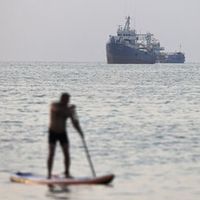
The narrow waterway off Iran’s coast normally carries about a fifth of the world’s oil and liquefied natural gas supplies, but tanker traffic has been severely disrupted for more than a week, forcing Persian Gulf producers to cut output and raising fears of a major supply shock.
Saudi Arabia has reduced production by between 2 million and 2.5 million barrels per day, according to a Bloomberg report, while Iraq has cut output by about 2.9 million barrels per day. The United Arab Emirates has lowered production by up to 800,000 barrels per day and Kuwait by about 500,000 barrels per day.
Saudi Aramco warned on Tuesday that continued disruption to shipping through Hormuz could have “catastrophic consequences” for global oil markets.
The strait is also crucial for natural gas exports. Qatar alone ships roughly 20% of the world’s liquefied natural gas through the corridor, meaning any prolonged closure could affect energy markets far beyond oil.
Rising fuel costs are already feeding fears of renewed inflation worldwide, with analysts warning that sustained oil prices above $100 per barrel could push US gasoline prices toward $4 per gallon and raise costs for air travel, manufacturing and food.
The White House is weighing several options to contain the economic fallout, including releasing strategic oil reserves, easing sanctions on Russian crude and coordinating with allies to stabilize global supply.
The Group of Seven has said it stands ready to take steps to support energy markets, including possible stockpile releases if disruptions continue.
A telecommunications tower stands in the background as a woman in Tehran uses her phone on January 24, 2026.
Iran’s government said on Tuesday that it is providing special internet access to select users capable of promoting its messaging online, even as the country remains under what monitoring groups call one of the most severe nationwide internet shutdowns ever recorded.
Much of that privileged access is believed to operate through so-called “white SIM cards” – mobile lines exempt from Iran’s filtering system that allow direct access to blocked platforms such as X, Telegram and Instagram.
Spokeswoman Fatemeh Mohajerani did not directly refer to those SIM cards but spoke about the government-imposed national internet blackout, saying Tehran is instead offering connectivity to “those who can better deliver the message.”
According to internet monitoring group NetBlocks, the Iranian government has been promoting its agenda through whitelisted online services while the public remains in a digital blackout
“The regime continues to promote its agenda through whitelisted networks, cultivating media assets at home and abroad,” NetBlocks said on Friday, six days into the latest round of nationwide internet shutdown.
This is while President Masoud Pezeshkian vowed in early December to deactivate the so-called “white SIM cards” that grant unfiltered access to a circle of state-linked users.
“We have instructed that these white internet lines be turned black as well, to show what will happen to people if this blackness continues,” he said.
Pezeshkian has repeatedly promised to lift filtering, a key pledge of his 2024 presidential campaign.
Meanwhile, Iran’s nationwide internet shutdown has continued for more than 240 hours, marking one of the most severe government-imposed nationwide blackouts ever recorded globally and the second longest in the country’s history after the January protests, according to NetBlocks.
The group said on Tuesday that Iran has now spent roughly a third of the year 2026 offline.
Russian President Vladimir Putin and Chinese President Xi Jinping speak during a plenary session in the outreach/BRICS Plus format at the BRICS summit in Kazan, Russia October 24, 2024.
Tehran may have assumed that a US–Israeli attack would activate the loose alignment it has cultivated with Moscow, Beijing and other non-Western powers. So far, it has instead exposed its limits.
What Iranian officials often presented as an emerging geopolitical counterweight to Western power appears, for now, far from a wartime coalition.
Russia and China have condemned the attacks and called for restraint, but neither has shown willingness to intervene militarily on Iran’s behalf.
Reports suggest Moscow may have shared limited intelligence that could assist Iranian targeting of US assets in the region. Even if so, such cooperation remains indirect and far short of what a wartime alliance would entail.
For Moscow, deeper involvement carries obvious risks. Russia remains heavily engaged in Ukraine and under sustained military and economic pressure from the West. Opening another confrontation with the United States in the Middle East would pose significant strategic dangers.
Yet instability in the region could still bring Moscow indirect gains. As a major oil exporter, Russia benefits from higher global energy prices, which help cushion the impact of Western sanctions.
A wider conflict could also divert Western political attention from Ukraine, easing pressure on its primary theater.
China’s calculus points in the same direction: distance. Beijing’s interests in the Middle East are largely economic—stable energy supplies, secure shipping routes and predictable markets. A major regional war threatens all three.
At the same time, a prolonged conflict that absorbs American attention and resources could indirectly ease pressure on China in its broader rivalry with Washington.
North Korea, often cited as part of an emerging anti-Western axis, has remained largely silent. Pyongyang lacks the logistical capacity to project meaningful military power into the Middle East and has little incentive to risk confrontation with the United States in a distant conflict.
For decades, Tehran invested heavily in expanding its regional influence through a network of non-state actors stretching from Lebanon to Yemen. Groups such as Hezbollah, Hamas and the Houthis were meant to provide strategic depth, allowing Iran to pressure adversaries indirectly while avoiding direct confrontation.
That network now faces growing strain.
Hamas has been significantly weakened by prolonged conflict with Israel. Hezbollah remains Iran’s most capable partner, but its structure also reveals a deeper limitation in Tehran’s approach: the system often depends on personal relationships between commanders rather than durable institutional frameworks, making coordination more fragile when individuals are removed.
The Houthis retain the capacity to disrupt shipping routes and launch missile or drone attacks across the region. But their strength lies primarily in asymmetric disruption; in a high-intensity campaign driven by air power and long-range strikes, such actions cannot quickly alter the strategic balance inside Iran itself.
Elsewhere, several militia groups cultivated by Tehran in Iraq appear reluctant to escalate dramatically, underscoring the limits of Iran’s ability to mobilize partners during a major confrontation.
In recent years, Iran has sought to present itself as part of a broader alignment against Israel while simultaneously pursuing pragmatic openings with Arab states. The China-brokered rapprochement with Saudi Arabia in 2023 suggested the possibility of a more stable Gulf balance.
But that détente depends heavily on regional stability. If Iranian actions—or those of allied militias—threaten shipping lanes or energy infrastructure, Arab governments may prove far less inclined to view Tehran as a reliable long-term partner.
If the conflict continues while its partners remain cautious, Iran risks growing isolation. Its ties with Russia and China are shaped primarily by overlapping interests rather than formal alliance commitments.
Strategic priorities diverge, and even governments opposed to Western dominance remain wary of dependence or rivalry.
A deeper alignment might have emerged under different geopolitical conditions, much as sustained confrontation during the Cold War pushed Western states toward institutional alliances such as NATO.
But that moment has not arrived. The war suggests it may not—at least not on terms Iran had imagined.
Israeli military illustration of a tunnel complex attributed to Ali Khamenei that it said was targeted in the March 6 strikes.
Israeli military images of an underground tunnel complex attributed to Ali Khamenei appear to confirm long-circulating rumors of a network stretching several kilometers beneath central Tehran, under medical centers, schools, and residential neighborhoods.
On March 5, shortly after heavy strikes targeted areas near the Pasteur government complex in central Tehran – a district that houses the Iranian presidency and several key government offices – the Israeli military published a video depicting what it described as Khamenei’s underground bunker system.
The complex resembles a subterranean city. According to the video and accompanying imagery, the facility appears to have been used as a secure shelter for Iran’s leadership and may still be used by remaining officials following Khamenei’s death.
A tunnel network stretching nearly five kilometers
Analysis of the imagery released by the Israeli military, using publicly available online mapping tools, suggests the tunnel network extends close to five kilometers in length.
To understand the scale of the project, it helps to compare it with ordinary infrastructure construction in Tehran.
According to statements by Tehran mayor Alireza Zakani and members of the Tehran City Council, building one kilometer of metro tunnel in Tehran currently costs between 5,000 and 6,000 billion tomans – roughly $30-36 million at an exchange rate of about 166,000 tomans per dollar.
This estimate covers only the excavation and structural work. It does not include interior finishing, equipment, ventilation systems, or other underground facilities.
Based on those figures, building five kilometers of underground tunnel would cost about 25,000 to 30,000 billion tomans, or roughly $150-180 million.
Given the secrecy and security requirements surrounding such a project, the actual cost was likely significantly higher than that of a standard transportation tunnel.
Under normal conditions, tunneling contractors in Tehran can excavate around 10 meters per day. At that pace, building a five-kilometer tunnel system would take at least 500 days – roughly 17 months.
Considering the classified nature of the project and the additional infrastructure involved, the construction timeline may have been considerably longer.
The core of the complex: beneath a medical facility
The video appears to place the central section of the bunker complex southwest of the presidential compound in the Pasteur district.
The site sits directly beneath the Shahid Shourideh Medical Center, a clinic affiliated with Iran’s Ministry of Agriculture. The facility has operated since 1985 and effectively functions as part of the broader Pasteur government complex.
Based on the height of vehicle ramps and the dimensions of vehicles visible in the imagery, the central installation appears to be located 40 to 50 meters underground.
From there, the tunnel system extends northwest toward another entrance near the end of Rajabi Street, roughly 200 meters from the Shourideh hospital complex.
Shahid Shourideh Medical Center, which is affiliated with Iran’s Ministry of Agriculture, sits above what appears to be the main core of Khamenei’s bunker complex, estimated to be 40 to 50 meters underground.
Easternmost entrance: next to an elementary school
The easternmost known entrance to the tunnel network appears to be located in the Sheikh Hadi neighborhood, along Valiasr Street, beneath the Jami multi-story parking garage.
This parking structure stands directly beside Hejrat Girls’ Elementary School, while Saheb a-Zaman Boys’ Elementary School lies about 100 meters away.
At the northern edge of the network sits another multi-story garage known as the 12 Farvardin Parking Complex, located near the intersection of Jomhouri Eslami Street and Danesh Street.
Both parking structures were inaugurated on December 4, 2017, as part of a paired urban development project attended by Tehran’s then-mayor Mohammad Najafi.
One entrance to the tunnel network appears to lie beneath a building opposite the Karimeh Ahl-e Beit clinic near Hor Square in central Tehran.
An entrance beneath a mosque, beside a school
Another entrance appears west of Pasteur Square, between Hor Metro Station and the square itself.
This access point lies beneath Tohid Mosque. Adjacent to the mosque is a building, and behind it stands Shahid Kadkhodaei Boys’ Elementary School.
Roughly 200 meters away, another possible entrance is located on the southwestern side of Pasteur Square, along a street that houses the AJA University of Command and Staff – the staff college of the Islamic Republic of Iran Army.
Nearby are the Karimeh Ahl-e Beit dental clinic and medical clinic, as well as the 29 Farvardin Pharmacy, which is affiliated with Iran’s army.
The easternmost entrance to the tunnel complex appears to lie beneath the Jami multi-story parking garage, directly next to Hejrat Girls’ Elementary School.
Western entrance beside a football school
The westernmost identified entrance to the tunnel network appears to lie beneath a small building near an office responsible for issuing hunting weapon permits.
Immediately next to the building, sharing a wall, is a football training school, while dense residential complexes surround the area.
This location sits near the intersection of Sepah and Kamali streets, along Kashan Street, at the end of Fourth Street.
The tunnels also lie close to the Yas and Namjou residential complexes, which are affiliated with the Iranian army.
One of the entrances to the tunnel network appears to lie beneath a mosque next to Shahid Kadkhodaei Boys’ Elementary School.
A cargo ship carrying containers approaches towards the Yantian port in Shenzhen, Guangdong province, China April 17, 2025.
Two cargo ships owned by a sanctioned Iranian shipping company have departed a Chinese chemical-storage port carrying cargo and are heading toward Iran, the Washington Post reported citing an analysis of ship-tracking data, satellite imagery and sanctions records.
The vessels – the Shabdis and the Barzin – are operated by the Islamic Republic of Iran Shipping Lines (IRISL), a state-owned carrier under sanctions by the United States, Britain and the European Union. Washington has accused IRISL of transporting materials used in Iran’s ballistic missile program.
The ships recently docked at Gaolan port in Zhuhai on China’s southeastern coast, a facility experts say handles large volumes of industrial chemicals, including sodium perchlorate, a key precursor used to produce solid rocket fuel.
Experts tracking the vessels said the cargo likely includes sodium perchlorate, which Iran requires for missile propellants.
“Given the track record, the most parsimonious explanation is that they’re loading the same commodity they’ve been shuttling for the past year-plus,” Isaac Kardon, a senior fellow at the Carnegie Endowment for International Peace, said.
Kardon said Beijing could have delayed the ships’ departure using administrative or customs procedures but did not do so.
“China could have held these vessels at port, imposed an administrative delay, invented a customs hold – any number of bureaucratic tools, but didn’t,” he said, calling the decision notable at a time when the United States and Iran are engaged in direct military confrontation.
As of Saturday, both ships were in the South China Sea. The Barzin had anchored off the coast of Malaysia while en route to Iran’s Bandar Abbas port, about 4,000 miles away, where it is expected to arrive next week. The Shabdis is sailing toward Iran’s Chabahar port, with an estimated arrival of March 16.
Both destinations lie along the Strait of Hormuz and host major Iranian naval facilities.
US sanctions announced last year targeted the transfer of sodium perchlorate and other chemicals from China to Iran, citing their use in solid propellants for ballistic missiles. Sodium perchlorate is used to produce ammonium perchlorate, a core component in missile fuel.
U.S. officials have long accused China of allowing transfers of missile-related materials to Iran, allegations Beijing has denied, saying the United States exaggerates commercial or dual-use trade.
Since the start of the year, at least a dozen other IRISL vessels have visited Gaolan port, with draft data suggesting most departed carrying cargo. Some of those ships later unloaded at Iran’s Shahid Rajaee port near Bandar Abbas, the country’s main container terminal.
The latest departures come days after US and Israeli strikes targeted Iranian missile facilities and other military infrastructure.
Analysts say that damage may have increased Iran’s need for rocket fuel components.
“Tehran’s need for propellant precursors just went from urgent to existential,” Kardon said.
Iranian political and media figures criticized President Masoud Pezeshkian on Saturday after he apologized for what he called “fire at will” attacks by the country’s armed forces on neighboring countries and instructed them to stop such attacks.
In a video message published earlier in the day, Pezeshkian said authorities had ordered the armed forces to halt missile strikes on neighboring countries unless attacks originate from their territory.
“The temporary leadership council approved yesterday that neighboring countries should no longer be targeted and missiles should not be fired unless an attack on Iran originates from those countries,” Pezeshkian said.
“The armed forces have so far acted with a kind of ‘fire at will’ authority, but they have now been notified that from now on they must not attack neighboring countries or target them with missiles,” he said, adding that he “apologizes personally” over the matter.
Lawmakers push back
Mohammad Manan Raeisi, a lawmaker representing Qom, described the remarks as “humiliating” and said they showed the Assembly of Experts should quickly move to select a new leader.
“Did neighboring countries not place their land, assets and hotels at the disposal of our enemies? Should our military not have struck those bases and assets of the enemy that you are now apologizing for so humbly?” Raeisi wrote.
Ebrahim Azizi, head of the parliament’s national security and foreign policy committee, wrote on X that all US and Israeli bases in the region were “legitimate and lawful targets” in the ongoing conflict.
“The Islamic Republic has no red line in defending national interests. This battle continues,” Azizi wrote.
Media figures question message
Ezzatollah Zarghami, a former culture minister and ex-head of state broadcasting, wrote that the remarks created confusion about the conduct of the war.
“We did not understand what happened. But neither did the armed forces act on a fire at will basis, nor can the regional war mentioned by the ‘martyred imam’ be interpreted in different ways,” Zarghami wrote.
Meisam Nili, a conservative media activist, also criticized the comments.
“Why retreat from the military strategy of the ‘martyred imam’ when we are on the verge of selecting a new leader? Any ceasefire is treason,” Nili wrote.
Former lawmaker Jalal Rashidi Koochi also criticized the president’s message, saying it showed weakness.
“An apology happens when a mistake has occurred. We made no mistake. Your message showed no sign of authority,” Rashidi Koochi wrote.
Pezeshkian’s remarks came as explosions were reported on Saturday at Dubai International Airport and loud blasts were heard in Abu Dhabi, according to multiple reports.
Trump comments
US President Donald Trump said after Pezeshkian remarks that Iran had apologized to its Middle East neighbors and promised it would not fire missiles at them anymore.
In a post on Truth Social, Trump said Iran made that promise only because of what he called relentless US and Israeli attacks.
“Iran, which is being beat to HELL, has apologized and surrendered to its Middle East neighbors, and promised that it will not shoot at them anymore. This promise was only made because of the relentless U.S. and Israeli attack. They were looking to take over and rule the Middle East,” Trump wrote.
Trump also warned that Iran could face further strikes.
Iran, he added, would be “hit very hard” on Saturday and said additional areas and groups of people were under consideration for targeting, citing what he described as Iran’s “bad behavior.”