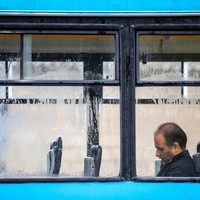
Pedestrians pass festival posters in Tehran during this year’s Fajr Film Festival, February 7, 2026
Iran’s Fajr Film Festival went ahead this year as planned. But it did so in a country still reeling from bloodshed, and the red carpets beneath its guests carried a symbolic weight that many in the film community found difficult to ignore.
Some chose not to attend. Others did, and the result was a festival that felt unusually detached from the public mood—less a national cultural event than a carefully managed display of continuity.
Now in its 44th year, the festival took place less than forty days after tens of thousands of protesters were killed during the government’s crackdown. Under those circumstances, the decision to proceed on schedule was bound to draw scrutiny.
The nature of the festival itself has evolved over time, with an increasing share of films produced by state institutions or affiliated organizations. This year, too, such bodies as municipal authorities and even the judiciary appeared among the producers.
This has contributed to a growing perception, particularly among independent filmmakers, that the festival increasingly reflects official priorities rather than the diversity of Iranian cinema.
That perception was reinforced by a number of high-profile absences. Some directors and actors announced they would not attend.
The actor Elnaz Shakerdoost, one of Iran’s most recognizable performers, publicly questioned the timing of the festival and announced she would step away from acting. “Which festival? Which celebration?” she wrote. “I will not attend any celebration, nor will I ever again play a role in this land that smells of blood.”
Other films were screened without their directors or cast present. In several cases, producers appeared alone at press conferences. The director Soroush Sehat and the cast of his widely discussed film declined to attend altogether, leading organizers to cancel its press session.
These absences altered the character of the festival’s public discussions. Press conferences often featured only those filmmakers who had chosen to participate, some of whom criticized colleagues who had stayed away.
Mohammad Hossein Mahdavian, a director known for films focusing on Iran’s security institutions, described actors who declined to attend as “cowards.”
Many film critics and journalists opted not to cover the event. Even Film Emrooz, a long-established cinema magazine known for its cautious editorial line, did not publish its customary festival issue.
Public turnout appeared subdued as well. Organizers sought to maintain the appearance of normal activity, but attendance remained visibly lower than in previous years.
The closing ceremony reflected similar tensions. Several winners did not appear to accept their Simorgh awards. President Massoud Pezeshkian attended and praised those who had participated, signaling the government’s continued investment in the festival’s symbolic importance.
One award recipient attempted to acknowledge the broader context, alluding to the recent violence while accepting his prize. His remarks, however cautiously phrased, underscored the gap between the official narrative of continuity and the unresolved trauma still shaping public life.
Iran’s film industry has long occupied a complex position—both an instrument of national identity and a space for independent artistic expression. This year’s festival highlighted how difficult it has become to sustain that balance.
An illustration showing an ancient Iranian soldier and a Revolutionary Guard member holding a weapon together, displayed during a November 7 ceremony in Tehran where a statue of pre-Islamic Persian King Shapur I was unveiled.
Tehran’s unveiling of a towering statue depicting the Roman Emperor Valerian kneeling before pre-Islamic Persian King Shapur I has renewed criticism of the Islamic Republic’s appeal to nationalist sentiment following the June war with Israel.
For over forty years, the theocracy purged ancient Persian history from schoolbooks, replacing it with post-Islamic narratives. But after the 12-day conflict with Israel, officials have turned to the distant pre-Islamic past to rally a divided society.
From murals of ancient kings and soldiers to patriotic songs added to Shi’ite mourning ceremonies performed before Supreme Leader Ali Khamenei, Tehran now embraces imagery once deemed heretical by its own revolutionary ethos.
The statue unveiled in Tehran's Revolution Square
'Kneel before Iran' campaign
Tehran’s Revolution (Enghelab) Square was the scene of an unusual spectacle on Friday as officials unveiled a massive bronze statue depicting Roman Emperor Valerian kneeling in submission before Sassanid King Shapur I, commemorating Iran’s victory at the Battle of Edessa (260 AD).
The event was held under the slogan “Kneel before Iran,” part of what authorities describe as a campaign to project “national unity and historical pride” following the June war with Israel.
Tehran Mayor Alireza Zakani, a staunch ultraconservative, said on X: “Enmity with Great Iran can only end in kneeling before this historic nation.”
Municipal official Davood Goodarzi said the installation would be accompanied by visual displays depicting “other victories of Iranians over foreign aggressors,” including the defeat of British forces by local commander Rais-Ali Delvari, Mirza Kuchak Khan’s resistance against Russian troops, and Surena’s triumph over Rome at the Battle of Carrhae in 53 BCE.
The goal, Goodarzi said, is “strengthening concepts such as national dignity, social unity, and Iranian identity.”
The statue, he said, would remain temporarily at Revolution Square before being moved to a city gateway “where it will stand as the first emblem of Iran before diplomats and foreign visitors.”
Unveiled women were allowed to attend the unveiling ceremony—an uncommon scene at events organized by Tehran’s ultra-hardline municipality.
The turn to the pre-Islamic past
The sharp reversal also recalls remarks once made by Khamenei. In a 2011 speech, he asserted that “all the great military victories of this nation came after Islam,” dismissing pre-Islamic accounts as “things that are not documented.”
In 1987, he had said that prophets triumphed over kings such as Cyrus and that “nothing remains of these monarchs in history but names remembered with derision.”
Nevertheless, pro-government social media accounts have now gone so far as to circulate posters equating Khamenei himself with Shapur, showing him standing with a staff as Benjamin Netanyahu and Donald Trump kneel before him. The caption reads: “You will kneel before Iran.”
Image circulating by hardliners on social media
'Hypocrisy'
Pro-government figures have hailed the move as a patriotic success. Conservative political reporter Hossein Saremi posted: “Today’s grand Iranian gathering showed that people and the state share one essence: Iran itself. Nothing can take our homeland away.”
Others, however, called the spectacle “hypocrisy.” Journalist Gholamhossein Pashaei wrote on X: “Every year you close Pasargadae to stop people from celebrating Cyrus Day, yet you unveil Shapur’s statue in Enghelab Square with drums and fireworks during Fatimiyya (mourning period)!”
Dissident commentator Hamid Asafi called the ceremony “a perfect snapshot of the Islamic Republic’s contradictions.”
On Telegram he wrote: “A week ago they closed Cyrus’s tomb out of fear of the crowds, and now they glorify Shapur in the same breath. The Islamic Republic fears living history but poses for selfies with its corpse.”
He added: “They know people no longer respond to rosaries and sermons. That’s why they’ve brought history back to the stage—in a controlled costume. If they can’t erase the past, they’ll try to own it.”
The irony deepened as UNESCO formally recognized Cyrus’s Charter as one of the earliest human-rights documents.
President Masoud Pezeshkian wrote on X: “Iran, the cradle of dialogue, justice, and coexistence, can still inspire peace today.”
Users swiftly replied, questioning how such pride could coexist with a government that blocks access to Cyrus’s tomb each year to those wishing to visit it on his birthday.