An Iranian cleric visiting the Islamic Revolutionary Guard Corps (IRGC) Aerospace Force Museum in Tehran.
US President Donald Trump’s new National Security Strategy (NSS) signals a more hands-off approach toward Iran and marks a departure from the outlook of his first term, according to veteran Iran-watcher and analyst Behnam Ben Taleblu.
The 2025 National Security Strategy reflects a narrowing of what Washington now defines as its core national interests, Taleblu said, with Iran mentioned just three times despite being labeled a central threat in Trump’s 2017 strategy.
“There’s a focus on the homeland, the Western Hemisphere, strategic competition with China and getting Europe to do more,” said Taleblu, an analyst for the Foundation for Defense of Democracies think tank in Washington DC, adding that Iran is absent from the list of top-tier threats outlined in the document.
The strategy released this month emphasizes reducing US involvement in the Middle East in favor of focusing on great power competition with China, threats in the Western Hemisphere and urging Europe to shoulder more security responsibility.
Iran appears to have slipped down Washington’s priority list following last year’s 12-day war between Israel and Iran, which the United States briefly joined.
“It seems like, at least for the Trump administration, they’re content to take that victory lap,” Taleblu said on Eye for Iran, saying the White House is attempting to declare success and move on following US strikes on Iran’s nuclear facilities.
The NSS suggests Washington is ready to “turn the page” on a region that has dominated US foreign policy for decades, he added, and it credits Trump’s energy policies, regional diplomacy and limited use of force for creating political space to step back from the Middle East.
US strikes on Iran included the use of 30,000-pound bunker-buster bombs carried by B-2 stealth bombers.
While President Trump has said Iran’s major nuclear sites were “obliterated,” US intelligence assessments indicate the program was set back but not completely destroyed, according to officials cited in US media reports.
Iran is believed to possess more than 400 kilograms of highly enriched uranium whose whereabouts remain unknown, and Iranian officials have said they rebuilt its missile capacity and would respond forcefully to any future attack.
“Iran may be weakened, but it is down and not out,” Taleblu added.
The strategy document implies that major regional crises — including the Gaza war, the Israel-Hezbollah conflict in Lebanon, Houthi attacks from Yemen and instability in post-Assad Syria — are either resolved or on track toward resolution.
The document does not appear to assess that Iran could strongly reverse recent setbacks to its nuclear program and its so-called Axis of Resistance coalition.
While Taleblu credited the Trump administration for reviving elements of its maximum pressure campaign of sanctions, he criticized what he called gaps. Iranian oil exports have reached record highs, and the administration has not issued a single new human rights designation related to Iran in 2025.
“While the regime is threatening the life of this very president and the first family, it is beyond me to be thinking about peace and prosperity without a clear strategy to contain Iran further,” Taleblu said, “There is a lot of room for improvement when I look at both this document and the administration’s track record this year.”
Venezuela's President Nicolas Maduro speaks at the Miraflores Palace in Caracas, Venezuela, November 11, 2025.
US Senator Lindsey Graham on Tuesday expressed disappointment that Washington had not more clearly committed to toppling Venezuelan President Nicolas Maduro, calling his continued rule a boon to Iran and terrorism.
Graham, a veteran foreign policy hawk representing South Carolina, was speaking to reporters after being briefed along with dozens of other senators on Venezuela strategy by Secretary of State Marco Rubio and Defense Secretary Pete Hegseth.
"If, after all this Maduro is still in power. That's the worst possible signal you could send to Russia, China, Iran," said Graham, "I want to reassert again, you cannot allow this man to be standing after this display of force."
The United States has ramped up a military deployment in the Caribbean as part of a pressure campaign on Venezuela and its leader Nicolas Maduro. US attacks on alleged drug boats there and in the Pacific have killed at least 87 people, in strikes which Democratic opponents and rights groups say violate the laws of war.
The Trump administration has branded Maduro a narco-terrorist and said drug flows from Venezuela kill innocent Americans and justify a wartime approach.
Trump has vowed to extend US attacks to the mainland and said in an interview last week that Maduro's "days are numbered," without elaborating.
His influential chief of staff Susie Wiles told Vanity Fair in an interview published on Tuesday that "(Trump) wants to keep on blowing boats up until Maduro cries uncle."
"I want clarity right here," Graham added in his remarks to reporters. "I want us to be level with the American people on what we're doing. I think we're doing a good thing. I think we're making us safer as a nation. We're cleaning up our backyard."
"Too many Americans have died ... he's aligned with Hezbollah. There's a million reasons you want Maduro to go, but just say it. Just say, this man in our backyard runs a narco-terrorist state along with international terrorists."
US Secretary of State Marco Rubio last week cast Venezuela as a regional platform for Iranian influence, describing Maduro’s government as a narcotics transit hub that hosts Iran’s Revolutionary Guards and its Lebanese ally Hezbollah.
Little public evidence exists about the security relationship Venezuela has with Iran or its armed allies. Tehran and Caracas boosted ties under Maduro's predecessor Hugo Chavez, who cast himself as a bulwark against what he called American imperialism.
Maduro has rejected US accusations that he runs a drug cartel and calls the military buildup in the region a bid to impose Washington's will on his oil-rich country.
Trump has presented himself as a peacemaker, as a leader who is ending wars as he puts it through a so-called peace through strength strategy.
The Trump administration's new National Security Strategy (NSS), released earlier this month, makes an argument for a hands-off approach to the Middle East, while showing clear willingness to lean into tensions with Venezuela.
While the Trump administration maintains their main efforts are about combatting alleged drug smuggling, Graham sees US posturing as signaling regime change, demanding clarity.
"I want clarity right here, President Trump is saying his days are numbered. That seems to me that he's got to go," Graham said.
The wreckage of an intercity bus that overturned and hit a taxi on the Isfahan–Natanz highway in central Iran, killing 13 people and injuring 11 others on December 16, 2025, File photo
A bus crash on the Esfahan-Natanz highway killed 13 people after an intercity coach allegedly veered into the opposite lane and slammed into a taxi on Tuesday, with Iran’s road police blaming suspected driver fatigue for the accident.
Emergency services said two passengers in the taxi and nine bus passengers died shortly after the accident. The crash also injured at least 11 others with multiple traumas, all of whom are currently in urgent care.
The Scania intercity bus, operated by the Royal Safar Isfahan company and travelling from Esfahan toward Tehran, overturned around 22:10 local time near kilometer 80 of the Esfahan–Natanz route, then collided with a passenger car, official media cited local police and provincial officials as saying.
The Iranian Red Crescent said the remaining occupants suffered injuries of varying severity and were taken to hospitals in Natanz, Shahinshahr and Isfahan.
Police account
A senior traffic police official told state media that the preliminary hypothesis is that the driver’s drowsiness and loss of control caused the bus to veer into the opposite lane, overturn and strike the car, but added that the final conclusion will depend on full technical and safety assessments.
Authorities said the scene has been cleared and traffic restored, while forensic and road-safety teams continue to inspect the vehicle, road conditions and possible mechanical factors.
Officials have said that if any negligence by the bus company, driver or other parties is confirmed, the case will be pursued through legal channels.
Iran’s Vice President on Tuesday in Tehran recalled a similar deadly accident in October in northern Iran, rejecting the driver fatigue theory.
“Is the driver to blame, when it’s apparently noted that this accident occurred about 20 minutes after he passed the police station? That would mean drowsiness, which is being raised as the issue, was not involved,” Mohammad Reza Aref said in a speech.
“A few months ago in Semnan we had a similar case, when they were going from the dormitory to class and the same thing happened and students were killed,” he added.
At least 26 students have died in 13 accidents involving university buses across Iran over the past decade, the daily Ham-Mihan reported earlier this year, reviving concerns about road safety and vehicle standards.
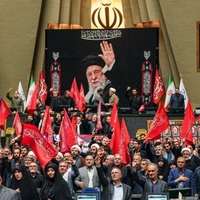
Iran’s Supreme Leader Ali Khamenei speaks at an event in Karaj, Alborz province, Iran, December 15, 2025.
Supreme Leader Ali Khamenei said in a speech that Iran faces a campaign by its enemies aimed at public opinion and cultural identity to bring about regime change which a US-Israeli war in June failed to achieve.
“We are in a propaganda war and a spiritual war,” Khamenei said during a meeting in Karaj on Monday which local media published the next day.
“The enemy understood that seizing this land and this country through pressure and military tools is not possible.”
Khamenei said Iran’s adversaries had shifted their focus to influencing public opinion and culture. His remarks appeared to refer to the United States and Israel.
Iran's two nemeses launched a surprise attack in June, culminating in US attacks on three key nuclear facilities. Though US President Donald Trump said the raids obliterated Tehran's capability, a dispute festers over Iran's nuclear ambitions.
Tehran denies seeking a bomb but the United States along with other Western countries and Israel deny its intentions. Trump has vowed to attack Iran again if it restarts uranium enrichment and Iran has denied a punishing response in any war.
“If they want to interfere and achieve success, they must change hearts and minds,” he said. He said pressure on Iran was ongoing in the military, economic and media realms as well as in cyberspace and the foreign press.
“All of this is focused on one point, and that point is pressure on the resistance of nations, with the Iranian nation foremost,” he said. Khamenei said the ultimate goal of such efforts was to erode Iran’s revolutionary and religious identity.
“The enemy’s objective in our country is to gradually turn people away from the revolution, its goals and its memory,” he said. He called on supporters of the Islamic Republic to recognize what he described as the adversaries’ strategy and to strengthen Iran’s cultural and media response.
The veteran theocrat, 86, has long accused Tehran's adversaries of seeking regime change by sowing the seeds of protest and discontent. Iran for over a quarter century has quashed repeated rounds of widespread unrest with deadly force.
Authorities stepped up a crackdown on dissidents and alleged spies in the wake of the June conflict even as it has relaxed enforcement of certain Islamic cultural rules in the theocracy in a move opposed by some hardliners.
Khamenei's remarks come as Iran’s Revolutionary Guards spokesman said last month that Tehran's archenemy, Israel, is in no position to launch a new war against the country, describing current rhetoric as psychological pressure rather than a genuine military threat.
A Kurdish political prisoner in Iran began a hunger strike by sewing his lips in protest at being denied family visits and prison leave, a rights group said on Tuesday.
Nayeb Askari, who is serving a 15-year sentence at Orumiyeh Central Prison in northwest Iran formally informed prison authorities that he had started a hunger strike and sewed his lips on December 13, France-based rights group Kurdistan Human Rights Network (KHRN) said.
In a letter to prison officials, Askari said he had been barred from family visits for the past year without explanation and that repeated requests for temporary prison leave had gone unanswered. He launched the hunger strike after prison authorities failed to respond to his complaints, he added.
Askari, from Orumiyeh, was arrested on March 24, 2021, by intelligence agents from Iran’s Islamic Revolutionary Guard Corps (IRGC) and was initially held at the IRGC’s Al-Mahdi detention center for three months, where he was allegedly subjected to physical and psychological torture, according to KHRN.
"He was subjected to severe physical and psychological torture in order to extract forced confessions," KHRN said. "He was also denied access to a lawyer and contact with his family during this period," the rights group added.
Askari's arrest followed his return to Iran from the Kurdistan Region of Iraq after receiving what the rights group described as a “safe-conduct letter” arranged through the IRGC.
Iranian authorities initially sentenced Askari to death in absentia in 2018 on charges of “enmity against God” (moharebeh) linked to alleged membership in the Kurdistan Free Life Party (PJAK), according to KHRN. The sentence was later overturned, and the charge was amended to “armed insurrection” (baghi).
In October 2023, Askari was again sentenced to death on the same charge, prompting a brief hunger strike. The Supreme Court later overturned the ruling for a second time and referred the case to another court branch.
In mid-October 2024, Askari was sentenced to 15 years in prison and fined 900 million rials (about $700) on charges of “armed insurrection,” the rights group said.
KHRN said Askari has previously staged prolonged hunger strikes in detention, including a 32-day strike in 2021 to protest authorities’ refusal to transfer him to an external hospital for medical treatment.
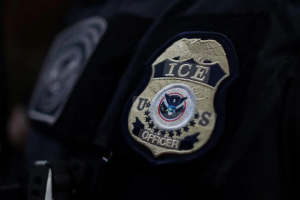
Immigration and Customs Enforcement agents detain a man after conducting a raid at the Cedar Run apartment complex in Denver, Colorado, February 5, 2025.
A US federal judge on Monday ordered the release of an Iranian migrant held by immigration authorities for nearly six months, ruling that the government had shown no realistic prospect of deporting him to a country other than Iran in the foreseeable future.
Hamid Ziaei, who was detained in June after a check-in appointment with US Immigration and Customs Enforcement in California, had been held at the Torrance County Detention Facility in New Mexico while US officials pursued possible deportation to a third country, his attorneys said.
“The US government provided no evidence that there was any likelihood of Mr. Ziaei’s removal in the reasonable, foreseeable future,” Rachel Landry, a staff attorney at Innovation Law Lab, told the court in Albuquerque, the group said.
US District Court Judge Matthew Garcia said he would issue an order for Ziaei’s release within 24 hours, Landry and fellow attorney Tiffany Wang said.
Court filings on Ziaei’s behalf say he fled Iran after speaking out against the government and entered the United States in San Diego in January 2024. His asylum request was rejected, but he was released in mid-2024 with authorization to work based on concerns he could face persecution if returned to Iran, the filings said.
An ICE officer said in court documents that the agency began vetting Ziaei for removal to a third country in August and initiated procedures to coordinate an interview with a foreign embassy that might accept him.
The US attorney’s office in New Mexico, representing immigration authorities, declined to comment. In filings, immigration authorities cited a 2001 US Supreme Court ruling they said gives the government at least six months to make removal arrangements.
In a December 2 statement submitted to the court, Ziaei said prolonged detention led to anxiety and panic attacks, deferred dental treatment for infections, and weight and muscle loss that could affect his future income as an athlete.
The case comes as Iran’s foreign ministry has confirmed recent US detentions and deportations of Iranian nationals under tightened immigration enforcement, including groups returned to Iran via transit countries.