Iran militant group Jaish al-Adl announces new strategy as attacks continue
Makes spokesperson introduced as "Mahmoud Baluch" in video from the Popular Fighters Front, screen grab
The Sunni militant group Jaish al-Adl hailing from Iran's Baluch ethnic minority announced it would change its strategy toward civil disobedience under a new umbrella group gathering like-minded factions, even as it continued deadly attacks on government forces.
In a video message posted on Telegram, masked spokesman Mahmoud Baluch announced the formation of the new “Popular Fighters Front” on Wednesday which he described as a merger of several Baluch political groups and movements in the restive southeastern region of Iran.
“I am honored to tell the suffering people who long for liberation from the oppression of the rule of the Supreme Leader that the fighters of Sistan and Baluchistan, understanding the country’s critical situation and with the aim of increasing the effectiveness of the struggle” had formed the body, he said.
The announcement came after the new group claimed responsibility for an armed attack which Iranian state media said killed several members of the security forces on Wednesday.
Iran, the United States and several other countries have designated Jaish al-Adl as a terrorist organization, citing its record of bombings, ambushes, kidnappings and suicide attacks targeting the army, border guards and police.
In a written manifesto, the new group said it aims to fight poverty, injustice and discrimination by prioritizing civil action.
“We consider civil activity the natural and legal right of every citizen,” it said. “In this regard, the Popular Fighters Front is pursuing civic, media and political efforts aimed at conveying the people’s voice, raising public awareness and strengthening national cohesion in the face of discrimination and inequality.”
“Civil action must be carried out responsibly, within the law, and with full observance of personal and public security principles,” he added. It did not renounce violence.
Haalvsh, a rights group that documents abuses and unrest in Sistan-Baluchestan, said the merger includes the PADA Baloch Movement, the Nasr-e Baluchestan Movement, Jaish al-Adl, the Mohammad Rasulullah group led by Haji Vahed Bakhsh, as well as groups operating under the label of spontaneous Baloch fighters.
Jaish al-Adl (Army of Justice) emerged around 2012 as a successor to Jundullah, after Tehran's capture and execution of Jundullah’s leader Abdelmalek Rigi.
The group operates mainly in Iran’s Sistan-Baluchistan province along the border with Pakistan and says it fights for political and religious rights for Iran’s Sunni Baloch minority in the Shi'ite theocracy.
Brigadier General Amir Avivi (Reserves) Founder and CEO Israel Defense and Security Forum (IDSF)
Israel will not allow Iran to restore its air defense systems, missile infrastructure or nuclear facilities after a 12-day war in June and is prepared to strike again if Tehran moves to rebuild, a former senior Israeli general told Iran International.
“Any substantial effort to restore those capabilities will be a trigger for action,” Brigadier General Amir Avivi, a former officer in the Israeli military who now serves in the reserves, told Iran International in an interview.
The United States held five rounds of negotiations with Tehran over its disputed nuclear program earlier this year, for which President Donald Trump set a 60-day ultimatum.
When no agreement was reached by the 61st day Israel launched a surprise military offensive on June 13, followed by US strikes on June 22 targeting key nuclear facilities in Isfahan, Natanz and Fordow.
Avivi said Israel's destruction of Iran's air defense capabilities which ultimately paved the way for the US bombing run was swift.
“Within two days we had opened an air corridor to Tehran and could operate almost freely over large parts of Iran,” Avivi said. “They had more than 130 air-defense systems in the west and around Tehran, and we took out roughly 84 of them very quickly.”
Three red lines
Avivi said Israel in coordination with the United States is closely tracking Iran’s efforts to repair war damage as Tehran tries to project strength while quietly restoring parts of its military infrastructure.
“We are watching them by the minute, and there are three red lines that will bring Israel to act again: rebuilding advanced air defenses that close the corridor to Tehran, resuming mass production of ballistic missiles, and any move to renew nuclear weapons work,” Avivi said.
Tehran denies seeking a nuclear weapon and says it aims only for peaceful technology. Israel and Western countries doubt its intentions.
Israeli intelligence has warned that Iran hopes to build a missile arsenal capable of overwhelming Israel's defenses, even as Tehran insists its program is defensive and conventional.
“Before the war they were aiming for around 10,000 ballistic missiles, and we are not going to sit and wait for them to return to that level or get close to a weapons‑grade nuclear capability,” Avivi said.
Scientists, sites and industry
The attacks on June 21 also struck the Islamic Revolutionary Guard Corp’s (IRGC) external arm, killing Mohammad Saeed Izadi, who oversaw Palestinian operations, and Mohammadreza Nasirbaghban, the Quds Force’s deputy for intelligence.
The strikes killed senior nuclear scientists along with hundreds of military personnel and civilians. Iranian counterattacks killed 32 Israeli civilians and an off-duty soldier.
“We didn’t only hit the nuclear sites, we hit the scientists, the weaponization experts and the industries that make explosives, fuel and components, so they cannot easily rebuild,” Avivi said.
Iranian authorities have quietly moved surviving nuclear scientists to safe houses and dispersed some sensitive work, while publicly insisting that missile and cyber units remain fully operational.
“The regime was hit very, very hard, much harder than people think, and recovering that military‑industrial base will take them a very long time,” Avivi said. “The image of Iran as a regional powerhouse was exposed as a paper tiger, and that has encouraged Europe to move toward harsher measures.”
Psychological pressure
During the June attacks, Israel also struck Tehran’s Evin prison and state television main building. Iranian officials condemned Israel's onslaught as "terrorism" and "psychological warfare".
The UN Special Rapporteur on human rights in Iran said in October that Israel likely violated international law in its military campaign in June while Tehran expanded repression after the conflict with hundreds of executions and new curbs on dissent.
When asked what was the objective of the attack on the prison which according to official tallies killed about 80 people, Avivi said it was a message to leaders in Tehran.
“We hit symbols of repression and propaganda to show that if we decide to destabilize the regime itself, not just its military capabilities, we can reach those places,” Avivi said.
“The idea was to throw the leadership off balance and make them feel existentially threatened, not just militarily exposed.”
‘Campaign between wars’
Avivi described the current period with Iran and its allies as a “campaign between wars,” in which covert operations and limited strikes are used to contain threats between major flare‑ups.
“We are moving from a short war to ongoing operations between wars, some of them kinetic and some not, including cyber and intelligence work,” he said.
Since June, Israel has continued to hit carry out air strikes on targets it says aim at Hezbollah in Lebanon and Hamas in Gaza. The strikes have killed hundreds of people according local health authorities, many of them civilians.
“We will keep degrading these groups systematically until the day comes when local governments can deal with them themselves,” Avivi said.
Next objective
Iran’s Revolutionary Guards claimed victory in the 12‑day war and threatened a tougher response if Israel strikes again in rhetoric rejected by Israel and the United States.
“In the last round we did not set regime change as a formal goal, but if this regime continues to threaten Israel’s existence, next time bringing it down could be on the table for Israel and the US,” Avivi said.
Security forces detained Nobel Peace Prize laureate Narges Mohammadi and several other activists during a memorial ceremony in the northeastern city of Mashhad, the local governor told state media.
The detentions occurred amid a heated gathering of mourners at a memorial service for Khosrow Alikordi, a prominent human rights lawyer whose recent death has drawn public anger and suspicion among his supporters of foul play.
Alikordi, a former political prisoner who represented jailed protesters, was found dead under unclear circumstances in his office in Mashhad last week, with fellow lawyers and activists questioning the official account of cardiac arrest and alleging possible involvement by security forces.
"Khosrow Alikardi was devoted to freedom and justice, but he never bowed his head to oppression," Narges told attendees in a speech.
"The people are standing here. We are all sisters and brothers. We are all Iranians. With one voice, in solidarity and unity, we say: by the blood of our fallen comrades, we will stand firm until the end," she said.
The Norwegian Nobel Committee on Friday condemned her arrest and called on Tehran to "specify Mohammadi’s place of detention, ensure her safety and well-being and release her unconditionally."
Mohammadi, according to videos circulated online, appeared to be heckled off stage by some attendees, who chanted slogans against the Islamic authorities and in favor of the country's pre-1979 ousted monarchy.
Her foundation posted online that activists Sepideh Qolian, Pouran Nazemi, Hasti Amiri and Aliyeh Motalebzadeh were also arrested, among others.
Mashhad governor Hassan Hosseini told state media that the arrests were made for the detainees' safety as the crowd turned unruly.
"This was done to protect them, because in such circumstances other groups might also take confrontational action. For this reason, the prosecutor’s office intervened to ensure that no problems would arise for these individuals," he told state media.
Javad Alikordi, the lawyer’s brother, said in an audio message that security forces beat Mohammadi and Gholian before taking them away. He said detainees were transferred to a detention facility linked to the intelligence arm of Iran’s Revolutionary Guards in Mashhad.
It was not immediately possible for Iran International to verify his account.
Crackdown
Human Rights Watch decried the arrests and said they come "amid an intensified and full-fledged crackdown on dissent."
"Authorities must immediately and unconditionally release all individuals arrested in connection with exercising their human rights," the rights watchdog added on X.
Mohammadi, one of Iran’s most prominent human rights defenders, has repeatedly said she faces serious threats from Iranian security agencies. In August, she told Germany’s Der Spiegel magazine that intelligence agents had issued direct and indirect death threats against her.
The chair of the Norwegian Nobel Committee said at the time that Mohammadi had warned her life was in danger, citing what she described as threats of “physical elimination” by state agents.
Mohammadi has accused Iranian authorities of intensifying pressure on civil society since the June ceasefire with Israel, saying repression of activists, journalists and critics has deepened.
Rights groups say Iran remains one of the world’s most restrictive environments for free expression, with activists frequently detained, prosecuted and imprisoned.
Mohammadi, who is serving a combined 13-year and nine-month prison sentence on national security charges, has been on medical furlough from Tehran’s Evin Prison. She has said she will not return voluntarily and that any re-arrest would amount to civil disobedience.
Lebanon’s foreign minister said Arab and international parties have warned Beirut that Israel is preparing a wide military operation, while accusing Iran of playing a destabilizing role in Lebanon and the wider region.
“We have received warnings from Arab and international parties that Israel is preparing for a wide military operation against Lebanon,” Foreign Minister Youssef Raji told Al Jazeera on Friday. He said Beirut was “intensifying diplomatic contacts to keep Lebanon and its facilities out of any Israeli strike.”
Raji said Hezbollah’s arsenal has failed to protect Lebanon or support Gaza, as the Lebanese state pushes to bring all weapons under national control.
“Hezbollah’s weapons have proven ineffective in supporting Gaza and defending Lebanon,” he said, adding that the government is in dialogue with the group to persuade it to hand over its arms. “But Hezbollah refuses,” he said.
Lebanon has tasked its army with extending state authority nationwide following a ceasefire with Israel that took effect in late 2024 after more than a year of cross-border fighting.
Iran ties and conditions for dialogue
Raji said Iran’s role in Lebanon and the wider region has fueled instability, while stressing that Beirut remains open to talks with Tehran under clear conditions.
“Iran’s role in Lebanon and the region has been very negative,” he said. “We have a problem with Iran, but we are open to dialogue, provided it stops interfering in our internal affairs and halts funding an illegal organization in Lebanon.”
Iran has long backed Hezbollah and has resisted international and domestic calls for the group to disarm, arguing that continued Israeli actions justify its armed presence.
Diplomatic exchange with Tehran
Raji’s remarks follow a diplomatic exchange with Iranian Foreign Minister Abbas Araghchi, who earlier this month invited his Lebanese counterpart to visit Tehran. Raji declined the invitation, citing unfavorable conditions, and proposed meeting in a neutral third country.
In response, Araghchi said he understood Lebanon’s position given ongoing Israeli actions and said he would accept an invitation to visit Beirut. He said Iran also seeks “a new chapter” in relations based on mutual respect and sovereignty.
A campaign supported by more than 800 Iranians at home and abroad is calling for the release of detained teenager Bita Shafiee and her mother.
The public appeal, published this week under the title Campaign to Support Bita Shafiee, warns that the teenager remains in detention while being held separately from her mother, Maryam Abbasi-Nikoo, who is also imprisoned.
“Bita Shafiee is a child in prison, separated from a mother who is herself incarcerated … Iran, as a member of the Convention on the Rights of the Child and the International Covenant on Civil and Political Rights, is obliged to uphold fundamental human rights,” the statement reads.
The signatories demanded immediate action to secure the release of both detainees and a transparent account of their legal status and health. They stressed the need for prompt access to lawyers and family members, impartial investigations into any mistreatment, and an end to delays in providing medical or psychological care.
Call for independent monitoring
The campaign says that safeguarding children’s rights “is not contingent on political beliefs” and that all citizens, regardless of family background, are entitled to legal protection, counsel and freedom from arbitrary arrest.
Security forces detained Shafiee, a former political prisoner from Shahinshahr, on November 13. Abbasi-Nikoo was arrested days earlier on November 10 by Intelligence Organization personnel of the Revolutionary Guards. She had previously been detained in July 2022 on a charge of “insulting the prophet” before being acquitted.
Intensified crackdown after June conflict
Rights groups and media outlets report a widening crackdown in recent months, particularly after the 12-day war with Israel. Reuters reported on November 13 that the scope of political repression in Iran has expanded, citing activists who said the escalation was without precedent.
The petition’s organizers highlighted what they called the need for “cross-border solidarity” to press for the safety of the teenager and her mother. International pressure from human rights groups, professional associations and educational networks “can reduce the cost of repression and enable practical support for those at risk,” they wrote.
Most signatures came from inside the country, with additional support from Iranians in Sweden, Canada, Germany and the United Kingdom.
The petition reflects growing civic mobilization over arrests that critics say increasingly target minors and family members alongside political activists.
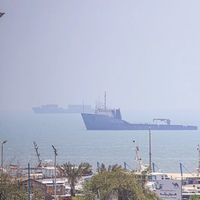
A view shows Russian warships during major naval drills, File Photo.
Ukraine said on Friday it struck two Russian vessels in the Caspian Sea that had previously been sanctioned by the United States for transporting military cargoes between Iran and Russia.
Ukraine’s special forces said in a statement on Telegram that the operation was carried out with the help of what they described as a local resistance group and targeted the ships near the Russian republic of Kalmykia.
The vessels were identified as the Composer Rakhmaninoff and the Askar-Sarydzha. Ukraine said both ships had been used by Russia for military purposes and were under US sanctions over their role in moving weapons and military equipment between Iran and Russia.
Ukraine did not say how the ships were hit or provide details on the extent of any damage.
The statement said the resistance group had supplied information on the ships’ маршруtes and cargoes. Russia has not commented on the claim.
Iran and Russia have expanded military and logistical cooperation since Moscow’s full-scale invasion of Ukraine in 2022. Western governments have accused Tehran of supplying drones and other equipment to Russia, allegations Iran has denied.
Iranian-designed Shahed drones, now manufactured inside Russia under the name Geran, have played a growing role in the war. The Financial Times reported earlier this year that the drones are increasingly overwhelming Ukraine’s air defenses as Russia steps up swarm attacks.
Ukraine’s air force has said Russia often launches large numbers of Shahed-type drones alongside missile strikes to strain air defense systems. The United States has imposed multiple rounds of sanctions on Iran’s drone production and procurement networks over their alleged role in supporting Russia’s war effort.