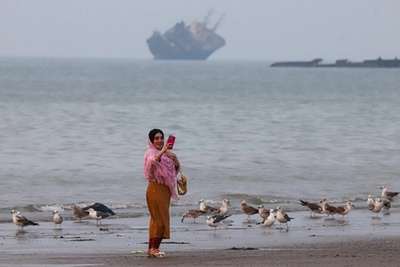
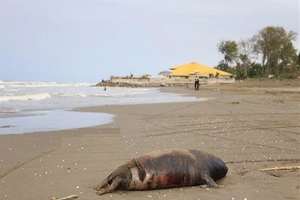
A view from the Caspian Sea coast in northern Iran
Iran said on Tuesday that enhancing strategic cooperation with the five Caspian Sea littoral states has become a top foreign-policy priority, citing the basin’s growing significance in trade, transit, tourism and energy.
Speaking at the opening of the first international governors’ conference of Caspian coastal provinces in the northern city of Rasht, Foreign Minister Abbas Araghchi said the Caspian region now holds the same weight in Iranian strategic planning as the Persian Gulf.
Araghchi told delegates that Iran’s neighborhood is “the main pillar” of its diplomacy and that cooperation among Caspian states had expanded across political, economic and security fields.
He said the five littoral governments – Iran, Russia, Azerbaijan, Kazakhstan and Turkmenistan – had already built regular platforms for coordination, including leaders’ summits, ministerial meetings and now, for the first time, a gathering of provincial governors.
In outlining Tehran’s priorities, Araghchi said the Caspian basin is central to Iran’s plans for transport corridors and energy cooperation.
“The Caspian Sea basin … in the field of energy and transit corridors has extraordinary importance for all Caspian countries,” he said.
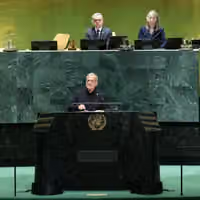
Officials attending the governors’ conference of Caspian coastal provinces pose for a group photo in Rasht, November 18, 2025.
Regional officials at the event echoed his remarks.
Gilan Governor Hadi Haghshenas told the conference that joint action was essential to protect the Caspian’s environment as water levels fall and coastal ecosystems come under strain.
“We can, with shared cooperation, minimize the impact of falling water levels and the environmental damage caused by shipping and offshore oil activity,” he said.
Kazem Gharibabadi, Iran’s deputy foreign minister for legal and international affairs, said the provinces bordering the Caspian handle key responsibilities in fisheries, energy and transit.
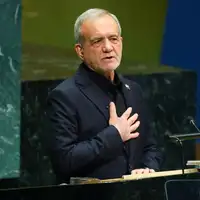
Deputy Foreign Minister Kazem Gharibabadi speaking at the governors’ conference of Caspian coastal provinces in Rasht, November 18, 2025
On the region’s commercial role, he said: “By developing joint projects among Caspian coastal provinces and creating avenues for reciprocal investment, we can expand this region’s potential in ways that benefit all its people.”
"The Caspian is a natural crossroads for North-South and East-West transit routes, and by strengthening port capacity, improving transport infrastructure and coordinating logistics, we can significantly increase the Caspian’s share of international trade and turn existing corridors into stable, reliable routes,” the diplomat added.
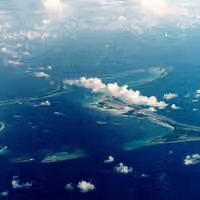
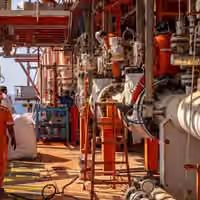
An aerial view of the Caspian Sea
Caspian Sea’s growing role
Iran is placing new emphasis on the Caspian Sea as a strategic anchor for its north-south trade ambitions, viewing the basin as a vital link in the International North-South Transport Corridor (INSTC), which connects Indian Ocean ports to Russia and Europe.
The northern provinces of Gilan, Mazandaran and Golestan handle most of Iran’s Caspian traffic and host its main ports at Anzali and Amirabad.
According to an analysis by Mostafa Mohammadi, a political-economy researcher at Mazandaran University, the Caspian has long been an underused asset for Tehran despite its economic and geopolitical potential.
He describes the area as “the strategic depth of the Islamic Republic,” saying Iran’s priorities rest on securing its northern frontier, limiting foreign military presence in the basin and strengthening ties with Russia, Turkey and the Central Asian republics.
Mohammadi said that Iran is the only littoral state that has yet to exploit its offshore Caspian energy reserves, while neighbors have developed theirs for decades.
He argues that Iran’s geography gives it unique logistical leverage between the Caspian and the Persian Gulf, making it a natural bridge for rail, road, air and maritime flows across Eurasia.
“Turkmenistan and Azerbaijan remain significantly dependent on Iran’s geography for global trade access,” he wrote.
Iran aims to use this position to increase INSTC cargo volumes, upgrade its northern ports, and attract investment in shipping, fisheries, tourism and coastal industries.
Officials say the governors’ conference this week in Rasht reflects a shift toward integrating provincial-level diplomacy into national foreign-policy planning.
Foreign Minister Abbas Araghchi at the governors’ conference of Caspian coastal provinces in Rasht, November 18, 2025
Littoral states see gains as trade grows
Regional cargo data show strong growth across the Caspian basin.
Freight volumes on the Trans-Caspian International Transport Route (TITR) – the Middle Corridor linking China and Europe – rose 63% to 4.1 million tons in the first 11 months of 2024, according to Caspian News. Container traffic increased 2.6-fold to 50,500 TEU over the same period.
Kazakhstan reported 2.3 million tons of cargo along the corridor in the first half of 2025, a 7% year-on-year rise, Eurasian Star said. Azerbaijan handled 6.17 million tons of sea freight in January-August 2025, up 9.3%, according to Caliber.az.
Infrastructure upgrades are also accelerating. The Port of Baku plans to expand capacity from 15 million to 25 million tons, while academic research identifies Caspian ports as “critical logistics nodes” linking maritime trade to inland transport networks across Russia, Central Asia and the Caucasus.
For landlocked Central Asian states, the Caspian provides a route to global markets that reduces dependence on Russian transit.
For Azerbaijan and Kazakhstan, it has become an increasingly important leg of east-west trade amid geopolitical realignments and Moscow-related sanctions on traditional routes.
Infrastructure and environment challenges
Despite rising volumes, structural weaknesses continue to constrain the region’s full potential.
A 2024 study by the he Central Asia Regional Economic Cooperation (CAREC) Program cited limited multimodal integration, fragmented logistics operators and inconsistent customs procedures as major bottlenecks slowing cargo transfers between sea, rail and road.
Environmental risks are also mounting with Iranian officials warning that up to a quarter of the Caspian Sea's water levels may dry up within the next 20 years.
Azerbaijan’s environment ministry reported in August that the Caspian Sea’s water level had fallen 2.5 meters over three decades, with annual declines of up to 30 cm disrupting port operations and increasing shipping costs.
Officials at the Caspian governors’ conference urged coordinated action.
Gilan’s governor said during the event that joint monitoring could “minimize the consequences of falling water levels” and safeguard fisheries, while Gharibabadi said environmental protection was inseparable from energy, transport and port-development planning.
A deputy Iranian foreign minister said that although numerous channels exist for exchanging messages with the United States, very few of those communications are substantial enough to build on, arguing that Washington is still not ready for a results-oriented negotiation.
Saeed Khatibzadeh, deputy foreign minister and head of the ministry’s political studies center, told CNN that Iran’s nuclear program “cannot be shut down,” adding that infrastructure had been damaged in recent conflicts but the program rests on “domestically developed knowledge spread across the country.”
He added US officials must abandon the idea of leveraging diplomacy to achieve goals they failed to secure through military pressure.
“We cannot enter a negotiation that is doomed to fail and ultimately becomes a pretext for another war. If the other side accepts the logic of negotiation – meaning give-and-take – sets aside certain illusions, and stops trying to use political and diplomatic tools to obtain what it could not achieve through a military campaign, then we can move forward within the framework outlined by the Supreme Leader.”
Khatibzadeh said Iran remains prepared to avoid further escalation in the region but warned that the country “is not an easy target,” citing the 12-day conflict with Israel earlier this year. “Iran is the oldest continuous living civilization on Earth,” he said. “The only language we respond to is the language of respect and equal-footing dialogue.”
Asked about US demands over Iran’s nuclear activities, he said international law makes clear that Tehran is entitled to the full range of peaceful nuclear rights as a member of the Non-Proliferation Treaty and under IAEA oversight.
“Iran will not accept being treated as an exception,” he said. “Ideas such as halting enrichment entirely or restricting Iran’s basic rights are unacceptable.”
Prospect of another war
Khatibzadeh said Iran had already begun rebuilding its defensive posture after the ceasefire.
“The other side is preparing for another war,” he said. “Every legitimate defensive capability must be strengthened. No country compromises on its national security and Iran is no exception.”
He added that Iran’s goal remains to prevent another conflict. “We are trying to change the strategic calculations in Tel Aviv and Washington,” he said. “We are ready for any adventure they may attempt, but we are doing everything to avoid war.”
He rejected suggestions that Iran’s missile strikes during the conflict were ineffective.
“They claimed Iran could not respond,” he said. “They censored the reality and said our missile penetration rate was 10%, then later 30–40%. The truth is much higher. With our advanced missiles we were able to penetrate multiple defense layers and strike wherever and whenever we chose.”
Khatibzadeh said Iran maintains multi-layered relations with Russia and a strategic partnership with China, and would continue cooperation with both countries.
He also dismissed speculation that Iran might reassess its position on nuclear weapons. “We are members of the NPT and the IAEA. Even after hostile actions by the Trump administration and the bombing of peaceful nuclear facilities, we did not leave the NPT,” he said. “Our nuclear program is peaceful and supported by the Leader’s fatwa.”
India’s embassy in Tehran on Monday said Iran will suspend its visa-waiver facility for ordinary Indian passport holders from November 22 after reports that Indians were being lured to the country on false job offers and kidnapped for ransom.
In a travel advisory, the embassy said Indian nationals had been “tricked into journeying to Iran by taking advantage of the visa waiver facility,” with many abducted upon arrival by criminal groups posing as recruitment or travel agents.
The advisory said Iran had decided to halt the visa-waiver scheme “to prevent further misuse of the facility by criminal elements.”
“Indian nationals with ordinary passports would be required to obtain a visa to enter or transit through Iran,” the advisory added.
The embassy urged Indians planning to travel to Iran to remain “vigilant” and avoid agents offering visa-free travel or onward transit to third countries via Iran.
In May, India’s embassy in Tehran said three Indian nationals who had traveled to Iran that month had gone missing.
The missing men — Hushanpreet Singh, Jaspal Singh, and Amritpal Singh — are all from the northern Indian state of Punjab and reportedly lost contact with their families shortly after landing in Tehran on May 1.
According to Indian media, they had planned to travel to Australia via Dubai and Iran, reportedly with the help of an agent based in Hoshiarpur who was also missing.
Relatives said the men were kidnapped and that a ransom was demanded.
In early June, the IRGC-affiliated Tasnim news agency reported that the three men were rescued in a police operation against the hostage-takers in Varamin, south of Tehran.
The Indian Embassy later said the three kidnapped men had been “safely rescued” and were now under its care, adding that it was arranging their repatriation.
Iran's military and economic setbacks have deepened this year after it was worsted in a US-Israeli war and hit by mounting sanctions, two prominent experts told an Iran International panel, drawing parallels with the waning days of the Soviet Union.
"I do think there are people inside of Tehran who say in their quiet moments, we're a fading regime," said Norman Roule, a veteran of the Central Intelligence Agency for over 30 years who once oversaw its Iran desk.
"We're not so far off from the Soviet Union in our final days, our leadership is not going to crawl into the grave when the Supreme Leader dies with him, and we need to survive," he added. "How do we modulate these dials, and how do we play this?"
"It's not to say that the Islamic Republic is the Soviet Union or 2025 is 1989," said Mark Dubowitz, CEO of the hawkish Washington-based think tank the Foundation for Defense of Democracies (FDD).
"History doesn't repeat, it echoes, as they say, but I think it's important to remember that we grew up in an era where the Soviet Union looked invincible."
Dubowitz likened Tehran's change in tack on some social issues to the attempts by the Soviet Union's last premier, Mikhail Gorbachev, to implement partial reforms to save the Soviet system only to bring about its downfall.
A surprise Israeli military campaign in June killed hundreds of military personnel along with civilians, knocking out much of Iran's air defenses. The US joined the conflict by attacking three Iranian nuclear sites before clinching a ceasefire.
Iranian counterattacks killed 32 Israeli civilians and an off-duty military officer.
In the intervening months, the standoff over Iran's disputed nuclear program has festered as Washington under President Donald Trump has stepped up sanctions and European powers triggered the resumption of UN sanctions.
As the moves have deepened economic pain, Iran's clerical rulers have eased enforcement of Islamic veiling laws, paused a draconian new hijab law and looked the other way as once-banned outdoor concerts proliferate.
But crackdowns on dissidents and political speech have sharply mounted since the conflict, according to rights groups.
"There's a bit of a Soviet Union of the late 1980s. Who believed in the great Soviet revolution in 1988?" Roule told the panel moderated by Iran International's Fardad Farahzad. "This government is facing rot. It's just inevitable rot."
'Regime change'
At the height of the conflict, the leaders of both Israel and the United States suggested a desire to topple Iran's ruling system but a ceasefire implemented by President Trump made the prospect more distant.
Israel, Dubowitz asserted, remains dedicated to uprooting its arch-enemy in the region.
"After many, many years, that bringing down the regime in Iran is now a central pillar of Israeli strategy. I think October 7 ... changed everything. I think this is 'we can no longer live with the Islamic Republic. We know that Khamenei is committed to our destruction.'"
Roule expressed doubt that any outside power could carry out transformational change in Iran.
"I'm not sure that any external country can change that entire edifice, but certainly an external country such as the United States can and should be providing whatever support that can be provided so that the Iranian people can change that structure from within to what they need to give themselves that better future," he said.
Tehran has accused Israel and the West of trying and failing to topple the system which it attributes to popular support and resistance against foreign aggression.
Authorities this month erected a billboard in Tehran's Revolution Square with Iraq's Saddam Hussein and Muammar Gaddafi shown imprisoned in the Statue of Liberty's crown - victims, according to state ideology, of US regime change misadventures.
"They didn't survive an attack by the United States or Israel," Roule said. "They survived a surgical strike by the United States on select nuclear facilities."
Dubowitz acknowledged the term regime change was deeply unpopular in Washington.
"I think in our system, we don't like the word regime change because of our experience with Iraq and Afghanistan, though no one's talking about 500,000 mechanized US troops invading Iran," Dubowitz added.
"What we're actually talking about is the Reagan strategy, right, which Ronald Reagan successfully implemented in the 1980s which is maximum support for anti regime dissidents while putting maximum pressure on the regime."
A senior advisor to Iran’s Supreme Leader said on Sunday that President Donald Trump must drop the idea that pressure can force Iran into concessions, adding that Tehran remains ready for talks on equal terms but will not abandon uranium enrichment.
“The US president must accept that peace is not achieved by force,” Kamal Kharrazi, head of Iran’s Strategic Council on Foreign Relations, said during a speech at a conference in Tehran.
“As your predecessors tested Iran and saw that Iran cannot be destroyed through force and stands firm in defending its rights, you should study their experience. Come and hold real negotiations with Iran based on mutual respect,” Kharrazi said in comments directed at Trump.
"Of course, you should know that we will not abandon enrichment, nor will we give up our military power," he added.
Kharrazi said Iran began producing weapons and missiles during the Iran–Iraq war in the 1980s and has since become a major missile power.
US talks with Tehran over its disputed nuclear program began earlier this year with a 60-day ultimatum. On the 61st day, June 13, Israel launched a surprise military campaign which was capped with US strikes on June 22 targeting key nuclear sites in Esfahan, Natanz and Fordow.
Iran denies seeking nuclear weapons and has called the attacks illegal.
The United States has demanded Iran renounce domestic uranium enrichment while Tehran maintains its nuclear program is an international right.
Kharrazi argued that United Nations failed to protect Iran’s rights during the June war. “You saw that the United Nations did not help Iran, and the secretary general only called for restraint,” he said.
He said the United States and Israel bear responsibility for the June strikes on Iranian nuclear facilities, calling them illegal.
“Attacking nuclear facilities is essentially illegal, especially facilities that are under the supervision of the Agency (the International Atomic Energy Agency),” he said, adding that Washington must accept accountability.
Kharrazi’s comments came as Iran’s foreign minister, Abbas Araghchi, also addressed the conference in Tehran.
The privileged children of Iran’s ruling elite are building futures overseas that their parents have withheld from millions of Iranians for almost half a century.
Every society has its elite. But few countries exhibit as stark a divide between rulers and ruled as the Islamic Republic of Iran.
The leadership in Tehran still insists that the system built after the 1979 revolution is righteous, independent, and morally superior to the West. They proclaim that Iran is self-sufficient and culturally immune to foreign influence. They demand that ordinary citizens remain loyal, endure hardship, and treat isolation as virtue.
And yet, when it comes to their own families, the narrative implodes.
The offspring of Iran’s most powerful political, military, and clerical figures overwhelmingly choose to live somewhere else—most often in the United States, Canada, Europe or Australia. They study at Western universities, work in Western corporations, and enjoy Western freedoms.
This is neither accident nor anomaly. It is a pattern so consistent that Iranians have given it a name: the diaspora of privilege.
A list that goes on and on
Consider the Larijani family, long central to the architecture of the Islamic Republic. Ali Larijani—head of state television, nuclear negotiator, Secretary of the Supreme National Security Council and a twelve-year speaker of parliament—has spent years warning the public about the dangers of American influence.
Yet his daughter, a medical doctor, lives and practices in Ohio. She built a life in the very country her father depicts as an existential threat.
Or take Yahya Rahim-Safavi, former commander-in-chief of the Revolutionary Guard and one of the supreme leader’s closest advisers—who helped define the concept of “cultural resistance” and oversaw enforcement of compulsory hijab.
His daughter now lives freely in Australia, enjoying precisely the choices her father spent decades denying Iranian women.
Even families associated with the Islamic Republic’s “moderate” or “reformist” wings follow the same path.
The two daughters of former president Mohammad Khatami pursued higher education and lived for extended periods abroad.
So did a niece of former president Hassan Rouhani—herself the daughter of a presidential aide and senior nuclear negotiator. Factional differences vanish when opportunity abroad beckons.
The contradiction repeats. Masoumeh Ebtekar, one of the spokespeople of the 1979 hostage-takers, spent years justifying the takeover of the US Embassy. Decades later, she sent her son to study in Los Angeles—hardly the den of decadence and corruption described in her generation’s propaganda.
The Nobakht siblings, both accomplished physicians in top American institutions, followed a similar path. Their father and uncle held senior roles shaping Iran’s budgetary and economic policies—policies that left Iranian hospitals under-funded and understaffed. Yet their children built world-class medical careers abroad, in systems defined by stability and scientific freedom.
Even the grandchildren of Iran’s most senior clerics are part of the same exodus.
Zahra Takhshid, granddaughter of late Ayatollah Mohammadreza Mahdavi-Kani—one-time head of the Assembly of Experts and custodian of the regime’s ideological purity—now teaches law at an American university.
Her work focuses on rights, freedoms, and digital media: topics that would collide instantly with state censorship at home.
A transactional exodus
Taken together, these examples expose a political truth the regime cannot conceal: Iran’s rulers do not trust the system they impose on the public.
If they did, their children would stay—study in its universities, rely on its hospitals, and build their futures in the society their parents govern. But they don’t. They leave, quietly and steadily.
This exodus is not ideological. It is transactional. When you are connected to power, the world is your oyster.
While ordinary Iranians face sanctions, inflation, unemployment and severe limits on travel and opportunity, the children of high-ranking officials glide past these barriers. Western passports, long-term visas, elite degrees and high-paying jobs become accessible through money, influence and political insulation.
This is not the diaspora produced by repression or economic collapse—the path millions of ordinary Iranians have taken out of necessity. This is something else entirely: a ruling-class diaspora born of privilege and contradiction.
Louder than words
The noble-born are of course fully entitled to live wherever they wish and pursue the futures they desire. But their choices, their quiet escape, speaks louder than their parents’ slogans.
When the sons and daughters of ministers, generals, parliament leaders and revolutionary icons choose Los Angeles over Tehran, Cleveland over Qom, Melbourne over Mashhad, and Washington over Isfahan, they deliver a verdict more powerful than any opposition manifesto: The system is not good enough, not even for its architects.
The Islamic Republic demands loyalty from the public, but its own heirs refuse to live under the conditions created for everyone else. This is the heart of the hypocrisy: restriction is mandatory for ordinary Iranians, freedom is hereditary for the elite.
A government whose children flee its ideology cannot claim legitimacy. A revolution abandoned by its heirs cannot claim success. And a system that exports its privileged offspring to the West while confining its own people at home is not a model—it is a contradiction waiting to collapse under the weight of its own lies.