US lawmakers urge probe into China’s missile fuel precursor supplies to Iran
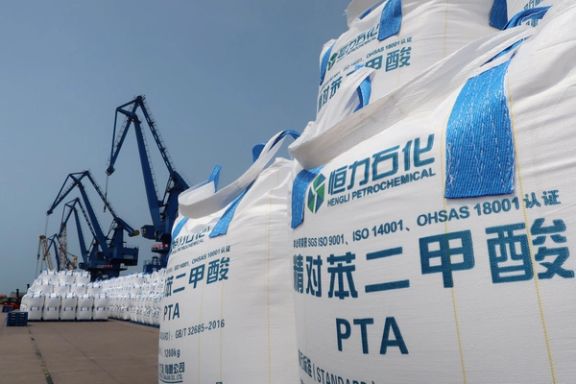
The logo of Chinese chemical producer Hengli Group is seen at its headquarters in Dalian, Liaoning province, China August 27, 2019
Two Democratic members of the United States Congress urged the Secretary of State and CIA Director to investigate a large shipment of missile propellant precursor material from China to Iran.
Representatives Raja Krishnamoorthi and Joe Courtney sent a letter to Secretary of State Marco Rubio and CIA Director John Ratcliffe on Wednesday, calling for a probe into Chinese firms' delivery of 2,000 tons of sodium perchlorate - a critical ingredient in making ballistic missile propellant - to Iran since late September in violation of UN sanctions.
The chemical shipped via 10 to 12 vessels to Bandar Abbas port, could fuel up to 500 mid-range missiles, accelerating Tehran's arsenal rebuild after a 12-day war with Israel in June, the congressmen said based on report previously appeared on CNN.
The letter said the shipments contravene September's reinstated UN sanctions prohibiting support for Iran's ballistic missile program and nuclear delivery systems.
“Beijing's aid enables Tehran's post-war rearmament efforts despite US efforts to deter such transfers,” the lawmakers said. “April Treasury sanctions on Iranian and Chinese entities failed to halt the flow, as shipments continued unabated with another 1,000 tons delivered in June.”
Iran has rejected reported US demands that it curb the range of its missiles to achieve any peace deal, calling the requests a non-starter which curbs its defense.
Sanction enforcement
In April the US Treasury sanctioned several Iranian and Chinese entities for facilitating transfers of sodium perchlorate and similar chemical precursors to the Islamic Revolutionary Guards Corps (IRGC) for ballistic missile production.
"Beijing’s continued transfers to Tehran represent a direct threat to regional stability and enable authoritarian aggression," the lawmakers said, asking for details on US countermeasures and coordination with allies.
The letter said the shipments were tracked through cargo manifests, crew social media, and shipping data. Several vessels, including the sanctioned MV Basht, disabled Automatic Identification System (AIS) tracking to disguise their movements.
The transfers involved previously sanctioned Chinese entities like Shenzhen Amor Logistics and Yanling Chuanxing Chemical Plant, targeted in April Treasury sanctions.
Unofficial accounts pointed to sodium perchlorate and other compounds imported from China for Iran’s missile program as the cause of an April 26 blast at the Bandar Abbas port which killed 57 people. Authorities have denied any military link.
The United States on Tuesday announced sweeping sanctions on 32 individuals and companies across eight countries it accused of helping Iran rebuild its ballistic missile and drone programs.
A joke about a 10th century Persian poet Ferdowsi landed an Iranian female comedian a six-month prison term and mandatory homework on the bard amid the Islamic Republic's broader pivot toward nationalism following the June war with Israel.
Zeinab Mousavi had joked about the revered author of the national epic the Shahnameh (Book of Kings) in a comedy segment, incurring the stint behind bars and an order to prepare a supervised thesis on the poet.
Mousavi, known for her online satirical persona “Empress Kuzcooo” — a parody character of an elderly villager whose tightly worn hijab exposes only her nose — was convicted over the controversial segment posted on her social media in August.
The sketch, which recited verses from the Shahnameh with irreverent commentary, drew condemnation online and from prominent cultural figures who described it as an insult to Iran’s heritage.
According to a copy of the ruling published by her husband on social media, Mousavi must prepare a compulsory thesis under the supervision of the Ferdowsi Foundation and an instructor approved by the institution.
The thesis must address topics such as “Ferdowsi’s place in Iran’s national identity and culture” and “the importance of the Shahnameh in Persian literature.”
“The defendant is obligated, under the supervision of the Ferdowsi Foundation and with the guidance of an approved instructor, to prepare a compulsory thesis over a six-month period and defend it,” the verdict said.
The court also ordered her to conduct at least 120 hours of storytelling sessions for children and teenagers in underprivileged areas, using material from the Shahnameh, in coordination with the Institute for the Intellectual Development of Children and Young Adults and the Education Ministry.
The sentencing comes as Iranian authorities move to invoke nationalism and glorify Iran’s ancient history to promote unity, emphasizing nationalist symbols more heavily in public messaging following the June war with Israel.
Symbols of Iran’s pre-Islamic past had long been shunned by the theocracy.
The Shahnameh largely recounts the tales of Iranian kings before the Arab conquest and the advent of Islam during the 7th and early 8th centuries.
Mousavi has been arrested several times on charges such as “insulting religious sanctities,” often in connection with satire aimed at the country’s compulsory hijab laws.
She was detained for around a month in October 2022 during Iran’s nationwide Woman, Life, Freedom protests sparked by the death in morality police custody of 22-year-old Mahsa Amini.
Dan Rogers, a national security and intelligence advisor, speaks as public hearings continue for an independent commission probing alleged foreign interference in Canadian elections in Ottawa, Ontario, Canada February 1, 2024
Canada disrupted multiple potentially fatal plots by Iranian intelligence services targeting perceived enemies on Canadian soil, spy chief Dan Rogers said on Thursday.
“In particularly alarming cases over the last year, we’ve had to reprioritize our operations to counter the actions of Iranian intelligence services and their proxies who have targeted individuals they perceive as threats to their regime,” Rogers said in a public speech streamed live in Ottawa.
“In more than one case, this involved detecting, investigating and disrupting potentially lethal threats against individuals in Canada,” added Rogers, who leads the Canadian Security Intelligence Service (CSIS).
Canada severed diplomatic relations with Iran in 2012 and has issued a series of sanctions over Tehran’s human rights abuses and designated Iran's Islamic Revolutionary Guard Corps (IRGC) a terrorist entity in 2024.
There are nearly 300,000 people in Canada of Iranian descent according to a 2021 Census, making it the world's second-largest diaspora community after the United States.
Rogers described the actions of Iran, along with those of India and China, as "transnational repression" which his agency along with law enforcement were determined to confront.
Canada has levied a series of sanctions on Iran for human rights abuses since the Women, Life Freedom protest movement after the death of a young woman, Mahsa Amini, in morality police custody in 2022.
In March, Canada imposed sanctions under the Special Economic Measures (Iran) Regulations against three Iranian individuals and four entities for what it described as gross human rights violations, including repression of women and girls.
The move meant 208 Iran-linked individuals and 254 entities in total were sanctioned by authorities.
A Christian convert detained in Tehran’s Evin Prison was denied adequate medical care after suffering a spinal fracture from a fall, London-based rights group Article 18 reported.
Article 18, which promotes freedom of religion in Iran and documents the persecution of Christian converts, said Aida Najaflou, 44, fell from her top bunk in the early hours of October 31, fracturing her T12 vertebrae.
She was taken to Taleghani Hospital for an X-ray but returned to prison the same day on a stretcher, still in severe pain and without the surgery doctors recommended.
Protests from fellow prisoners later prompted officials to transfer her to Shahid Tajrish Hospital, where doctors again advised urgent surgery and physiotherapy.
Despite this, the group said Najaflou remains in prison without proper medical treatment.
Najaflou, who suffers from rheumatoid arthritis, had repeatedly warned prison authorities that climbing to the top bunk was unsafe, but her requests for a lower bed were ignored.
She was still recovering from a nine-hour operation when Ministry of Intelligence agents arrested her in February and has been denied adequate care throughout her detention, including during 65 days of solitary confinement in Ward 209 of Evin Prison.
Article 18 said she remains behind bars because her family cannot afford the $130,000 bail set for her in May, part of a broader pattern of heavy bail conditions imposed on Christian detainees.
As another example, the group said the Lida Alexani, the wife of Iranian-Armenian pastor Joseph Shahbazian was released after a month only after posting $50,000 bail.
Under Iranian law, only ethnic Armenians and Assyrians born into Christianity are recognized as Christians. Conversion from Islam is prohibited.
According to US-based rights group Human Rights Activists in Iran (HRANA), around 11 percent of victims of religious-minority rights violations in Iran over the past decade have been Christians, particularly converts.
HRANA said Christians accounted for more than 9 percent of such cases last year.
Najaflou is being prosecuted in an Islamic Revolutionary court alongside two other Christian converts Joseph Shahbazian and Nasser Navard Gol-Tapeh.
They were charged earlier this year with gathering and collusion and propaganda against the Islamic Republic of Iran over ordinary Christian activities such as prayer meetings and baptisms, according to Article 18.
Article 18 said Najaflou also faces two additional charges — propaganda activity against Iran in cyberspace and propaganda in favor of groups opposed to Iran — over alleged posts on social media supporting the 2022 protests that erupted after the death of a young woman, Mahsa Jina Amini, in morality police custody.
She is also accused of allegedly criticizing slain Hezbollah leader Hassan Nasrallah on social media.
A rain prayer ceremony led by Ayatollah Morteza Morvarid, a member of the Supreme Council of the Khorasan Seminary, at the Educational-Training Complex of Hazrat Mahdi in Mashhad, northeastern Iran, November 13, 2025.
An Iranian Grand Ayatollah has urged the faithful to perform traditional Islamic prayers for rainfall as a worsening drought across the country has caused water shortages and threatens to eventually make the capital Tehran uninhabitable.
Grand Ayatollah Abdollah Javadi Amoli, a Shi'ite religious authority based in the holy city of Qom, said during his weekly ethics session on Wednesday that Islamic tradition recommends the so-called salat al-istisqa, which he described as a prayer for water in all forms, not just rain.
“This prayer, meaning asking for water, is not only for requesting rain but also for the abundance of water in wells, springs, and underground sources,” he said.
Multiple cities in Iran have held or scheduled rain-seeking prayers this week in response to a dramatic drop in rainfall and depleted river and reservoir levels.
In Tehran, the prayer will be held on Friday at 15:00 at the shrine of Imamzadeh Saleh Shrine in north Tehran, led by Ayatollah Seyyed Jamal al‑Din Din Parvar according to state media reports.
In Qom in central Iran the ceremony is scheduled for Friday morning at the Grand Mosque, as announced by provincial officials.
In Mashhad, in Khorasan Razavi Province, the country’s second-largest city and a major religious center with around four million residents, the prayer ceremony was held on Thursday.
Last week, the head of the Mashhad Water and Wastewater Company said water reserves in the city’s dams have now dropped to below 3 percent of capacity.
In Qazvin Province, the prayer ritual was performed on Monday, according to IRGC-affiliated Tasnim.
“The prayer for rain is an opportunity for hearts to return to God, to repent for shortcomings, and to recall hope and humility. When people pray with pure hearts and unity, divine mercy revives the earth,” Tasnim quoted Ayatollah Hossein Mozaffari, the Friday Prayer Leader of Qazvin, as saying about the ceremony.
Iran is now facing one of its most severe shortages in decades, with major reservoirs and dams nearing depletion.
President Masoud Pezeshkian said this month that if rain does not arrive before December, water rationing in Tehran would be needed.
Officials say the city of more than 10 million may be rendered uninhabitable if the drought persists. "Even if we do ration and it still does not rain, then we will have no water at all. (Residents) have to evacuate Tehran," Pezeshkian declared in a speech.
Last week, Iranian officials warned that water rationing could soon begin in several major cities, including Tehran, Mashhad and Isfahan, as reservoir levels fall to their lowest in decades amid a sixth consecutive year of severe drought.
Experts say the crisis is the culmination of decades of environmental mismanagement and overexploitation of resources.
Despite repeated warnings from experts over the years, Iran’s water management system has focused on building dams and drilling deep wells instead of investing in and maintaining infrastructure, often blaming the crisis solely on declining rainfall.
A senior member in Supreme Leader Ali Khamenei's office said on Thursday that Iran's leader views talks with the United States as acceptable if they mitigate threats to the country and advanced its interests.
The comments by Mehdi Fazaeli, a political analyst and member of the Office for the Preservation and Publication of the Works of the Supreme Leader, were a rare nod to the idea of dialogue with Tehran's arch-enemy from the theocrat's circle.
He is widely regarded as among the few officials authorized to interpret Khamenei's views.
Talks were ended by a surprise Israeli military campaign on Iran in June capped off by US attacks on Iranian nuclear sites. The negotiations have not resumed despite US entreaties as Khamenei led senior officials in accusing Washington of perfidy and aggression.
"Negotiations with the United States are not absolutely forbidden, but are only allowed if they are conditional, closely controlled, and in line with the system’s higher interests," Fazaeli told a diplomacy forum at Baqir al-Ulum University in the holy city of Qom, describing Khamenei's position. "No strategic trust in the United States exists."
"The Supreme Leader does not reject negotiations per se," he added, "but evaluates them based on their purpose and framework. Negotiations that imply retreat are unacceptable, but controlled, intelligent talks aimed at averting threats are permissible."
Despite what he described as deep strategic mistrust, Fazaeli said Khamenei has at times allowed narrow, issue-specific contacts “to safeguard higher national interests,” citing earlier talks on Iraq, Afghanistan and the nuclear issues.
Khamenei, 86, came out strongly against renewing talks with the United States after the June war killed hundreds of military personnel and civilians. Iranian counterattacks had killed 32 Israeli civilians and an off-duty soldier.
"The Americans sometimes say they would like to cooperate with Iran. Cooperation with Iran is not possible as long as the United States continues to support the accursed Zionist regime, maintains military bases, and interferes in the region," he said in a speech earlier this month.
US President Donald Trump said last month that the United States was ready to reach a deal “when Tehran is ready,” saying “the hand of friendship and cooperation is open.”
The United States wants Iran to halt domestic enrichment and rein in its missile program and support for armed allies in the region.
Tehran denies seeking a nuclear weapon citing a religious decree by Khamenei, rejects giving up its nuclear activities and has said discussions on its defense posture are a non-starter.
Fazaeli said Khamenei’s order against nuclear arms “is a ruling that remains fixed and cannot be changed,” adding that it bars “production, stockpiling and use”
The UN nuclear watchdog said on Wednesday it had not been able to check Iran’s enriched uranium stock for five months because Tehran has not allowed inspectors to reach the seven sites bombed in June. It said verification is “long overdue” and that it has lost “continuity of knowledge” of Iran’s nuclear material.
Before the attacks, inspectors had confirmed Iran held about 440 kilograms of uranium enriched to 60 percent purity.
Meanwhile, Foreign Minister Abbas Araghchi wrote to UN chief António Guterres on Wednesday saying Trump publicly admitted to directing Israel’s initial strikes on Iran, demanding the United Nations extract reparations from Washington.