Nobel laureate says Iran cannot reform itself, end of theocracy certain

Iranian activist and Nobel laureate Narges Mohammadi said on Tuesday that there was no prospect for reforming the country's Islamic theocracy and its downfall was assured.
Iranian activist and Nobel laureate Narges Mohammadi said on Tuesday that there was no prospect for reforming the country's Islamic theocracy and its downfall was assured.
“Reform has been dead for years. The time for reforms has long passed. The real main struggle is between the realistic survivalists and those seeking the end of religious despotic regime,” Mohammadi posted on X on Tuesday.
“As a human rights defender and peace advocate and fundamentally based on the criteria of peace and human rights, I believe in a transition and am working to end the Islamic Republic as a religious despotic regime,” she added. “Victory is not easy, but it is certain.”
Mohammadi criticized talk of reform, calling it fruitless. “Our pact is freedom, democracy, and equality, whose key step is ending religious tyranny,” she said.
Iran's reform movement began in the 1990s under President Mohammad Khatami (1997-2005) and sought to promote civil liberties, press freedom and dialogue after years of hardline policies.
It peaked with the 2009 Green Movement protests led by reformist candidates Mirhossein Mousavi and Mehdi Karroubi against Mahmoud Ahmadinejad's disputed election victory.
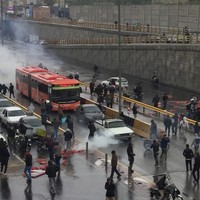
Security forces crushed it with lethal violence, killing dozens and arresting thousands, stifling momentum.
In 2013 and 2017, moderate cleric Hassan Rouhani backed by sidelined reformists persuaded voters to choose him as what was widely called the “better of the two evils,” warning that electing another hardline Ahmadinejad-style president would be disastrous.
His first term saw a period of relative economic stability, particularly after the partial lifting of sanctions under the 2015 nuclear deal. But Donald Trump’s withdrawal from the accord and the return of US sanctions, followed by the government’s crackdown on economic protests in 2017 and 2018, left many voters disillusioned.
‘Sweeping change or collapse’
Calls for radical change have since persisted and mounted among some former officials, who warn of systemic collapse without overhaul.
Mohammad Sarafraz, a Supreme Cyberspace Council member and former head of the state broadcaster IRIB, urged sweeping reforms on Saturday in an interview with Khabar-e Fori, cautioning that without them, the Islamic Republic faces “war, collapse, or chaos.”
Even US talks or oil export gains won't fix deeper political and economic woes, he said, demanded fundamental reform rather than a mere change of president, advocating genuine public participation in governance.
In July, former government official and political activist Mostafa Tajzadeh warned Supreme Leader Ali Khamenei to pivot or resign.
"In this critical situation, Mr. Khamenei has no option but to apologize to the Iranian people and accept fundamental reforms in line with national demands, including by forming a constituent assembly based on completely free and fair elections," he said, "or to resign and step down."
In recent years, the pursuit of reform has shifted toward regime change, as seen in the 2017-18 and 2022 Woman, Life, Freedom uprisings, with many people viewing the system as irreformable.