Women flouting hijab deserve death penalty, ex-Guards commander says
A former commander of Iran’s Islamic Revolutionary Guard Corps (IRGC) has called for the execution of women who reject the country’s mandatory hijab.
“The sentence for someone who does not accept the hijab is execution,” Hassan Hassannia said. “If the martyrs were here, they would flay the skin off those who, with the slogan ‘woman, life, freedom,’ stripped themselves naked,” he added, referring to the slogan chanted during Iran’s nationwide 2022 protests sparked by the death in custody of 22-year-old Mahsa Jina Amini.
He said women who refuse to wear the hijab “will not be corrected by dialogue,” urging that they be dealt with using “the harshest punishment.”
Hassannia also criticized Iranian officials who question the Islamic Republic’s hijab mandate, saying, “You became president, minister and governor and swore on the Quran to uphold the constitution; you are wrong when you say you do not accept the hijab.”
His comments come as Iran’s hardline daily Kayhan, run by Supreme Leader Ali Khamenei’s representative, blamed government bodies for lax enforcement of hijab rules and called for stronger promotion of compulsory veiling in a commentary published last week.
Earlier in the week government spokesperson Fatemeh Mohajerani, had said that “hijab cannot be restored to society by force” and that social values should be strengthened through cultural engagement rather than coercion.
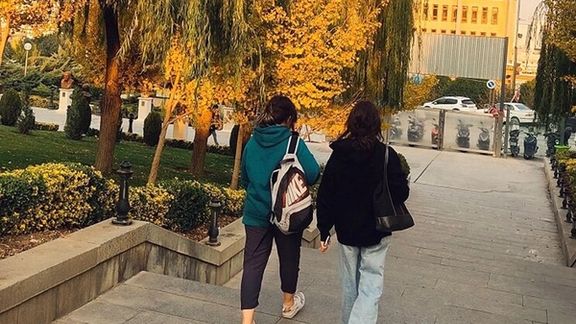
Defiance of Iran’s mandatory hijab laws has endured since the 2022 protests, as unveiled women continue to appear in public across major cities despite recent recurring crackdowns on businesses accused of serving women without headscarves.
John K. Hurley US President Trump's nominee for Under Secretary for Terrorism and Financial Crimes at Department of the Treasury attends a Senate Banking, Housing, and Urban Affairs Committee confirmation hearing on Capitol Hill in Washington, DC, US, April 10, 2025
A senior treasury official is traveling to the Middle East in a bid to ramp up pressure on Tehran and its armed affiliates, Reuters reported on Friday.
"I look forward to meeting with our partners to coordinate our efforts to deny Tehran and its proxies the financial access they rely on to evade international sanctions, fund violence, and undermine stability in the region," it cited John Hurley, Treasury undersecretary for terrorism and financial intelligence, as saying in a statement.
Iran backs various armed groups in the region opposed to Israel and the United States including Hezbollah in Lebanon, Hamas in Gaza, the Houthis in Yemen and Shi'ite militias in Iraq and Syria.
Hurley will travel next week to Israel, the United Arab Emirates, Turkey and Lebanon to focus on implementing US sanctions on Iran, Reuters reported.
Since the October 7 2023 Hamas attacks which killed 1,200 and brought back over 200 to Gaza as captives, Israel has launched attacks in Lebanon and Gaza which have killed over 70,000 people according to local health officials.
The campaigns deeply weakened Iran-backed armed groups there.
'Sustained pressure'
"President Trump has made clear that Iran's destabilizing and terrorist activities must be met with sustained and coordinated pressure," Hurley said.
UN sanctions have been reimposed on Iran since last month, initiated by France, Germany, and the United Kingdom over Tehran's failure to cooperate with the International Atomic Energy Agency (IAEA) and engage in direct talks with the United States.
Iran suspended cooperation with IAEA inspectors after a 12-day war in June against Israel and the United States in which they attacked Iranian nuclear sites, codified via a new law passed by parliament.
Tehran denies seeking a nuclear weapon, but Western powers and Israel doubt its intentions.
President Trump withdrew from a 2015 Iran nuclear deal and imposed stringent sanctions he bills as a "maximum pressure campaign".
Upon starting his second term Trump reinstated the policy, intensifying sanctions to curb Iran's nuclear program and proxies, while seeking a tougher new deal.
People take part in a protest in solidarity with the Palestinians, in London [Hollie Adams/Reuters]
Iran’s backing of Hamas has not only deepened Palestinian suffering but also strengthened hardliners in Israel, two Gaza-born activists told Eye for Iran, warning that Tehran’s influence is faltering as its regional sway ebbs.
“The Iranian regime has an interest in a continuous conflict with Israel,” said Palestinian political analyst Khalil Sayegh. “The Palestinians have been used as pawns in this game very cynically."
US President Donald Trump’s administration is advancing a 21-point postwar framework for Gaza, unveiled earlier this month. The plan rules out any political or military future for Hamas — the Iranian-backed group that has ruled the enclave since 2007 — and proposes Arab-led reconstruction under international supervision.
The plan has been described by regional analysts as a potential turning point — one that could further erode Iran’s leverage after the fall of its key Arab ally Bashar al-Assad in Syria and the weakening of Hezbollah in Lebanon.
Sayegh's father died during the war due to what he described as medical neglect due to Israeli attacks on health facilities and lack of access to medical care. His sister too lost her life while en route to Egypt on a so-called safe route designated by Israel where he says were barred from entering.
Despite his loss, he co-founded the Agora Foundation for Middle East Peace, an initiative that aims to promote a lasting peace, equal rights and prosperity for both Palestinians and Israelis.
Tehran’s support for Hamas and Islamic Jihad, Sayegh said, has long played into the hands of Israeli hardliners.
“Since day one, the extremists in the region have been feeding each other,” he said. “The Israeli right-wing extremists are on the record saying that Hamas is good for us and therefore we have to support them and fund them. The existence of the Iranian regime has been weaponized and used by Benjamin Netanyahu for so long.”
Hamza Howidy, also a Gaza-born activist who was twice imprisoned by Hamas before fleeing the enclave in 2023, said resentment toward Iran is widespread among ordinary Gazans.
“There is a huge, huge hate for the Iranian regime inside Gaza because those people see the Iranian regime as number one, the financer and the reason why Hamas is still there,” he said.
Howidy recalled how Gazans reacted after the death of former Iranian President Ebrahim Raisi in a helicopter crash in May 2024, which led to the election of Masoud Pezeshkian.
“When the Hamas affiliated people tried to make a poster for him inside Gaza during the war, the civilians themselves decided to go to take down this poster,” he said.
A shifting regional context
Both Sayegh and Howidy said Israeli claims of an expanding Iranian role in the West Bank are often exaggerated.
Sayegh said Iran’s ability to move weapons or influence groups in the West Bank has sharply diminished. “They keep trying from what I know, but I don’t think they will succeed,” he said. “They lost Syria — that was their biggest front to claim they’re coming to liberate Palestine.”
Iran’s role in sustaining Palestinian divisions has undermined every path toward peace, Sayegh told Iran International's podcast Eye for Iran.
“Iran has maintained the Palestinian division between the West Bank and Gaza,” Sayegh said. “That has been used by the Israeli regime to argue that a two-state solution is not possible because of the Iranian funding to Hamas.”
Iranian weapons seized by Shin Bet and Israeli army
Iran’s shrinking reach
Both men said Iran’s influence is diminishing as its proxy network weakens across the region — a further blow to Tehran’s ambitions after two years of devastating war which followed Hamas-led attacks into Israel on October 7, 2023.
The assault killed 1,200 Israelis and brought over 200 others back into Gaza as captives. Israel's devastating incursion into the enclave killed at least 67,000 people.
“I think (Iran) will be weakened tremendously because of the incidents that happened during the past two years,” Howidy said. “I’m talking about the end of the Syrian regime, the notorious Bashar al-Assad and his regime, and then to the defeat or deterrence of Hezbollah in Lebanon.”
The recent recognition of a Palestinian state by Canada, France, Italy, and Britain, Sayegh said, would remove Tehran’s main ideological justification for interference.
“When a Palestinian state emerges," he said, "the Iranian regime would lose its biggest ideological weapon that they are using—the grievances of the Palestinian people and its weaponization to justify its neo-imperialism in the region and to justify its repression of the Iranian people."
You can watch the full episode of Eye for Iran on Youtube or listen on any podcast platform of your choosing.
Egypt's Foreign Minister Badr Abdelatty attends a joint press conference with Palestinian Prime Minister Mohammad Mustafa in Cairo, Egypt March 1, 2025
Egyptian Foreign Minister Badr Abdelatty said he had urged Iran and the UN nuclear watchdog to resume nuclear cooperation as Tehran continues to bar inspections of nuclear sites attacked in a June war.
Abdelatty conveyed the message in telephone calls to Iranian foreign minister Abbas Araghchi and International Atomic Energy Agency (IAEA) chief Rafael Grossi, according to a statement by the Egyptian foreign ministry on Friday.
Iran denies seeking a nuclear weapon but Western powers and Israel doubt its intentions.
Egypt's efforts aim "to support security and stability in the region by finding peaceful solutions to the Iranian nuclear file," it said, adding Abdelatty "stressed the importance of continuing the dialogue between the two sides and resuming and strengthening cooperation."
The two sides inked a deal in Cairo in September aimed at resuming full IAEA access but little progress appears to have been made.
Iran suspended cooperation with IAEA inspectors after a 12-day war in June against Israel and the United States in which they attacked Iranian nuclear sites, codified via a new law passed by parliament.
Under the post-war law, inspections proceed via Supreme National Security Council (SNSC) approval for limited IAEA access at non-stricken sites, maintaining safeguards obligations under conditional cooperation while excluding full reporting and Non-Proliferation Treaty (NPT) oversight.
Iran had warned the any concessions on inspections would be void if Western sanctions return. Since the re-imposition of UN sanctions last month, the agreement's fate with the agency remains unclear.
"We are trying to build it back, and we are inspecting in Iran," Grossi said on Wednesday. "Not at every site where we should be doing it—but we are gradually coming back."
Grossi added there was no indication of any suspicious activity at the sites attacked by Iran's foes.
The Center for Strategic and International Studies (CSIS) reported Tuesday, citing satellite imagery, that Iran has continued construction at a major underground nuclear site near Natanz.
An Iranian economics journalist whose work scrutinizing the country's free trade zones resulted in multiple judicial summonses has suffered a stroke, sources familiar with her health told Iran International.
Marziya Hosseini lost part of her short-term memory after the stroke and remains hospitalized, they added.
Despite her condition, judicial authorities issued a new summons dated October 26, giving her five days to report to the Qeshm Public and Revolutionary Prosecutor's Office on a Persian Gulf island that was the subject of her investigations.
Charges include "slander, spreading falsehoods, satire and insult to officials and agents."
Hosseini, who has faced prior restrictions from Iran’s security officials, was summoned in June after criticizing President Masoud Pezeshkian's support for Qeshm Free Trade Zone CEO Adel Pighami.
In an X post then, she wrote: "Mr. President, see the result of your support for the corrupt CEO of the Qeshm Free Trade Zone."
She accused Pighami of embezzling public funds and holding back progress at the Qeshm free zone, adding that exposing corruption prompted complaints and threats against her rather than accountability for the issues she rasied.
The Qeshm Free Trade Zone, a key economic hub in southern Iran, has long been plagued by corruption allegations including Islamic Revolutionary Guards Corps (IRGC) linked monopolies and tax evasion through shell companies.
In 2015, the Iranian government confiscated Qeshm Airlines from its owner Babak Zanjani over bribery charges and unpaid oil debts.
Hosseini's ordeal highlights an intensifying crackdown on press freedom under President Pezeshkian.
A November 2024 report by the watchdog group Defending Free Flow of Information Organization documented 78 judicial and security actions against media outlets and journalists in his first 100 days, marking an uptick in efforts to squelch free media.
Marek Kaufman screen grab image from released video by Mehr News Agency on June 21,2025
Mark Kaufman, a German national detained in Iran in June on suspicion of espionage has been freed under conditional pardon, journalist Kambiz Ghafouri told Iran International.
“Iranian judicial and security officials directed Kaufman to submit a conditional release request. He was removed from prison and fully released on Thursday,” Ghafouri told Iran International on Friday.
Ghafouri, a veteran investigative journalist who has reported previously on undisclosed developments within Iran's security establishment and who broke the news via a post on X, said Kaufman remained in Iran.
No official Iranian media has reported the release, and the German Foreign Ministry did not immediately respond to an Iran International request for comment.
Iranian media reported in June that Kaufman had been arrested on alleged spying charges near restricted nuclear and military sites in Markazi province.
State news agency Mehr released a video they say showed Kaufman, describing him as a Jewish-German dual national tourist cycling through the region, speaking after his arrest.
In the footage, Kaufman says he was aware he was near a military area and that taking photos or videos was not allowed. He adds that he sent his location to a friend. The video is heavily edited and does not include a clear confession.
Iranian officials accuse Kaufman of gathering intelligence on sensitive military sites, including missile silos, drone routes and airbases.
Mehr said he was detained by Islamic Revolutionary Guards Corps (IRGC) intelligence operatives in an area marked with warning signs.