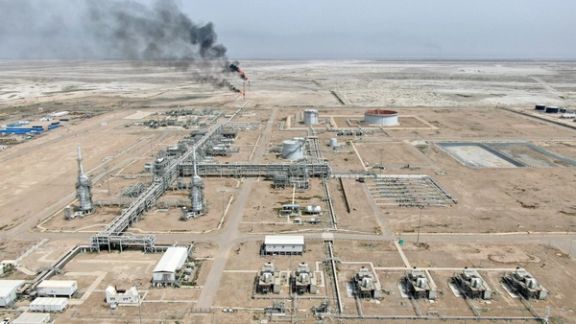
A view shows the Iraq's Majnoon oilfield near Basra, Iraq, March 31, 2021. Picture taken with a drone.
ExxonMobil’s return to southern Iraq this month underscores how far Baghdad has surged ahead of Tehran in exploiting their shared border oilfields—and how the two neighbors’ fortunes are diverging.
The deal with Basra Oil Company and the State Oil Marketing Organization, announced last week, aims to revive production at Majnoon, which is part of the same geological structure as Iran’s Azadegan field.
ExxonMobil plans to invest $5-10 billion to boost Majnoon’s output by 240,000 barrels a day over five years, helping Iraq hit its target of seven million barrels per day by 2030.
The American supermajor had left the Iraqi space when it exited another oil field due to what it described as challenging contract terms.
Across the border, decades of sanctions, underinvestment, and weak governance have crippled Iran’s ability to tap the same reservoirs including Azadegan, Yadavaran and West Karun, leaving output far below capacity.
Iraq’s comeback
Iraq’s resurgence is best illustrated by Majnoon, Artawi and Dehloran.
Majnoon, discovered in 1975 but dormant for decades, now produces more than five percent of Iraq’s total output. Artawi doubled production last year and is on course to do so again this year.
Together, these fields have added roughly 300,000 barrels a day since 2010, far outpacing Iran’s performance on the same geology.
The October ExxonMobil deal builds on this momentum, introducing advanced processing infrastructure and a profit-sharing model designed to sustain growth.
Iraqi Prime Minister Mohammed Shia al-Sudani attends a signing ceremony for a preliminary agreement between Iraq's Oil Ministry and Exxon Mobil to develop the Majnoon oil field, in Baghdad, Iraq, October 8, 2025
Iran’s stagnation
Iran, despite holding the world’s fourth-largest proven oil reserves, produces only about 200,000 barrels a day from the West Karun cluster—less than comparable Iraqi fields.
Modest gains at South Azadegan and Yaran this year have done little to close the gap.
Experts estimate Iran needs $11 billion to fully develop its five joint fields, but sanctions have deterred most international investors.
Sporadic involvement by Chinese and Russian firms has yielded little progress, while the absence of a bilateral framework for cross-border field management risks reservoir damage from unilateral drilling.
Iran’s National Iranian Oil Company still relies on old-style contracts offering low returns of 15-20 percent, compared with Iraq’s 20-30 percent technical service terms that attract global players.
As a result, Iran’s shared fields operate at barely a quarter of their potential.
Recent government plans to raise West Karun output to 550,000 barrels a day by 2033 are widely seen as unrealistic without sanctions relief and major reforms.
Meanwhile, a shadow trade rebranding Iranian oil as Iraqi through ship-to-ship transfers keeps exports near 1.5 million barrels a day but undermines transparency and investor confidence.
Shifting Power Balance
The contrast between Basra’s humming rigs and Ahvaz’s stalled projects reflects more than technical capacity — it marks a shift in regional power. Iraq’s energy sovereignty is strengthening through foreign partnerships and phased development, while Tehran’s stagnation erodes both revenue and influence.
Iraq’s experience shows how targeted investment and competent management can turn contested resources into engines of growth. For Iran, isolation and rigid policies have turned the same geology into a symbol of lost opportunity.
The collapse of Iran’s Ayandeh Bank resembles a national-scale Ponzi scheme, exposing how reckless lending, political patronage, and failed mega-projects drained public wealth.
Ayandeh survived on illusion—paying old investors with new deposits while building an empire of glass and marble called Iran Mall.
Founded in 2010 by businessman Ali Ansari, Ayandeh emerged from the merger of his Bank Tat with several smaller institutions.
Within a few years, it shook up Iran’s banking sector by offering interest rates roughly four percentage points higher than those allowed by the Money and Credit Council.
The strategy drew millions of depositors and rapidly expanded its market share; by 2017, Ayandeh held 7.6 percent of all deposits in Iran’s banking system. Beneath that success lay a web of risky loans and inflated promises.
By 2020, the bank’s fortunes had reversed, and calls for its liquidation began. When it was finally folded into Bank Melli, the savings of seven million depositors were trapped in bad loans and speculative ventures.
Much like a Ponzi scheme, Ayandeh relied on a steady inflow of new deposits to pay earlier investors while channeling enormous sums into illiquid assets—mostly real estate.
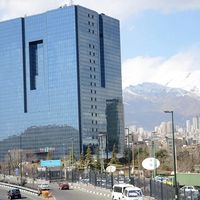
Iran Mall in the west of Tehran
Biggest Gamble: Iran Mall
Experts trace Ayandeh’s downfall to its massive exposure to real estate, especially the Iran Mall—a colossal shopping and leisure complex west of Tehran (1.95 million square meters) developed and owned by Ansari himself.
Investigations showed that roughly 70 percent of Ayandeh’s lending went to the Iran Mall Development Company, a subsidiary fully owned by the bank.
The loans exceeded the legal limit for a single borrower by more than a thousandfold—blatant self-dealing that violated banking laws capping ownership of any single shareholder at 10 percent, or 30 percent with Central Bank approval.
Ayandeh’s executives effectively lent billions to themselves, betting that post-nuclear-deal optimism and foreign investment would transform Iran Mall into a profit engine.
But after the US withdrew from the JCPOA in 2018, Iran’s economy contracted, purchasing power plunged, and foreign brands stayed away. What was meant as a monument to modern commerce became a mausoleum of financial hubris and cronyism.
Shielded by Power
Ansari, now 63, began building his empire in his twenties, founding Bank Tat in 2009 with a capital base of 2 trillion rials (about $200 million at the time) before merging it with other institutions to form Ayandeh.
Beyond Iran Mall, he owned several luxury properties, including a Tehran tower sold to convicted tycoon Babak Zanjani, who paid only one-fifth of the price.
After Ayandeh’s dissolution, Ansari claimed his “conscience is clear,” though he has faced no legal proceedings.
Rumors persist of political protection, including alleged ties to Mojtaba Khamenei, the Supreme Leader’s son, and Gholam-Ali Haddad-Adel, Mojtaba’s father-in-law.
These remain unverified but reinforce perceptions that Ayandeh’s rise and fal were inseparable from Iran’s political elite.
‘People pay the price’
By the time the Central Bank dissolved Ayandeh, the bank was 550 quadrillion rials (roughly $5.1 billion) in debt.
If its real-estate assets—including Iran Mall—cannot be sold to cover liabilities, the Central Bank will have to print money to repay depositors, injecting vast sums into the economy—a “pure inflationary disaster,” as the financial outlet Bourse Press warned.
Officials have pledged that major shareholders will be held accountable and small depositors repaid first, but skepticism abounds.
Economist Ali Sarzaeem argued that the Central Bank long knew the scale of Ayandeh’s abuses but lacked the will to act.
“If the bank’s assets are overvalued or unsellable,” he wrote, “the gap between debt and equity will again be filled from the pockets of ordinary Iranians.”
The moderate-conservative Jomhuri Eslami painted an even bleaker picture: “Even more tragic is that this infection has been passed on to Bank Melli—and that bank too will sooner or later meet the same fate.”
A vessel anchors next to Iranian offshore oil rig, Ilam, in the Persian Gulf, September 2025
Discounts on Iranian crude sold to China have widened to their steepest levels in over a year as tougher Western sanctions on Iran and Russia disrupt logistics and discourage independent refiners already struggling with limited import quotas, Reuters reported on Wednesday.
According to trade sources who declined to be named due to commercial sensitivities, offers for Iranian light crude have dropped to more than $8 a barrel below benchmark ICE Brent for December delivery, compared with about $6 in September and $3 in March.
Bids have fallen even lower -- to discounts near $10 per barrel -- as buyers seek to offset sanctions risks and possible delays at Chinese ports.
The slide follows a fresh wave of US, UK and EU sanctions targeting Russian and Iranian energy networks, including several Chinese refiners, ports, and shipping firms accused of moving sanctioned oil.
The measures have compounded uncertainty for Chinese “teapot” refiners, many of whom have run out of crude import quotas for 2025, reducing purchases ahead of expected new allocations in November.
The new Western sanctions have also hit Russian producers, prompting some Chinese and Indian buyers to pause purchases and pushing additional Russian barrels into the spot market, further weakening prices for Iranian grades.
The overlap has created what traders described as a “buyers’ standoff” with sellers unable to move cargoes quickly.
"There was just too much supply, and the market is directionless," a China-based trader told Reuters.
Iranian crude exports -- around 14% of China’s total imports -- fell to 1.2 million barrels per day in September, down from an average of 1.38 million bpd this year, according to data from analytics firm Kpler.
Beijing’s independent refiners have turned into Iran’s lifeline buyers, often processing oil delivered via a network of ship-to-ship transfers and rebranded cargoes that obscure origin and ownership.
A Reuters investigation this week traced parts of this “shadow fleet” to a New Zealand insurer, Maritime Mutual, accused of covering vessels carrying Iranian and Russian crude under false identities.
The report said the insurer’s clients had moved at least $18 billion worth of Iranian oil since 2018, highlighting how Tehran has maintained exports despite sanctions.
Iran’s oil ministry continues to reject Western restrictions as “illegal,” vowing to sustain exports to China and other Asian markets.
Nearly 90% of Iranian oil shipments are now believed to go to China, much of it through ship-to-ship transfers and offshore storage, according to Western and industry estimates.
Earlier this month, the US Treasury imposed sanctions on more than 50 individuals, entities and vessels tied to Iran’s petroleum and gas trade, marking the fourth round of such measures under President Donald Trump targeting Chinese refiners still buying Iranian crude.
With official trade channels shrinking, Tehran has also been reported to accept Chinese weapons and infrastructure projects as payment in barter-style arrangements designed to sidestep banking restrictions.
Retirees across Iran held protests over the past week, demanding overdue pension payments and relief from rising cost of living according to voice and video submissions sent to Iran International.
Demonstrations were reported in cities including Zanjan, Tabriz, Tehran, Esfahan, Gilan and Fars, with participants chanting slogans that reflected both economic hardship and political frustration, lapse in their pay and benefits.
In Zanjan and Tabriz, retirees gathered outside government buildings, chanting: “People's rights must be settled,” and “Yesterday's warriors are today's claimants. Yesterday's fighters are today's rights-seekers.”
The term “warriors” refers to veterans of the eight-year Iran-Iraq war, many of whom now face financial insecurity.
Iran’s Intelligence Ministry issued a confidential warning in August, anticipating serious fallout from the potential return of UN sanctions under the snapback mechanism.
In Tehran and Esfahan, protesters voiced anger at financial mismanagement, shouting: “The major shareholder devoured our rights,” and “Don't delay—settle our dues today.”
Some chants directly challenged official narratives, with demonstrators declaring: “Our enemy is right here; they lie that it's America.”
In Gilan and Fars provinces, retirees accused both parliament and the government of deceiving the public. “Parliament and government both lie to the nation,” one group chanted, while another called out: “Cry out against this endless injustice!”
Price hike on rise
The protests come amid a sharp rise in consumer prices following the reactivation of UN sanctions by European powers last month. Basic goods have become increasingly unaffordable for many Iranians, particularly those on fixed incomes.
Rice market in Tehran
A grocer in Tehran shared a video showing his dwindling stock of rice, lamenting the price rise: “Top-grade Pakistani rice was 14.5 million rials ($13) before. A month later, it hit 21 million rials ($19). How can a head of a family with monthly income of 20 million rials ($18) could afford just for rice?”
Iran’s minimum monthly wage for 2025 stands at 104 million rials ($96), leaving many unable to cope with the rising cost of living.
Another woman posted a video comparing rice prices year-over-year: “This rice cost 11 million rials ($10) last year. Now it’s 33 million rials ($30). Khamenei, for 46 years you chased missiles, war, death to this and that, conquering this and that peak. Today, every calamity you inflicted is boomeranging on you.”
In another clip, a woman displayed two plastic bags of fruit—bananas, oranges, apples, and grapes—costing 20 million rials ($18). She narrated a comparison during the video. “In 1977, a Mercedes Benz coupe was 4 million rials (equal to $3 now). Now I pay this amount for fruit that vanishes in two days.”
A man driving through Tehran recorded a video responding to Interior Ministry claims that there has been no “visible shock” to the economy due to reimposition of UN sanctions.
“Want to see shock? Check the commodity basket. You're unfit to run the country. You must go. Islamic Republic corruption must end so someone honorable can govern.”
Meanwhile, an Iranian health official warned last week that about 120,000 Iranians die each year from nutrition-related causes, as rising food prices and declining consumption of staples such as dairy, meat, fruits and vegetables deepen the country’s public health crisis.
The Liberian-flagged oil tanker Ice Energy transfers crude oil from the Iranian-flagged oil tanker Lana (former Pegas), off the shore of Karystos, on the Island of Evia, Greece, May 26, 2022.
A New Zealand insurer is under investigation for allegedly helping vessels transport sanctioned Iranian and Russian oil, a Reuters special report said on Tuesday, as Tehran’s crude exports continue to flow mainly to China despite US sanctions.
According to Reuters, Maritime Mutual, based in Auckland, is alleged to have provided insurance to dozens of tankers that carried Iranian crude under false identities through ship-to-ship transfers and falsified records.
Police searched the company’s offices in Auckland and Christchurch on October 16 as part of a financial crime investigation into possible sanctions violations, the report said.
The insurer, run by British national Paul Rankin, is reported to have covered vessels belonging to Iran’s so-called “shadow fleet,” tankers that disguise their ownership and routes to move sanctioned cargo. Ships insured by Maritime Mutual have carried at least $18 billion worth of Iranian oil since 2018, Reuters said.
Documents reviewed by Reuters showed that vessels insured by the company often disabled tracking systems or sent fake coordinates, a tactic known as “spoofing,” to conceal their movements.
Maritime Mutual said it “categorically denies” breaching sanctions and keeps a “zero-tolerance policy” toward violations. It said it operates under “rigorous compliance standards designed to ensure full adherence to all applicable laws.”
Shiraz Marine connection in Iran
Reuters reported that Shiraz Marine, an Iranian shipping company, described itself as a representative of Maritime Mutual.
A letter posted on Shiraz Marine’s website, bearing what appeared to be Maritime Mutual’s logo and the signature of company founder Paul Rankin, said the Iranian firm could promote the insurer’s interests.
Shiraz Marine later referred to itself on social media as the “official representative of the New Zealand P&I Club (MMI) in Iran,” Reuters said.
Shiraz Marine did not respond to Reuters' questions about the matter.
Maritime Mutual’s revenues rose sharply after US sanctions on Iran and Russia tightened.
Company filings showed average annual revenue growth of 41 percent from 2019 through 2024, reaching $108.5 million last year, up from $14.2 million in 2018.
Revenue growth peaked at 60 percent in 2023, the first full year after Western sanctions on Russian energy exports took effect, Reuters said.
Analysts told Reuters that the shadow fleet remains crucial to Tehran and Moscow’s ability to sell oil abroad despite sanctions.
Protection and indemnity coverage from insurers such as Maritime Mutual allows these ships to enter ports and conduct trade that might otherwise be blocked.
“Without that they’re dead in the water,” said David Tannenbaum, director of sanctions consultancy Blackstone Compliance Services, commenting on Reuters’ findings.
Iran and China oil ties
Tehran has long rejected Western sanctions as illegal and vowed to maintain its oil exports despite restrictions.
The investigation coincides with evidence of sustained Iranian oil flows to China. The Wall Street Journal reported earlier this month that Beijing funnels billions of dollars to Tehran through a covert payment system that swaps oil for infrastructure projects.
The report said around 90 percent of Iran’s oil exports now go to China, much of it transferred between ships at sea to obscure origin and destination.
Data cited by Iran International showed Iranian crude shipments to China rising to 1.68 million barrels per day in August, their highest level since before the Trump administration reimposed sanctions.
Earlier this month, the US Treasury announced sanctions on more than 50 individuals, entities, and vessels linked to Iran’s petroleum and liquefied gas exports, saying the move aimed to “degrade Iran’s cash flow” and disrupt funding for militant groups. Treasury Secretary Scott Bessent said the action marked the fourth round of measures under President Donald Trump targeting China-based refiners that continue to buy Iranian oil.
Land subsidence driven by decades of groundwater over-extraction is emerging as a direct threat to some of Iran’s most treasured heritage sites, including Persepolis, Naqsh-e Jahan Square and the Tomb of Cyrus, Iranian scientists and officials say.
Geologists cited by Tasnim news agency said subsidence has accelerated across provinces such as Isfahan, Fars and Tehran, with field observations of cracks, surface fissures and foundation instability near historic structures.
“Nearly half of Iran’s valuable historic fabric lies in subsidence-prone zones,” geologist Ali Shahbaz was quoted as saying, adding that “63 nationally registered monuments and 27 world-class sites” are in affected areas.
In Isfahan, the long-dry Zayandehrud river has been linked to ground settlement of roughly 16-25 cm a year in the city’s north, raising stability concerns for Naqsh-e Jahan Square, the Shah and Sheikh Lotfollah mosques, and the Safavid-era Si-o-se-Pol and Khajou bridges, Tasnim reported.
In Fars province, subsidence in the Marvdasht plain -- estimated around 14 cm a year -- has prompted warnings about drainage systems and stone platforms at Persepolis and potential long-term risks to the Tomb of Cyrus at Pasargadae and the rock-cut tombs of Naqsh-e Rostam.
The concerns come amid broader alarms over nationwide land-subsidence.
Tasnim, citing official tallies, said 380 cities and about 9,000 villages have reported some level of subsidence, with roughly 42 million people living on sinking ground.
Iran’s Geological Survey says two decades of drought and sustained over-pumping, compounded by fragmented water governance, have pushed 106 plains into non-recoverable subsidence.
Cultural-heritage specialists stress there is no immediate risk of collapse at marquee sites, but warn that cumulative deformation, coupled with drying soils and sporadic heavy rains, could inflict irreversible damage over years to decades.
“No site is on the brink today,” Shahbaz said. “But without curbing withdrawals and restoring groundwater, we are setting the stage for losses that cannot be repaired.”