Iran’s rape survivors face justice that feels like another assault - Shargh
A woman sits in partial shadow, her face turned away from the camera.
In Iran, women seeking justice for rape face a system that reopens their wounds — forcing them to relive trauma in courts that offer punishment without protection, and laws with no room for mercy, a report by leading reformist newspaper Shargh said.
The report is by Niloufar Hamedi, the journalist who — along with Elaheh Mohammadi — was jailed for covering the in-custody death of Mahsa Jina Amini, an act of reporting that helped ignite the Woman, Life, Freedom movement.
In her latest piece, They Rape You Once; You Die a Thousand Times, Hamedi gives voice to women who say that pursuing justice can be as punishing as the assault itself. Their accounts reveal a system that forces survivors to relive their trauma while offering little protection or empathy.
"Rape happens once, but its shrapnel pierces the survivor’s heart again and again," one woman, who remained anonymous for her safety, told Shargh.
For three years, she traveled nearly 900 kilometers from her hometown to Tehran to pursue her case, appearing repeatedly before lawyers, judges, and investigators.
The courts drag out the case, forcing survivors to recount their assaults again and again — a process that reopens their wounds and turns the pursuit of justice into another form of punishment, the women were quoted as saying in the article.
Another survivor, identified only as Sh, said: "The body’s natural defense tries to erase painful memories so you can move on — but in my case, I couldn’t erase anything. Each time I retold what happened, my whole body relived the trauma."
Death sentence for rapists
The newspaper report highlights a justice system that reopens wounds rather than healing them, and a penal code that offers only one punishment — death — leaving survivors with no other legal recourse.
"Many of us don’t want the perpetrator executed," one woman said, "but the law offers no other path."
Beyond the courts, the article explores a culture that blames victims and protects abusers.
Sociologist Mahsa Asadollahnejad told Shargh that humiliation is "the deepest wound" and that indifference allows it to spread.
Without naming officials, Hamedi’s report exposes a broader failure — laws that leave no space for mercy, a judiciary that retraumatizes, and a culture that silences.
Her restrained tone allows the women’s voices to speak for themselves, revealing the quiet persistence of systems that claim moral authority yet perpetuate harm.
Russian President Vladimir Putin (left) meets Iran's Supreme Leader Ali Khamenei in Tehran on November 1, 2017
Russia’s Deputy Foreign Minister Sergey Ryabkov on Monday dismissed suggestions of mistrust between Moscow and Tehran, as tensions rise among Iranian political factions over the Islamic Republic’s partnership with Russia.
In an interview with Iran's official news agency IRNA, Ryabkov asserted that the two neighbours had to stand “even closer” in the face of Western pressures.
"I don't believe we have any mistrust in our countries. I hope people who understand very difficult, challenging period which both of our countries are moving through," Ryabkove said.
"Russia is very prepared to do so in all areas, be it economy, be it finance, be practical cooperation on transportation, be it pacific use of nuclear energy."
The interview was conducted in Moscow at a time when in Tehran rival factions battle over Russia’s role in Iran's foreign policy and its alliance with the Islamic Republic.
Rift in Tehran
A short video widely circulated in Iran recently, in which former president Rouhani criticized UN sanctions from 2010 onward, noting that even Russia and China had supported them.
Rouhani's foreign minister, Mohammad Javad Zarif, also told a conference in Tehran that Russia did not want Iran to have normal relations with the rest of the world, yet did not wish for Iran to enter direct confrontation with other states either.
“I find it necessary to express my explicit criticism of the former president and foreign minister who, precisely as our strategic partnership with Russia is progressing, have damaged this path through their statements," Iran’s parliament speaker said on Sunday.
Ryabkov said Russia and Iran remain strong partners in the nuclear field and accused the United States and the European Union of using Tehran’s nuclear activities as a pretext for military threats and sanctions.
“This is to the detriment of international security and the overall prosperity of humankind,” Ryabkov said. “We strongly condemn this, and we stand hand in hand, shoulder to shoulder with Iran.”
Mounting pressure
Last month, UN sanctions were reimposed on Iran after France, Germany, and the United Kingdom triggered the so-called snapback mechanism, accusing Tehran of spurning diplomacy and nuclear inspections.
Russian Foreign Minister Sergey Lavrov said the snapback provision — which allows for the rapid reimposition of UN sanctions if Iran breaches the agreement — was “largely Zarif’s creation” and a “legal trap” for Tehran.
Tehran maintains that UN Resolution 2231, which endorsed the 2015 nuclear deal, has expired, ending all restrictions against the country.
Iranian officials have repeatedly said the country’s nuclear rights remain intact, accusing the United States and Europe of breaching the accord, while asserting that Russia and China support its position against Western efforts to reimpose UN sanctions.
Iran and Russia signed a 20-year strategic cooperation agreement in January, endorsed by Presidents Vladimir Putin and Masoud Pezeshkian. The treaty covers cooperation in defense, energy, transportation, finance, and cultural exchange.
A flag of Iran flutters at a tourist park named "Iran Garden" which was funded by Iran, at Maroun Al Ras village in southern Lebanon, near the border between Lebanon and Israel, October 4, 2010
Despite the Gaza ceasefire, Iran is expected to maintain its regional strategy and support for its Palestinian ally Hamas, a think tank closely affiliated with the Israeli military said in a report on Monday.
In its latest assessment, the Meir Amit Intelligence and Terrorism Information Center (ITIC) said the end of hostilities in Gaza will not significantly alter Tehran’s policy.
Iran remains committed to expanding its influence in the Palestinian territories, particularly through logistical and financial support to Hamas and other factions operating in both Gaza and the West Bank, the think tank affiliated with the Israel Defense Forces (IDF) said.
“Tehran views Hamas’s continued presence in these areas as a potential avenue to rebuild its capabilities and preserve Iranian leverage, even amid mounting operational constraints,” the report said.
Since Hamas’s October 7, 2023 attack on Israel — in which about 1,200 Israelis were killed and more than 200 taken hostage and dragged into Gaza — Iran’s regional allies, including Hamas, Lebanon’s Hezbollah, and Yemen’s Houthis, have suffered major blows in fighting.
Still, the ITIC report says Iran is unlikely to alter its policy of supporting and sustaining proxy networks across the region, particularly the so-called “Axis of Resistance.”
“The Houthis are capitalizing on the Gaza ceasefire to enhance their weapons stockpile and offensive capabilities, further entrenching Iran’s influence in the Arabian Peninsula,” the report said.
Iranian officials have publicly supported the ceasefire but emphasized that the decision was made independently by Hamas.
Tehran declined to participate in the recent peace summit in Sharm al-Sheikh, Egypt, citing ongoing threats and sanctions against Iran.
Analysts believe Iran is far more comfortable operating in the shadows and through proxies, preferring to stay in the background and avoid direct conflict.
A seven-year-old disabled and orphaned girl named Dorsa was brutally sexually assaulted by the director of a rehabilitation center in Mazandaran province, leaving her with severe genital injuries, according to a report by Ham-Mihan newspaper.
The report published on Monday said the assault occurred at the Ferashtegan Mehr Kalar rehabilitation institute near the northern town of Kelardasht.
The girl was taken to a hospital on September 28 after severe bleeding.
Police initially claimed in their report that the girl was injured after a “pipe left in the restroom” hit her genital area, but hospital staff and the newspaper rejected this explanation as implausible.
Doctors told Ham-Mihan that the child, who was always in diapers due to her cerebral disability and difficulty walking, could not have caused such an injury herself and showed no bruises or marks typical of a fall.
Medical staff said the injury appeared deliberate, adding that “it seemed someone had scratched her body with nails, causing the bleeding.”
The Mazandaran Welfare Organization later confirmed that security cameras had captured “inappropriate behavior and deliberate physical abuse” of Dorsa by staff at the center.
The female director of the facility was arrested on charges of abuse and later released on bail pending trial.
Following the incident, provincial authorities revoked the institution’s license and ordered its closure. Dorsa was moved to another facility for children with mild intellectual disabilities, along with three other orphans.
Ham-Mihan noted that the now-defunct center had been established with charitable donations, and some donors have since demanded their contributions back from local authorities.
Activists say Dorsa’s case is not an isolated incident, citing other reports of abuse, assault, and even deaths of disabled residents at welfare centers across Iran.
They argue that oversight of such institutions should be transferred from the Welfare Organization to an independent body, warning that poor vetting and training of staff continue to endanger vulnerable children.
According to the Welfare Organization, nearly 59,000 people currently live in 1,190 centers and care homes under its supervision nationwide.
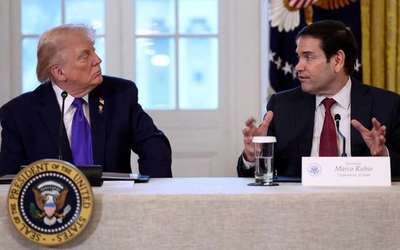
US President Donald Trump warned Iran's Supreme Leader Ali Khamenei in a letter in March that failure to reach a deal through talks would lead to war, an Iranian deputy foreign minister said on Monday.
Iran agreed to indirect negotiations, while Washington pushed for direct talks, Takht-Ravanchi said.
“The content of the letter and the attitude of US officials showed they believed with Trump’s return, the whole world needed him and he could dictate the terms,” he said, adding that Tehran decided to respond but only through indirect channels.
In June 2025, tensions between Israel and Iran erupted into open conflict when Israel launched coordinated airstrikes on Iran’s nuclear facilities, including Natanz and Isfahan, as well as several missile and command centers.
Several top Iranian military leaders, including IRGC commander-in-chief Hossein Salami and armed forces chief of staff Mohammad Bagheri, were killed in Israeli attacks
Citing an imminent threat from Tehran’s expanding nuclear program, Israel’s operation drew swift retaliation from Iran, which fired waves of missiles and drones at Israeli targets.
Within days, the United States joined the campaign, striking key Iranian nuclear and military sites in support of Israel. The fighting lasted nearly two weeks, leaving heavy damage.
Economic reform in the country is impossible without energy reform, Iran’s parliament speaker Mohammad Bagher Ghalibaf said on Monday, adding that his remarks should not be interpreted as an immediate plan to raise energy prices.
“Economic reforms and progress are meaningless without energy reform,” Ghalibaf said in a speech on Monday. “With the current energy situation, can we expect proper efficiency? Everything about it is completely wrong,” he said.
The government’s priority, he added, was not to raise prices but to restructure the energy sector. “This does not mean we want to increase energy prices – that has its own method. Raising prices is not the first step; there are several stages before that,” Ghalibaf said.
The comments come amid growing conjecture in Iranian media over a possible imminent increase in gasoline prices. Last week, President Masoud Pezeshkian said there was no doubt that fuel prices would eventually need to rise, though he acknowledged that such a move could worsen economic hardship for ordinary Iranians.
Iran's Parliament Speaker Mohammad Bagher Ghalibaf
“It’s not that simple,” Pezeshkian said. “Of course it must be done, that’s obvious, but it can’t be done overnight,” he added.
Call for fair energy use
Ghalibaf described the first step in energy reform as what he called popularization, suggesting that the country’s vast energy resources must benefit all citizens equally. “This is public wealth and must reach the people fairly. It’s not acceptable that 46 percent of the population fully benefits from part of this energy while 52 percent get nothing,” he said.
Changing consumption habits, he added, is essential to avoid waste. “If culture improves, energy consumption will improve. We cannot have the heater on while people sit at home in undershirts,” he said.
The parliament speaker did not elaborate on the mechanism of the proposed popularization plan. His remarks come as Iran, despite possessing the world’s second-largest natural gas reserves, faces chronic energy shortages that disrupt industries and daily life.
In recent months, widespread blackouts and gas shortages have forced temporary shutdowns across several provinces, exposing what officials themselves have described as deep structural and managerial failures in the energy sector.