Former president Hassan Rouhani (left) and seating parliament speaker Mohammad Bagher Ghalibaf
The clash over Russia’s role in Iran has reached unprecedented levels, with the parliament speaker publicly attacking a former president and his foreign minister for speaking out against Moscow.
Parliament turned into a battlefield on Sunday as Speaker Mohammad-Bagher Ghalibaf and hardline lawmakers accused Hassan Rouhani and Mohammad Javad Zarif of “undermining national interests” with their recent remarks.
“I find it necessary to express my explicit criticism of the former president and foreign minister who, precisely as our strategic partnership with Russia is progressing, have damaged this path through their statements,” Ghalibaf declared.
His comments were followed by hardline MPs chanting “Death to Fereydoun” — Rouhani’s family name. Moderates rushed to defend the duo, calling the events in parliament an orchestrated show of loyalty to Moscow.
“Have the Russians made Iranian citizens’ silence toward Kremlin policies a precondition for cooperation?” renowned commentator Ahmad Zeidabadi wrote on social media. “If so, that’s a shameful arrangement.”
‘Edited out of context’
The uproar followed circulation of a short video in which Rouhani criticized UN sanctions from 2010 onward, noting that even Russia and China had supported them.
Moderate outlets accused Rouhani’s critics of selectively editing the former president’s remarks, publishing what they said was the full version.
“He not only did not make insinuations against Russia … but also supported strengthening relations with Moscow and Beijing during his own terms,” Khabar Online wrote in a Monday editorial.
Rouhani was criticizing former president Mahmoud Ahmadinejad, the editorial asserted, and Ghalibaf would have known this if he had not relied on “bulletins handed to him.”
Lavrov had branded the so-called snapback clause of the 2015 nuclear deal a “legal trap,” saying it was secretly arranged between Zarif and then–US Secretary of State John Kerry. Zarif later rejected that claim and accused Moscow of blocking Iran’s ties with the West.
‘Most-despised figure’
The confrontation quickly spilled onto social media.
Hesamoddin Ashna, a security adviser close to Rouhani, wrote on X: “It’s not wise to read aloud every paper that’s handed to you. As far as we know, Mr. Rouhani has made no recent statement about Russia.”
Foreign-policy journalist Hadi Mohammadi argued that Ghalibaf was misdirecting his anger: “Mr. Ghalibaf seems to have forgotten that it was the Russian foreign minister who began this … But attacking Rouhani is always less costly.”
Hardline lawmaker Amirhossein Sabeti hit back with harsh personal jibes at Rouhani.
The former president, Sabeti wrote on X, is “the most despised politician in Iran” for the bloody suppression of the 2019 fuel protests and carries a “delusion of higher office” — a reference to speculation that Rouhani hopes to succeed Supreme Leader Ali Khamenei.
‘Power struggle’
Rouhani has shown markedly increased public activity after years of silence, especially in the months since the June war with Israel. He recently criticized low voter turnout in the 2020 parliamentary election, where Ghalibaf secured only 4.4 percent of Tehran’s vote.
“How can such a parliament claim to speak for 80 percent of the people?” Rouhani asked in a public statement this month.
Observers see the attacks as part of a broader power struggle.
“It’s a fight for a bigger share of the emptied pockets of Iranians and the country’s wealth,” journalist Jamshid Barzegar told Iran International.
The episode underscored how Moscow’s influence has become both a symbol and a fault line in Iran’s power struggle.
A woman feeds her chickens in a rural duelling northeast of capital Tehran, Iran, October 2025
Prominent centrist figures in Tehran are calling for pragmatic measures including a rethink of relations with Washington to address Iran’s deepening economic problems and foreign policy challenges.
The ideas floated include a Hamas-inspired peace initiative to defuse external threats, and a sweeping cabinet reshuffle to inject “agility” into an administration facing a multitude of crises.
“There is a third option between surrender and refusal to negotiate,” renowned journalist Mohammad Ghoochani wrote in the moderate daily Sazandegi (Construction).
“That third way is active resistance against Western neo-colonialism. We should surprise the world by ending our passive diplomacy, just as Hamas did.”
Ghoochani now serves as the political chief of the centrist Executives of Construction Party, founded by allies of the late Akbar Hashemi Rafsanjani—widely regarded as the Islamic Republic’s most pragmatic leader.
“The current situation is a continuation of the old ‘neither war nor negotiation’ strategy. But the war has already happened. We cannot continue living in suspension,” Ghoochani added.
He also criticized Foreign Minister Abbas Araghchi for refusing “to sit with countries that have attacked Iran,” arguing that Tehran’s absence from the Gaza peace summit in Egypt amounted to ceding regional leadership to Israel.
‘Strategic, not tactical’
Party Secretary General Hossein Marashi also weighed in on the prospect of rapprochement with Washington, while condemning what he described as U.S. attempts to influence Iran’s defense and security policies.
“If talks are to be constructive, both sides must focus on shared concerns, chiefly reducing regional tensions,” he said.
“Any dialogue between Iran and America must be strategic, not a tactical move, which seems to be Washington’s approach.”
He warned that continued Western pressure would only deepen Iran’s alignment with Moscow and Beijing, arguing that diplomacy should be guided by national interest rather than ideology.
Marashi’s comments on foreign policy dovetailed with his economic critique—delivered in the same week—underscoring the party’s call for a broader change of course.
‘A hungry nation can’t resist’
In an editorial published last week, Marashi issued a stark warning:
“A hungry nation entangled in economic hardship and unemployment cannot sustain resistance.”
He called for a major reshuffle of President Masoud Pezeshkian’s cabinet to address Iran’s economic malaise, which he linked primarily to sweeping international sanctions.
“For 20 years, our target was 8% annual economic growth. But we’ve averaged just 1%, meaning Iran has effectively regressed by 7% each year,” he wrote in a Sazandegi editorial.
He later blamed hardliners for the “costly maneuvers” that, in his view, led to the snapback mechanism being triggered by European powers and the reimposition of UN sanctions.
Still, he reserved his harshest criticism for those attacking Iran, while defending Tehran’s record in recent conflicts in an interview with the moderate outlet Didar News:
“Many Iranians criticize the Islamic Republic’s policies, but no decent Iranian would accept compromising the country’s security or its legitimate defense rights.”
Economic reform in the country is impossible without energy reform, Iran’s parliament speaker Mohammad Bagher Ghalibaf said on Monday, adding that his remarks should not be interpreted as an immediate plan to raise energy prices.
“Economic reforms and progress are meaningless without energy reform,” Ghalibaf said in a speech on Monday. “With the current energy situation, can we expect proper efficiency? Everything about it is completely wrong,” he said.
The government’s priority, he added, was not to raise prices but to restructure the energy sector. “This does not mean we want to increase energy prices – that has its own method. Raising prices is not the first step; there are several stages before that,” Ghalibaf said.
The comments come amid growing conjecture in Iranian media over a possible imminent increase in gasoline prices. Last week, President Masoud Pezeshkian said there was no doubt that fuel prices would eventually need to rise, though he acknowledged that such a move could worsen economic hardship for ordinary Iranians.
Iran's Parliament Speaker Mohammad Bagher Ghalibaf
“It’s not that simple,” Pezeshkian said. “Of course it must be done, that’s obvious, but it can’t be done overnight,” he added.
Call for fair energy use
Ghalibaf described the first step in energy reform as what he called popularization, suggesting that the country’s vast energy resources must benefit all citizens equally. “This is public wealth and must reach the people fairly. It’s not acceptable that 46 percent of the population fully benefits from part of this energy while 52 percent get nothing,” he said.
Changing consumption habits, he added, is essential to avoid waste. “If culture improves, energy consumption will improve. We cannot have the heater on while people sit at home in undershirts,” he said.
The parliament speaker did not elaborate on the mechanism of the proposed popularization plan. His remarks come as Iran, despite possessing the world’s second-largest natural gas reserves, faces chronic energy shortages that disrupt industries and daily life.
In recent months, widespread blackouts and gas shortages have forced temporary shutdowns across several provinces, exposing what officials themselves have described as deep structural and managerial failures in the energy sector.
Two senior members of President Masoud Pezeshkian’s administration urged officials and citizens to refrain from public criticism of the government, describing Iran’s current economic and political situation as “wartime conditions.”
First Vice President Mohammad Reza Aref said on Sunday that criticism of the government’s performance was serving the enemy. Speaking at a meeting of the Market Regulation Headquarters, Aref accused outside actors of spreading “malicious and misleading analyses” following the recent 12-day conflict, which he said were being echoed domestically.
Iran’s Chamber of Commerce in September projected a worst-case scenario of a 60% currency plunge, inflation at 75%, and unemployment at 14% in the coming months.
Responding to growing discontent over the government’s handling of poverty and rising living costs, Aref said supervisory and economic institutions must “avoid giving excuses to the enemy” and “not dishearten the public.” He warned officials against airing internal disagreements in public, adding that “there is no need for officials to discuss disputes at podiums; such issues should be resolved in meetings.”
Officials defend government amid rising hardship
President Pezeshkian last week acknowledged that his administration’s economic policies were contributing to inflation, saying, “We are creating inflation. We are sleeping on gold, yet the people are hungry.” His remarks drew criticism from Javan, a newspaper affiliated with the Islamic Revolutionary Guards Corps, which urged the president to address inequality instead of “repeating the word hunger.”
Mounting inflation, shrinking household purchasing power, and soaring living costs have deepened public frustration, exacerbated by the reactivation of the UN’s snapback sanctions mechanism against Iran.
Mohammad Jafar Ghaempanah, Pezeshkian’s executive deputy, also described the current situation as wartime on Sunday. Rising sanctions, he said, meant “the country must be evaluated in exceptional, not normal, circumstances.”
“Parliament members have the right to criticize the government,” Ghaempanah said. “But this is not the time to question how the country is being managed.”
Their remarks came amid intensifying domestic criticism over economic hardship, while Iranian officials continue to stress the need for “internal cohesion” against what they call a “hybrid war.”
Actress Fariba Naderi (left) and her friend and colleague Narges Mohammadi
A viral celebrity interview has reignited debate in Iran over class privilege and widening social divides, exposing deep resentment toward wealth and the growing gulf between everyday struggle and elite detachment.
The interview clip featuring actress Fariba Naderi on the weekly YouTube show Pump went viral in Iran within hours of streaming, sparking backlash over her comments on class divides and privilege in Tehran’s affluent northern neighborhoods.
The entertainment program, streamed on YouTube and several domestic platforms, quickly drew 900,000 views on YouTube alone—despite the site being officially blocked in Iran.
Naderi, who won the Crystal Simorgh for Best Actress at last year’s Fajr Film Festival, made lighthearted remarks about the class and lifestyle of another actress and close friend, Narges Mohammadi. What she intended as humor was widely perceived as tone-deaf amid worsening economic hardship.
Fariba Naderi (right) and her friend and colleague Narges Mohammadi
“There's a big class difference (between Narges and I),” she said with a grin. “But class differences don’t matter to me... We live in Shahid Fallahi (the upscale neighborhood of Zafaraniyeh), and they live below Vanak Square (in northern Tehran).”
She added that for people like her, “below Vanak” meant paeen-shahr — a phrase used for lower-class districts of Tehran, though Vanak Square itself is considered upscale.
Host Amir-Hossein Qiyasi encouraged the joking tone, but many viewers saw her remarks as glorifying privilege and reinforcing the city’s “uptown versus downtown” divide.
The outrage beyond the joke
The clip quickly became a symbol of elitism and cultural detachment among Iran’s celebrities. Politicians, journalists, and critics from across the spectrum joined the debate.
The state-run ISNA news agency noted that even humor about class now provokes collective anger in a society where inequality is deeply felt. “Tangible economic hardship and the lived experience of inequality have made even jokes about wealth sound like arrogance.”
Fariba Naderi on Pump YouTube show
Conservative commentator Farhad Rezazadeh wrote: “Class difference is not just an economic reality but the moral decline of a nation. Whoever glorifies it shares in its corruption.”
“Thank Fariba Naderi—no one could have so simply shown how deep Iran’s class divide has become… There’s a gulf between privilege and survival,” reformist journalist Davoud Heshmati remarked on X.
A deeper anxiety over inequality
Naderi’s supporters say she was merely joking and that decades of economic disparity cannot be blamed on an actress. They argue the backlash shows a tendency to scapegoat celebrities rather than confront systemic inequality.
Others, however, saw her comments as trivializing hardship and exposing simmering resentment beneath Iran’s economic stagnation.
Journalist Rasoul Asadzadeh wrote that the controversy evokes memories of corruption and humiliation in daily life: “It’s a reminder of the humiliation of begging for school tuition, taking a second job to pay rent, working extra hours for dental costs, and the crushing load we Iranians—men and women alike—carry just to live with dignity.”
Critics also tied the outrage to Iran’s broader economic trajectory. Some users cited Ayatollah Khomeini’s 1979 promise that his revolution would “turn the slum dwellers into palace dwellers.”
Despite Iran’s per-capita GDP roughly doubling since then, chronic inflation and soaring living costs have made ordinary Iranians poorer and eroded the middle class.
“In a country where inflation has hit unprecedented levels and the middle class—the stabilizing pillar of any society—has practically vanished, jokes about class difference are not funny. They are disrespectful to people’s pain,” journalist Azadeh Mokhtari posted on X.
She added: “A society where living costs crush citizens doesn’t need laughter at its own suffering—it needs empathy and a reflection of reality. Turning inequality into comedy only normalizes injustice.”
Iran’s parliament speaker Mohammad Bagher Ghalibaf
Iran’s parliament speaker Mohammad Bagher Ghalibaf on Sunday sharply criticized former president Hassan Rouhani and ex-foreign minister Mohammad Javad Zarif, saying their recent remarks had undermined Tehran’s growing strategic cooperation with Russia.
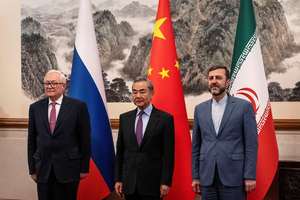
Ghalibaf said in a parliamentary address that the government’s coordinated diplomatic efforts with Moscow and Beijing, including a recent joint letter to the United Nations rejecting Western efforts to revive UN sanctions, marked a “legal and strategic victory” for Iran.
He accused Rouhani and Zarif of harming this progress “at a sensitive time” with their statements, without elaborating.
During Sunday’s open session, several lawmakers were also heard chanting “Death to Fereydoun” -- referring to Rouhani by his birth surname.
Amirhossein Sabeti, a lawmaker from Tehran, said Rouhani “belongs behind bars.”
Rouhani and Zarif recently criticized Russia’s role in the negotiations that led to the 2015 Joint Comprehensive Plan of Action (JCPOA), accusing Moscow of contributing to the creation of the snapback mechanism that paved the way for the reimposition of UN sanctions last month.
Iran says UN Resolution 2231, which endorsed the 2015 nuclear deal, has expired, ending all restrictions. Tehran has repeatedly said that its nuclear rights remain intact, accused the US and Europe of breaching the accord, and that Russia and China backed its position against Western efforts to reimpose UN sanctions.
“China and Russia, as two permanent members of the UN Security Council, have stood firmly alongside Iran, signaling that the era of US and Western unilateralism has come to an end.”
Ghalibaf said the structure of the international system now reflects the emergence of a new era in which China, Russia, Iran, and the 120 members of the Non-Aligned Movement have “legally ended the misuse of international institutions” and are resisting the unlawful dominance of the United States and its European allies -- a shift that, Ghalibaf added, will help weaken the impact of sanctions on Iran.