• العربية
  • فارسی
BrandBrand
  • Iran Insight
  • Politics
  • Economy
  • Analysis
  • Special Report
  • Opinion
  • Podcast
  • Live TV
  • Iran Insight
  • Politics
  • Economy
  • Analysis
  • Special Report
  • Opinion
  • Podcast
  • Live TV
  • Theme
  • Language
    • العربية
    • فارسی
  • Iran Insight
  • Politics
  • Economy
  • Analysis
  • Special Report
  • Opinion
  • Podcast
  • Live TV
All rights reserved for Volant Media UK Limited
volant media logo

Iran parliament speaker sends anti-terror finance law for implementation

Oct 18, 2025, 10:12 GMT+1Updated: 00:10 GMT+0
Iran parliament speaker Mohammad Bagher Ghalibaf

Iran parliament speaker Mohammad Bagher Ghalibaf has sent to President Masoud Pezeshkian the law approving the country’s accession to the UN anti-terror finance convention, with conditions that limit implementation to Iran’s constitution and domestic laws.

Ghalibaf issued the notification under Article 123 of the constitution, which requires the speaker to forward approved legislation to the president for enforcement.

The law is part of Iran’s effort to meet Financial Action Task Force (FATF) standards requiring countries to monitor and report financial transactions to curb money laundering and terror funding.

Mohsen Dehnavi, spokesman for the Expediency Council, said Iran’s accession was approved with two safeguards. Parliament attached a clause requiring the government to act within the framework of the constitution, and the council added that the Islamic Republic would implement the treaty only insofar as it aligns with domestic laws.

“If any part of the convention conflicts with Iran’s internal legislation, national laws will take precedence,” Dehnavi said. “The Expediency Council approved joining the convention based on these two conditions.”

The move came days after a bid to block the government from joining the United Nations convention against terror financing. Lawmakers rejected the motion with 150 votes in favor, 73 against and nine abstentions out of 238 members present. The proposal, introduced by conservative lawmakers, sought to halt Iran’s conditional approval to join the convention.

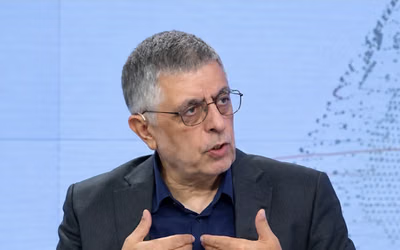
lawmakers voted down

Earlier this month, the Expediency Council, which resolves disputes between parliament and the Guardian Council under Supreme Leader Ali Khamenei, gave conditional approval for joining the treaty after years of delay, saying implementation would depend on guarantees that Iran’s economic and security interests are protected.

Backers see relief, opponents fear exposure of financial networks

Hardline lawmakers say joining the UN anti-terror finance convention could expose Iran’s financial networks used to bypass US sanctions and support regional allies. Supporters argue that compliance could reconnect the country’s banks to global systems and attract investment amid a deep economic crisis.

Mohammad-Mehdi Shahriari, a member of parliament’s national security committee, said on Saturday that reopening debate on the Countering Financing of Terrorism bill was illegal and would deepen Iran’s isolation, ILNA reported.

He said President Masoud Pezeshkian’s government had obtained the Supreme Leader’s consent to review the measure after expert study. “The CFT was approved with conditions and safeguards after a long process involving parliament, the Guardian Council, and the Expediency Council,” he said.

Shahriari criticized ultraconservative lawmakers for trying to block progress. “Our revolutionary brothers said it was not the right time to discuss this,” he said. “But with so many barriers in trade and banking, the Palermo and CFT bills can ease the burden created after years of sanctions.”

Revisiting the bill in parliament was illegal because the Supreme Leader had already authorized its review, he said.

Regional ties and economic impact

Failure to adopt global financial rules has worsened Iran’s economic problems and strained ties even with friendly states, Shahriari said. “Russia and China have both said that our refusal to join FATF conventions complicates trade with them,” he said. “When most countries have joined and only Iran and North Korea stand apart, what purpose does it serve except more isolation?”

The United States has for decades accused Tehran of using its regional allies to fund and organize attacks, labeling Iran the world’s leading state sponsor of terrorism for 39 consecutive years.

Most Viewed

‘We cannot bring America to its knees,’ former Tehran mayor says
1

‘We cannot bring America to its knees,’ former Tehran mayor says

2

Iran’s strikes on Persian Gulf water and power were deliberate - Reuters

3

Tehran hospital locks its main building and treats patients in the courtyard

4

Iran speaker says government overstepped on anti-terror finance rules

5

Iran shipped jet fuel to Myanmar despite US blockade - Reuters

Banner
Banner
Banner
Banner
Banner

Spotlight

  • Iran cultivated Houthis for years before opening new war front, Yemeni insider says
    PODCAST

    Iran cultivated Houthis for years before opening new war front, Yemeni insider says

  • After the killings, Iran turned on the families of the dead

    After the killings, Iran turned on the families of the dead

  • Iran’s rulers face a reckoning with their own people, former US envoy says
    ONE-ON-ONE

    Iran’s rulers face a reckoning with their own people, former US envoy says

  • Iran speaker says government overstepped on anti-terror finance rules

    Iran speaker says government overstepped on anti-terror finance rules

  • Ignore prices and economy is fine, Iran ex-minister says

    Ignore prices and economy is fine, Iran ex-minister says

  • Iran police killed brothers celebrating Khamenei’s death, source says

    Iran police killed brothers celebrating Khamenei’s death, source says

  • Nowhere else to go? The puzzle behind Iran’s stock rally
    INSIGHT

    Nowhere else to go? The puzzle behind Iran’s stock rally