Iran blasts US 'law-breaking' after Trump threat warning
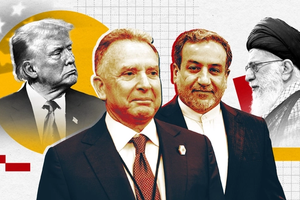
Iran's foreign ministry on Monday branded the United States a "law-breaking" country, rejecting any prospect of talks with Washington after US President Donald Trump warned he would again bomb Iran if it resumes nuclear activities.
Trump’s public remarks amounted to an admission of “a criminal and illegal act” that only reinforced America’s image as a violator of international law, Foreign Ministry Spokesman Esmail Baghaei said during his weekly briefing.
“It will be clear to the international community and to the Iranian nation that the United States is a law-breaking country,” Baghaei added. “We have no plan for negotiations.”
The spokesman was speaking a day after Trump told at a ceremony marking the 250th anniversary of the US Navy at Naval Station Norfolk in Virginia that he would not wait so long next time to strike Iranian nuclear facilities.
“We’ll have to take care of that too if they do,” Trump said, referring to Tehran’s potential resumption of nuclear activity. “You want to do that, it’s fine, but we’re going to take care of that and we’re not going to wait so long,” he told sailors gathered at the base.
Tehran faults IAEA report
A recent report by the International Atomic Energy Agency (IAEA) and its subsequent use by the United States and three European countries -- Britain, France, and Germany -- created a pretext for further attacks, Baghaei said.
The IAEA, according to the spokesman, should have condemned the US and Israeli strikes on nuclear sites. “The report enabled the US and the European trio to exploit the situation to their advantage.”
Tehran was now focused on assessing the consequences of Western actions and that no active inspections were taking place inside Iran, said the Iranian diplomat. “The Cairo arrangement is no longer functional or enforceable,” he added.
Iran lashes out at European governments
Baghaei accused the three European powers of acting irresponsibly and using the Joint Comprehensive Plan of Action’s (JCPOA) dispute mechanism to impose Washington’s demands.
“All three conditions set by the Europeans were unreasonable,” he said, adding that Iran nonetheless agreed to engage the IAEA “based on safeguard commitments.”
The understanding reached with the agency, as put by Baghaei, had initially been welcomed in Europe but was later rejected under US pressure. “The Europeans could not prove themselves as mature and independent negotiating parties.”
On Gaza, detainees, and diplomacy
Turning to regional issues, Baghaei said Iran welcomed “any initiative that can stop the genocide in Gaza and enable humanitarian assistance.”
He also confirmed ongoing diplomatic efforts for the release of Iranian national Mahdieh Esfandiari and two French citizens detained in Iran.
Baghaei concluded by saying Iran would never “plead for negotiations.” “Diplomacy is a two-way process… We will use it only when we determine it serves our national interests.”
A supply vessel approaches the Nasr production platform, located 32 kilometers southwest of Siri Island in the Persian Gulf, where crude from the Alvand field is mixed with oil from the Sivan, Dena, and Nosrat fields before being piped to Siri Island for processing and storage.
China is secretly funneling billions of dollars to Iran through a covert payment system that bypasses US sanctions by swapping oil for infrastructure projects, The Wall Street Journal reported, saying the hidden conduit enabled Tehran to receive up to $8.4 billion last year.
Citing Western officials, the report said the mechanism -- linking state-owned firms, a government insurer, and an unregistered financial intermediary -- has provided a critical lifeline to Iran’s sanctions-hit economy, with state insurer Sinosure and a little-known financial vehicle called “Chuxin” channeling the money to Chinese contractors working in Iran.
Under the system, an Iranian-linked seller books crude sales to a Chinese buyer tied to state trader Zhuhai Zhenrong; the buyer then deposits funds with Chuxin, which pays Chinese firms working on insured projects inside Iran, according to the report.
The crude typically reaches China via ship-to-ship transfers that obscure origin, the officials said.
Beijing’s Foreign Ministry told the WSJ it was “unaware of the arrangement” and “opposes illegal unilateral sanctions.”
Sinosure and Zhuhai Zhenrong did not comment, the paper said, adding neither Sinosure nor Chuxin is under US sanctions.
“Iranian entities rely on shadow banking networks to evade sanctions and move millions,” said John K. Hurley, the US Treasury undersecretary for terrorism and financial intelligence, in a separate statement last month.
Brad Parks of AidData said Sinosure-backed deals typically require that “every creditor and every construction contractor has to come under this umbrella,” likening the Iran setup to documented structures in Iraq.
The conduit has helped sustain Iran’s sanctions-hit economy with US officials estimatingroughly 90% of Iran’s oil exports go to China.
Washington has warned Beijing over such purchases and has tightened measures on the “shadow fleet” moving Iranian crude, the Journal reported.
US President Donald Trump visits Norfolk, Virginia, US October 5, 2025.
US President Donald Trump warned that Washington would bomb Iran again if it restarts its nuclear program, speaking on Sunday at a ceremony marking the 250th anniversary of the US Navy at Naval Station Norfolk in Virginia.
“We’ll have to take care of that too if they do,” Trump said, referring to Tehran’s potential resumption of nuclear activity. “You want to do that, it’s fine, but we’re going to take care of that and we’re not going to wait so long,” he told sailors gathered at the base.
Trump praised the June 22 US airstrikes on Iran’s nuclear facilities -- codenamed Operation Midnight Hammer -- as perfectly executed, saying American B-2 bombers and submarine-launched Tomahawk missiles hit every single target.
The operation targeted three key Iranian nuclear sites at Fordow, Natanz, and Isfahan, following an Israeli air campaign that began on June 13 against Iranian military and nuclear-related sites.
“The B2s, what they did. Those beautiful flying wings, what they did, they hit every single target. And just in case, we shot 30 Tomahawks out of a submarine,” Trump said at the event.
Iran had been within a month of developing a nuclear weapon before the strikes, Trump said, adding that US forces had prevented Tehran from crossing that threshold.
“They were going to have a nuclear weapon within a month,” Trump said. “And now they can start the operation all over again, but I hope they don’t because we’ll have to take care of that too if they do, I let them know that.”
Operation was decades in the making
Trump told the audience that B-2 pilots informed him the Pentagon had been planning such an operation for 22 years, saying no previous president had “the guts to do it.”
Trump’s comments come as his administration presses Iran to halt uranium enrichment and curb its ballistic missile program, demands Tehran has repeatedly rejected.
The president’s warning suggests Washington is prepared for further confrontation if Iran resumes nuclear activity, highlighting a renewed phase of military and diplomatic brinkmanship between the two countries.
International Atomic Energy Agency (IAEA) Director General Rafael Grossi
Military strikes on Iran’s nuclear sites would have only short-term effects and fail to destroy its capabilities, the UN atomic watchdog chief said, urging diplomacy as the sole path to a lasting solution to concerns over Tehran’s disputed nuclear program.
"One thing is clear to me, to Iran, and to those who attacked Iran: a lasting, permanent solution to this situation and to the doubts surrounding Iran’s nuclear program can only be diplomatic," Rafael Grossi said on a podcast hosted by Colombia’s Innovation for Development Foundation on Friday.
"Although attacks or military action may have short-term effects, the technical and technological capabilities exist — what was destroyed can be rebuilt," he added.
"I always remind all the parties involved that beyond missiles and bombs, the only lasting solution will have to be some form of new agreement to restore lost trust.”
Talks between Tehran and Western powers over the country's nuclear program remain stalled.
A sixth round of indirect US-Iran talks was suspended in June after Israel and the United States struck Iranian nuclear facilities, prompting waves of Iranian missile retaliation against Israel.
A preliminary US Defense Intelligence Agency assessment found the strikes may have delayed Iran’s nuclear program by only a few months, according to a report by Reuters.
However, US President Donald Trump has consistently said Iran’s nuclear facilities targeted in the attacks were “totally obliterated.”
In a confidential report leaked to reporters last month, the International Atomic Energy Agency (IAEA) said Iran's stock of near-weapons grade uranium had increased almost eight percent before Israel attacked its nuclear facilities on June 13.
The report shows Iran had 440.9 kilograms (972 pounds) of uranium enriched up to 60%, marking a 7.9% increase since the UN nuclear watchdog’s previous report in May.
Iran insists its nuclear program is for civilian use and denies pursuing the development or acquisition of nuclear weapons.
Germany's Foreign Minister Johann Wadephul on Friday said Berlin wants a negotiated solution to limit Iran’s nuclear program after the reimposition of United Nations sanctions.
The UN sanctions on Iran were reinstated on September 28 after the UK, France, and Germany (the E3) triggered the snapback mechanism under the 2015 nuclear deal known as the Joint Comprehensive Plan of Action (JCPoA).
The E3 said the decision followed “Iran rejecting two offers put on the table by the JCPoA coordinator in 2022 and further expanding its nuclear activities in clear breach of its JCPoA commitments.”
Former Iranian diplomat Hamid Baeidinejad said Iran’s nuclear issue will remain a defining challenge for decades, arguing that uranium enrichment is a permanent feature of the country’s national and diplomatic landscape.
Speaking at a conference on “Nuclear Law in Peace, War and Post-War,” Baeidinejad said Iran’s nuclear file “has been with us for fifty years and will stay with us for another fifty.”
He described enrichment as “a very important national achievement” that cannot be separated from Iran’s future international relations.
He said reaching any new agreement on the issue would require long and exhausting negotiations, adding that “there is no easy or quick solution to such a complex international matter.”
Baeidinejad also said five rounds of indirect talks between Tehran and Washington over the summer failed to yield progress and that mutual distrust deepened after an Israeli strike in June.
According to him, “Iran’s only path forward is continued diplomacy, even if the process is difficult and slow.”
He called for international consensus to ban attacks on nuclear facilities, saying, “No one in Iran doubts that attacking nuclear installations must be absolutely prohibited and punishable under international law,” but acknowledged that building such a norm would take “years of study, debate and persuasion.”
Baeidinejad added that the 2015 deal’s snapback mechanism had been designed after lengthy talks to balance Iran’s demand for lifting UN sanctions with the powers’ insistence on retaining a safeguard. “More than a thousand hours of negotiations were devoted to this single issue,” he said.
He urged Iranian academics and research institutions to engage more deeply in nuclear law and safeguards, arguing that “we must become an active player in shaping global norms, not just a subject of them.”
Iranian Foreign Minister Abbas Araghchi and Foreign Ministry spokesman Esmail Baghaei meet with foreign envoys in Tehran on October 5, 2025.
Western countries rejected renewed negotiations with Tehran because of what Iran’s Foreign Minister Abbas Araghchi described as excessive demands on Sunday.
The remarks came during a meeting with foreign ambassadors in Tehran, where he said the session was held to brief diplomats on developments in New York and the reactivation of UN sanctions.
“Iran had sought a fair and balanced solution, but Western states responded negatively out of greed,” Araghchi said.
Iranian Foreign Minister Abbas Araghchi during a meeting with foreign envoys in Tehran on October 5, 2025
“Years of pressure had proven that there is no solution to Iran’s nuclear issue other than diplomacy...The snapback of sanctions, like military attacks, cannot work.”
All UN sanctions suspended under the 2015 deal with Iran snapped back into force on September 27, one month after European powers triggered the snapback mechanism.
The three European countries had weakened their own diplomatic role by resorting to pressure, he said
The Cairo agreement with the IAEA was no longer viable after the snapback, and Iran would redefine its framework for engagement under new conditions, according to the Iranian foreign minister.
Iran had demonstrated goodwill in its dealings with both Western powers and the IAEA, Araghchi said, adding that Tehran had “taken every step it could to reach a negotiated solution.”
“We showed goodwill through our cooperation with the Agency and our fair proposals. The West has no excuse to say Iran avoided talks, nor any justification for triggering the snapback mechanism… Iran’s position is now fully vindicated.”
The United Nations sanctions include restrictions on Iran’s nuclear and military activities, asset freezes on designated entities, and a duty to “exercise vigilance” when doing business with Iran.
France, Germany and the United Kingdom said in a joint statement the reimposition of sanctions was unavoidable after Iran’s breaches of the 2015 nuclear deal, citing enriched uranium stockpiles 48 times above agreed limits.
However, the foreign minister said Iran had proved it seeks only to secure its legitimate rights while remaining open to any fair diplomatic path.
“The last time there was an attack, more than 120 countries condemned it because Iran acted wisely,” Araghchi said. “Once again, Iran has shown it is a smart player that will not surrender its rights.”