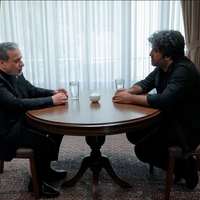
Iran's foreign minister Abbas Araghchi talks to lawmakers in parliament, Tehran, Iran
Iran’s foreign minister Abbas Araghchi could be on shaky ground, with reformists pressing for his replacement by former Foreign Minister Ali Akbar Salehi, according to a prominent conservative commentator in Tehran.
Nasser Imani, a longtime contributor to the Supreme Leader-funded Kayhan newspaper, also hinted that Araghchi’s recent overtures on negotiations with the United States have received tacit approval from supreme leader Ali Khamenei.
Tehran is in a tough spot, with the resumption of UN sanctions triggered by European powers weeks away barring an unlikely diplomatic breakthrough.
“Hardliners in Iran are constantly threatening to impeach Araghchi and put former President Hassan Rouhani on trial … while reformists are pressuring the government to replace Araghchi with Salehi,” moderate outlet Khabar Online quoted Imani as saying on September 16.
“When the Foreign Ministry is weakened, the shop window is broken,” he warned. “Everyone knows this—especially those gentlemen attacking Mr. Araghchi for wanting to negotiate with the Americans and the IAEA.
They know that the Foreign Ministry team and the government act in full coordination with the entirety of the governance.”
The phrase “entirety of the governance” is widely read as a euphemism for Khamenei himself—perhaps the first time a conservative insider has publicly suggested the Supreme Leader’s approval for talks with Washington.
Araghchi facing fire
Imani’s remarks appear designed to shield Iran’s top diplomat from hardliner attacks.
Araghchi, a graduate of Imam Sadeq University, has come under mounting pressure from hardliners, particularly in parliament, for his agreement with IAEA chief Rafael Grossi on nuclear cooperation.
The deal sparked fierce backlash, with some MPs accusing him of defying legislation mandating withdrawal from the Non-Proliferation Treaty. Ultraconservatives such as Hamid Rasai have even threatened to impeach him.
Araghchi, summoned to parliament, has tried to balance hardliner demands with what he frames as national interests, denying he had broken the law while still permitting IAEA access.
Salehi, by contrast, is a US-educated nuclear expert and MIT alumnus who remains a trusted Khamenei confidant despite his reformist leanings.
In the early 2010s, Khamenei tasked him with running a backchannel to Washington, separate from Mahmoud Ahmadinejad’s Foreign Ministry, a track that ultimately paved the way for the 2015 nuclear deal.
Calls for talks with US
But Iran’s leadership may face even greater trouble abroad if it fails to strike a quick understanding.
Pressure is now mounting from Europe, where foreign ministers have tied continued sanctions relief to concrete steps on the nuclear file, warning that sanctions would be reimposed if Tehran fails to act in the coming days.
At home, moderates weary of the impasse are voicing impatience with the endless brinkmanship.
Former diplomat Javid Ghorbanoghlou urged readiness for “comprehensive negotiations with America,” while analyst Morteza Makki wrote in reformist daily Etemad that Tehran has decided to cooperate with the UN nuclear watchdog and that opposition from radicals had little bearing on key decisions.
He pointed out that both Araghchi’s meeting with parliament’s National Security Committee and a statement by the Supreme National Security Council confirmed the IAEA deal fell within the SNSC’s nuclear committee framework.
A woman with her hand-painted with the word "Freedom" takes part in a protest following the death of Mahsa Amini, in Athens, Greece, October 1, 2022
Three years after the death of Mahsa Amini in morality police custody and subsequent protests which were quashed with deadly force, the mood among Iranians has only darkened, with many pointing to hardships that increasingly shape daily life.
In response to Iran International query asking viewers what had changed since her death and the igniting of the Woman, Life, Freedom protest movement, most said life had become ever harder.
“Every day people fall deeper into ruin: more penniless, more unemployed, more hungry. There’s no water, power, or gas in places. Killings and violence have increased,” another message said.
Many Iranians are grappling with shortages of water and electricity and cited the mounting toll of high inflation and broader economic strain.
Sanctions, corruption and mismanagement have plagued Iran's economy for decades.
The wave of civil disobedience especially among women and girls continues subtly across Iran and has even spread to many traditionally religious cities.
“We’re in Mashhad. Even though it’s a religious city, many women come out with freer dress. I used to wear the chador, but since Mahsa I no longer wear hijab. Men have also changed. They’re united with the women,” one respondent said.
Other messages confirm that civil disobedience over dress codes and open defiance of Islamic regulations is widespread across the country.
“Women this year gained a little more freedom in dress. Men wear shorts and tank tops in public now. The government is failing on the hijab issue, but a woman still cannot claim her rights even in a court. Child laborers and people sleeping in cardboard boxes remain — poverty is rampant,” a caller said.
Patchy enforcement
A harsh new sanctions and chastity bill passed by the hardliner-dominated parliament was frozen by Iran's top security body this year in an apparent bid by the theocracy to forestall further unrest.
Some messages suggested that in affluent areas, obedience to the Islamic dress code has collapsed almost entirely, but that the trend was far from universal.
“The Mahsa movement caused the costly system of forced hijab to crumble. But in practice nothing changed, it got worse," in person said.
"A few women walking unveiled in the streets only benefits the wealthy; it does nothing for the millions who are starving. In fact, those who were killed and injured suffered the most. There’s no benefit for the poor.”
Beyond shortages of water and electricity, callers pointed to critical deficits in health and food supplies.
There are reports of shortages of essential medicines including treatments for rare diseases, cancer and chronic illnesses, as well as a scarcity of powdered milk and infant formula.
Rising food inflation has placed basic staples out of reach for many families. Still, messages of hope and a desire for change are widespread.
“Life has become much harder financially, socially and psychologically," one respondent said, "but we feel that a small spark, one small spark could become the final ax to tear down this tree of oppression."
Abolfazl Adinehzadeh's sister commemorating him at his graveside
Iranian authorities have led a systematic campaign to silence the families of those killed and executed amid the Woman, Life, Freedom protest movement—denying public mourning, arresting relatives and subjecting mourners to threats and intimidation.
From the earliest days after the death of Mahsa Amini in morality police custody three years ago, family memorials and funerals became focal points for renewed protest.
Victims' kin insist that remembrance itself is a form of resistance, and safeguarding the right to mourn is central to winning truth and justice.
In Iran, funerals and anniversaries have long been potent political tools. They gather people across social and geographic divides, create moments of public memory and sustain narratives of grievance and solidarity.
The 2022–23 protests frequently reignited during burials and 40-day mourning periods. Since then, authorities have continued to dismantle these anniversary rituals through arrests, intimidation, legal harassment and tight security controls at cemeteries where the victims are buried.
Families who refuse to forget
Despite these pressures, families persist. They gather at cemeteries, share photos and videos on social media, and hold private ceremonies to honor their loved ones. Many celebrate birthdays and New Year holidays at graves, bringing cakes, flowers, and posting images online as quiet acts of resistance.
Like previous years, Mahsa Amini’s father, Amjad Amini, published a defiant message on September 14 in remembrance of his daughter on Instagram.
“The memory and demand for justice for Mahsa and the other slain protesters will never be forgotten,” he wrote.
Menaced for mourning
The case of Mashallah Karami demonstrates the lengths to which the state will go to scotch remembrances. His son, Mohammad-Mehdi Karami, along with co-defendant Mohammad Hosseini, was executed in January 2023 for alleged involvement in the death of a Basij militia member in Karaj in central Iran. They denied the charges.
Karami’s father, a street vendor who campaigned relentlessly for his son and Hosseini, was arrested in August 2023 during a security raid. Authorities froze the family’s bank accounts and repeatedly destroyed plaques commemorating the men.
He now serves an eight-year and ten months sentence in prison on fabricated charges of money laundering and obtaining property through illegitimate means, on top of fines and asset confiscations. His appeals for a retrial were rejected by the Supreme Court this month.
Similarly, Mohammad Javad Zahedi, 20, from Sari in northern Iran, was shot dead in September 2022 while on his way to a pharmacy, his body showing close to a hundred pellet wounds.
His mother, Mahsa Yazdani, launched a social media campaign demanding justice but was arrested ahead of the first anniversary of his death.
She was sentenced to 13 years in prison, including a mandatory five-year term, on charges of insulting sacred values and inciting people to disrupt national security, insulting the Supreme Leader and propaganda against the system.
Her sentence was later commuted to home detention with an electronic ankle bracelet, and she was finally released in March after serving two years.
Lawyers in the dock
Legal defenders of these families have also faced persecution.
Saleh Nikbakht, winner of the European Parliament’s Sakharov Prize in 2023, who represented Mahsa Amini’s family, was sentenced to one year in prison for interviews with Persian-language media outside Iran and cooperation with hostile states.
Another lawyer, Khosrow Alikordi, was likewise sentenced to one year in prison for propaganda in favor of opposition groups. He represented the prosecuted members of Abolfazl Adinehzadeh’s family.
Adinehzadeh, a seventeen-year-old student, was shot with over 70 pellets in Mashhad during the protests.
Several of his family members, including his father and sister were charged with propaganda against the system. They had been detained at his gravesite on the first anniversary of his death.
Over 500, most of them young people, were killed by security forces during Iran's 2022-2023 Woman, Life, Freedom protests
Countless young Iranians whose lives were snuffed out in the Woman, Life, Freedom protests became enduring symbols of defiance — human faces for a movement that challenged the very foundations of the Islamic Republic.
Beyond Mahsa Amini — the most internationally recognized martyr for the cause — the names of Nika Shakarami, Hadis Najafi, Sarina Esmailzadeh, Mohsen Shekari, Mohammad Hosseini and others have been engraved in the collective memory of Iranians who remember them affectionately by their first names.
Each represented a different facet of society: women demanding autonomy, teenagers daring to risk their futures, children like 10-year-old Kian Pirfalak killed by a stray bullet and young men executed for their solidarity with women's plight.
The spark: Mahsa "Jina" Amini
The protests began with the death of Mahsa "Jina" Amini, a 22-year-old Kurdish woman who was arrested by Iran’s morality police on September 13, 2022, over the state’s mandatory hijab law.
She was critically injured in custody and died days later in the hospital.
Her name became a rallying cry, her image circulated widely on social media and protest banners across Iran and beyond. Amini's innocence and tragic death resonated deeply with ordinary Iranians, making her the most enduring icon of a movement that sought not just reform but a different future.
Nika Shakarami: the young rebel
Sixteen-year-old Nika Shakarami vanished after joining a Tehran protest in the early days of the uprising. A video captured her shortly before her disappearance, standing on a trash bin, burning her headscarf and chanting “Down with the dictator" with other protesters.
Ten days later, her body was returned to her family under suspicious circumstances. Authorities claimed she fell from a building. Her relatives disputed this, saying her nose was broken and she was beaten. A BBC World report in May 2024 alleged she was sexually assaulted and murdered.
Nika was known for her creativity and love of the arts — poetry, drawing, and music. She dreamed of becoming a professional singer. Outspoken and spirited, her short life of artistic aspiration and teenage defiance became a symbol of how ordinary young Iranians risked everything for freedom.
Hadis Najafi
Hadis Najafi: 22-year-old TikToker
Hadis Najafi, 22, was shot multiple times in the face, neck, chest, abdomen and hand during a protest rally in Karaj in central Iran. Her family was pressured to announce she had died of natural causes.
Najafi frequently posted on TikTok and Instagram, sharing glimpses of her daily life. In a video recorded before she was killed, she said: “I like to think that when I look back on this a few years later, I’ll be pleased I joined the protest.”
Her mother told Iran International that Hadis joined the protests both to mourn Mahsa Amini and to oppose the theocracy's mandatory Islamic dress code for women. Before leaving home, Hadis said she hoped that years later when change comes to Iran she could look back and be glad she had taken part.
Sarina Esmailzadeh: freedom-loving teenager
Sarina Esmailzadeh and her brother in one of her cooking posts
Sixteen-year-old Sarina Esmailzadeh from Karaj was a bright, curious teenager with broad interests. She loved cooking, K-pop music and making playful videos for her YouTube and TikTok channels.
She spoke candidly about justice and freedom. In one post she asked: “What can people expect from their own country? Welfare, welfare, welfare. Nothing else. Why am I not like that teenager in New York who doesn’t have to worry about the compulsory hijab or economic hardship?”
Her online presence, blending humor, music and political awareness, made her a powerful symbol of the courage and aspirations of Iran’s Gen Z.
Mehrshad Shahidi: a voice silenced too soon
Young chef Mehrshad Shahidi at work
Security forces beat 19-year-old chef Mehrshad Shahidi to death with batons at a Revolutionary Guards detention center in Arak, a day before his twentieth birthday in October 2022. Authorities pressured his family to say he died of a heart attack.
Thousands attended his funeral, chanting anti-government slogans. Mehrshad was already head chef at a local restaurant, studying hospitality at university, and a decorated athlete in gymnastics, volleyball, and swimming.
Authorities never tried those accused of his killing, instead threatening his family with destroying his grave — a site still visited by mourners — if they held public commemorations.
Shekari and Hosseini: death sentences for defiance
Mohammd-Mehdi Karami's father holding photos of his son (left) and Mohammad Hosseini (right)
Mohsen Shekari, 23, and Mohammad Hosseini, 39, were among the first protesters executed after closed-door trials in late 2022 and early 2023. Their deaths, intended as deterrence, became instead rallying cries.
Shekari, a café worker and self-taught guitarist, was arrested during a Tehran protest. Hosseini, a martial arts champion working on a chicken farm, was arrested after attending the memorial for Hadis Najafi in Karaj, where security forces shot dead three protesters.
Shekari was arrested at a protest rally in the west of the capital. Hosseini was arrested a day after the crackdown on a remembrance ceremony for Hadis Najafi in Karaj during which three protesters were shot dead by security forces.
Both were accused of injuring Basij militia members. They denied the charges, and rights groups reported their televised confessions were extracted under torture.
Their executions underscored the movement’s human cost — ordinary men defying extraordinary repression and paying with their lives.
The Islamic Republic survived the Woman, Life, Freedom protests three years ago, but Iranian women’s defiance keeps reshaping society and their lives in irreversible ways.
After the crackdown, hardliners introduced new “hijab enforcement” bills and deployed surveillance cameras to identify unveiled women.
The laws remain on the books, but the persistent defiance of women—and men supporting them—has rendered them largely unenforceable.
“Looking back to three years ago, when the government seemed in total control, I wonder at the courage of those who left home to protest knowing they could be shot, arrested, blinded, or confined to a wheelchair for life,” said Shina, a 34-year-old artist in Tehran.
The Islamic Republic survived the Woman, Life, Freedom protests three years ago, but Iranian women’s defiance keeps reshaping society and their lives in irreversible ways.
After the crackdown, hardliners introduced new “hijab enforcement” bills and deployed surveillance cameras to identify unveiled women.
The laws remain on the books, but the persistent defiance of women—and men supporting them—has rendered them largely unenforceable.
“Looking back to three years ago, when the government seemed in total control, I wonder at the courage of those who left home to protest knowing they could be shot, arrested, blinded, or confined to a wheelchair for life,” said Shina, a 34-year-old artist in Tehran.
Recalling the 2022–2023 protests and the extraordinary violence against demonstrators, she described the cost as heavy.
“People eventually returned to their homes, but no one doubts that the change that followed was worth it. Those who protested will protest again, and many who stayed home will go out if women's achievements are in danger,” she said.
Walking through even conservative cities such as Qom and Mashhad, as witness accounts and an abundance of videos on social media attest, the rules for women's appearance have shifted drastically since Mahsa Amini died in morality police custody in 2022.
The nationwide protests which followed were scotched with deadly force.
Her supposed offense was strands of hair showing beneath her headscarf, though she wore a modest black coat and trousers.
At the time, morality police patrols were a daily fixture, stationed at squares, metro stops and shopping malls, stopping and arresting thousands of women or impounding their cars.
Today, unveiled women are a pervasive sight in shops, banks, restaurants and metro cars.
'No going back'
On top of the gains, new boundaries are being tested daily by women.
“There is no going back for women. The genie is out of the bottle and can’t be pushed back into it,” said Taha, a 55-year-old from Tehran, and pointed to shifts far beyond clothing.
“For decades, riding motorbikes was taboo. Just look at how many women now ride in defiance of authorities who refuse them licenses because of gender. Like those who defied the hijab, they are multiplying by the day and will eventually force the government to give in,” he said.
Public singing and dancing—once unimaginable—are now similarly more visible, especially among young people. Women post videos of their performances on social media. Each act chips away at decades of enforced control, much like posting unveiled photos once did.
Women are not alone
Many Iranian men openly support women’s demand for control over their appearance and lives.
“My daughter dreams of becoming a gymnast or ballerina, performing for the public and taking part in international competitions. Other young girls have similar aspirations," said Alireza, father of a teenage boy and girl.
"The women of my generation were forced into submission and their dreams were lost, but the young people of today will not give in; they know that they still have a long way to go and need our support."
Taha said male solidarity with women was essential for progress.
“Seeing women breaking out of boundaries is extraordinary and inspiring. We must support them in whatever way we can so our daughters, wives, and friends can't be forced back into defined roles,” he added.
"What Iranian women have achieved, through years of perseverance and sacrifice, has been a lesson to all.”