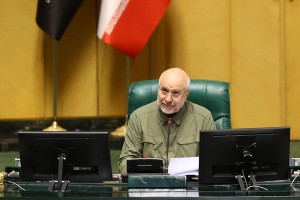
Exit from NPT would not trigger war, Iranian MP says

Exit from the Nuclear Non-Proliferation Treaty would not determine whether Iran faces war, an Iranian parliament member said on Thursday.
Exit from the Nuclear Non-Proliferation Treaty would not determine whether Iran faces war, an Iranian parliament member said on Thursday.
“Leaving or staying in the Nuclear Non-Proliferation Treaty (NPT) would not be decisive in whether others choose war against Iran because they have attacked us before despite the law,” Hossein Ali Haji Deligani said.
“If we have unity and cohesion inside the country, there will be no war. The possibility of war exists only when there is no cohesion,” Haji Deligani added.
Last week, Iran’s parliament held a closed-door session to discuss how to respond to European powers’ move to trigger the snapback mechanism, including leaving the NPT, with lawmakers insisting the measure would have little real economic impact.
Lawmakers are considering a bill that would require Tehran to leave the treaty if UN sanctions are restored under the snapback mechanism.
Iran’s parliament -- not the government -- holds constitutional authority over membership in the Nuclear Non-Proliferation Treaty.
Demands at the table
Iran’s conservative daily Farhikhtegan wrote on Thursday that the United States treats negotiations not as genuine diplomacy but as a tool to extract further concessions.
“Raising preconditions such as limiting the range of Iran’s missiles to 500 kilometers, cutting ties with the Axis of Resistance, and ending support for Hezbollah in Lebanon and the Popular Mobilization Forces in Iraq are naturally demands that Iran will not accept,” the paper said.
‘Axis of Resistance’ is a term the Islamic Republic uses to refer to its proxy forces in the region, including Palestinian militant groups, the former Syrian regime, the Lebanese militant group Hezbollah, and other factions.
“It is clear that Iran will not yield to accepting this threat,” Farhikhtegan added.
Iran supports Hezbollah and Iraq’s Popular Mobilization Forces (PMF) through logistical and financial means to expand its regional influence. Along with groups such as Yemen’s Houthis, these allies form part of Tehran’s wider proxy network in the Middle East.
Ali Larijani, Secretary of the Supreme National Security Council, echoed the view on Tuesday, writing on X that Americans repeatedly use issues such as missile restrictions to press for gains.
“The path for negotiations with the US is not closed; yet these are the Americans who only pay lip service to talks and do not come to the table — and they wrongfully blame Iran for it,” Larijani said. “By raising unrealizable issues such as missile restrictions, they set a path which negates any talks.”
Europe’s snapback threat
Britain, France, and Germany — the three European signatories to the 2015 nuclear deal — notified the United Nations in late August that they would pursue the reimposition of sanctions unless Iran returned to nuclear talks, granted inspectors wider access, and provided details on its uranium stockpile. European governments have stressed there is still time for diplomacy before sanctions formally return.
Iran has rejected the move, arguing that the Europeans themselves failed to uphold their commitments under the 2015 agreement after the US withdrawal in 2018.
European governments said they may extend the one-month deadline if Iran resumes direct talks with Washington, allows inspectors access, and clarifies its stockpiles.