Rights group reports secret prison run by Iran's Guards in Isfahan
An undated handout image shows the interior of Rajai Shahr Prison, west of Tehran
A warehouse disguised as an industrial facility in Shahin Shahr, Isfahan, is being used as a secret prison where hundreds of Iranian inmates are held in inhuman conditions under the management of a Revolutionary Guards cooperative, the Iran Human Rights Society said on Tuesday.
“In recent weeks, multiple reports have surfaced about a facility in Shahin Shahr officially designated as a ‘prison employment site,’ which in practice has become a warehouse for holding hundreds of inmates in harsh, inhuman conditions,” the group said.
The facility is described as a large warehouse with a small yard fenced off with barbed wire, lacking the basic standards of an official prison. Photographs published by the group show the area but do not provide verifiable coordinates due to concealment and security measures.
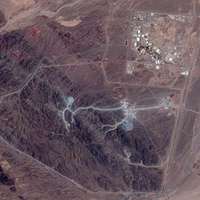
A handout image released by the Iran Human Rights Society shows a map of a secret prison site in Shahin Shahr, Isfahan province, August 2025.
“Despite its name, no job training or rehabilitation takes place there. Instead, around 100 prisoners are bussed out daily from 5 a.m. and put to work in conditions resembling forced labor.”
Iran International can not independently verify the report.
Harsh conditions and deprivation
Prisoners endure overcrowding without cooling or ventilation systems, the rights group added. Water and electricity are cut for three days each week, and detainees are given only minimal food.
“Food and bread are provided in very small and poor-quality amounts… daily rations are just two loaves of bread and low-quality food.”
No medical services are available, and the only drugs regularly distributed are sedatives and methadone, pushing many inmates to forced consumption, wrote the Iran Human Rights Society.
“Reports from Shahin Shahr prison paint a disturbing picture of a hidden and illegal detention site… a place for added deprivation, forced labor, and psychological and physical pressure,” the report said, urging international bodies to press Iran to meet its human rights obligations.
An Iranian Tondar missile is launched during a test at an unknown location in central Iran, September 2009
Iran’s state-affiliated Farhikhtegan newspaper warned on Wednesday that Tehran should prepare for “potential threats from its northern borders” following the US-brokered Armenia-Azerbaijan deal to develop the Zangezur corridor.
The daily compared the situation to Iran’s missile strike on a US base in Qatar during the June conflict, saying Tehran must make clear that “if threats arise from the soil of neighboring states, security considerations will prevail over diplomacy.”
The article comes after a US-brokered peace deal between Armenia and Azerbaijan earlier in August granted Washington leasing rights to develop the Zangezur transit corridor, now renamed the Trump Route for International Peace and Prosperity (TRIPP).
The deal allows a US company to build and manage the route connecting Azerbaijan with its exclave Nakhchivan, a project Tehran has repeatedly described as a geopolitical risk.
A building stands damaged in the aftermath of Israeli strikes, in Tehran, Iran, June 13, 2025.
US President Donald Trump said on Tuesday that both he and Israeli Prime Minister Benjamin Netanyahu should be considered “war heroes” for their roles in the attacks on Iran that he said destroyed its nuclear program.
“Nobody cares, but I am too. I sent those planes,” Trump told radio host Mark Levin.
Talks with Tehran under the Trump administration began with a 60-day ultimatum. On the 61st day, June 13, Israel opened a military campaign. Nine days later, US bombers hit three Iranian nuclear sites, which Trump has repeatedly said “obliterated” the country’s program.
“We wiped out Iran’s entire nuclear capability overnight, which they’d have used against Israel in two seconds if they’d had the chance—but we took it out. Iran was four weeks from a nuclear bomb,” Trump said.
Trump also described hosting the pilots behind the Iran strike. “I sent those planes. You know, 22 years. The pilots came, I rewarded them, I brought them all into the Oval Office, the people having to do with that operation, which was so perfect.”
During the intense 12-day conflict in mid-June 2025, Israel’s airstrikes on Iran resulted in over 1,000 Iranian deaths, while Iran’s retaliatory missiles and drones killed 31 Israelis. The conflict also claimed the lives of over 30 senior Iranian commanders and 11 nuclear scientists.
File photo of some Iranian missiles during a military parade in Tehran
Iran’s defense minister said on Wednesday that the country has developed a new generation of missiles with greater capabilities than those used in the recent 12-day conflict with Israel, and would deploy them in the event of further hostilities.
“The missiles we used in the 12-day war were built several years ago. Today we possess missiles with far better capabilities, and if the Zionist enemy embarks on another adventure, we will certainly use them,” Defense Minister Brigadier General Aziz Nasirzadeh told reporters in Tehran, according to state media.
He said the confrontation was not only with Israel but with “all the logistical, intelligence and support capabilities of the United States” behind it. Despite this, he said, Iranian forces relied entirely on domestically produced systems.
“The world saw that the missiles we used struck their targets and inflicted heavy losses on the Zionist enemy,” Nasirzadeh said. He added that while Israeli media censored footage of strikes, “the information gradually emerged, showing the strength of Iran’s armed forces.”
Nasirzadeh said Israel’s defense systems – including the US-made THAAD and Patriot batteries, the Iron Dome and Arrow – had been unable to stop most of the projectiles.
“In the early days, about 40% of our missiles were intercepted, but by the end of the war, 90% were striking their targets,” he said. “This showed that our experience was growing while the defensive power of the other side was decreasing.”
Earlier in August, Israel’s military chief said the army is prepared to launch more strikes on Iran if necessary, after what he described as a successful preemptive war in June that halted an emerging existential threat to Israel.
Israel launched a surprise military campaign on June 13 targeting military and nuclear sites, assassinating senior Iranian commanders, and killing hundreds of civilians.
A sign for Lot 41 of Tehran Cemetery (Behesht-e Zahra) before being turned to a parking lot
A section of Tehran’s largest cemetery holding executed dissidents from the early 1980s has been turned into a parking lot, Iranian officials have confirmed.
Lot 41 in Behesht-e Zahra Cemetery contains the remains of members of groups who opposed Ayatollah Khomeini’s rule following Iran’s 1979 revolution—especially the Mujahedin-e Khalq Organization (MEK)—as well as Baha’is and wealthy individuals accused of “corruption on earth.”
“Lot 41, where hypocrites were buried early in the revolution, was left untouched,” Tehran’s deputy mayor Davoud Goudarzi told reporters, using the pejorative for MEK in the Islamic Republic’s lexicon.
“We suggested to the relevant authorities and later to the provincial supply council that, since people frequently visit Lot 42 and parking was needed, this plot could be converted. We received permission and did it.”
News of the conversion quickly sparked criticism from human rights advocates and families of those buried in Lot 41.
“Destruction of these graves is a serious human rights violation as it hinders future investigations into the mass executions carried out by the Islamic Republic,” Shahin Milani, Executive Director of the Iran Human Rights Documentation Center, told Iran International on Tuesday.
‘Curse-land’
For decades, Lot 41 has been heavily guarded, monitored around the clock with cameras and personnel. Some Iranians call it the “section of the executed” or “curse-land,” while the cemetery officials refer to it as the “scorched section.”
Authorities have tried to erase its traces over the decades by breaking headstones, concealing grave markers, burning trees and leveling the ground.
Tehran municipality established Lot 42 at the end of June to bury those killed during Israel’s 12-day military campaign against Iran.
According to Iranian media, Israeli strikes killed dozens of senior security officials and several nuclear scientists. Government figures put the overall toll at more than 1,000 Iranians, including hundreds of military personnel and civilians.
“We turned Lot 41 … into a parking lot for visitors to Lot 42,” cemetery chief Mohammad Javad Tajik told Shargh daily on August 16.
In the aftermath of the 1988 massacre of political prisoners, many bodies were never identified or returned to families.
Calls for justice continue to this day, led by survivors, relatives, and human rights groups—who see the destruction of Lot 41 as part of a deliberate effort to erase evidence of past crimes.
“This action violates the dignity and respect of the dead and denies their families the possibility to honor their loved ones,” Milani said.
Iran’s economy is reeling from an acute labor shortage following the mass deportation of undocumented Afghan migrants, with key industries such as construction and agriculture struggling to function.
For decades, Afghans have formed the backbone of Iran’s low-wage workforce, filling jobs few Iranians were willing to take.
Their sudden absence now threatens both growth and jobs.
Conservative economist Mohammad-Hossein Mesbah called the push to send Afghans home “economic suicide.”
“Abbasabad industrial town [south of Tehran] was almost entirely closed today,” he posted on X. “Why? Shortage of labor. Job ads everywhere … Not a single worker to be found.”
From open borders to expulsions
Before the Taliban’s return to power in 2021, the Afghan population in Iran rarely exceeded two million, including about 780,000 with official refugee status. Under former President Ebrahim Raisi’s “open borders” policy, that number surged to more than seven million.
President Masoud Pezeshkian has since reversed course under public pressure.
Officials say more than one million migrants have left in the past 100 days, though an estimated six million remain—four million without legal status.
The government has vowed to enforce labor laws, including fines of around $20 per day for undocumented workers, doubling for repeat offenses. Yet enforcement remains patchy in sectors long dependent on informal labor.
Iran has sent back more than a million Afghans to Afghanistan in the past few months
Afghans’ role in the Iranian workforce
According to the Ministry of Cooperatives, Labor, and Social Welfare, 433,000 registered Afghan workers were active as of June 2025—roughly 2 percent of the total labor force.
More than half worked in construction, while others were employed in industry (19 percent), agriculture (11 percent), and mining (less than 1 percent).
A Chamber of Commerce study noted that Afghans, once concentrated in unskilled jobs, had increasingly moved into skilled and technical roles.
Their disappearance is now raising alarms about productivity and output across the economy.
Industry and construction hit hardest
The owner of an industrial workshop in Boumehen, near Tehran, told Shargh newspaper that even legally employed Afghans have left in fear. “We still haven’t found replacements, and nobody responds to our job ads,” he said.
Construction has been hit hardest.
In 2024, estimates suggested that Afghans made up three-quarters of Iran’s 1.5 million construction workers, and nearly half of those in Tehran.
With deportations underway, projects have stalled, and labor costs have jumped by 30–50 percent. The spike is expected to push housing costs even further out of reach.
Rising costs for food and services
Agriculture has also been disrupted. Farmers report delays in harvesting summer fruits and other perishable produce, including pistachios and saffron—two of Iran’s top non-oil exports.
Higher labor costs threaten to drive up food prices at a time when inflation is already high.
Urban services are showing strain as well.
In Tehran, the deportation of hundreds of Afghan street cleaners employed by municipal contractors has left piles of garbage and recyclables in some neighborhoods. Overflowing trash has become a visible sign of how deeply the deportations are reshaping daily life.
Some contractors have lost up to 80 percent of their workforce, according to city official Naser Amani.