Iran's president to visit Armenia next week amid Zangezur dispute - media
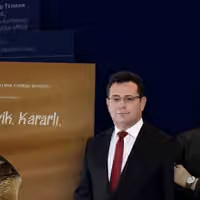
Iran's President Masoud Pezeshkian (right) meets Armenian Prime Minister Nikol Pashinyan in Tehran on July 30, 2024
Iran’s president will travel to Yerevan next week, Armenian media reported on Tuesday citing the country’s economy ministry, as Tehran continues to push back on a US deal with Armenia to develop a controersial corridor along its southern border with Iran.
Masoud Pezeshkian will start his four-day visit to Yerevan on August 18, according to Armenian media outlets.
Iran's government or state-run media have not yet confirmed the visit which is expected to focus on the US-Armenia deal on a Caucasus corridor.
On Friday, Trump brokered a peace deal between Armenia and Azerbaijan, which gives Washington leasing rights to develop the Zangezur transit route connecting Azerbaijan with its exclave, Nakhchivan. It will be renamed the Trump Route for International Peace and Prosperity (TRIPP).
On Monday, Pezeshkian had a phone conversation with Armenian Prime Minister Nikol Pashinyan, during which he urged regional countries to "remain vigilant and cautious in the face of possible schemes by the United States to pursue its hegemonic goals in Caucasus."
He warned that the United States may use the Zangezur project to achieve its objectives under the guise of economic investment or promotion of peace.
On Tuesday, Iranian Foreign Minister Abbas Araghchi said the planned transport route must not change the region’s geopolitics or cut Iran's access to other corridors.
Speaking in a phone call with his Armenian counterpart Ararat Mirzoyan, Araghchi said, “In any decision or action, respect for national sovereignty and the territorial integrity of countries must be fully observed."
Earlier in the day, government spokeswoman Fatemeh Mohajerani dismissed what she called exaggerated claims about the Zangezur corridor, saying it covers only a small area near Iran’s border.
"It is not as if our entire northern border has been lost,” Mohajerani said, but added that that Iran demands stability, territorial integrity, and existing sovereignty to be preserved.
A senior adviser to Iran’s supreme leader, however, vowed to block the establishment of the transit corridor saying it would endanger regional security and alter the region's geopolitics.
“This passage will not become a gateway for Trump’s mercenaries — it will become their graveyard,” Ali Akbar Velayati said.
Velayati stressed that Iran has always opposed the Zangezur corridor, saying it would alter borders, fragment Armenia, and restrict Iran’s regional access.