Traditional flood irrigation of agricultural land in Iran
At the cost of creating serious water shortages, Iran’s agricultural sector has vastly expanded over recent decades in pursuit of food self-sufficiency and hard currency through exports.
The country is already grappling with one of the worst water crises in the Middle East, with more than 300 cities currently experiencing water stress according to official statistics.
Former Agriculture Minister Isa Kalantari put the situation starkly in an interview with the Entekhab newspaper, saying the agricultural sector consumes 77 billion cubic meters of water annually—85–90 percent of Iran’s total water withdrawals—producing $40 billion in output but imposing an environmental cost of $44 billion.
A political push for food independence
Since the Islamic Revolution, food self-sufficiency has been treated as a pillar of economic independence. This strategy gained momentum during the 1980–1988 Iran–Iraq War and amid international sanctions.
“Tensions in foreign policy have led the state to treat food sovereignty as a security issue; this approach, instead of promoting genuine development, has merely resulted in the unchecked expansion of agriculture,” said Morad Kaviani-Rad, professor of hydro-politics at Tehran University, in an interview with Entekhab.
Kaviani-Rad said that Iran’s Planning and Budget Organization recognized as early as the 1950s that the country lacked the natural capacity for full agricultural self-sufficiency and should instead prioritize industrialization.
Nevertheless, Supreme Leader Ali Khamenei has repeatedly called for increased domestic food production and population growth. In a 2021 speech, he said Iran could feed four times its current population with existing rainfall if resources were managed properly.
The emphasis on food self-reliance and export-oriented agriculture has long drawn criticism from experts.
“Failing to understand the subtle yet strategic difference between ‘food self-sufficiency’ and ‘food security’ ... will destroy agriculture, the economy, water, land, natural resources, farmers’ livelihoods and the security of an entire nation,” warned Kaveh Madani, a leading Iranian environmentalist, in a December 2023 post on X.
Water-intensive exports deepen the crisis
Despite mounting evidence, Iran’s agricultural expansion continues largely unchecked, with subsidies and government incentives still promoting cultivation of thirsty crops for export, a practice often described as “exporting virtual water.”
Pistachios, for example, earned $1.5 billion in export revenues in the year to March 2025 but require 5,000–7,000 cubic meters of water per hectare annually. They are mainly grown in Kerman province, one of Iran’s driest regions, where over-extraction has led to aquifer depletion and land subsidence.
According to Iran’s Trade Promotion Organization, agricultural products accounted for approximately 12 percent of the country’s non-oil exports in the year to March 2025, underscoring their economic significance.
This year’s severe drought and worsening water shortages in areas including Tehran, however, have amplified warnings about growing water-intensive crops for export.
"Just as the reservoirs are one by one approaching zero, truckloads of cucumbers, watermelons, and potatoes are being shipped to Iraq and Russia," wrote Iranian journalist Azadeh Mokhtari in Rokna News on August 22. "This isn't called export; it's called an emergency outflow of the country's water resources—with no return."
A recent speech by Iran’s Supreme Leader Ali Khamenei has energized hardliners who see it as a mandate to silence reformists advocating direct talks with Washington and nuclear concessions.
Khamenei on Sunday appeared to dismiss a manifesto by reformist groups which called for direct talks with Washington and suspension of uranium enrichment.
Hardliners were quick to interpret his words as a rebuke to the authors of the recent Reform Front statement and figures such as former president Hassan Rouhani and his foreign minister Mohammad-Javad Zarif, who also urge direct talks and diplomacy.
“Those who say, ‘Why don’t you negotiate directly with the United States and solve the issues,’ are superficial, because the reality is different," Khamenei said in his speech.
Analysts are divided over the implications. Dissident commentator Reza Alijani told Iran International that Khamenei’s stance reveals “a backward Cold War mindset” hostile to compromise, warning he is “gambling with the fate of the country and the Iranian people.”
Others argue the speech was more rhetorical than absolute. Ruhollah Rahimpour noted in a post on X that Khamenei has made similar statements even while Iran’s diplomats were actively engaged in talks.
The timing of the remarks, however, is significant. Just a week earlier, the Reform Front called for direct US negotiations, suspension of enrichment, and acceptance of full IAEA monitoring in exchange for sanctions relief.
Hardliners hailed Khamenei’s speech as a rejection of that appeal.
“The Leader’s wise remarks struck like a resounding slap against submissive reformists—against Rouhani, Zarif, (Mohammad) Akhoundi, Azar Mansouria and others,” wrote ultra-hardliner activist Alireza Aliyaninejad on X.
Ultra-hardliner defiance
Khamenei’s simultaneous expression of support for President Masoud Pezeshkian and emphasis on a united front against foreign enemies has complicated the picture.
Reformist-leaning figures and outlets highlighted the endorsement, while some ultra-hardliners such as lawmaker Hamid Rasaei insisted such support was merely pro forma.
Only hours after the speech, Rasaei suggested that parliament could oust Pezeshkian for incompetence, likening him to Iran’s first president Abolhassan Banisadr, who was impeached in 1981 despite Ayatollah Khomeini’s earlier backing.
The threat against Pezeshkian triggered backlash even within conservative circles.
Revolutionary Guards-affiliated media accused Rasaei of defying Khamenei’s call for unity. A Telegram channel believed close to the Guards warned: “This is a complete final warning—in the true sense of the word—to you and to all (ultra-hardliners) who, contrary to the explicit order of the Supreme Leader, engage in creating distractions and acting against national cohesion and unity.”
The Guards-affiliated Javan newspaper went further, calling for Rasaei to be prosecuted.
Green light for prosecution?
Judiciary chief Gholam-Hossein Mohseni-Ejei warned the Reform Front over its statement: “Those who, whether out of negligence or questionable motives, signed it should acknowledge their mistake and withdraw this disgraceful act. Naturally, the Tehran prosecutor will also carry out his legal duty."
Reformists rejected the accusation of betrayal.
“The Reformist Front’s statement is not an alignment with the enemy, but the voice of the voiceless who are worried about Iran. Judicial action against ‘opinions, criticism, and proposed solutions’ reflects a crisis in listening,” responded Azar Mansouri, the Front’s leader, on X.
A group of young men and women in casual, Western-style clothing gathered around a woman in Lebanese-style hijab seated on a large red armchair placed in the middle of a street in Iran..
A viral series of photos showing women without headscarves on the streets of Tehran has ignited heated debate on social media over claims that the Islamic Republic has loosened its enforcement of compulsory hijab.
The images, some first shared in early August on X by social media activist Sana Moeinni, depict scenes that appear to show everyday urban life in present-day Iran. They present a strikingly relaxed atmosphere, with diversity in clothing styles and subtle cultural symbols such as flags used in Shiite Muharram mourning ceremonies.
One photo shows a group of young men and women in casual, Western-style clothing gathered around a woman in Lebanese-style hijab seated on a large red armchair placed in the middle of a street.
Another depicts a woman and child riding a yellow scooter—an image that would have been almost unthinkable just a few years ago, when an unwritten ban on riding bicycles or motorcycles in public was strictly enforced.
Staged reality or social progress?
Critics argue that the images are staged. Diaspora journalist Amir Kalhor called them part of a coordinated propaganda campaign.
“This project, involving dozens of photographers, models, and production teams, is designed to project a fabricated, sanitized image of life in Iran under the rule of the Islamic Republic for international audiences,” Kalhor wrote on Instagram.
Supporters of President Masoud Pezeshkian, however, see the backlash differently. Kiana Poorhaghighi, a young pro-government activist, argued that opposition groups feel threatened because hijab enforcement has been a powerful rallying point.
“If the Islamic Republic acknowledges diversity of clothing, as seen in these photos, the opposition loses one of its strongest tools,” she wrote on X.
Alireza Ziloochi, who calls himself a tourism expert, said: "I still can’t figure out when I should say, ‘Bravo for this courage. Everyday acts of resistance matter. People need to get used to seeing these images,’ when someone posts a photo without hijab in Iran’s streets — and when I should say, ‘The reformist scoundrels have launched the regime’s whitewashing project, because otherwise the streets of the city aren’t like this at all.’"
The photographers have not been publicly identified.
‘Fragments of reality’
Some critics accused the photographers of “selectively highlighting fragments of reality” to suggest that Pezeshkian’s government has eased restrictions, while concealing the ongoing struggles women face.
A commenter argued that the photos “whitewashed” the reality of the Islamic Republic by showing unveiled women but not the harshness of the daily risks women take: “It’s a struggle that costs us—materially, emotionally, mentally, and even physically,” she wrote.
Others framed the issue in broader terms of personal freedom: “Our women’s clothing, whether veil or bikini, should not be imposed by the state. Women and men should decide for themselves. We do not need guardians.”
The reality on the ground
In May, Iran’s Supreme National Security Council shelved a new hardline bill mandating stricter hijab rules, reportedly out of fear of public backlash. Enforcement has not disappeared, but reports of women facing harassment, including fines and impounding of their vehicles, are not as common as before.
While unveiled women are now common in Tehran and other cities, most still carry scarves in their bags to use in banks, government offices, or public transport if ordered.
“You can say we are free only when we can go to the bank, tax office, or hospital without a hijab, and are not told at the entrance to cover up,” one user wrote on X.
Few women dress entirely as they wish: most avoid sleeveless shirts, shorts, or short skirts, opting instead for long sleeves and modest skirts as a compromise to avoid confrontation.
“[Having to wear] long-sleeved blouses, pants, and long skirts in 40-degree heat cannot be considered freedom of dress,” a post on X argued.
Change from above or women’s steadfastness?
Supporters of Pezeshkian credit his presidency with the apparent relaxation of enforcement in recent months. Others insist that it is women’s defiance—not government reform—that has shifted the balance.
“The fact that women today walk unveiled in Tehran or even ride motorcycles is neither the result of ‘reform’ nor the reformists’ achievement,” one critic wrote, pointing out these relative freedoms are not formally recognized as legal rights.
“Any change in this matter is the result of women’s resistance,” wrote feminist activist Zeinab Zaman.
Unveiled Iranian girl dances around a bonfire during height of Woman, Life, Freedom movement in 2022.
Stanford professor and historian Abbas Milani says the Islamic Republic's real opposition is not abroad but inside the country: women walking unveiled, teachers refusing propaganda, and artists reimagining history.
Milani toldEye for Iran podcast that Iranian women are at the heart of today’s opposition.
“The Iranian woman who decides to walk in the streets of Tehran, Shiraz, Bandar Abbas, without a veil… that’s the most potent opposition to this regime,” he said.
Despite intensified crackdowns, women continue to defy compulsory hijab laws.
Public opinion surveys point in the same direction. A poll conducted last summer involving more than 77,000 people found that a majority reject the Islamic Republic and favor either regime change or a structural transition.
Milani said the most authentic expressions of opposition are found in cultural acts, not exile politics.
“It is the manifesto of the future of Iran,” he said.
Milani highlighted a recent production at Stanford University by acclaimed playwright Bahram Beyzaie, a reinterpretation of the revolution through the eyes of women. The play drew widespread interest inside Iran, with audiences requesting online access, while receiving little notice outside.
Awakening from a 'nightmare'
“Iranians have woken up from this nightmare,” Milani said referring to the Islamic Republic, “but now they need to get rid of the source of this nightmare, which is dogmatism, which is religious domination, which is velayat-e faqih. (Guardianship of the Islamic Jurist)"
Milani’s remarks come as Iran faces one of its harshest crackdowns in decades. Rights groups say more than 1,000 people have been executed in the past year, many in public.
In Isfahan, authorities have begun ordering the confiscation of Baha’i homes and assets — a move the community’s representatives described to Iran International as “economic strangulation.”
Meanwhile, the Supreme Court has upheld the death sentence of labor activist Sharifeh Mohammadi, and women’s rights defender Hasti Amiri has been sentenced to three years in prison after protesting executions and appearing unveiled in public.
Milani argues that Iranians have too often been trapped in emotional narratives of the 1953 coup orchestrated by the CIA and the 1979 Islamic Revolution, casting the monarchy and the Islamic Republic in black-and-white terms.
"The Shah was, at worst, an authoritarian leader. At best, he was a modernizer,” Milani said. “This regime, at best, is a pseudo-totalitarian regime. And at worst, totalitarian.”
The difference, Milani said, is that while the monarchy did not attempt to reshape private lives, the Islamic Republic has tried to engineer a “new man and woman,” reducing women to second-class citizens and criminalizing dissent.
Former Iranian Premier Mohammad Mossadegh is sentenced to three years' solitary confinement by a military court in Tehran, December 21, 1953.Credit: STR / ASSOCIATED PRESS
Milani argued that younger Iranians are less interested in “black and white” narratives about 1953 that toppled the democratically elected government of Mohammad Mosaddegh, and more focused on freedom, equality, and dignity in their daily lives.
The Islamic Republic has long invoked the 1953 coup to justify hostility toward the United States, while downplaying the fact that Mosaddegh’s supporters were outlawed after 1979.
In 2023, the CIA for the first time described its role in ousting Mosaddegh as “undemocratic.” Yet Milani says the coup cannot be reduced to CIA intrigue alone, arguing that Iran’s clergy were decisive in turning against Mosaddegh.
Iran's future in people's hands
Seven decades on, he believes the lesson is clear: Iran’s future will not be decided by nostalgia or in-exile politics but by the resilience of ordinary citizens.
“The future of Iran,” Milani said, “is in the hands of those women, those teachers, those citizens who refuse to live by this ideology. They are the opposition to this regime.”
“Iranian society is more represented by intellectuals who used to be religious and now go and kiss the feet of a Baha’i and say, I’m sorry for everything we have done to you,” he added. “That’s the future of Iran. Those women are the future of Iran. They are the opposition to this regime.”
A conservative daily in Tehran has accused the Taliban of deliberately withholding water to pressure Iran, urging the government to use diplomatic, economic and other tools to punish the group.
"The Taliban are intentionally cutting water flows to Iran," the Jomhouri Eslami newspaper said earlier this week in an editorial titled "End Taliban’s Impudence", warning against what it called the inaction of Iranian officials in the face of the Taliban’s “hostile conduct.”
The newspaper described Afghanistan’s now officially inaugurated Pashdan Dam as the Taliban’s “second major water blow to Iran” after refusing to deliver Iran’s allotted share of the Helmand River (Hirmand in Persian) in recent years.
According to Khorasan newspaper, the diversion of the Harirud River to fill the Pashdan Dam in Herat Province has led to the drying up of the Doosti Dam on the Iran–Turkmenistan border—the main drinking water source for Mashhad, Iran’s second-largest city.
The 1973 Helmand River Treaty grants Iran an average flow of 26 cubic meters per second (around 820 million cubic meters annually), though drought conditions allow for reductions.
The Kamal Khan Dam, inaugurated in March 2021 under President Ashraf Ghani, fueled Iranian fears of reduced Helmand flows. Kabul framed the project as a sovereign right, while Tehran viewed it as a treaty violation.
The Helmand once sustained the Hamoun wetlands, Iran’s third-largest lake system. Prolonged droughts, damming, and contested releases have dried the wetlands, devastating Sistan-and-Baluchestan.
The construction of Pashdan Dam, the second Afghan dam affecting Iran, began before the Taliban retook Kabul. Seeking legitimacy through visible projects, the Taliban completed the dam and began impoundment in December 2024, with full inauguration announced a few days ago.
Criticism of Tehran’s 'concessions'
Jomhouri Eslami also accused successive Iranian governments, especially that of late President Ebrahim Raisi, of overlooking Taliban hostility while offering “political and economic concessions.”
“Out of fear of public opinion, they could not formally recognize the Taliban’s illegitimate rule in Afghanistan but still offered it all the privileges normally reserved for a recognized government,” the paper wrote.
The editorial charged that by remaining silent on water disputes, Iranian authorities have “encouraged the Taliban’s boldness.”
It said it is “not calling for harsh measures,” but urging political and economic pressure, alongside tighter control over unauthorized Afghan migrants, to restrain the group.
Iran-Taliban relations since 2021
When the Taliban retook Kabul in August 2021, Iran pursued a pragmatic policy: avoiding formal recognition but maintaining contacts to manage trade, refugees, border security, and above all, water.
During the Kamal Khan Dam’s inauguration in 2021, Ashraf Ghani suggested that Afghanistan might “trade water for oil.” Since then, Iranian media have suggested that the Taliban, too, is using water as a bargaining chip—pressuring Tehran to recognize its government.
In January 2025, Foreign Minister Abbas Araghchi became the first Iranian foreign minister in eight years to visit Kabul, seeking to address refugees, border tensions, and Helmand treaty obligations. The visit underscored how water disputes now dominate the bilateral agenda.
Jomhouri Eslami described Araghchi’s visit to Kabul as a “grave diplomatic mistake,” criticizing the government for ignoring what it suggested was deliberate desiccation of Mashhad’s primary water supply.
The government of President Masoud Pezeshkian has stepped up deportations of undocumented Afghans, with more than 1 million expelled since January. The Taliban have condemned the expulsions as violations of both international norms and Islamic principles.
However, the two sides have also engaged inpragmatic cooperation despite tensions. A recent report claimed that Iran’s Revolutionary Guard got a leaked British Ministry of Defense database from the Taliban, hoping to use it to detain suspects as bargaining chips in nuclear talks while the Taliban seeks recognition as Afghanistan’s rulers.
The Telegraph reported on Thursday that the Taliban are transferring three Afghans suspected of spying for Britain to Iran. The move is part of the secret agreement between the two governments to coordinate arrests of Afghans who worked with British forces.
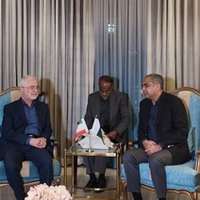
Iran's President Masoud Pezeshkian and President of Belarus, Aleksandr Lukashenko. August 2025
Iranian President Masoud Pezeshkian visited Belarus this week, a heavily sanctioned Russian ally, in a trip that highlighted how Tehran’s “Look East” strategy ties it more closely to Moscow and Beijing and their sanctioned partners.
Tehran has framed the August 20 visit as part of a concerted move against Western pressure.
Iran newspaper, the administration’s mouthpiece, wrote that the president’s decision to visit Minsk was a logical continuation of Tehran’s foreign policy—a policy emphasizing a multipolar world, national sovereignty, independence, and resistance to coercion.”
Similarly, Nour News, close to Ali Khamenei's top advisor Ali Shamkhani, described the trip as a “clear message against global unilateralism and sanctions.”
Consolidating the 'Look East' strategy
For many observers, the choice of Belarus as one of Pezeshkian’s first foreign destinations after the 12-day war with Israel was a deliberate statement of intent.
Esfandiar Khodaee, a foreign relations commentator, wrote in Khabar Online that the visit showed the “Looking East” policy was no longer just a legacy of Mahmoud Ahmadinejad or Ebrahim Raisi, but “a standing pillar of the Islamic Republic’s foreign policy.”
The approach traces back to Ahmadinejad’s presidency, when Tehran expanded ties with China, Russia, India, and members of the Shanghai Cooperation Organization. Supreme Leader Ali Khamenei reaffirmed the policy in 2018 with the slogan “Looking East,” emphasizing reliance on non-Western partners as sanctions mounted.
Analysts note that Europe’s hardened stance on Iran’s nuclear file—coupled with escalating US sanctions—has pushed Tehran further into Russia’s orbit.
As a commentary published by Moj News Agency put it, “Tehran’s choice of Belarus at this moment highlights its prioritization of ties with anti-Western, pro-Russian states—especially as Europe in recent months has shown no flexibility in its dealings with Iran.”
"Those who say we shouldn’t work with China and Russia — do they mean we should stand alone?" Ali Larijani, the secretary of Iran's Supreme National Security Council said in an interview with Khamenei's website published on Friday.
"Well, when the Westerners don’t work with us, we work with China, we work with other countries," he added.
A message of resilience
Belarus, like Iran, is heavily sanctioned and has faced sharp international isolation since aligning with Moscow over the war in Ukraine. Both states thus share an interest in showcasing resilience against sanctions.
Alireza Salimi, a member of parliament’s presiding board, told ISNA that the president’s visits to Armenia and Belarus sent a message that Iran is “sanctions-proof”.
The rhetoric was reinforced by the agreements signed in Minsk. Foreign Minister Abbas Araghchi announced that Tehran and Minsk were upgrading their Comprehensive Cooperation Roadmap for 2023–2026 into a strategic partnership agreement.
The two sides also discussed closer alignment within the Eurasian Economic Union, BRICS, and the Shanghai Cooperation Organization.
Military and security undertones
Though economic cooperation was highlighted, the military dimension loomed large. Tehran and Minsk have quietly expanded security ties in recent years: an August 2023 defense memorandum paved the way for Belarusian forces to join Iranian drills in 2024, and Iran opened its first military attaché office in Minsk in 2025.
Belarusian officials have recently discussed ramping up missile production, including exploring nuclear-capable options for their Polonez rocket systems. Iran’s expertise in missile development makes it a potential partner and could raise concerns in Western capitals.
Both governments also maintain open support for Moscow’s war effort, a stance that has drawn sharp condemnation from Ukraine and NATO states. Kyiv in particular has repeatedly denounced Tehran’s supply of drones to Russia.
Trade remains modest but symbolic
Despite official optimism, trade between the two countries remains limited. Araghchi said bilateral exchanges totaled $140 million in the first half of 2025—a 14 percent increase from last year, but quite modest.
Even if current volumes are low, both sides see such arrangements as politically symbolic and vital to their shared sanctions-circumvention strategies.
Both governments also see potential in expanding connectivity. Reza Masroor, head of Iran’s Supreme Council of Free and Special Economic Zones, noted that Belarus could gain access to open waters via Iran’s free zones through the Makhachkala–Caspian Port route.
This, he argued, would allow Minsk to bypass Baltic restrictions and connect to the North–South Corridor, enabling exports of potash, agricultural goods, and industrial products to markets in the Middle East, Africa, and beyond.