Israel-backed cyberattacks cripple IRGC finances, burn $90 million in crypto – WSJ
A man carries stacks of Iranian rial banknotes at the Central Bank
Israel-backed hackers wiped out $90 million in Revolutionary Guards crypto wallets during last month's war, calling it a landmark campaign to cripple Iran’s financial backbone, The Wall Street Journal reported.
Predatory Sparrow, the group believed to be aligned with Israeli intelligence, demonstrated “surgical precision and total freedom of access,” erasing data and destroying wallets linked to the Islamic Revolutionary Guards Corps (IRGC), according to a report published Sunday.
By targeting Bank Sepah—the Guards’ central financial institution—hackers rendered Iran’s military payroll inoperative and triggered cascading disruptions. “Automated teller machines went dark, and online and in-branch services shut down,” the report said. “Salary and pension payments halted.”
The hackers also penetrated Nobitex, Iran’s dominant cryptocurrency exchange, extracting and burning stablecoins tied to IRGC operational funds.
Nearly 90 percent of the country’s crypto transactions pass through Nobitex, and the group extracted approximately $90 million in stablecoins linked to IRGC funds. These were then burned by transferring them to inaccessible blockchain addresses, permanently removing them from circulation.
“Predatory Sparrow reportedly extracted $90 million from wallets linked to the Islamic Revolutionary Guard Corps, then burned the assets by transferring the funds to addresses where they could not be retrieved, thereby permanently removing them from circulation,” the article said.
The strike ignited a broader panic. Though not directly attacked, Iran’s largest commercial bank, Bank Melli, couldn’t meet demand for cash. The Central Bank of Iran attempted to contain the collapse by injecting liquidity, but confidence evaporated. The rial fell more than 12 percent, and authorities suspended trading on the Tehran Stock Exchange.
The attack denied officials and security personnel access to their own money, directly challenging the government’s ability to sustain loyalty through financial means.
The report also said that the success of the cyber campaign has reframed US strategy. While President Trump said at the NATO summit, “We want [Iranians] to be prosperous, we want them to do well, but they can’t have nuclear weapons," it was a message to Iran's Supreme Leader that he must relinquish the nuclear program or face economic collapse.
The report said that sanctions that drive the Islamic Republic finances into vulnerable channels such as crypto and informal banking will likely be part of that strategy, in addition to shifting US cyber policy from passive backing to active involvement in offensive operations alongside Israel.
“Cyber warfare also rewards live-fire experience," the article said. "The more Washington and Jerusalem operate together in combat, the stronger their alliance grows. And when the next big test comes—as it surely will—the nations that have trained together under fire will dominate the field."
Iran’s top air defense commander said the country's skies are being vigilantly guarded “day and night” following the recent 12-day conflict with Israel.
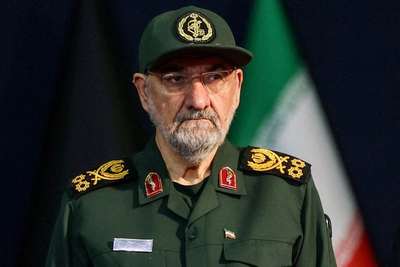
Brig. Gen. Alireza Sabahifard, who leads the Khatam al-Anbia Air Defense Base, said Iran’s air defense forces are operating with “open eyes and full strength” and will, in his words, “rub the nose of aggressors into the dirt” backed by military capabilities and “trust in God.”
The Khatam al-Anbia Central Headquarters, Iran’s highest operational military command, oversees planning, coordination, and operational supervision of all armed forces. Its air defense base is responsible for coordinating and operating air defense activities across both the Army and the Revolutionary Guards (IRGC).
On Sunday, Mahmoud Mousavi, the army’s deputy for operations, said Iran has replaced air defense systems damaged during last month's conflict with Israel.
"Some of our air defenses were damaged, this is not something we can hide, but our colleagues have used domestic resources and replaced them with pre-arranged systems that were stored in suitable locations in order to keep the airspace secure," Mousavi added.
During the June conflict, Israel's air force took control of Iranian airspace, delivering a significant blow to the country's air defenses, while Iran's armed forces responded with successive waves of missile and drone attacks on Israeli territory.
Israeli military officials say that 120 air defense systems were destroyed or disabled since the first wave of attacks—around a third of Iran’s pre-war total. Long-range systems, including Russian-supplied S-300s and Iran’s Bavar-373 batteries, were among those targeted.
Iran’s government has ordered the closure of public offices in Tehran Province for Wednesday amid an ongoing energy crisis and a nationwide heatwave, as the country’s president warned of a worsening water shortage.
“Following the continued extreme heat and the necessity of conserving water and electricity, Wednesday, 23 July, has been declared a public holiday in Tehran Province,” government spokesperson Fatemeh Mohajerani wrote on X.
“It is an opportunity for rest, a short trip, or being with family, of course while observing safety guidelines and conserving energy,” she added.
The announcement came as temperatures in parts of Iran soared above seasonal averages, with Tehran reaching around 104°F (40°C) on Sunday, putting further strain on the country’s aging power grid and water supply systems.
In a cabinet meeting on Sunday, Pezeshkian cited a report from the energy ministry and warned that the crisis was more severe than acknowledged.
“The water crisis is more serious than what is being discussed today, and if we do not take urgent action now, we will face a situation in the future for which no remedy can be found,” Pezeshkian was quoted as saying by state media.
“In the water sector, beyond management and planning, we also need to address excessive consumption,” he added.
In response to the country's water crisis, water shutoffs have spread across Iran, especially Tehran, amid growing reports of silent rationing—claims denied by officials who attribute the issue to a mere drop in pressure.
Last week, Iran's Energy Minister Abbas Aliabadi warned that the country's critical reservoirs could run dry within weeks. Aliabadi added that Iran is negotiating with neighboring countries to import water
Iranian authorities have arrested at least eight relatives of protesters killed during the 2022 uprising in recent weeks, amid a broader crackdown on dissent in the aftermath of the country’s war with Israel last month.
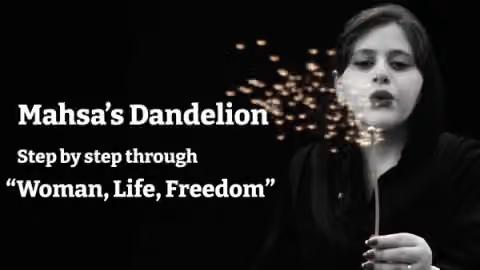
The most recent case involves Mahsa Shafiee, the 24-year-old sister of slain protester Parsa Shafiee, who was arrested by intelligence agents at her home in Yasuj, southwestern Iran, on Thursday, according to a source who requested anonymity due to fear of reprisals.
Eighteen-year-old Parsa was killed in November 2022, during the nationwide protests sparked by the death in custody of Mahsa Zhina Amini over an alleged hijab law violation in September that year, which triggered the nationwide uprising known as the Woman, Life, Freedom Movement.
In addition to Shafiee's detention, her father was also summoned by the Revolutionary Guard's intelligence on the same day, according to former political prisoner and rights activist Foad Choobin.
“The Shafiee family is currently under severe pressure from security institutions and has been threatened not to share information about Mahsa’s situation,” he wrote on X Sunday, adding that Mahsa’s whereabouts are currently unknown.
An undated photo of Mahsa Shafiee alongside her younger brother Parsa Shafiee who was killed during Iran's Woman Life Freedom protests in 2022.
Last Monday, Ehsan Khazaei, the brother of slain protester Erfan Khazaei, and his wife Neda Karegar were arrested in Tehran. According to Norway-based rights group Hengaw, more than 60 security agents stormed their residence, beat family members, and confiscated mobile phones. US-based rights group HRANA reported that the couple was later released on bail.
On June 23, Suleiman Qader Galwan, the brother of slain protester Abdulsalam Qader Galwan, was arrested in Oshnavieh, a city in West Azarbaijan province, following a raid by intelligence agents.
Ali Mohammadi, the father of slain protestor Shahriyar Mohammadi, was arrested on June 21 in Bukan, also in West Azarbaijan province, his daughter Asrin told Iran International.
Asrin said that her father was beaten during interrogation and lost consciousness, after which he was briefly hospitalized. Asrin added that her father is being denied independent legal representation.
On June 19, security forces also arrested Majid Naderkhani, whose son Matin was detained during the 2022 protests and shot dead months after release from prison.
In Yasuj, Feyzollah Azarnosh, the father of 18-year-old slain protester Pedram Azarnoosh, was arrested on June 18 and transferred to Yasuj Central Prison following questioning, according to a report by Hengaw.
That same day in Bukan, Karim Qaderpour, the father of protest victim Awat Qaderpour, was detained and taken to an undisclosed location.
A senior advisor to Iran's Supreme Leader and the Russian president discussed the Middle East tensions and Tehran's atomic program in a meeting in Moscow, a Kremlin spokesperson said, as the two sides prepare for joint naval drills in the Caspian Sea.
Ali Larijani briefed Vladimir Putin on the Iranian officials’ assessments regarding the escalating crisis in the Middle East and developments related to Iran’s nuclear program, the Russian state news agency RIA said citing Kremlin spokesperson Dmitry Peskov.
Sky News reported on Sunday that Iran and the European troika are set to hold nuclear talks next Sunday in Geneva.
In his meeting with Larijani, Putin reaffirmed Russia’s support for a political resolution to concerns over Iran’s nuclear activities and also regional stability, according to Peskov.
Putin’s remarks came almost a month after the end of Israel’s 12-day military campaign against Iran, a conflict that sharpened Tehran’s concerns about future strikes and sparked widespread criticisms in Iran about Russia's alleged failure to support its ally.
Last month, the Russian president told Iran’s foreign minister in Moscow that Israel's "absolutely unprovoked aggression against Iran is unfounded and unjustified." However, Putin stopped short of directly calling out the United States or Israel for attacking Iran.
On June 19, the Russian president refused to speculate on the possibility of Israel or the US targeting Iran's Supreme Leader Ali Khamenei. "I do not wish even to discuss such a possibility," he told Reuters.
One day later, Kremlin spokesman Peskov told Sky News that Russia would react "very negatively" if Khamenei was killed. He also dismissed the idea of a regime change in Tehran, calling it "unimaginable".
"It should be unacceptable, even talking about that should be unacceptable for everyone," Peskov said, in a thinly veiled reference to Washington.
Iran-Russia naval drills
Iran and Russia will begin a joint naval exercise in the Caspian Sea on Monday, July 21, part of a three-day drill aimed at boosting maritime safety and regional cooperation, Iranian state media reported.
The CASAREX 2025 search-and-rescue exercise, hosted by Iran’s Navy, will include units from the Iranian Army and IRGC naval forces, Iran’s national police, and the Russian Navy, with observers from other Caspian littoral states.
Held under the slogan “Together for a Safe and Secure Caspian Sea,” the drill is designed to enhance coordination and operational readiness among coastal nations, IRGC media reported.
Iran’s Islamic Revolutionary Guard Corps has warned of the looming return of UN sanctions and called for psychological readiness among the public, as IRGC-linked Tasnim says Iran has reached an agreement in principle with Europe to resume nuclear talks.
In a bulletin published on Sunday, Sobhe Sadegh, the daily outlet of the IRGC’s political department, described the prospect of renewed UN sanctions as a multidimensional threat and said policymakers must focus on preparing the public and economic actors rather than relying on hopeful messaging.
“A change in the tone of policy—from absolute hope-building to psychological readiness—is essential,” the outlet said.
The comments come amid growing concern in Tehran that Britain, France, and Germany may move to trigger the snapback mechanism before the 2015 nuclear deal’s 10-year term expires in October.
Once activated, the mechanism would restore all UN sanctions on Iran without the possibility of veto from Russia or China.
Meanwhile, a source quoted by the IRGC-linked Tasnim News Agency said Iran has reached an agreement in principle with the three European countries to hold negotiations, though discussions are ongoing about time and location.
“There is agreement on holding the negotiations, but consultations on where and when are ongoing,” the source said.
However, Sky News reported on Sunday that Iran and the European troika are set to hold talks next Sunday in Geneva.
Officials warn of retaliation
On the other hand, lawmakers from Iran’s Parliament National Security and Foreign Policy Committee repeated Tehran’s position that any effort to revive UN sanctions would prompt a response.
“Europeans have no right to consider reactivating snapback sanctions when they themselves failed to meet their JCPOA obligations,” said committee member Vahid Ahmadi in an interview with Didban Iran.
“The Islamic Republic has prepared responses and will implement corresponding actions.”
Tehran's preconditions for nuclear talks
Ahmadi listed three conditions for Iran’s return to the negotiating table: condemnation of recent US and Israeli attacks on Iran, recognition of war-related damages, and guarantees against future aggression.
“If the West expects Iran to come back to the negotiating table, it must first recognize and rectify the aggression committed against us,” Ahmadi added. “There must be international condemnation, a clear assessment of the damages, and credible guarantees that our sovereignty won’t be violated again.”
MP says snapback is 'psychological ploy'
Committee member Esmail Kowsari dismissed the snapback threat as a “psychological ploy,” though Sobhe Sadegh warned that failure to manage expectations could intensify inflation and trigger capital flight.
The outlet proposed measures including new taxes and restrictions on foreign transactions.
“If the Westerners are acting in good faith, they must first condemn the aggressions and crimes of the United States and the Zionist regime, and only then speak of negotiations. We have not walked away from the negotiating table and have acted based on logic and the law. Even now, if they intend to make threats, the Iranian nation is prepared,” he added.
"If the enemies move toward using force," Kowsari warned, “they will undoubtedly face a firm and severe response. We will make important decisions and will not allow the security and authority of the Iranian nation to be undermined.”