Iran criticizes US, reaffirms nuclear position at diplomatic forum
Iranian President Masoud Pezeshkian (2nd left) speaking during the Tehran Dialogue Forum on May 18
Iran's president on Sunday strongly criticized US President Donald Trump's accusations that Iran is a source of regional insecurity as Tehran hosted a diplomatic forum attended by delegates from 53 countries — including the Omani foreign minister mediating US-Iran nuclear talks.
At the opening of Tehran Dialogue Forum on Sunday, Masoud Pezeshkian reaffirmed Tehran’s commitment to its peaceful nuclear program while rejecting accusations of weaponization.
“We have the right, under the nuclear Non-Proliferation Treaty (NPT), to use nuclear technology for peaceful purposes such as health, agriculture, and industry,” he said.
The president pointed out Iran’s long-standing position that it does not seek nuclear weapons, citing religious prohibitions and ethical opposition to weapons of mass destruction.
“Our religious belief does not permit the production of nuclear weapons — tools that can destroy humanity and have no future on this Earth besides savagery,” Pezeshkian said. “Even the US president said, ‘We must make sure Iran does not have a nuclear weapon.’ Fine — let them come and check. We have nothing to hide.”
The Tehran Dialogue Forum, organized by Iran’s Ministry of Foreign Affairs, aims to promote unofficial diplomacy, according to the ministry. The two-day event includes participation from foreign ministers, senior policy officials, and UN representatives, with panel sessions livestreamed to audiences worldwide.
Omani Foreign Minister Badr bin Hamad al-Busaidi — who has facilitated four rounds of indirect talks between Iran and the United States — attended the forum and may be carrying a new American proposal Trump alluded to Friday.
Trump said Iran has the US proposal, but hours later Iran’s Foreign Minister Abbas Araghchi said Tehran has received no written offer, directly or indirectly.
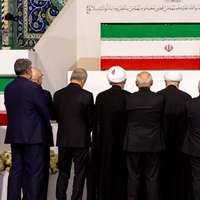
Iranian President Masoud Pezeshkian (center) and senior Iranian diplomats and foreign guests at the Tehran Dialogue Forum on May 18
Call for a ‘fair and balanced’ nuclear deal
In a keynote speech at the same forum, the Iranian foreign minister described US sanctions as “unjust and unilateral,” directly targeting Iranian civilians, and urged their genuine and verifiable removal.
He added that Tehran remains committed to diplomacy and the nuclear non-proliferation treaty. “We are seeking a fair and balanced agreement that fully respects Iran’s nuclear rights under the NPT and leads to the tangible and verifiable removal of sanctions,” Araghchi said.
“Sanctions that directly target our people must be lifted in a real and measurable way,” he added. “Such an agreement can serve the interests of both sides and promote peace, stability, and security in the region.”
Araghchi said again that Iran has never pursued nuclear weapons and expressed Tehran’s willingness to resolve international concerns through transparency and dialogue.
“We have always worked to address logical international concerns about our nuclear program through interaction and transparency,” he said.
Last month, UN's nuclear watchdog chief Rafael Grossi said in an interview with Le Monde that Iran was “not far” from being able to produce an atomic bomb, describing the country’s progress as “pieces of a puzzle” that could potentially come together.
Iran’s stockpile of 60% enriched uranium has risen to 275 kg, up from 182 kg last quarter, the the International Atomic Energy Agency (IAEA) chief told the agency’s board in March, warning that Iran remains the only non-nuclear weapon state enriching to such a level.
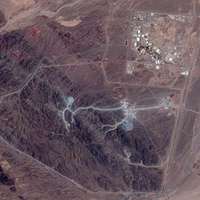
The IAEA says 60% enrichment has no credible civilian use and is close to weapons-grade. Iran maintains that its nuclear program is for peaceful purposes and remains under IAEA monitoring and has no secret nuclear site.
Iran’s Foreign Minister Abbas Araghchi speaking during the Tehran Dialogue Forum on May 18
Iran outlines foreign policy strategy, offers reset with Europe
In his address, Araghchi outlined Iran’s evolving foreign policy under President Pezeshkian, structured around three pillars: expanding ties with neighbors, strengthening cooperation with emerging powers and the Global South, and balancing relations with both Eastern and Western blocs.
“Iran seeks to play an active role in shaping a multipolar, just global order,” he said, pointing to Iran’s membership in BRICS and the Shanghai Cooperation Organization.
Iran views its participation in organizations like BRICS and the Shanghai Cooperation Organization as a sign of its growing alignment with multipolar global structures.
Araghchi also said Tehran is ready to begin a “new chapter” with Europe if European states adopt an independent and constructive approach.
He added that Tehran is open to improving ties with Europe if there is a “genuine will” and an “independent approach” from European partners. “If Europe is ready to move past a fixation on disputes, we are ready to open a new chapter.”
Earlier in the day, conservative daily Farhikhtegan reported that European powers pressed for a formal seat at the table and new enforcement mechanisms during Friday’s meeting in Iran’s consulate in Istanbul.
A view from the Tehran Dialogue Forum on May 18
Rejecting ‘external domination’ for regional agency
Addressing the broader geopolitical context, both Pezeshkian and Araghchi denounced what they called foreign interference in West Asia.
“The fate of our region should not remain in the hands of extra-regional powers... it must not remain tied to decisions made in think tanks outside of it,” Araghchi said, citing the Gaza crisis as further evidence of the failure of international systems.
“West Asia needs a fundamental rethinking of its self-image,” Iran’s top diplomat said at the forum, titled “Regional Agency in a Disordered World: Unity or Division?”
He called for a rethinking of the region’s self-image, moving away from narratives imposed by outside actors and instead building an indigenous order. “It is time we dismantle the fabricated and imposed quasi-realities, and establish a local, desirable, and sustainable order,” he said.
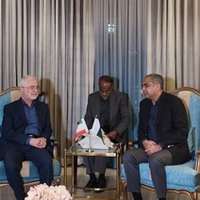
Iranian President Masoud Pezeshkian (left) shaking hands with Omani Foreign Minister Badr bin Hamad al-Busaidi during the Tehran Dialogue Forum on May 18
Forum as a platform for unofficial diplomacy
The two-day Tehran Dialogue Forum, hosted by Iran’s Foreign Ministry think tank — the Center for Political and International Studies — brings together 200 foreign delegates, including ministers and decision-makers from Persian Gulf and Asian states, according to state media.
Saeed Khatibzadeh, head of the Center, described the forum as “a platform for unofficial diplomatic conversation” that consolidates prior regional conferences on the Persian Gulf, Central Asia, and Afghanistan into a single event aimed at strengthening regional diplomacy.
This year’s forum marks a return after a one-year hiatus due to the death of Iran’s former President Ebrahim Raisi and Foreign Minister Hossein Amir-Abdollahian in a helicopter crash
Khatibzadeh said the forum’s revival under the new administration signals a renewed commitment to diplomacy “rooted in regional priorities, not foreign agendas.”
“Diplomacy, like all other fields, has diverse methods — sometimes a single individual can advance diplomacy as much as an institution,” he said.
He said that all Persian Gulf states sent high-ranking delegations, and that the conference includes 40 panel discussions broadcast live. Around 50 foreign media outlets are covering the event, he said.
The message of Iran’s leadership at the Forum was clear: while Tehran is open to renewed engagement with the US and Europe, it will not accept coercion or compromise on what it views as sovereign rights.
“As a free human being, I reject all forms of coercion,” said President Pezeshkian. “So does every free person in this country and this region. Free nations will never bow to pressure.”
Iranian President Masoud Pezeshkian said on Saturday that Iran is open to negotiations but will not retreat in the face of threats, while Foreign Minister Abbas Araghchi ruled out any compromise over enriching uranium.
“We are not seeking war. We believe in negotiations and dialogue,” Pezeshkian said at a military ceremony in Tehran. “But we are not afraid of threats and we will never retreat from our legal rights.”
Pezeshkian criticized US President Donald Trump for sending what he called contradictory messages. “He talks of peace while threatening us with advanced weapons. No one but him believes these contradictions,” Pezeshkian said.
The president added that Iran would stand firm. “They assassinate our scientists and accuse us of terrorism. But we are the victims of terror,” he said. “They should not expect us to give up our military and nuclear achievements under pressure.”
Separately, Foreign Minister Abbas Araghchi said Iran remains committed to peaceful nuclear development under the Non-Proliferation Treaty but will not negotiate away its right to enrichment.
“Iran is ready to build trust about the peaceful nature of its program, but cannot compromise on the legal and inalienable right to enrichment,” Araghchi said at a meeting with the Pugwash Conferences on Science and World Affairs. He added that Iran had “paid a heavy price” to preserve this right and would not accept restrictions as a long-standing NPT signatory.
Araghchi also criticized what he called inconsistent messages from US officials, saying they had complicated negotiations and undermined trust. “The Americans change their positions frequently and face pressure from war-driven lobbies,” he said. “This is their internal issue, but Iran will stay focused on its lawful and principled position.”
US President Donald Trump said on Friday that Iran will not be given time to develop a nuclear weapon and warned that a resolution will come “one way or the other,” suggesting the outcome could be peaceful or violent.
“There’s not plenty of time,” Trump said in an interview with Fox News' Bret Baier. “We’re going to have a solution one way or the other. It’s either going to be violent or non-violent. And I far prefer non-violent.”
“I don’t want it to be a violent thing, but they’re not going to have a nuclear weapon,” he added. “I know so many Iranians from New York, from Washington, from a different place. These are great people. You know, they have to view them as people.”
Trump said Iran appears interested in engaging. “Iran wants to trade with us, okay, if you can believe that. And I’m okay with it. I’m using trade to settle scores and to make peace,” he said. “I’ve told Iran, we make a deal, you're going to be really... you’re going to be very happy.”
He also questioned why Iran would pursue nuclear energy given its vast oil reserves. “When you have unlimited amounts of oil and gas, why are you putting up nuclear civil?” he said. “If you’re sitting on one of the largest piles of oil in the world, why?”
Trump says Iran got US proposal
Earlier in the day, Trump told reporters that Iran had received a formal US proposal for a nuclear agreement and warned Tehran not to delay. “They have a proposal. More importantly, they know they have to move quickly or something bad—something bad's going to happen,” he said.
Axios reported Thursday that the written proposal was delivered during the fourth round of indirect talks between US and Iranian officials last Sunday in Muscat, Oman. The document, carried by White House envoy Steve Witkoff, reportedly outlines terms for a monitored civilian nuclear program.
According to the report, Iranian Foreign Minister Abbas Araghchi took the proposal back to Tehran for review by Supreme Leader Ali Khamenei and other senior officials. U.S. and diplomatic sources described the offer as the first formal one from the Trump administration since talks began in April.
Iran, however, denied receiving any proposal. Araghchi wrote on X that no such document had been delivered and reaffirmed Iran’s position on uranium enrichment.
“The messaging we—and the world—continue to receive is confusing and contradictory,” Araghchi said. “Mark my words: there is no scenario in which Iran abandons its hard-earned right to enrichment for peaceful purposes.”
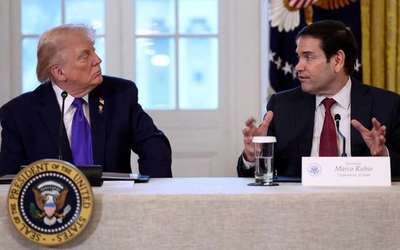
US Secretary of State Marco Rubio, speaking Thursday from Turkey, said diplomacy remains on the table but emphasized that the decision ultimately lies with Iran’s Supreme Leader.
“I hope he chooses the path of peace and prosperity, not a destructive path,” Rubio said.
The flags of EU, Iran, France, Germany and the United Kingdom
Iran’s outreach to European powers has divided Tehran’s political commentators over whether engaging France, Germany and Britain serves any real purpose amid the Islamic Republic's talks with Washington.
Senior diplomats from Iran and the three European signatories to the 2015 nuclear deal met in Istanbul on Friday in what appears to be Tehran’s attempt to prevent a "snapback" of the UN sanctions that were suspended for ten years as part of that deal.
But the initiative is being questioned—somewhat surprisingly—by voices long known for advocating diplomacy, such as former lawmaker Heshmatollah Falahatpisheh.
“There is no point in holding talks with Europeans. Iran’s only solution is to continue negotiations with the United States,” he told the conservative Nameh News on Friday
“Europe’s influence will remain insignificant as long as Trump is the President of the United States.”
Missed chances
A former head of parliament’s foreign policy committee, Falahatpisheh argued that Iran’s recent diplomatic overtures to the signatories of the 2015 deal are little more than a symbolic attempt to break out of the political impasse created by Washington.
“Iran should have negotiated with (US President) Trump during his first term,” Falahatpisheh said. “Unfortunately, Iranian officials are known for their costly and untimely decisions.”
This critique of past decisions may be shared by many in Tehran’s commentariat, but the way forward is certainly not.
“Even if talks with the Americans are paused or entangled in new complexities, we should not stop our negotiations with the Europeans,” political analyst Ali Bigdeli told the moderate outlet Fararu.
“The truth is that the Europeans are holding a hostage called the ‘trigger mechanism,’ which they can use to pressure us. If they don’t agree to postpone its activation by a year, they can use it as leverage against us,” he added.
Fearing the trigger
The trigger clause in the 2015 nuclear deal allows any signatory to reimpose lifted UN sanctions on Iran. The United States effectively forfeited that prerogative when the first Trump administration withdrew from the agreement in 2018.
It remains unclear whether the so-called snapback of sanctions was discussed in the Istanbul roundtable on Friday.
European officials described the event as a broad discussion about Tehran’s relationship with the West. Iran’s Foreign Minister Abbas Araghchi asserted that it had “nothing to do with negotiations with Washington.”
It did, as far as the media inside Iran are concerned. Whatever their view on the significance of the Istanbul meeting, most editorials linked it to the talks with the US.
“The position of the United States, which has initiated bilateral negotiations with Tehran, has somewhat sidelined Europe’s role,”Khabar Online wrote in an editorial on Friday.
“The nuclear negotiations are not merely a diplomatic engagement between Iran and Europe, but will more broadly affect the balance of power in the region,” it concluded.
Iran's Supreme Leader Ali Khamenei and Emir of Qatar, February 2025
Qatar's diplomatic prowess was lavished with praise by US President Donald Trump on his visit this week, suggesting the maverick mediator state may be set for more involvement on one of the region's trickiest dossiers: Iran.
Trump's remarks could herald a bigger role for Qatar as the US-Iran talks mediated by Oman appear headed for crunch time.
During a state dinner in Doha this week, Trump appeared to acknowledge Qatar’s crucial role in helping put off a US military strike on Iran amid high stakes talks over Tehran's disputed nuclear program.
Trump praised Qatar’s leadership, specifically Emir Sheikh Tamim bin Hamad Al Thani, for resisting calls within Washington and its allies to deliver a “hard blow” to Iran.
“Iran should seriously thank the emir of Qatar, because there are others who want to deal a hard blow to Iran, unlike Qatar,” Trump said. “Iran is very lucky to have the emir because he’s actually fighting for them. He doesn’t want us to do a vicious blow to Iran.”
Hashem Ahelbarra, a correspondent for Qatar-owned Al-Jazeera, said the comments strongly indicate a potential larger role for Doha in mediating a settlement between Tehran and Washington.
“They played quite a crucial role in mediating between the Iranians and the Americans in the past.”
Iran’s Foreign Minister Abbas Araghchi’s visits to Riyadh and Doha earlier this month just ahead of the fourth round of nuclear talks held in Oman and Abu Dhabi highlight Tehran’s willingness to broaden the regional dialogue.
Perils of potential US-Iran military confrontation for Qatar
The gas-rich microstate has been key mediator for the United States in regional conflagrations from Afghanistan to Gaza.
Qatar, which has strong ties with the US and hosts Al Udeid Air Base—the largest US military base in the Middle East—opposes any US or Israeli military strike on Iran and its nuclear facilities, emphasizing the risk of regional destabilization, and seeks a diplomatic solution.
“We have no hostility toward our neighboring countries, and brotherhood prevails among us. However, US bases located in the region's countries will be considered targets by us in the event of an attack on the Islamic Republic of Iran,” he said.
In March 2025, Qatari Prime Minister Sheikh Mohammed bin Abdulrahman Al Thani warned that military strikes on Iranian nuclear facilities could have catastrophic environmental consequences, such as contaminating the Persian Gulf’s waters.
This, he said, would imperil the water security of Qatar, along with other states like the UAE and Kuwait, all of which rely heavily on desalinated water from the Persian Gulf.
Good neighbors
Iran and Qatar, which share stewardship of South Pars, the world’s largest natural gas field, have maintained close economic and political relations over the years.
Iran played a crucial role in helping Qatar maintain economic stability and connectivity with the outside world when Saudi Arabia, the UAE, Bahrain and Egypt imposed a blockade on Qatar in 2017, partly due to its close ties with Iran.
Tehran offered Doha diplomatic support, opened its airspace to Qatari aircraft, sent dozens of cargo planes and ships loaded with food, and expanded maritime trade routes to Qatar through its southern ports.
Qatar also played a pivotal role in facilitating the release of five American citizens detained in Iran in September 2023, hosting multiple rounds of indirect negotiations between US and Iranian officials in Doha.
The unfrozen funds, stipulated to be used solely for humanitarian purposes, such as purchasing food and medicine, were transferred to Qatari banks and Qatar committed to overseeing the disbursement of these funds to ensure compliance with US sanctions.
The funds, however, have not been made available to Iran due to a quiet agreement between Washington and Doha.
Iran's Supreme Leader Ali Khamenei blamed Washington for obstructing the release of the funds during his meeting with the Emir of Qatar in Tehran in February and said Iran expected Doha to resist US pressure.
US President Donald Trump gestures, while he boards Air Force One, in Abu Dhabi, United Arab Emirates, May 16, 2025.
US President Donald Trump said on Friday that Iran has received a formal American proposal for a nuclear agreement and warned Tehran to respond swiftly or face consequences.
“They have a proposal. More importantly, they know they have to move quickly or something bad—something bad's going to happen,” Trump told reporters aboard Air Force One after leaving the United Arab Emirates.
Axios reported Thursday that the written proposal was delivered during the fourth round of indirect talks between US and Iranian officials last Sunday in Muscat, Oman. It was the first formal offer made by the Trump administration since negotiations began in April, Axios cited US and diplomatic sources saying.
The document, handed over by White House envoy Steve Witkoff, outlines terms for a civilian nuclear program, with specific provisions for international monitoring and verification.
Iranian Foreign Minister Abbas Araghchi reportedly took the proposal back to Tehran for review by Supreme Leader Ali Khamenei, President Masoud Pezeshkian, and other senior officials.
Witkoff described the proposal as “elegant” and “very big” in a recent briefing to the United Nations Security Council, according to Axios, but acknowledged that more work was needed. A fifth round of talks has not yet been scheduled.
Iran has responded positively in public statements. Ali Shamkhani, a senior adviser to Khamenei told NBC News that Tehran is ready to stop enriching uranium to weapons-grade levels, reduce its stockpiles and accept inspections—if the United States lifts all sanctions.
US Secretary of State Marco Rubio, speaking Thursday from Turkey, said the diplomatic window remains open but warned the decision ultimately rests with Iran’s leadership.
“In the end, the decision lies in the hands of one person, and that's the Supreme Leader in Iran, and I hope he chooses the path of peace and prosperity, not a destructive path,” Rubio told reporters.