• العربية
  • فارسی
BrandBrand
  • Iran Insight
  • Politics
  • Economy
  • Analysis
  • Special Report
  • Opinion
  • Podcast
  • Live TV
  • Iran Insight
  • Politics
  • Economy
  • Analysis
  • Special Report
  • Opinion
  • Podcast
  • Live TV
  • Theme
  • Language
    • العربية
    • فارسی
  • Iran Insight
  • Politics
  • Economy
  • Analysis
  • Special Report
  • Opinion
  • Podcast
  • Live TV
All rights reserved for Volant Media UK Limited
volant media logo

Talks with Tehran at tipping point, former US negotiators say

Negar Mojtahedi
Negar Mojtahedi

Iran International

Apr 21, 2025, 22:35 GMT+1Updated: 08:36 GMT+0
Italian security forces guard the venue for US-Iran talks on Saturday

As nuclear talks between Washington and Tehran edge forward, two former US officials warned the process is approaching a critical juncture—one that Iran may exploit to either extract deep concessions or run out the clock.
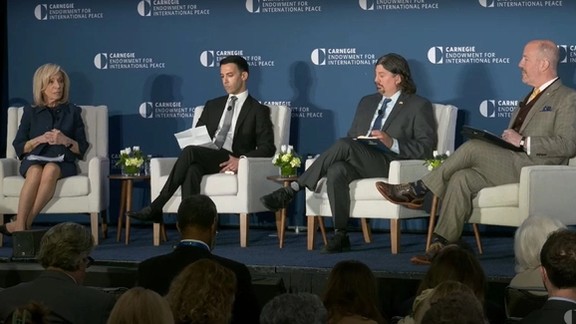

The gap between what the United States seeks and what Iran is willing to accept may simply be too wide to bridge, warned Christopher Ford, who served as Assistant Secretary for International Security and Nonproliferation during the Trump administration’s first term.

His remarks came at a panel hosted by the Carnegie Endowment for International Peace, as momentum appears to be building toward renewed talks between Washington and Tehran over Iran’s nuclear program.

100%
Host Andrea Mitchell with panel guests

Ford voiced deep skepticism about the direction of the negotiations and suggested Iran’s strategy may be to delay any meaningful outcome until after October, when UN Resolution 2231 is set to expire—removing the legal basis for snapback sanctions.

Host Andrea Mitchell with panel guests

“If I were on the Iranian side, that would be my negotiating strategy piece number one: draw this out,” he said.

The panel, titled From JCPOA to TBD: Assessing the Prospects for Diplomacy with Iran, followed the abrupt cancellation of a separate virtual session that was to feature Iran’s Foreign Minister, Abbas Araghchi.

Araghchi had been added to the speaker lineup on Saturday for Carnegie’s high-profile Nuclear Policy Conference. But on the morning of the event, the think tank announced the session had been canceled after the Iranian delegation allegedly demanded last-minute changes that would have barred both the moderator and audience from asking questions.

Ford pointed to the incident as a revealing example of how Iran approaches diplomacy.

“Carnegie has gotten a bit of a flavor of the Iranian negotiating style in the past 24 hours,” Ford said. “The disingenuous bait-and-switch kind of thing. He knew what he was doing, and I commend you all for standing, you know, sticking to your guns on this.”

Richard Nephew, who helped craft US sanctions against Iran during the Obama administration and is now at the Washington Institute for Near East Policy, echoed Ford’s concerns and called Iran’s current approach opportunistic.

“If you're Abbas Araghchi, you have to be trying to see what you can get and see whether or not you can get a concessional deal that puts you in a better position,” said Nephew, a former US negotiator.

He argued that Iran is probing for sanctions relief with minimal nuclear concessions—and may be encouraged by internal divisions within the Trump administration over whether a deal should be hardline or more flexible.

“Their actual entry point is to see what they can get… They get sanctions relief with fairly minimal nuclear concessions.”

Nephew added that public comments from US officials suggest openness to a significantly looser agreement.

“I think if you look at the plain text reading of what the president and what Witkoff have said, one can read into that a much looser, much, much softer deal,” he said.

While expressing doubt that a lasting agreement is within reach, Nephew suggested that a short-term deal could still help stabilize the situation if it limits nuclear activity and includes robust IAEA oversight.

Both experts portrayed the current moment as one of fragile, uncertain diplomacy—with high stakes and little room for error.

Most Viewed

Iran's oil output plunges below pre-war domestic needs
1
ANALYSIS

Iran's oil output plunges below pre-war domestic needs

2

Iran state TV says modified missile could reach US base in Britain

3
ONE-ON-ONE

Iranians and Israelis can defeat the IRGC together, says Arab-Israeli activist

4

Seven years after ‘Bloody November,’ Iran rations gasoline it dares not reprice

5

Locks for cash: inside Iran's booming hair trade

Banner

Spotlight

  • Can higher fuel prices curb Iran’s smuggling problem?
    ANALYSIS

    Can higher fuel prices curb Iran’s smuggling problem?

  • Canadian MP to flag paintball gun findings after Iran protest blindings
    PODCAST

    Canadian MP to flag paintball gun findings after Iran protest blindings

  • Locks for cash: inside Iran's booming hair trade

    Locks for cash: inside Iran's booming hair trade

  • Seven years after ‘Bloody November,’ Iran rations gasoline it dares not reprice

    Seven years after ‘Bloody November,’ Iran rations gasoline it dares not reprice

  • Iranians and Israelis can defeat the IRGC together, says Arab-Israeli activist
    ONE-ON-ONE

    Iranians and Israelis can defeat the IRGC together, says Arab-Israeli activist

  • Iran's oil output plunges below pre-war domestic needs
    ANALYSIS

    Iran's oil output plunges below pre-war domestic needs

Banner
Banner
Banner
Banner
Banner
Banner












