• العربية
  • فارسی
Brand
  • Iran Insight
  • Politics
  • Economy
  • Analysis
  • Special Report
  • Opinion
  • Podcast
  • Iran Insight
  • Politics
  • Economy
  • Analysis
  • Special Report
  • Opinion
  • Podcast
  • Theme
  • Language
    • العربية
    • فارسی
  • Iran Insight
  • Politics
  • Economy
  • Analysis
  • Special Report
  • Opinion
  • Podcast
All rights reserved for Volant Media UK Limited
volant media logo

Iranians decry intensified Ramadan enforcement amid economic hardships

Maryam Sinaiee
Maryam Sinaiee

Iran International

Mar 5, 2025, 14:31 GMT+0
Iran Police enforcing Ramadan rules at a park

Iranians are voicing renewed criticism over the strict enforcement of Ramadan regulations—which ban public eating and drinking—reinforced by authorities’ threats of harsh punishment.

In voice messages shared with Iran International over the past week, numerous citizens remarked that these restrictions—including shutting down eateries that fail to observe Ramadan rules—are being enforced more strictly than in previous years.

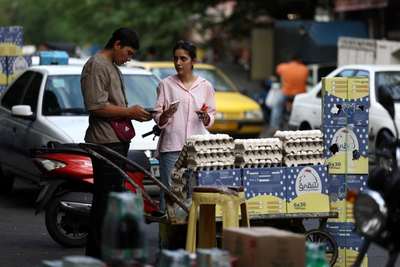
Referring to the soaring prices of food and other commodities, one of the recorded messages said, “The economy is getting worse by the day, but this month the dose [of pressure] has increased more than ever.”

In one message, a citizen reported that the police confiscated his driver’s license and impounded his car after catching him smoking inside it, while a young conscript noted that soldiers are prohibited from bringing food into the barracks.

Additional messages also described stricter enforcement in schools.

46 years of Ramadan regulations

Since its inception, the Islamic Republic has consistently enforced a ban on public eating and drinking during Ramadan—a holy month of fasting for Muslims—requiring eateries to remain closed during fasting hours.

The state refers to violators as engaging in “making a show of not fasting,” a term coined to describe those who publicly disregard fasting regulations.

In April 2024, Supreme Leader Ali Khamenei addressed reports of increased violations in Tehran and some other cities in a speech, stating that while the government does not seek to force piety, it must uphold religious norms. He urged authorities and citizens alike to prevent public non-compliance.

Every Ramadan, hundreds of individuals are arrested and thousands of businesses face temporary closures for violating these rules. Non-Muslim Iranians and foreign visitors are also required to comply, though there are exceptions. For instance, hospital patients are excused, although medical staff are expected to follow the rules.

While the number of Iranians who voluntarily fast remains unclear, many—including civil servants and factory workers—feel compelled to appear compliant, fearing repercussions or the possibility of “offending” those who do observe the fast.

In recent years, discontent has notably grown among segments of the population who view these restrictions as oppressive. Similar to the defiance of hijab mandates, some now see openly defying Ramadan rules as a political act.

Crackdown in schools

Under Shia law, girls are considered adults from age nine and boys from age fifteen, making them subject to fasting regulations. This year, the Education Ministry intensified enforcement across all schools, ordering canteens to remain closed throughout Ramadan.

Previously, many canteens did not serve food but allowed students to bring meals from home—often providing a space or facilities for heating them—and permitted non-fasting students to eat discreetly. However, the stricter measures now mean even young children must go without food during school hours.

In a statement released on its Telegram channel, the Coordination Council of Teachers’ Associations—a dissident teachers’ union—denounced the ministry’s directive, calling it an act of violence and oppression against children. The union also warned of health risks, especially for students already suffering from malnutrition due to economic hardship.

Ramadan coinciding with Persian New Year holidays

This year, Ramadan again coincides with the ancient Persian New Year (Norouz) beginning on March 20, due to the ten-day difference between the official solar and Islamic lunar calendars. The hospitality sector, which typically flourishes during Norouz, now faces heavy losses because of Ramadan restrictions.

To exacerbate matters for businesses already struggling under the economic crisis—and for those who are non-religious—the first day of the holiday also falls on the anniversary of the wounding of the first Shia saint, Ali ibn Abi Talib, in 661, with his death commemorated two days later. Both occasions are solemn mourning days in Iran.

Legal ambiguity

Under Iran’s Islamic Penal Code, violators can face punishments ranging from 10 days to two months in prison, or up to 74 lashes.

Some Islamic law experts in Iran, such as Mohsen Borhani, argue that Sharia law does not prescribe punishments for “making a show of not fasting.” In a recent post on X, he wrote, “Judicial interference in religious matters is wrong and ineffective in [promoting religious observance].”

Most Viewed

Disputes within Iran leadership blocked negotiators’ trip to Islamabad
1
EXCLUSIVE

Disputes within Iran leadership blocked negotiators’ trip to Islamabad

2
ANALYSIS

Internet Pro or Censor Pro? Iran rolls out a new service

3
INSIGHT

As Tehran digs in, ordinary Iranians pay the price

4
INSIGHT

Who backs war now? Tehran flips the script

5
VOICES FROM IRAN

Inflation spikes, basic goods slip out of reach for Iranians, citizens say

Banner
Banner

Spotlight

  • Tehran stocks head for reopening, but it risks triggering a new crisis
    ANALYSIS

    Tehran stocks head for reopening, but it risks triggering a new crisis

  • Power vacuum in Tehran emboldens hardliners
    INSIGHT

    Power vacuum in Tehran emboldens hardliners

  • Inflation spikes, basic goods slip out of reach for Iranians, citizens say
    VOICES FROM IRAN

    Inflation spikes, basic goods slip out of reach for Iranians, citizens say

  • Iran turns to citizenship and assets as tools of pressure beyond its borders

    Iran turns to citizenship and assets as tools of pressure beyond its borders

  • Who backs war now? Tehran flips the script
    INSIGHT

    Who backs war now? Tehran flips the script

  • As Tehran digs in, ordinary Iranians pay the price
    INSIGHT

    As Tehran digs in, ordinary Iranians pay the price

•
•
•

More Stories

Iran's President Pezeshkian bruised by hardliners' blitz on cabinet

Mar 5, 2025, 08:54 GMT+0
•
Behrouz Turani

Iran's embattled President Masoud Pezeshkian is feeling shaken but determined to carry on in office after hardliners forced out two of his key aids, a source close to his office told Iran International.

The source, who spoke on condition of anonymity, said the President is no quitter but has been "a bit fragile since Sunday evening".

Economy Minister Abdolnaser Hemmati was impeached by parliament while Vice President for Strategic Affairs Javad Zarif resigned under pressure last week.

The latter was the country's most prominent reformist and an articulate exponent of the Islamic Republic's foreign policy on the world stage. Zarif would likely have been Pezeshkian's key player in nuclear talks the administration hopes could have rolled back US-led sanctions crippling Iran's economy.

Hardliners, most importantly Supreme Leader Ali Khamenei, have rejected those talks.

But now that Pezeshkian's agenda appears decisively thwarted, Tehran newspapers which had long alluded to the possibility of his resignation have gone largely mute on such an unprecedented move which would lay bare political infighting.

Unlike a few weeks ago, when newspapers and websites openly debated Pezeshkian's possible resignation from various political perspectives, the topic now appears off-limits.

Journalists and commentators have largely avoided mentioning resignation directly, possibly engaging in self-censorship as they grasp the gravity of the situation and fearing reactions by authorities.

Nearly all outlets treated the word as taboo, instead voicing concerns over the collapse of Pezeshkian’s “national reconciliation” project—an effort to bridge the divide between rival factions, including Reformists and hardliners, to curb political infighting.

Only one prominent reformist, former lawmaker Ali Nazari—now editor-in-chief of the reformist daily Mostaghel—openly addressed the issue. He advised Pezeshkian to "honorably resign" following the removal of two top aides: Economy Minister Abdolnaser Hemmati and Vice President Mohammad Javad Zarif.

Although government spokesperson Fatemeh Mohajerani officially dismissed rumors of Pezeshkian's possible resignation, a viral video on social media fueled further speculation. The footage showed Pezeshkian reciting a verse from the Quran: "If you live in poverty and misery, weakness is not an excuse to stay where you are. Leave!"

Many interpreted this as a sign of his frustration and sense of powerlessness, possibly hinting at a decision to step down. Others suggested he was simply encouraging Iranians struggling under economic pressure to consider emigration.

Meanwhile, some users circulated another video from Pezeshkian's election campaign, in which he said, "If I find it impossible to stand by my promises, I will discontinue my political activities."

Many newspapers and websites in Iran have highlighted the impact of Zarif's absence in the Pezeshkian administration.

They noted that Zarif would be sorely missed, as the president had relied on him in the unlikely event of a shift in Khamenei's firm stance against negotiations with the United States.

One newspaper pointed out on Wednesday that with Zarif and Hemmati gone, 75% of Pezeshkian’s cabinet is now made up of hardliners—figures he had attempted to co-opt but who remain fundamentally opposed to him.

Only two days after the impeachment of Hemmati and the removal of Zarif from his post, most of the press have almost forgotten the former while Zarif's pictures were all over both conservative and proreform media.

Although the word "resignation" was largely avoided, newspapers and websites widely discussed the deadlock created by Sunday's events. Ham Mihan wrote, "Those who brought about the deadlock are expected to explain it and show a way out of it."

Former diplomat Kourosh Ahmadi wrote in Shargh, "It was clear long ago that there was no room for Zarif in the government." On the conservative front, political commentator Mehdi Arab Sadeq wrote on the Nameh News website, "Zarif was Pezeshkian's last line of defense. With his departure, Pezeshkian lost at least half of his social backing."

On the same website, centrist politician Mansoor Haqiqatpour advised that Pezeshkian should remove all the conservatives he brought into his government. Like many other commentators across the political spectrum, he argued that Pezeshkian's national reconciliation project has failed and should be abandoned.

The pro-reform outlet Rouydad24 described Sunday's events as a symbolic defeat for the Iranian president and warned that even greater pressure is yet to come. 

Living condition are bad in Iran, judiciary chief says

Mar 4, 2025, 10:08 GMT+0

Iran's chief justice acknowledged the country's severe economic struggles and corruption in different levels of government.

Speaking at a meeting with members of the National Security and Foreign Policy Committee of the parliament on Tuesday, Gholamhossein Mohseni Ejei said, "The people's livelihood is not good; it is bad. All branches of government must work to strengthen the country's economic and productive base, which is crucial for improving people's living conditions."

His comments come amidst widespread economic hardship in Iran, exacerbated by international sanctions and domestic mismanagement.

Ejei stressed the need for a shift in the culture surrounding investment, urging, "We must change the culture of supporting investors in the country. We should not consider wealth as something negative.”

Advocating for the utilization of the potential of Iranians living abroad, he asked. “Are all Iranians living abroad against the Islamic Republic?" he asked.

Addressing concerns about government corruption, he said, "Corruption is contagious; sometimes financial corruption leads to political and cultural corruption as well. We in the judiciary do not claim to be without flaws, but we have dedicated ourselves to correcting weaknesses and shortcomings."

Iran rejects talks under Trump's maximum pressure as political shake-up continues

Mar 4, 2025, 09:10 GMT+0

Iran will not engage in negotiations under maximum pressure, government spokesperson Fatemeh Mohajerani said in a press briefing, pushing back against interpretations that Tehran categorically refuses talks under sanctions.

"The phrase 'we do not negotiate under sanctions' is not accurate; rather, we 'do not negotiate under maximum pressure,'" she said.

Her remarks came as Supreme Leader Ali Khamenei ruled out direct talks with Donald Trump, who reinstated severe sanctions last month. The US president defended his approach, saying reports of a planned military strike on Iran were greatly exaggerated and that he preferred a deal.

Iranian President Masoud Pezeshkian has said he supported negotiations but has aligned with Khamenei’s decision against engaging in talks. Addressing parliament on Sunday, he said his initial stance had been for diplomatic engagement but deferred to the Supreme Leader's position.

"Negotiation is a voluntary act," Mohajerani said. "No one can force another person to sit at the negotiating table."

Amid mounting political shifts, Mohajerani dismissed concerns that recent resignations and dismissals could fracture government unity.

"Impeachment or resignation of an individual does not take us away from national unity in solving people's problems," she said, referring to the ousting of Vice-President Mohammad Javad Zarif and Economy Minister Abdolnaser Hemmati.

Zarif, known for his role in the 2015 nuclear deal, tendered his forced resignation on Sunday, though Pezeshkian has not accepted it. Mohajerani confirmed that "one side of a resignation is its acceptance, which has not yet been granted by Pezeshkian."

Zarif later wrote on X that he stepped down following a meeting with Iran’s judiciary chief, who advised him to "return to the university to prevent further pressure on the government."

With economic concerns mounting, Mohajerani acknowledged the challenges but stressed that solutions would take time. "The country's economic issues did not emerge overnight and will not be resolved overnight either," she said.

Iran’s parliament impeached Economy Minister Hemmati on Sunday, bringing his tenure to an end after lawmakers blamed him for the country’s worsening economic crisis.

The vote followed a heated session in which Hemmati defended his record while critics pointed to the surging exchange rate and rising inflation, blaming him for its worsening since coming to office.

Gutted cabinet, rejected US overtures put Iran's Pezeshkian in tough spot

Mar 4, 2025, 08:11 GMT+0
•
Behrouz Turani

After Iranian hardliners ousted two key aides and rejected his hopes for talks with the United States, the young presidency of relative moderate Masoud Pezeshkian appears to be at a low ebb.

Economy Minister Abdolnaser Hemmati was impeached by Parliament while Vice President for Strategic Affairs Javad Zarif resigned under pressure last week.

Hardliners accused Hemmati of failing to curb rising prices, inflation, and the devastating devaluation of Iran’s rial, while Zarif faced criticism over his family members' US citizenship. Pezeshkian had strongly defended both men.

The key question in Iranian newspapers on Monday was, "Will hardliners stop here?" Some outlets predicted that attacks on Pezeshkian and his government would continue.

Political commentators speaking to Persian-language media outside Iran said that anyone in Pezeshkian's position would have resigned almost immediately.

Inside Iran, however, commentators remained silent or were too intimidated to voice opinions that could be seen as undermining the government's integrity or sowing discord among officials.

What media, commentators, and politicians in Iran did not say was that Hemmati was impeached for economic problems rooted in Supreme Leader Ali Khamenei’s refusal to negotiate with the United States to address Iran’s chronic economic crisis. While many have acknowledged in recent months that US sanctions are the primary driver of Iran’s economic hardships, they have consistently avoided blaming Khamenei for the situation.

Even Pezeshkian and Hemmati, who detailed Iran’s deep economic problems in their speeches at the Majles, avoided explicitly naming Khamenei as the culprit. However, Pezeshkian made it clear: "I wanted to negotiate with the United States, but Khamenei forbade negotiations, and therefore, I said we won't negotiate."

That statement alone was damning. Pezeshkian was desperately trying to convey to the nation that the suffering was not his fault. From Khamenei’s perspective, shifting the blame to the economy minister helped absolve the Supreme Leader of responsibility for prolonging the country’s financial hardships.

With Khamenei dominating the country's political and media landscape, Pezeshkian has little room to further defend himself. He is likely to be left isolated, facing intensified attacks from hardliners who oppose his presidency and have never hidden their desire to unseat him.

The pro-reform website Fararu quoted former government spokesman Ali Rabiei as saying, "Pezeshkian has more difficult days ahead of him."

Other reformists, including cleric Mohammad Ali Abtahi, a former aide to President Mohammad Khatami, criticized Pezeshkian for his attempts to unify with hardliners. Abtahi argued that Pezeshkian appointed ultraconservatives to key positions in his government without securing their support for his administration.

Tehran's former mayor Gholam Hossein Karbaschi, who is currently the proprietor of centrist Ham Miham daily, wrote: "The hardliners will be further emboldened if Pezeshkian does not object and keeps giving concessions to ultraconservatives."

Karbaschi advised Pezeshkian that "There should be a limit to the idea of national reconciliation." He added that Hemmati's impeachment was a factional move and is not likely to bring about any improvement in the country's economic situation." He explained that the "ultraconservatives always held a grudge against Hemmati since June 2021 when he was competing with ultraconservative figureheads Saeed Jalili and Ebrahim Raisi as presidential candidate and questioned their understanding of the country's economy."

Referring to "the failure of national reconciliation as Pezeshkian's main project," proreform Rouydad24 warned the Iranian President: "Reconciliations with others in power has failed. Think of reconciling with the people."

Iranian ex-ministers sentenced in major trade corruption case

Mar 3, 2025, 18:53 GMT+0

Two former Iranian ministers have been sentenced to prison for their roles in a major corruption case involving the tea company Debsh, according to Iran’s judiciary spokesperson.

Former trade minister Reza Fatemi-Amin received a one-year sentence and former agriculture minister Javad Sadatinejad was handed two years after both found guilty of “complicity in disrupting the country’s economic system”.

The sentencing of former government officials marks a rare instance of high-profile figures being prosecuted in the Islamic Republic. Appeals and commutations have meant similar sentences are often not fully implemented.

The Debsh Tea scandal, one of the largest financial corruption cases in Iran’s history, involved financial misconduct amounting to approximately $3.4 billion. Investigations uncovered widespread fraud, including large-scale tea smuggling, currency manipulation and illegal acquisition of foreign exchange.

At the center of the scandal was the industrial group’s CEO Akbar Rahimi Darabad, who on Monday was sentenced to 66 years in prison for various economic crimes according to his spokesman, including organized smuggling and bank fraud.

Rahimi Darabad has also been required to return over €2 billion in received foreign currency facilities and pay fines for various smuggled tea shipments.

The two ex-ministers were among 44 individuals found guilty in the case, which allegedly involved Iran’s Central Bank and customs and various ministries, raising public concerns over the extent of economic misconduct in the country.

The investigation alleged that Debsh Tea had exploited government policies to acquire vast amounts of foreign currency at official exchange rates, later selling it at significantly higher prices on the open market.

The company also smuggled tea into the country without fulfilling tax and import obligations.