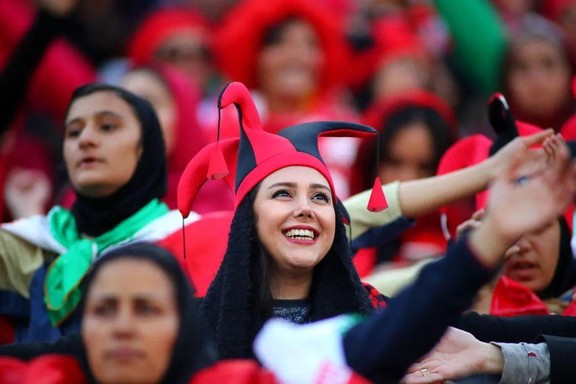
Female fans of Esteghlal FC allowed to watch a game in 2022
Female Iranian football fans are no longer officially banned from stadiums but religious fundamentalists still publicly rue the lifting of the four-decade-old restriction.
The ban enforced after the Islamic Revolution of 1979 was lifted in October 2019 under pressure from FIFA, the governing body for international football and its Asian counterpart the Asian Football Confederation (AFC).
FIFA had warned Iran’s football federation that it could face expulsion from global tournaments including the World Cup if women were not allowed to attend.
Female fan of Tractor FC at Tehran's Azadi Stadium
Women are still not permitted to attend all matches. Local authorities frequently cite what they call insufficient preparation, such as the lack of designated seating areas for women as a reason for their exclusion.
When women are allowed, the number of tickets available to them is often limited, and female enforcement officers in black chadors are present to ensure compliance with mandatory hijab laws.
Nevertheless, footage and photos posted on social media show defiance of the hijab is widespread.
Hijab enforcers and female fans at Tehran's Azadi Stadium
The hardline newspaper Kayhan, closely linked to the office of Iran’s Supreme Leader, criticized the decision to allow women into stadiums. On Thursday, the daily accused proponents of the change of “implanting the idea that women’s success and dignity lie in imitating men’s behavior and attire.”
Kayhan’s criticism followed the release of footage showing female fans at a match between Tractor FC and Persepolis FC on Wednesday in which both male and female fans were seen cheering and occasionally swearing.
Kayhan argued that women’s presence has not improved what it described as the “poisonous and unhealthy atmosphere” of stadiums. It said it has led to violations of what it called women’s dignity, a “fundamental principle in Iranian and Islamic culture," according to the hardline paper.
Official poster of Offside, a 2006 film about women trying to watch a football game disguised as men
Iranian authorities have long justified the ban on women’s attendance as a measure to protect them from exposure to profanities often chanted by male fans, even if women were seated in separate sections of the stadium.
Over the years, some women have taken significant risks to watch matches. Disguised as men, they attempted to enter stadiums but were often caught, arrested, abused or even sentenced to prison terms.
The ultra-hardline outlet Mashregh News also criticized FIFA President Gianni Infantino, suggesting he should have attended the Wednesday game week to understand the authorities’ stance against women’s presence in stadiums.
Infantino has consistently pressured Iran on this issue, particularly after the tragic case of Sahar Khodayari.
In September 2019, Khodayari, nicknamed the Blue Girl after her favorite team Esteghlal FC (nicknamed the Blue Team), set herself on fire after being sentenced to jail for attempting to enter Tehran’s Azadi Stadium disguised as a man.
This issue has also been reflected in art and media. Jafar Panahi’s 2006 film Offside depicted the story of young women disguising themselves as boys to watch a World Cup qualifying match at Azadi Stadium. The film won the Silver Bear at the Berlin International Film Festival but was never approved for screening in Iran.