Hardliners caution against US talks but others buoyed by Pentagon pick
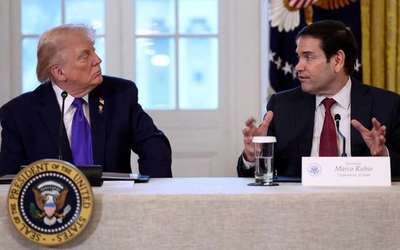
US President Donald Trump signs executive orders in the Oval Office, January 23, 2025.
While prominent Iranian officials and clerics reaffirmed their opposition to negotiating with the United States, one appointment in Donald Trump’s administration has raised cautious optimism for a potential diplomatic opening.
The appointment of Michael Dimino as Deputy Assistant Secretary of Defense for the Middle East is seen by some observers in Tehran as an indication of a possible recalibration in US policy toward Tehran.
Esmaeil Khatib, Iran’s Intelligence Minister, dismissed the notion of productive negotiations with the US, citing previous instances where, according to him, Washington failed to uphold its commitments.
“The Islamic Revolution has extensive experience with these negotiations, a prominent example being the JCPOA. Negotiations held in Oman, as well as those concerning our assets in Qatar and South Korea, all reveal that the Americans have not fulfilled their promises in any of them,” Khatib told ILNA, referencing the 2015 nuclear deal.
He repeated his staunch opposition to what he called imposed negotiations, adding, “Anyone who is truthful will earn the respect of Iran, Islam, and the Revolution for their honesty, and wherever there is deceit, arrogance, hostility, and oppression, Iran will resist.”
Clerics Echo Anti-US Sentiment
Tehran’s Friday prayers featured strong rebukes of US policies. Ahmad Khatami, a senior ultra-conservative cleric, invoked Iran’s ideological opposition to Washington, saying, “The late leader Khomeini called the US the Great Satan. The Supreme Leader Ali Khamenei has reiterated this stance numerous times.”
Khatami argued that the US’s primary aim in seeking talks was to undermine the Islamic Republic, adding, “The US seeks negotiations as a means to confront the Revolution.”
Ahmad Alamolhoda, Mashhad’s hardliner Friday Prayer Leader, also criticized domestic advocates for dialogue with the West, asking, “With whom do you wish to negotiate? With defeated elements who have sunk to such humiliation?”
Dovish Dimino?
While Iranian hardliners reject overtures from Washington, moderate voices within the country have pointed to potential openings under Trump’s renewed tenure.
Fararu, a relatively moderate Iranian news outlet, highlighted comments by VP for Strategic Affairs Mohammad Javad Zarif, who expressed hope for a more rational approach from Trump.
The outlet noted that recent changes in Trump’s foreign policy team, including Dimino’s appointment, could signal an interest in diplomacy.
Dimino’s stance on the Middle East contrasts with more forceful policies. He has opposed preemptive military strikes on Iran, called for reducing the US military footprint in the region, and emphasized diplomacy as a solution to conflicts.
This Department of Defense official has said that the US should significantly reduce its troop presence in the region and shut down its military bases in Iraq and Syria.
Dimino had described US strikes on the Houthis as lacking deterrent value. He also called for a reassessment of the US presence in the Persian Gulf.
"Iranian power remains both exaggerated and misunderstood. Its economy continues to underperform, and its conventional military is antiquated and untested. Tehran simply doesn’t have the financial capital or hard power capabilities to dominate the Middle East or directly threaten core US interests," he wrote in a 2023 article.
He has repeatedly warned that Israeli attacks on Iran and the Islamic Republic’s proxy forces increase the risks to US forces in the region.
Critics, however, argue that his affiliation with the Quincy Institute for Responsible Statecraft —a think tank known for promoting restraint in US foreign policy—raises concerns about the administration’s commitment to Israel.
Pro-Israel figures, such as commentator Mark Levin, have criticized Dimino’s views, citing his opposition to US defensive support for Israel against Hezbollah. Others view his appointment as a potential indicator that Trump is exploring non-military options in dealing with Tehran.
US-Iran relations have been fraught since Trump’s 2018 withdrawal from the JCPOA, a decision that intensified sanctions and strained Tehran’s economy.
Tensions peaked in January 2020, when a US drone strike killed IRGC Qods Force Commander Qassem Soleimani, an event that both nations view as a turning point in their confrontation.
As Trump’s administration implements a renewed maximum pressure campaign, debates persist about the feasibility of US-Iran diplomacy.
The Azerbaijan Ministry of Foreign Affairs building.
On Saturday, Azerbaijan’s Ministry of Foreign Affairs summoned Jafar Aghaei Maryan, the chargé d'affaires at Iran's Embassy in Baku, to lodge a protest over alleged anti-Azerbaijan content in Iranian media.
According to the APA news agency, Azerbaijani officials raised objections over what they described as a systematic campaign by Iranian media outlets, allegedly close to the Iranian government, to discredit Azerbaijan.
The controversy follows reports that Azerbaijan expelled or barred 16 Iranian female students, accusing them of collaborating with Iranian-linked entities. Iranian state media condemned the expulsions as being aligned with Israel’s policies.
Tensions further escalated earlier in January after Azerbaijan’s security services said they had foiled a plot to assassinate a prominent local Jewish figure for $200,000. Two suspects were arrested, with Azerbaijani officials alleging they acted "under the guidance of a foreign country." While no nation was explicitly named, sources within Azerbaijan’s Jewish community have pointed to Iran.
Meanwhile, on Friday, Mojtaba Demirchilou, an aide to Iran’s foreign minister and director general for Eurasia affairs, met with Azerbaijan's ambassador in Tehran, Ali Alizadeh. During the meeting, Demirchilou protested what he described as "negative actions by certain circles or individuals in Azerbaijan," including the "unethical incident" involving Iranian students. He described these actions as "damaging to relations between the two nations" and called for decisive measures against those responsible.
This development adds to long-standing tensions between the two countries. Tehran has been critical of Baku’s close ties with Israel, while Azerbaijan has expressed frustration over Tehran’s alleged provocations, including inflammatory rhetoric by Iranian clerics and media.
Earlier this month, Azerbaijani President Ilham Aliyev condemned remarks by Iranian cleric Seyyed Hassan Ameli, the Friday Prayer Leader of Ardabil. Ameli accused Azerbaijan of collaborating with Israel and described President Aliyev's policies as part of a "multi-billion dollar gamble with the Israelis." The remarks, aired on IRIB News, also reportedly included insults towards Turkish President Recep Tayyip Erdoğan.
During a press briefing, Aliyev publicly questioned Iran’s leadership over its silence on the matter, demanding an apology. "What is their reaction? Does [the Iranian leadership] support this or not? Who will apologize to Azerbaijan?" Aliyev asked, reflecting the deepening strain between the neighbors.
FILE PHOTO: U.S. President-elect Donald Trump and Elon Musk watch the launch of the sixth test flight of the SpaceX Starship rocket in Brownsville, Texas, U.S., November 19, 2024.
The Iranian daily Etemad, which is close to President Masoud Pezeshkian's government, has urged officials to invite Elon Musk to Tehran, calling the outreach to the billionaire Trump advisor a golden opportunity for the country.
The proposal comes as Iranian officials and many commentators in Tehran advocate for negotiations with President Donald Trump to address differences with Washington and ease sanctions amid deep economic malaise.
In an editorial titled "Iran: The Gateway for Elon Musk to the Middle East," Etemad highlighted Musk’s global influence, describing him as "a world-renowned figure and an extraordinary, golden opportunity." The editorial urged officials to act swiftly, stating, "Let us seize this chance ahead of competitors and invite him to Tehran, to Azadi Stadium." It further remarked, "Just as he envisions carpeting Mars for humanity, we should not hesitate to roll out the carpet for him in Tehran."
This proposal coincides with speculation about Musk’s indirect involvement in the release of Italian journalist Cecilia Sala, who was arrested in Iran last month and released in January.
Last week, The New York Times reported that Musk reached out to Iran’s ambassador to the UN, Amir Saeid Iravani, to facilitate Sala’s freedom—a claim Musk denied on X, writing, "I haven’t had any interaction with Iran. Just recommended support from the US side." Iranian officials have dismissed the reports as "media storytelling and fabrication."
Also in November, The New York Times wrote that Musk and Iravani met in person in New York, which Tehran denied.
Despite the controversy, Etemad framed Musk’s potential visit as a pivotal moment for Iran, asserting, "His arrival in Tehran would attract more attention globally than his journey to Mars. Let us seize this opportunity for Iran and the Middle East." The newspaper argued that Musk’s presence could symbolize a leap forward in technology and artificial intelligence for the region.
Iran's President Masoud Pezeshkian during his Russian TV interview in Moscow.
Iran’s President Masoud Pezeshkian praised Vladimir Putin in a Russian state TV interview for resisting the United States but carefully sidestepped provocative questions as his government broaches potential renewed US talks.
Iranian state-controlled media published an official account of the interview on Friday from his visit to Moscow last week, highlighting exchanges with Vladimir Solovyov, one of Russia’s most outspoken nationalist TV personalities.
When asked about his view of Putin, Pezeshkian expressed appreciation for the Russian president’s opposition to unilateralism, a term often used by the two heavily sanctioned and isolated powers to describe US policies.
“That sense within us, and among those who seek freedom and independence, grows stronger by the day. As a result, we feel this shared connection and closeness in our beliefs, and we will stand together,” Pezeshkian said, referring to Putin.
Addressing sanctions imposed by the United States on both Russia and Iran, Pezeshkian emphasized the significance of their partnership.
“The long-term strategic agreement we signed with the Russian Federation indicates that neither Russia nor Iran intends to succumb to the demands they seek to impose on us,” he remarked.
Pezeshkian posed a question of his own, asking whether Moscow and Tehran would cooperate in mutual defense if Iran were attacked by the United States or Israel.
“According to the terms of the agreement, it has been established that in the event of an attack on Iran or Russia by another country, we are committed to refraining from any form of cooperation with the aggressor and preventing such an occurrence," he answered.
Pezeshkian’s answer implied that the strategic treaty he signed with Putin is not an ironclad mutual defense pact, despite Iran's heavy supply of drones and other munitions to Russia for its full-scale invasion of Ukraine.
The deliveries have been met with further US-led sanctions, deepening economic suffering in Iran which has led relative moderates in the country to call for renewed talks with the United States over Tehran's disputed nuclear program.
Solovyov posed a sharp question, asking why the Islamic Republic shows such restraint despite the United States imposing "terroristic sanctions" and Israel directly targeting its officials and interests.
While Pezeshkian condemned Israel, his response was measured, launching into an extended monologue about the peaceful nature of religions and prophets.
Solovyov persisted with his line of questioning, asking Pezeshkian for his thoughts on “the recent developments in the region and the Americans' efforts to create instability along Iran's borders.”
“As I mentioned earlier, the conflict is fundamentally about truth versus falsehood and justice versus injustice,” Pezeshkian replied, continuing into an extended philosophical reply.
Like Ankara and Moscow aspiring to rebuild their Ottoman and Russian empires, Iran was one of the world’s oldest empires, Pezeshkian said, which ruled vast territories but respected local customs and traditions and giving authority to local elites.
Pezeshkian went on to deny that the Islamic Republic has ever engaged in violent actions or encouraged and supported war in the region. However, a countdown clock in Tehran still prominently displays the purported timeline for Israel’s destruction.
The president had sounded a dovish tone in an interview with US news channel NBC in an interview in Tehran the same week.
"The Islamic Republic of Iran is committed to peace and de-escalation in the region and globally, condemns the Zionist regime's war-mongering, aggression, and genocide, and stands ready for honorable and equal negotiations," he said.
President Donald Trump's policy on Iran may depart from the maximum pressure campaign of sanctions which defined his first term, Alexander Farley of the Woodrow Wilson Center told Iran International.
Trump has excoriated his predecessor Joe Biden for allowing Iran to rake in more revenue from oil sales to boost armed allies in the region.
Newly appointed aides have pledged to revive a so-called maximum pressure campaign of sanctions on Iran to compel it to drop its disputed nuclear program.
But Trump's public break with two officials who helped mastermind the strategy may indicate a new tack on how to deal with Washington's Mideast arch-enemy.
"John Bolton, much like Brian Hook is someone who here in DC we associate very closely with the maximum pressure school of policy toward Iran," Farley said. "The fact that those two were removed must mean the President is somewhat unsatisfied with how things went in his last administration."
Trump dramatically deprived Bolton, his former national security advisor and former Iran envoy Brian Hook despite them being a target - like Trump himself - of alleged assassination plots by Tehran.
In the wake of Trump's first term, Farley continued, "Iran became more conservative, Iran became more embedded in the region in a lot of ways. That's changed recently, but perhaps that's what he's reflecting on."
"President Trump ... doesn't want to preclude maybe making a deal if he thinks it's in his interest and in the US interest. So I think, you know, he's kind of maybe giving up on theory a little bit and Maybe trying to take it in a new direction."
An advocate of hard line on friend and foe alike to advance his so-called America First policy, Trump has said Iran cannot be allowed to develop nuclear weapons but has also dismissed the idea of seeking regime change.
Speaking to reporters in the White House on Thursday, Trump said he hoped the United States would not have to support an Israeli strike on Iran to take out its nuclear sites and a deal would be preferable.
"I wouldn't say I foresee a deal, but I foresee some sort of effort to open up discussions," Farley added. "He might dangle some kind of opportunity to negotiate along with a very aggressive policy."
Families of Iranian political prisoners executed in the 1980s have been barred from entering Khavaran Cemetery in Tehran for more than 11 months, they said in an open letter to Iran’s President Masoud Pezeshkian.
The site, known for containing mass graves of thousands of political prisoners executed in the summer of 1988, has been closed to the families since early 2024, the families said.
“For 11 months, Khavaran’s gates have been closed to us,” the letter read. “Despite our numerous attempts to resolve this legally, we have been met with silence or insulting behavior by officials,” they said.
In the letter, the families accused authorities of obstructing their basic right to mourn. They detailed repeated appeals to various government bodies but said they have received no meaningful response.
They said their petitions have been referred between agencies, with intelligence officials refusing to address their concerns.
The families also condemned the burial of unrelated individuals at the cemetery, calling it disrespectful and a renewal of their grief. They demanded the removal of barriers to the cemetery, the reopening of its gates and the cessation of additional burials at the site.
A total of 93 families signed the letter, which also criticized the behavior of cemetery staff. They said the individual overseeing the site, identified as Masoud Momeni, has harassed families, limited their visitation times and demanded national ID cards to grant access to graves, further compounding their suffering.
The letter was also sent to senior officials, including the judiciary, interior ministry and Tehran's local authorities, as part of their ongoing fight for justice and accountability.
The Abdorrahman Boroumand Foundation, a US-based rights group, reported that on Friday, the families once again faced locked gates at the cemetery and protested the ban by scattering flowers at its entrance.