Kurdish cities in Iran strike over death sentences for two Kurdish women

Businesses in several Kurdish cities in Iran went on strike Wednesday after Kurdish groups called for a protest against the death sentences of two female political prisoners.
Businesses in several Kurdish cities in Iran went on strike Wednesday after Kurdish groups called for a protest against the death sentences of two female political prisoners.
Social media images showed closed shops in cities such as Sanandaj, Saqqez, Divandarreh, and Marivan in Kurdistan province, as well as Mahabad, Bukan in West Azarbaijan province, and Kermanshah.
Earlier this week, six Kurdish groups released a joint statement urging people to stage a strike on Wednesday to prevent the executions of Pakhshan Azizi and Varishe Moradi by shutting down marketplaces, workplaces, and schools.
Moradi was sentenced to death in November by Tehran's Revolutionary Court on charges of "armed rebellion." Azizi received the same sentence in July.
Both sentences have sparked outrage locally and internationally. Shirin Ebadi, a Nobel Peace Prize laureate, also joined the protest calls, writing on Instagram, “I urge all political, social, cultural, civil, and professional organizations to join this strike.”
Among the parties supporting the strike were the Democratic Party of Iranian Kurdistan, also known as the Kurdish Democratic Party of Iran (KDPI), the Kurdistan Free Life Party (PJAK), the Kurdistan Freedom Party (PAK), the Komala Party of Iranian Kurdistan, the Kurdistan Democratic Party of Iran, and the Kurdistan Organization of the Communist Party of Iran.
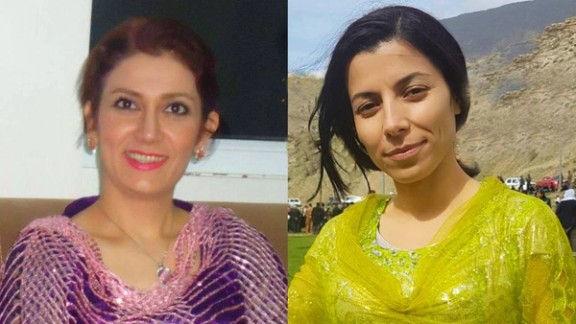
Azizi was sentence to death in July 2024 for “armed rebellion against the state” and imposed an additional four-year prison sentence for alleged membership in the PJAK, accusations her lawyers have denied. PJAK has been designated as a terrorist organization by Iran, Turkey, and the US.
In addition to these groups, students and a coalition of Kurdish women issued separate statements condemning the death sentences. They also expressed support for the strike, denouncing the treatment of Azizi and Moradi, who are detained in Tehran’s Evin Prison, notorious for its harsh conditions and political detentions.
Earlier this month, Amnesty International has condemned Iran’s Supreme Court for upholding Azizi’s death sentence, calling her trial deeply flawed and her punishment unjust. Amnesty said, “Iran’s authorities must halt any plans to carry out her execution and release her immediately,” adding that her conviction appears to be tied to her peaceful humanitarian and human rights work.
In a letter from prison, Azizi has described instances of torture and harassment, including mock executions. Her case has become a focal point for human rights organizations, with many viewing her sentencing as part of a broader pattern of state repression against political dissidents.
According to the US-based rights group HRANA, at least 54 political prisoners, including Azizi, are currently facing execution across various prisons in Iran. Iran has faced increasing international criticism for its widespread use of the death penalty, especially against political prisoners and activists.
The United Nations human rights office reported in January that Iran in 2024 executed 901 people, including 31 women, marking a sharp rise in capital punishment cases.