• العربية
  • فارسی
BrandBrand
  • Iran Insight
  • Politics
  • Economy
  • Analysis
  • Special Report
  • Opinion
  • Podcast
  • Live TV
  • Iran Insight
  • Politics
  • Economy
  • Analysis
  • Special Report
  • Opinion
  • Podcast
  • Live TV
  • Theme
  • Language
    • العربية
    • فارسی
  • Iran Insight
  • Politics
  • Economy
  • Analysis
  • Special Report
  • Opinion
  • Podcast
  • Live TV
All rights reserved for Volant Media UK Limited
volant media logo
ANALYSIS

Iran’s limited options for retaliation amid calls to end counterattacks

Mardo Soghom
Mardo Soghom

Iran International

Oct 26, 2024, 13:07 GMT+1Updated: 15:32 GMT+0
Iran's Supreme Leader and a group of his military commanders

While the Islamic Republic’s establishment downplays Israel’s air strikes as ineffective and praises Iran’s air defenses, many hardliners are pushing for a retaliatory response—one that risks triggering further reciprocal attacks.

Details of the Israeli attack are still unclear. The only certainty is that the air strikes targeted air defense systems and missile production facilities, but exactly how many targets were hit and what the damage was, has not yet been disclosed.

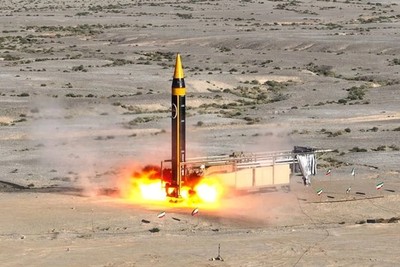
What are Iran's options for retaliation, despite its earlier stance suggesting it might forgo a response to a limited Israeli attack to avoid prolonging the cycle of counterattacks? Iran has already launched hundreds of ballistic missiles at Israel twice this year, causing minimal damage. With no effective air force, Iran’s retaliatory capabilities are largely confined to a few types of medium-range ballistic missiles, whose accuracy remains uncertain.

Both Israel and the United States have warned Tehran not to respond to this attack. “We urge Iran to cease its attacks on Israel so that this cycle of fighting can end without further escalation,” US National Security Council spokesman Sean Savett told reporters. The US has boosted its forces in the region with the aim of deterring further Iranian attacks, especially against its Arab allies around the Persian Gulf.

Iran has around 3,000 missiles available for more attacks against Israel, but it is not so much an issue of weapons availability, as much as an issue of more Israeli counterstrikes, while Iran’s skies apparently remain defenseless. There are no reports of Iranian air defenses intercepting even one Israeli missile on October 26. There are also no reports of any fighter jets being scrambled to face Israeli planes, which probably fired their ordinance from Iraqi airspace.

This means that if Iran decides to launch another round of missiles, Israel could counterstrike by targeting assets that would significantly impact Iran's Islamic government—particularly its economic infrastructure. One major point of weakness is oil refineries that produce for the domestic market. Iran has two large refineries and even if one of them is damaged, the country would face serious problems at the onset of winter. This approach would avoid impacting global oil prices, allowing Israel to sidestep potential backlash from the US, which has advised against targeting Iran's oil production and export facilities.

In recent past, Iran’s rulers could count on their well-armed proxies, such as the Lebanese Hezbollah, to play the role of a deterrent against Israel. However, after Israeli operations that became intense in recent months, both Hezbollah and Hamas have been significantly weakened. Despite Israel’s relentless bombardment of targets in Lebanon, Hezbollah has not been able to launch tens of thousands of rockets that many feared could overwhelm air defenses.

As a result, Iran’s longstanding strategy of confronting Israel through proxies abroad appears to have faltered, with hostilities now reaching its own soil. A single major Israeli airstrike on critical economic targets could pose serious threats to the Islamic government, already grappling with multiple economic crises. An impoverished population—hard-hit over the past five years and shown to be ready to protest—may not tolerate another severe decline in living conditions.

Most Viewed

Iran state TV says modified missile could reach US base in Britain
1

Iran state TV says modified missile could reach US base in Britain

2
ONE-ON-ONE

Iranians and Israelis can defeat the IRGC together, says Arab-Israeli activist

3

Seven years after ‘Bloody November,’ Iran rations gasoline it dares not reprice

4

Third US carrier joins Iran blockade, Bessent warns of economic collapse

5

Blair's sister-in-law attended Iran conference linked to IRGC spy recruitment - Telegraph

Banner

Spotlight

  • Can higher fuel prices curb Iran’s smuggling problem?
    ANALYSIS

    Can higher fuel prices curb Iran’s smuggling problem?

  • Canadian MP to flag paintball gun findings after Iran protest blindings
    PODCAST

    Canadian MP to flag paintball gun findings after Iran protest blindings

  • Locks for cash: inside Iran's booming hair trade

    Locks for cash: inside Iran's booming hair trade

  • Seven years after ‘Bloody November,’ Iran rations gasoline it dares not reprice

    Seven years after ‘Bloody November,’ Iran rations gasoline it dares not reprice

  • Iranians and Israelis can defeat the IRGC together, says Arab-Israeli activist
    ONE-ON-ONE

    Iranians and Israelis can defeat the IRGC together, says Arab-Israeli activist

  • Iran's oil output plunges below pre-war domestic needs
    ANALYSIS

    Iran's oil output plunges below pre-war domestic needs

Banner
Banner
Banner
Banner
Banner
Banner











