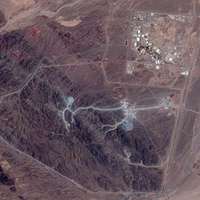
Military personnel stand guard at a nuclear facility in the Zardanjan area of Isfahan, Iran, April 19, 2024.
Iran's Islamic Revolutionary Guard and state media have denied reports that an air base in the central province of Isfahan, home to several Iranian military and nuclear facilities, was targeted by Israel overnight.
Reports of explosions in Isfahan in the early hours of Tuesday alarmed residents, with social media users speculating that Israel, amid heightened tensions, may have launched an attack on Iran’s nuclear and missile infrastructure.
The Islamic Revolutionary Guard's Saheb al-Zaman Headquarters in Isfahan issued a statement attributing the explosion heard at dawn on Tuesday to a defense system test conducted in the area.
“The sound of the explosion heard at midnight was due to seeing a luminous object and the test activity of the defense system,” the Public Relations Department of the Saheb al-Zaman Headquarters said in a statement on Tuesday.
An earlier statement from the Khatam al-Anbiya Air Defense Base similarily dismissed reports of an explosion, stating that the sounds heard in the city were due to the "testing of a new defense system."
Explosions have previously stirred concern in Isfahan; in mid-August, similar reports surfaced but were ultimately attributed to "training activities" by local authorities.
Isfahan, housing key nuclear facilities including the Natanz uranium enrichment complex, is a strategic site for Tehranand has been the target of suspected Israeli sabotage operations in the past.
In April, Israel reportedly destroyed part of an S-300 long-range air defense system in the city in response to Iran's earlier missile and drone barrage against Israel. The incident was viewed as part of an ongoing shadow war between the two nations, with Isfahan's military significance making it a focal point of tensions.
Following a series of highly effective Israeli operations against Iran's primary proxy, Hezbollah—which culminated in the assassination of its leader, Hassan Nasrallah—the Islamic Republic retaliated with a massive missile barrage against Israel on October 1. This marked the second Iranian missile strike since April.
Since then, anticipation has grown around an imminent Israeli response, with military analysts debating the scale and targets of potential retaliation.
Although strikes on Iran’s nuclear facilities remain a possibility despite the challenges involved, many experts argue that Israel is more likely to focus on crippling critical energy, economic, and military infrastructure for a broader strategic impact.
Foreign Minister Abbas Araghchi speaking in Tehran on October 8, 2024
Iran’s foreign minister warned Israel on Tuesday not to test Tehran’s resolve, stating that while Iran won’t act hastily, it also won’t hesitate to deliver a strong retaliation if attacked.
Abbas Araghchi spoke at a gathering marking the October 7 anniversary of the Hamas attack on Israel, where Iranian officials lauded the assault as a major achievement by the so-called "Resistance axis," a network of regional militant groups backed by Iran.
"We recommend the Zionist regime (Israel) not to test the resolve of the Islamic Republic. If any attack against our country takes place, our response will be more powerful," Araghchi said in a televised speech.
After a series of devastating Israeli operations against Iran’s main proxy group, the Lebanese Hezbollah and the killing of its leader Hassan Nasrallah, the Islamic Republic launched a large missile barrage against Israel on October 1. This was the second Iranian missile attack since April, but like the earlier operation, it inflicted little damage. The Israeli government immediately vowed a punishing retaliation, but so far, no attack has taken place.
Echoing Supreme Leader Ali Khamenei, Araghchi reaffirmed that Tehran “stands fully behind the Resistance, with its full strength and support.”
However, beyond its stockpile of hundreds of ballistic missiles, Iran has limited military capacity to effectively challenge Israel, which boasts far more advanced military and weapons systems. Despite launching around 300 ballistic missiles, along with drones and cruise missiles, in two large-scale attacks, Iran has achieved little success. Most of the projectiles have been intercepted by Israeli and allied anti-air defenses, rendering the assaults largely ineffective.
However, Araghchi warned that “Any attack by the Zionist regime [Israel] on Iran's infrastructure will be met with a stronger response.” He also stated “Our enemies know which targets within the Zionist regime are within our reach. They have witnessed firsthand the power of our missiles.”
The scope and scale of a potential Israeli attack on Iran are subjects of intense debate among military experts and analysts. While strikes on some of Iran’s nuclear facilities remain a possibility, most experts believe Israel would more likely focus on key energy, economic, and military targets.
Iran’s exiled prince Reza Pahlavi at the Western Wall in Jerusalem on April 18, 2023
Media outlets in Tehran have pounced on a fresh push by Iran's exiled prince to deepen ties with Israel and advocate for the fall of the Islamic Republic by highlighting differences between his father and the Jewish state.
Scrutiny of the long-overlooked historical chapter was revived when former Israeli Prime Minister Naftali Bennett last week urged Israel to act decisively against Iran, saying the Islamic Republic’s proxies Hamas and Hezbollah have been weakened.
"Israel now has its greatest opportunity in the last 50 years to change the face of the Middle East," Bennett posted on X on October 2, emphasizing the need for action following Iran’s missile attack on Israel the previous day.
Bennett's comments appear to reference events extending back to the Pahlavi era, coinciding with the 50-year anniversary of the 1973 Yom Kippur War.
Iranian dailies Entekhab and Shahr-e khabar said Bennett was highlighting a rift between Israel and Iran's leadership even prior to the 1979 revolution.
Iran’s historical relationship with Israel
Under Shah Mohammad Reza Pahlavi, Iran maintained close ties with Israel, becoming the second Muslim-majority nation to recognize the Jewish state.
Despite opposition from some political figures, relations between Iran and Israel were strengthened through arms deals and security cooperation, with Israel providing military assistance in exchange for Iranian oil.
The Islamic Republic largely upended that relationship, becoming one of Israel's most vocal adversaries.
Iran's leadership, particularly Supreme Leader Ali Khamenei, has repeatedly vowed Israel’s destruction, with state-sponsored events promoting Holocaust denial further inflaming tensions.
However the article on Entekhab's website on Monday noted that ties between Iran and Israel began to deteriorate after the 1973 Yom Kippur War in October 1973.
“The Shah sought more independence in foreign policy, diversifying arms purchases and pursuing stronger ties with other global powers, including the Soviet Union," Entekhab wrote on Monday.
"During the war, the Shah allowed Soviet planes to pass through Iranian airspace to deliver military supplies to Egypt, and Iran provided financial and oil support to Egypt. This further strained relations with Israel, leading to a gradual distancing between the two nations, which culminated in the complete severance of ties after the 1979 Iranian Revolution,” it added.
The Shah maintained good relations with then-Egyptian President Anwar Sadat and on a few occasion did criticize Israel while even more strongly criticizing the Palestinians. However, he was a Western ally and continued cooperation with Israel.
Reza Pahlavi’s advocacy
Reza Pahlavi, the exiled son of the Shah, presents a viewpoint that starkly contrasts with the narrative put forth by Entekhab and others.
He has actively called for “regime change” in Iran while advocating for renewed ties with Israel. In April 2023, Pahlavi traveled to Israel “to deliver a message of friendship from the Iranian people.” He publicly prayed for peace between Israel and Iran during a visit to the Western Wall in Jerusalem.
Pahlavi expressed hopes that the two nations can one day resume their historical friendship.
He tweeted from the Western Wall, referencing Cyrus the Great's liberation of the Jewish people: “It is with profound awe that I visit the Western Wall of that Temple and pray for the day when the good people of Iran and Israel can renew our historic friendship.”
In an interview with Fox News on Sunday, Pahlavi said, “An Iranian regime change would mean an end to many global problems.” He emphasized that a change would alleviate many global problems, highlighting the detrimental impact of the current leadership on Iran’s economy and stability.
"The nuclear threat, the proliferation of this ideology, period, the end of this regime would mean an end to all these problems," he said.
Twenty-two female political and ideological prisoners in Tehran’s Evin Prison have released an open letter demanding an immediate halt to the sexual harassment of inmates during body searches.
"We, a group of female political and ideological prisoners in Evin prison, are demanding accountability for the unconventional body searches and sexual harassment of several inmates during these inspections. If the authorities do not respond, we will resort to protest actions," their letter published on political prisoner Gholrokh Iiraee’s X account on Sunday said.
Recent reports have shed light on incidents of sexual assault and abuse within Iran’s prison system.
"These body inspections have become an excuse to sexually harass prisoners," said journalist and human rights activist, Reza Akvanian, commenting on the situation in an interview with Iran International.
While technology exists to conduct non-invasive scans, Akvanian said, Iranian prisons continue to allow invasive procedures that can result in sexual harassment. Akvanian doubted the Islamic Republic’s judiciary's willingness to address these violations, citing past neglect and the stepped-up sentences faced by activists who report such abuses.
Nobel Peace Prize laureate, Narges Mohammadi, imprisoned in Evin and one of the signatories of the letter, faced new charges earlier this yearafter exposing incidents of sexual harassment against detained women.
A March 2024 report from the UN’s Independent Fact-Finding Mission (FFM) on Iran confirmed instances of sexual violence, including gang rape and forced nudity inflicted upon those detained during Iran’s nationwide Women, Life, Freedom protests following Mahsa Amini's death in police custody in 2022.
“To extract confessions, punish and humiliate detained women, girls, men and boys, security officers subjected them to sexual and gender-based violence, including rape, gang rape, rape with an object, and forced nudity, as well as beatings, flogging and burning, the use of electric shocks, suspension, and stress positions, in acts amounting to torture,” the FMM said in their report.
Last year Human Rights Watch and Amnesty Internationalreleased reports detailing sexual assault by agents of the IRGC, Basij, Ministry of Intelligence, and various police departments against women, men, and children during the protests following Amini's death.
Commander of the Islamic Revolutionary Guard Corps' Quds Force Esmail Qaani
The top commander of Iran's military operations abroad has not been seen in days and several stilted official allusions to him on Monday further fueled speculation about his whereabouts and the possibility of his death at Israeli hands.
The leader of the Islamic Revolutionary Guard Corps' elite Quds Force Esmail Qaani did not appear alongside other top commanders Friday prayers led by Supreme Leader Ali Khamenei on Friday.
Iranian media reports on Saturday alleged that Qaani might have been in Beirut following the death of Hezbollah leader Hassan Nasrallah and continued Israeli air strikes on positions of the Iran-backed group.
Some Iran watchers suspect he might have been killed or injured in Israeli air strikes.
"Many are asking about General Qaani. He is well and actively engaged in his duties." Iraj Masjedi, the deputy coordinator of the Quds Force said on Monday.
"Some are suggesting a statement be issued. Why a statement? There is no need for such an action," he said.
Adding to the mystery, an October 1 post on Qaani's X account - "God is great" - appearing to celebrate Iran's large missile attack on Israel that day was subsequently deleted.
At a Tehran conference on youth issues where Qaani was due to speak on Monday, an organizers said he “sent his regards” and apologized for not being able to attend the meeting due to his involvement in matters elsewhere.
Informed sources have told Iran International that even Qaani's family remained unaware of his whereabouts.
A targeted air strike on Beirut last week which aimed to assassinate Hashem Safieddine, a senior Hezbollah leader and potential successor to Hassan Nasrallah, has raised speculation about Qaani’s possible presence.
Qaani had traveled to Lebanon to meet with Hezbollah officials in an effort to strengthen the group, the New York Times, citing three unnamed Iranian officials, reported. Reuters also reported on Sunday that according to Iranian officials Qaani has not been heard from since Friday.
Senior Hezbollah official Mahmoud Qmati told Reuters: "I have no information, we are also searching for the truth of this matter."
Israel was not aware of Qaani's presence when it struck Beirut, the Times of Israel reported citing military sources.
"If Qaani was actually with Safieddine during the strike, the IDF was not aware of this and that he was not the intended target," military sources told the Israeli daily.
Iranian exiled prince Reza Pahlavi issued a statement on the anniversary of the October 7 attack on Israel in an effort to reassure Iran’s neighbors that a revolution in Iran that topples its Islamic rulers would not add to the turmoil in the region.
“I say to you, our friends across the Middle East…this regime that has held us hostage for nearly half a century must go,” he said in a video statement on X. “I know you might fear change might bring chaos. But fear not, we will not allow a power vacuum to follow the collapse of the regime.”
Pahlavi has been calling for the fall of the current Iranian authorities for many years, appealing to western governments mainly. His recent message is addressed to regional powers, however, and has been published not just in English but also Hebrew and Arabic.
It appears to be an attempt to counter the Islamic Republic’s claim to be leading the fight against Israel and the US on behalf of the people of Muslims in the Middle East and beyond.
“(The Islamic Republic) has fueled sectarian conflicts in Syria, Iraq, Lebanon… It uses the Palestinians as human shields,” Pahlavi said. “The tyrant in Tehran couches his warmongering in Iranian nationalism. But he does not speak for our nation.”
The statement came as Israel weighs its options to retaliate against Iran's missile attack of 1 October. A day earlier, the exiled prince had expressed optimism that once the Islamic Republic is removed, there could be peaceful relations between Iran and Israel.
Interview with Fox News
“The end of this regime will mean an end to all these problems,” Pahlavi told in an interview with Fox News on Sunday.
Monday marked a year since Hamas forces stormed southern Israel, killing several hundred civilians and taking over 250 hostages. Since then, Israel has carried out extensive operations in Gaza, killing more than 40,000 Palestinians, according to the enclave's health officials.
Iran's leaders have praised Hamas for the attack, asserting that the country had no role in its planning or execution. Nonetheless, the Islamic Republic's unreserved support for armed groups who fight against Israel has put it on a collision course with Israel.
“If they provoke more escalation... it will create an incredible economic shock to the nation that will not be advantageous even to the regime itself,” Pahlavi said.