• العربية
  • فارسی
Brand
  • Iran Insight
  • Politics
  • Economy
  • Analysis
  • Special Report
  • Opinion
  • Podcast
  • Iran Insight
  • Politics
  • Economy
  • Analysis
  • Special Report
  • Opinion
  • Podcast
  • Theme
  • Language
    • العربية
    • فارسی
  • Iran Insight
  • Politics
  • Economy
  • Analysis
  • Special Report
  • Opinion
  • Podcast
All rights reserved for Volant Media UK Limited
volant media logo

Podcast: Is Israel's messaging failing, and how will Biden's policy be remembered?

Jul 27, 2024, 07:35 GMT+1Updated: 16:18 GMT+0

Israel’s Prime Minister Benjamin Netanyahu called for a military alliance in the Middle East to counter Iran’s threat, but his proposal has no chance without the backing of the American administration, said one of Netanyahu's former advisors.

Speaking at the US Congress on Wednesday, the Israeli Prime Minister called for the creation of a regional anti-Iran alliance in the Middle East, which he termed the ‘Abraham Alliance.’ He envisions this alliance as an extension of the ‘Abraham Accords.’

The groundbreaking accords normalized diplomatic relations with Israel and various Arab states, including the UAE, Bahrain, Sudan and Morocco during the Trump administration.

Netanyahu’s proposed pact to “counter the growing Iranian threat” comes on the heels of Secretary of State Antony Blinken warning that Iran’s ‘one or two weeks’ away from producing enough fissile material to manufacture a nuclear weapon.

On this week’s episode of ‘Eye for Iran’, Alex Selsky with the Middle East Forum, a conservative think- tank, said the idea of the 'Abraham Alliance’ would come as welcome news to Israel’s Muslim neighbors despite the war against Hamas and the destruction in Gaza.

“I think it's necessary. I think it depends on the United States…If our Arab friends and neighbors see that America gives the necessary backup, they will join,” said Selsky, who previously advised the Israeli Prime Minister.

But when it comes to the war of public relations, how is Israel fairing? And can Israel push its anti-Iran government rhetoric with the backdrop of the war against Hamas.

This week’s episode also speaks to an Iranian American human rights advocate on President Joe Biden’s legacy on Iran after he made the historic decision to drop out of the US presidential election.

Sarah Raviani, a visiting fellow at the National Union for Democracy in Iran (NUFDI), said Biden will be remembered for appeasing the Iranian government.

“We saw the disastrous $6 billion ransom deal, which received a lot of backlash from our community. And I urge everyone to remember that these are all decisions that were made not only by President Biden, but with his vice president Kamala Harris,” said Raviani referring to release of five detained Americans in Tehran and an unknown number of Iranians imprisoned in the US after billions of dollars in frozen Iranian assets were transferred from banks in South Korea to Qatar.

Raviani said the Biden-Harris administration would “say all the right things” but wouldn’t implement practical action.

She revealed her own personal insight as an activist pushing to influence US policy towards Iran like the work she did with NUFDI and other advocates to push through the MAHSA Act, a bill that strengthens US sanction against Iran’s rulers.

The MAHSA Act is bipartisan piece of human rights and anti-terrorism legislation that was named after Mahsa Amini, a 22-year-old Iranian-Kurdish woman who died while under police custody.

But just how do Iranian-Americans feel about Vice President Kamala Harris? Find out more with this week's episode of 'Eye for Iran.'

You can watch the entire episode on Iran International's YouTubePage or listen to it on Spotify, Apple or Amazon.

Most Viewed

Ghalibaf defends Iran-US talks amid hardline backlash
1
INSIGHT

Ghalibaf defends Iran-US talks amid hardline backlash

2
INSIGHT

Iran diplomacy wobbles as factions compete to avoid looking soft on US

3
VOICES FROM IRAN

Bread shortages, soaring prices strain households in Iran, residents say

4
ANALYSIS

The politics of pink: how Iran uses cuteness to rebrand violence

5

Scam messages seek crypto for ships’ safe passage through Hormuz, firm warns

Banner
Banner

Spotlight

  • Diplomacy tolls at Hormuz as conflict returns to its doorstep
    OPINION

    Diplomacy tolls at Hormuz as conflict returns to its doorstep

  • Opposition to US talks grows in Tehran as ceasefire deadline nears
    INSIGHT

    Opposition to US talks grows in Tehran as ceasefire deadline nears

  • Tehran moderates see ‘no deal–no war’ limbo as worst outcome
    INSIGHT

    Tehran moderates see ‘no deal–no war’ limbo as worst outcome

  • The future has been switched off here
    TEHRAN INSIDER

    The future has been switched off here

  • Lights out, then gunfire: Witnesses recount Mashhad protest crackdown
    VOICES FROM IRAN

    Lights out, then gunfire: Witnesses recount Mashhad protest crackdown

  • Is Iran entering its Gorbachev moment?
    INSIGHT

    Is Iran entering its Gorbachev moment?

•
•
•

More Stories

Patience runs thin in Tehran as cabinet formation drags on

Jul 27, 2024, 07:17 GMT+1

The slow pace of forming a new cabinet, nearly two months after rapid developments in Iran following the former president's death, has sparked widespread speculation among the public and politicians.

Newspapers and their affiliated politicians, as well as social media users are engaging in all sorts of speculation, many of which are quickly refuted by members of President-elect Masoud Pezeshkian's inner circle.

Expectations are often expressed as wishful thinking. As Pezeshkian himself has noted, some politicians try to promote themselves for desired posts by spreading rumors about their imminent appointment.

Some, like Ettela'at Newspaper Managing Editor Abbas Salehi Amiri have opted out of the vetting committees set up by former Foreign Minister Javad Zarif. Salehi, whose name came up in the media as one of those the committees have chosen for the post of Culture Minister, told reporters that he will not accept the position.

The newspaper, one of the biggest media organizations operating under the aegis of Supreme Leader Ali Khamenei's office, publishes a daily newspaper and a dozen popular magazines. It owns one of the country's biggest printing houses which has an enviable annual turnover. The newspaper also has a publishing house as well as several bookstores in Iran. It is far bigger than many of the government ministries.

On the other hand, although he has held government posts before, Salehi Amiri is a moderate politician weary of the utterly aggressive political landscape in Iran.

Iranian businessman and regime insider Hossein Marashi. Undated
100%
Iranian businessman and regime insider Hossein Marashi

Hossein Marashi, the Secretary General of centrist Executives of Construction Party that supported Pezeshkian during the election was rumored to be the next Vice President. However, he denied the reports. He said he has told Pezeshkian that Khamenei is a lonely person nowadays and he needs the country's biggest and most senior experts to serve in the government.

Another politician rumored to be the next vice president is former Majles Speaker Ali Larijani. While many politicians and members of the public have welcomed this rumor, some have expressed concerns that Larijani, being a far more prominent political figure than Pezeshkian, might overshadow the President and affect his performance.

Some Iranian politicians still believe that despite his disqualification by the Guardian Council for the latest and previous presidential elections, Larijani is still one of the closest Iranian politicians to Khamenei who trusts his loyalty and devotion.

Other media outlets in Iran have said with a degree of certainty that Larijani is going to be the next Secretary of Iran's Supreme Council of National Security. However, it would sound a bit strange if Larijani, a very proud politician, accepts to go back to a post he used to hold many years ago under President Mahmoud Ahmadinejad.

Meanwhile, former Culture Minister Ali Jannati who believes all the cabinet ministers and vice presidents will come from the moderate part of the Iranian political landscape, has reiterated that former Minister of Economy Ali Tayyebnia and former foreign minister Zarif will most certainly be in Pezeshkian's cabinet. Jannati and others have said that Larijani is ideal for the post of Senior Vice President and Tayyebnia is fit for the post of Vice President for Economic Affairs.

Several politicians including former Deputy Foreign Ministers Abbas Araqchi and Seyyed Mohammad Sadr as well as former Foreign Minister Ali Akbar Salehi are said to have been nominated for the post of Foreign Minister.

Zarif and former ITC Minister Mohammad Javad Azari Jahromi who have said they will not be in the new cabinet, are still mentioned as possible members of the cabinet despite harsh attacks by their political rivals in the ultraconservative Paydari Party who branded them as “Pat and Mat”, the sloppy characters of a Czech cartoon aired on the Iranian state TV.

Azari Jahromi, one of Iran's youngest former cabinet ministers and a former director general at the Ministry of Intelligence, has said that he doesn't mind others calling him Pat or Mat, adding that if Pezeshkian seeks his help, he will be there for him.

Rumors will soon end as Pezeshkian names his ministers and vice presidents, but conflicts and controversies over the appointments he makes are likely to continue for a long time.

Iran's president-elect says he will follow Khamenei's 'guiding light'

Jul 26, 2024, 18:42 GMT+1

Iran’s president-elect Masoud Pezeshkian reaffirmed his absolute allegiance to Supreme Leader Ali Khamenei on Friday, calling him the “guiding light” that the new Iranian administration would follow.

Since he won Iran’s presidential election earlier this month, Pezeshkian has been closely watched for hints of a potential ‘change’, domestically and toward the West. His latest words may have killed any such hope even before he names his cabinet.

“We do have the broad policies coming from His Greatness the Leader. I did say in our [presidential] debates that those policies are the guiding light of our path and define our goal,” Pezeshkian said in an exclusive interview with the website of the Supreme Leader’s office.

Despite widespread anticipation in Iran and abroad to see hints of any foreign policy changes, the new president did not touch the subject in the interview, which took place a few days before Pezeshkian’s inauguration, and was his first exposure to the media - if the website can be called a media outlet - since winning the vote.

Pezeshkian’s office canceled a customary press conference immediately after his victory, because he went to meet Khamenei. Amid a wave of speculations over his plans and appointments, he refrained from holding a press conference for three weeks.

Pezeshkian gave his first interview to the Leader's website
100%
Pezeshkian gave his first interview to the Leader's website

Pezeshkian confirmed in his interview that he would name his cabinet only after consulting with Khamenei and obtaining his approval. Political and security profiles, including the intelligence and foreign ministers, are known to be picked by the Supreme Leader.

However, Pezeshkian seems to have taken it one step further, suggesting that he would take to Khamenei his long-list of “4-5 candidates for each post” and make the final decision accordingly.

Beyond the “broad policies” set by the Supreme Leader, Pezeshkian seems to have little to offer at this stage. Responding to a question about the economy, he said he had “no immediate solution” and had to consult the experts. “What is urgent right now is to get rid of the [political] disagreements.”

Pezehskian did hint at a gasoline price hike, a uniquely sensitive issue to millions of Iranians that caused widespread unrest in 2019, during which 1,500 citizens were killed, according to unofficial reports.

“We have an energy imbalance in the country. We’re spending $8 billion to buy gasoline [annually],” Pezeshkian said in his interview published on Khamenei’s website. “This means we are buying gasoline at around 30,000 or 40,000 tomans [50-70 US cents] per liter, and then selling it for 1,500 tomans [2 cents] per liter. How long can we continue doing this?”

Despite having one of the world’s biggest oil reserves, Iran has had to import gasoline to compensate for the soaring demand and stagnant production in the country’s aging refineries.

Any hike in gas price would be hugely unpopular and could lead to yet another round of protests in Iran, which leaves Pezeshkian in an unenviable position. The last hike also came under a ‘moderate’ administration – that of Hassan Rouhani.

Economists warn Iran's president-elect about liberalization plans

Jul 26, 2024, 17:14 GMT+1
•
Maryam Sinaiee

Economists are warning Masoud Pezeshkian that rushing his plans to liberalize the economy including closing the gap between the official and market currency rates could cause a sudden economic shock.

Economic experts assert that the multi-rate currency system, with the government offering cheaper dollars to some importers, has primarily benefited a small group of merchants (rentiers) with political connections, fostering massive corruption.

Iran's currency that has steadily declined since the overthrow of monarchy in 1979, has experienced sharp falls since 2018 when the United States withdrew from the JCPOA nuclear deal and imposed oil export sanctions. The government, trying to prevent massive price hikes for imports, decided to offer cheap dollars to importers, indirectly subsidizing food, medicines and animal feed. However, influential insiders took advantage of the cheaper currency system to line their pockets with fake imports and still high prices for consumers.

These rates include the ‘preferential rate’ provided to importers by the government for food and medicine, cheaper than in the NIMA rate system whereby exporters must transfer their earned currency to importers. Then there is open market currency rate, which everyone can use to buy and sell foreign currencies at much higher rates. This is regulated by supply and demand, although the government tries to impact rates by periodically releasing dollars to banks and official exchanges.

Pezeshkian and his economic team led by Ali Tayyebnia, a prominent economist and former economy minister under President Hassan Rouhani, have vowed to eliminate the various rates to prevent corruption and stop the government’s extensive manipulation of the currency market.

Conservative politician and economist Ahmad Tavakkoli in an interview published Sunday, insisted that eliminating different currency rates is a “deadly advice” by the International Monetary Fund (IMF) that the governments of Hassan Rouhani and Ebrahim Raisi tried to implement. The outcome, he said, has only been further devaluation of the national currency and higher inflation.

“[Tayyebnia] must first explain who will determine the single rate, the government or the market? What rate will the government use to sell the currency [from oil exports)? The market rate?” he asked.

Already, some estimates say that one-third of the population has fallen below the 'poverty line' with annual inflation around 40% since 2019. If the government stops offering cheaper currency - or its indirect subsidies - food prices will soar, leading to dangerous instability.

Tavakkoli argued that allowing exchange rates to be decided by the market will not reduce demand for currency as personal investment or for exodus of capital. Open market rates will continue to grow and cause higher inflation and instability in the economy, and the government will eventually have to revert to two rates to avoid the ensuing destabilizing effect.

In a letter addressed to Pezeshkian, Farshad Momeni and Hossein Raghfar, two other prominent economists, similarly warned the new government about the consequences of plans that would “shock” the economy and put more pressure on the livelihood of the lower-income Iranians.

Momeni and Raghfar insisted that the new government must instead reduce its own unnecessary expenditures and avoid policies that could entail higher inflation, unemployment, and a higher income gap or encourage profiteering and corruption.

However, few experts or commentators dare to openly say that Iran's anti-West foreign policy, regional adventurism and nuclear program, resulting in sanctions, are key reasons why inflation is crippling the economy. A high degree of government ownership of businesses, top-down management of the economy that breed inefficiency and corruption, are also detrimental factors.

Pezeshkian has repeatedly vowed to end the government’s extensive intervention in the economy including strict price controls on various products that range from food and fuel to domestically produced cars and construction material, and to allow the “real private sector” and the government's ownership of most major companies.

He also insists that the eight percent economic growth prescribed by the country’s development plan is not achievable without foreign investment and has promised to try to solve the problem of paralyzing sanctions through engagement with the West and accession to the conventions of the Financial Action Task Force (FATF).

In a statement last week, Pezeshkian said the removal of sanctions would be a lengthy process and listed some of the most urgent economic tasks that need to be addressed in the first two years of his presidency.

Improvement of the economy and the lives of ordinary Iranians before sanctions are lifted is only feasible if the “wastage” of energy and foreign currency resources is reduced, the statement said.

The statement said the government’s direct and indirect ownership of big companies and lack of economic transparency and discipline were two areas that require urgent attention.

Harris condemns flag burning as ‘despicable,’ White House blames Iran

Jul 26, 2024, 12:30 GMT+1

Vice President Kamala Harris has condemned Washington demonstrators who burned the American flag and supported Hamas during Netanyahu's visit, as despicable acts by unpatriotic individuals.

Thousands of protesters were rallying against Israeli Prime Minister Netanyahu’s speech before Congress on Wednesday when many protesters engaged in violent acts, burning the US flag and defacing monuments.

Netanyahu’s speech not only pinpointed Iran as the instigator of all the turmoil in the Middle East, but also made special note of the protesters. Referencing Iran’s role in promoting and funding protests in the US, he went further than Harris, calling the demonstrators “Iran’s useful idiots."

“That’s not a phrase we would use,” National Security Communications Adviser John Kirby told reports on Thursday, when asked to react to that characterization by Netanyahu. “We know that Iran certainly has tried to meddle here. They’ve tried to sow discord. They’ve obviously contributed to some funding of some protesters,” Kirby said.

Asked whether he would describe Wednesday’s protest near the Capitol as “pro-Palestinian, pro-Hamas or anti-Israel,” Kirby said it was “a little bit of all those things.”

Earlier this month, US Director of National Intelligence Avril Haines’s assessment said that Iran is attempting to covertly stoke protests in the United States related to the conflict in Gaza, posing as activists online and, in some cases, providing financial support to protesters.

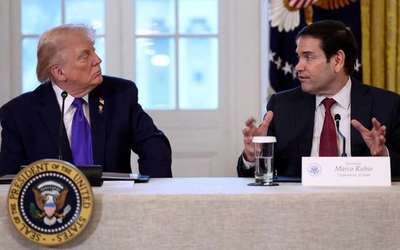
Republican Senator Marco Rubio, meanwhile, took a tougher stance, urging other Senators to consider a resolution that would see visitors and foreign nationals on a visa who support Hamas in the US forced to leave the country.

“If you’re in the United States on a visa and vandalizing property with phrases like ‘Hamas is coming,’ it’s time for you to go,” Rubio said on X. At a critical moment in negotiations over a possible Gaza hostage and ceasefire deal, Vice President Harris had her meeting with Netanyahu – her first with a foreign leader since starting her presidential campaign.

Harris, who did not preside over Netanyahu’s speech, held a press conference after their meeting. While expressing support for Israel’s right to defend itself, she emphasized the importance of how Israel does so. Harris voiced her refusal to stay silent on the human suffering in Gaza, pointing to the tragic images of dead children and displaced, desperate civilians.

Reports suggest that the Israeli leader was upset by Harris’ statement, concerned it will harm negotiations over a Gaza hostage and ceasefire deal.

David Friedman, the US Ambassador to Israel during the Trump administration, also weighed in, taking to X to critique Harris' statement, accusing her of failing to condemn Hamas and instead offering generic statements about complexities, nuances, and peace.

Netanyahu, who met with President Joe Biden before his meeting with Harris, is also scheduled to meet with former President Donald Trump on Friday.

Israel says Iran sabotaged French rail network ahead of Paris Olympics

Jul 26, 2024, 12:27 GMT+1

Israel's Foreign Minister Israel Katz says that the sabotage of France's rail infrastructure ahead of the Paris 2024 Olympics was influenced by "Iran's axis of evil and radical Islam."

On Friday, French train operator SNCF announced that the high-speed network suffered "malicious acts," including arson attacks, causing significant disruption just hours before the Olympic opening ceremony. Up to 800,000 passengers will face travel disruptions this weekend due to the attack.

Shortly thereafter, Israel’s Katz, attributed the attack to Iran, noting that he had previously warned French authorities about potential threats from Tehran targeting Israeli athletes in France.

"The free world must stop Iran now - before it's too late," Katz wrote on X.

In a letter on Thursday, Katz had alerted his French counterpart, Stéphane Séjourné, to an Iranian-backed plot aimed at the Israeli delegation participating in the 2024 Games.

“There are those who seek to undermine the celebratory nature of this joyous event,” wrote Katz. “We currently have assessments regarding the potential threat posed by Iranian terrorist proxies and other terrorist organizations.”

Also on Thursday, Israeli media reported that a group of anti-Israeli hackers, identifying themselves as “Zeus,” claimed responsibility for publishing personal information about Israeli athletes, including supposed images from their military service.

The National Cyber Directorate of Israel attributed this social media campaign to Iran, asserting that its primary goal is to intimidate the Israeli delegation. According to the Directorate's investigation, hackers have created social media channels to disseminate personal data about delegation members and send them threatening messages.

The hackers reportedly established social media profiles under the guise of GUD, a French far-right student union, using the encrypted chat application Telegram to post sensitive information such as bank account details, home addresses, and ID numbers of Israeli athletes. They also circulated alleged photos of the athletes during their IDF service, accusing the army of sending undercover operatives to the Games.

Gabi Portnoy, head of Israel's National Cyber Directorate, remarked, “Iran is exploiting an apolitical international sporting competition to promote digital terrorism against Israel and its right to participate in these competitions.”

These reports emerged just a day after Israel’s National Security Council issued safety guidelines for Israelis traveling to the Olympics, highlighting the threat from Iran-backed terror organizations targeting Israeli and Jewish individuals. The NSC also referenced recent arrests of French teens linked to the Islamic State.

The Olympic Games will be held from July 26 to August 11, followed by the Paralympic Games from August 28 to September 8.