• العربية
  • فارسی
BrandBrand
  • Iran Insight
  • Politics
  • Economy
  • Analysis
  • Special Report
  • Opinion
  • Podcast
  • Live TV
  • Iran Insight
  • Politics
  • Economy
  • Analysis
  • Special Report
  • Opinion
  • Podcast
  • Live TV
  • Theme
  • Language
    • العربية
    • فارسی
  • Iran Insight
  • Politics
  • Economy
  • Analysis
  • Special Report
  • Opinion
  • Podcast
  • Live TV
All rights reserved for Volant Media UK Limited
volant media logo

Khamenei defends 2020 bill blocking JCPOA revival, encourages bypassing sanctions

Jul 21, 2024, 13:24 GMT+1Updated: 14:55 GMT+1
Supreme Leader Ali Khamenei speaking at a meeting with Iranian parliament members on 21 July 2024

Iran’s Supreme Leader has defended a bill passed by the Iranian parliament in 2020 which played a significant role in preventing the revival of the JCPOA nuclear agreement.
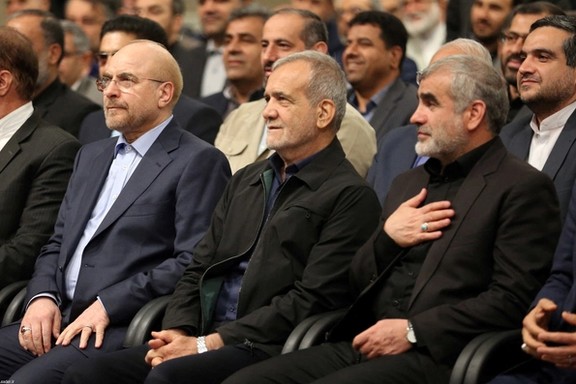
"Some people protested and found fault with the Strategic Action law, which is absolutely unfounded. This law was very much the right thing to do," Ali Khamenei asserted on Sunday. He was referring to Iran’s "Strategic Action Plan to Lift Sanctions and Protect the Iranian Nation’s Interests," a law mandating the government to enhance its nuclear activities if the US does not lift sanctions.

100%
Iran's President-elect Masoud Pezeshkian in a meeting with Supreme Leader Ali Khamenei in Tehran, Iran, July 21, 2024

Khamenei’s Sunday statements signal Tehran’s continued reluctance towards negotiating with Western powers as Iran continues to find ways to evade global sanctions.

Previously, former Foreign Minister Mohammad Javad Zarif, speaking at an election round table on June 18, noted that both Israel and the Parliament's strategic law were significant factors preventing US President Joe Biden from returning to the JCPOA.

The 2020 legislation was initiated in November after the election of Joe Biden, who had already pledged to return to the JCPOA during his election campaign. Iran devised the legislation apparently as a pressure lever against the United States, because it mandated a higher level of uranium enrichment and less inspections by the UN nuclear watchdog, IAEA, as negotiations were about to begin in 2021.

Iran's President-elect Masoud Pezeshkian in a meeting with Supreme Leader Ali Khamenei in Tehran, Iran, July 21, 2024

The JCPOA, originally established in 2015, aimed to limit Iran's nuclear program in exchange for relief from economic sanctions. However, after the United States withdrew from the agreement in 2018 under former President Donald Trump, Iran gradually reduced its compliance with the deal, but never violated it in a major way until Biden's election.

Efforts to revive the JCPOA have faced significant obstacles despite the Biden administration's willingness to return to the deal as he pledged during his 2020 presidential campaign.

More recently the International Atomic Energy Agency (IAEA) has criticized Iran’s nuclear activities, raising concerns about the program's peacefulness. The IAEA reported that Iran has stockpiled large amounts of highly enriched uranium, with Raphael Grossi saying that Iran is "weeks not months" from a nuclear weapon.

Khamenei further elaborated on the role of Iranian parliamentarians in bypassing sanctions imposed on Iran by Western countries.

"Parliament can play a role in both lifting and neutralizing sanctions… neutralizing sanctions is more important than lifting sanctions… lifting the sanctions is not in your hands, but it is in your hands to neutralize such measures, and there are good ways to neutralize the sanctions,”​ Khamenei stated.

The Sunday session was also attended by President-elect Masoud Pezeshkian. Although Pezeshkian has pledged to work towards lifting US sanctions during his recent presidential election campaign, he has emphasized he would follow Khamenei’s policies.

Despite sanctions for not only the nuclear program but for supporting Russia's war on Ukraine and rights abuses at home, Iran's oil exports have significantly increased. They have risen from 400,000 barrels per day after the 2019 US sanctions to over 1.5 million barrels per day currently.

Iran has employed numerous mechanisms through a wide range of entities and organizations to sell its oil via third parties to evade sanctions.

Most Viewed

Third US carrier joins Iran blockade, Bessent warns of economic collapse
1

Third US carrier joins Iran blockade, Bessent warns of economic collapse

2

Blair's sister-in-law attended Iran conference linked to IRGC spy recruitment - Telegraph

3

Iran facing one of fastest economic collapses ever, Bessent says

4
ONE-ON-ONE

Israeli opposition to Islamic Republic transcends party lines

5
VOICES FROM IRAN

Toxic air chokes Iranian cities, residents report health problems

Banner

Spotlight

  • Head full of pellets: protester recalls ordeal on Iran holiday island
    EXCLUSIVE

    Head full of pellets: protester recalls ordeal on Iran holiday island

  • Israeli opposition to Islamic Republic transcends party lines
    ONE-ON-ONE

    Israeli opposition to Islamic Republic transcends party lines

  • 2019 crackdown failed to break cycle of Iran street protests
    ANALYSIS

    2019 crackdown failed to break cycle of Iran street protests

  • Toxic air chokes Iranian cities, residents report health problems
    VOICES FROM IRAN

    Toxic air chokes Iranian cities, residents report health problems

  • Can higher fuel prices curb Iran’s smuggling problem?
    ANALYSIS

    Can higher fuel prices curb Iran’s smuggling problem?

  • Iran’s Janfada campaign gives Basij recruitment a patriotic banner
    ANALYSIS

    Iran’s Janfada campaign gives Basij recruitment a patriotic banner

Banner
Banner
Banner
Banner
Banner
Banner