Iran’s Top Diplomat Meets Syria’s Assad, Palestinian Factions
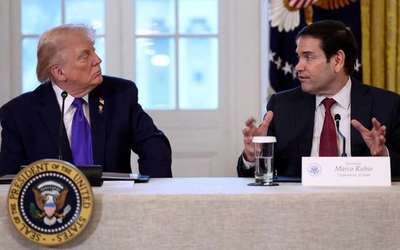
Syria's President Bashar al-Assad meets with Ali Bagheri Kani, Iran's acting foreign minister, in Damascus, Syria June 4, 2024
Iran's acting foreign minister Ali Bagheri-Kani met Syrian President Bashar al-Assad and Foreign Minister Faisal Mekdad in Damascus on Tuesday, where he also held a meeting with Palestinian representatives.
Reports in Iranian media emphasized that discussions were about the war in Gaza and “putting an end to Israeli crimes.”
Bagheri-Kani travelled to Syria after meetings in Beirut on Monday, his first trip abroad since becoming Iran's acting top diplomat following the deaths of his predecessor and Iranian President Ebrahim Raisi in a helicopter crash last month.
He also met Palestinian factions at the Iranian embassy in Damascus, as his predecessor had. There are no details about what was discussed in the meeting. Iran backs Palestinian armed groups including Hamas, which launched the October 7 attack on Israeli territory that triggered the Gaza conflict. The Iranian government immediately launched celebration on October 7 and has vowed to continue providing support to Hamas.
At a joint press conference alongside Mekdad, Bagheri-Kani said the pair had discussed the need for an immediate ceasefire in Gaza and the delivery of humanitarian aid without conditions. Iranian media said that the chief diplomat also emphasized the importance of strengthening the “strategic relations” between the two countries.
Syria’s Mekdad rejected reports about problems in the bilateral relations, calling such statements “Claims, delusions, or the wishes of some people.”
Bagheri-Kani was then received by Assad on Tuesday afternoon to discuss bilateral ties between the two close allies and "developments in the occupied Palestinian territories", according to Assad's office.
Lebanon's Hezbollah leader Sayyed Hassan Nasrallah meets with Iran's acting Foreign Minister Ali Bagheri Kani, in this handout picture released by Hezbollah Media Office on June 4, 2024, Lebanon.
One day before Bagher-Kani’s visit to Damascus, Iranian government media reported that a Revolutionary Guard "advisor", Saeed (Saeid) Abyar was killedin an Israeli air strike near Aleppo, the second largest city in Syria early Monday.
At least since 2017, Israel has regularly bombed Iran-related targets in Syria to prevent weapons transfers to Hezbollah in Lebanon and the expansion of Iranian bases in Syria.
A devastating air strike on April 1 flattened a building in the Iranian diplomatic compound in Damascus, where two senior Revolutionary Guard generals and five other officers died. Reportedly, these individuals were involved in operations aimed at intensifying attacks on Israel. This led to a massive Iranian missile and drone retaliatory attack against Israel on April 13, which inflicted minimal damage. Most projectiles were shot down.
In his day-long visit to Beirut, Bagheri-Kani met his Lebanese counterpart, other Lebanese officials and Sayyed Hassan Nasrallah, the head of powerful armed group Hezbollah which is the spearhead of Iran's network in the region.
Assad met Iran's Supreme Leader Ayatollah Ali Khamenei in Tehran on May 30 to offer condolences for the death of Raisi.
Abbas Abdi, a prominent 'reformist' commentator, suggested that clerics withdrew from running for the upcoming snap election as they believe their chances are slim.
“Even though the approval of those qualified has not yet been announced, it appears to be the first time since 1981 that clerics have entirely withdrawn from this area,” Abdi wrote on X on Tuesday.
The political analyst surmised that the reason might be that the clerics “are not hopeful of being voted president” but nevertheless “hold crucial positions” in the state and five of eight former presidents of Iran were clerics.
A total of 80 candidates have allegedly registered for the presidential elections following President Ebrahim Raisi's unexpected death in a helicopter crash last month. While among them are a few clerics, namely Mostafa Pourmohammadi, former interior minister and justice minister in two different administrations, Ahmad Akbari, former MP, and Mohammad Reza Mirtajodini, former vice president to Mahmoud Ahmadinejad, none are seen as the main competitors for the presidential role.
According to KhabarOnline, more than 70% of the registered candidates are current or former lawmakers.
After a week, the Guardian Council will announce the approved candidates, with the election scheduled for June 28. Candidates who have been approved will have the opportunity to campaign in the two weeks before the election. If no candidate receives more than 50% of the votes, a run-off election will be held on July 5.
Some of the most notable conservative candidates are hardline politician Saeid Jalili, conservative Parliament Speaker Mohammad-Bagher Ghalibaf, and the more "moderate" conservative Ali Larijani.
On the reformist and moderate side, Es’haq Jahangiri, former Vice President in Hassan Rouhani's administration, and Abdolnasser Hemmati, a former Central Bank of Iran governor, are among the leading contenders.
A network of Iranian operatives has targeted Israeli journalists and protesters with death threats amid its ongoing psychological warfare operation.
Death threats have been sent to the personal phones of Israeli reporters from Haaretz and Channel 13, accusing them of ‘collaborating with the enemy’.
Israel’s most left-wing newspaper, Haaretz, claims one of its reporters received a death threat on a call last week from a number registered abroad from a person speaking poor English.
In a bid to sow internal chaos amid the war in Gaza which has seen nationwide calls for the resignation of Prime Minister Netanyahu and a ceasefire to secure the release of hostages held by Iran-backed Hamas, digital surveillance firm Active Info, which has been monitoring the group for the past year, claims the sophisticated network also includes an account impersonating the controversial Minister of National Security, Itamar Ben-Gvir.
The influence network includes a Twitter account called Heroes of Israel, allegedly aligned with the campaign for a ceasefire and freeing of the hostages in Gaza. Hamas invaded Israel on October 7 killing 1,200 mostly civilians in a single day, taking 250 more hostage. Over 120 still remain inside the strip, several of whom are known to have been killed in captivity. As the war in Gaza rages on, the families of the hostages are desperate for a ceasefire to secure their release while the government has vowed there is no ceasefire until the elimination of the terror group.
The newspaper was contacted by the owner of the account who offered exclusive videos of the anti-government protests. When the reporter asked the source to identify themselves, they claimed to be a woman called Caroline Smart from the Netherlands who was unable to be in Israel herself due to the war.
Offering the reporter money to publish the pictures being offered "in order to help the campaign to free the hostages”, she offered to help install digital wallet software on his mobile device to make the payment in digital currency, a tool seen in previous cyber espionage campaigns by Iran.
When reporter Bar Peleg checked the Dutch number on WhatsApp he discovered the profile picture was stolen from the internet. When confronted, ’Caroline’ accused him of being “an Iranian spy”. The conversation was then manipulated, screenshot and sent to a pro-Israel page called Stand With Israel to insinuate the reporter was working with malign foreign influences or was aligned with the far right.
Just last week, Facebook's parent company reported that Iran was behind an influence operation exposed by Haaretz last year in coordination with researchers at Fake Reporter. It exposed a network with a plethora of fake accounts from gay representation to religious and political allegiances as the group delved into the multifaceted fabric of Israeli society.
Active Info claims the network has been operating on X for several months. Executed seamlessly, the fake Ben-Gvir account often echoes the real minister.
Last week other journalists from Channel 13 television news received threatening phone calls from foreigner numbers. "I know you up close, soon I will kill you and your family," said one with a Persian accent in a nighttime call to a reporter. Another reporter got one in the same Persian accent from a US phone number, saying "Leave Israel quickly, get it? You get it? If you don't, we'll kill you and your family.”
Defense sector retirees, public figures and even families of Israelis held by Hamas in Gaza and Knesset lawmakers have also recently received threatening letters and packages.
Iran began using the concept of foreign influence networks around two years ago to make connections with Israelis in an attempt to dupe them into acting as unwitting spies. They infiltrated the WhatsApp groups of political activists and convinced some to photograph the homes of top security officials, to print protest signs created by the Iranians on the hostages and even join fictitious demonstrations near the homes of hostage families.
In many cases, honey traps have also been used over the last two years. Iran International knows of several cases in which Israeli men were contacted on social media by figures posing as beautiful women asking them to meet in the likes of Turkey and Dubai. Though Israelis are trained in the army to recognize such fishing attempts, the intervention of intelligence agencies has been required in some cases.
"We have been aware of the practice of foreign influence networks asking Israelis for photos or videos since 2020," Active Info told Haaretz. "The goal is to give the foreign accounts local credibility, as if they were really involved in the protest movement. It's really a school of influence, creating fake conflicts between the right and the left, who argue with each other and even accuse each other of not being real."
The practice is not confined to Iran’s archenemy Israel. Dissident journalists abroad have also been the target of Iran’s spy-ops with death threats levied against Iran International reporters.
Just days ago, UN experts warned of transnational violence, threats, and intimidation by Iranian authorities and their proxies targeting Iran International and its journalists.
“We are deeply alarmed that death threats and intimidation against Iran International staff escalated into the violent stabbing of journalist Pouria Zeraati outside his home in London on 29 March 2024,” the experts said of the attack which sent shockwaves through the Iranian community.
Last year, the threats against Iran International staff became so severe that British security services MI5 said they could no longer protect the team, leading to a temporary relocation to Washington while the London offices were secured. MI5 and the police revealed they had foiled over 15 pilots on UK soil since the start of 2022 targeting “enemies of the regime”.
Ex-Iranian President Hassan Rouhani has been absent from several public events recently, fueling speculation of his performing a silent protest against the electoral system after being barred from the recent parliamentary elections.
Despite local media attributing his absence to a back condition, Rouhani’s selective appearances and recent criticisms of the government suggest another story. Last month, Rouhani, president from 2013-2021, openly criticized the Guardian Council. Appointed by Supreme Leader Khamenei, he accused the body of undermining democratic principles by disqualifying candidates with divergent political views after being barred from the March 1 Assembly of Experts elections.
Rouhani was present only at the memorial service for the late President Ebrahim Raisi, attended by the Supreme Leader, after his sudden death last month. However, his absence from other significant events, including the anniversary of Ayatollah Ruhollah Khomeini's death, a pivotal occasion for loyalists, has not gone unnoticed.
Rouhani has also recently opposed the reinstatement of morality police under a new crackdown plan on hijab regulations which has seen mass arrests of women for refusing the compulsory hijab, with state-sanctioned violence once more on the streets of Iran.
Mohammad Reza Naghdi, the coordinating deputy of the Revolutionary Guards
In the lead-up to Iran's snap presidential elections, high-ranking officials have admitted that candidates must be aligned with the Supreme Leader, Ali Khamenei.
"In the upcoming elections, we need to see who is on the path of the [Supreme] Leader and does not deviate from him; we must base our choice on him," said Mohammad Reza Naghdi, the coordinating deputy of the Revolutionary Guards, whose role is closely tied to Khamenei and the country's leadership.
Abdollah Haji-Sadeghi, Khamenei's representative in the Revolutionary Guards, also stated that devotion to the Supreme Leader should be the deciding factor in the elections, which come on the back of the sudden death of Ebrahim Raisi last month in a helicopter crash. Candidates have to be approved by the Guardian Council, which ultimately carries out the wishes of Khamenei.
"Let’s be mindful that devotion to the Supreme Leader should be the criterion and we should choose a servant for the leadership, not a burden," Haji-Sadeghi said.
Following the unexpected death of President Ebrahim Raisi in a helicopter crash on May 19,80candidates have registeredto contend for his position. The Guardian Council is set to announce the approved candidates after a week, with the election scheduled for June 28.
Multiple reformist candidates have already been denied applications to register as the process continues to channel the wishes of the Supreme Leader over the wishes of the people. Like previous presidential elections, turnout is expected to be as low as single figures.
Ali Rais al-Sadati, the brother of Iran's late president Ebrahim Raisi
The brother of Iran's late president has been denied application in the upcoming elections after Ebrahim Raisi's sudden death in a helicopter crash last month.
Ali Rais al-Sadati attempted to register on the last day of applications for the June 28 snap elections but his request was denied for failing to provide “the necessary requirements" according to reports on state media.
The authorities report that 80 candidates registered during the five-day registration period. Some question the high number and speculate about who will ultimately be accepted into the race by the Guardian Council acting on behalf of the Supreme Leader.
According to an Interior Ministry official, the Guardian Council will announce the names of qualified candidates on June 11 with the number of qualified candidates expected to range from as little as four to over 10.
Candidates who have been approved will have two weeks to campaign before the election. If no candidate receives more than 50 percent of the votes, a run-off election will be held on July 5.