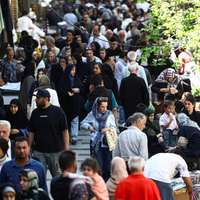
Iran's police forces stand on a street amid the implementation of the new hijab surveillance in Tehran, Iran, April 15, 2023.
The recent hijab crackdown has exposed deep divisions among Iran’s ruling ultra-hardliners, and a potential campaign to position President Ebrahim Raisi as the successor to Supreme Leader Ali Khamenei upon his passing.
The crackdown began on April 13 with the return of the infamous morality patrols to the streets. The extensive violence including sexual harassment against women has since been widely criticized by some hardliners and the media in Iran, including those close to Speaker of the Parliament Mohammad-Bagher Ghalibaf, as well as some religious Iranians who are supportive of enforcement of hijab rules and Khamenei’s positions in general.
On April 19, a tweet from Mehdi Fazaeli, deputy chief of the office overseeing the publication of Khamenei’s speeches and writings, further escalated controversies surrounding hijab enforcement methods—not the hijab principle—signaled Khamenei’s potential displeasure with the excessive and harsh enforcement f hijab.
In his tweet, Fazaeli first quoted Khamenei’s April 2023 famous edict about hijab last year and added in a note that “certain officials have recently been admonished [by the Supreme Leader] for their out of the ordinary actions [in enforcement of hijab].”
Fazaeli came under an avalanche of attacks from the ultra-conservative Paydari Party members and their allies, in media and social media, notably the ultra-hardliner chief editor of Kayhan daily, Hossein Shariatmadari, who is an appointee of the Supreme Leader. They accused Fazaeli of lying and misrepresenting Khamenei’s position with his tweet, and even being an enemy “infiltrator” in his office.
The Paydari Party itself is positioned at the extreme end of the fundamentalist camp in the Islamic Republic and other ultra-hardliners often refer to them as “super-revolutionaries”.
Iran’s ruler Ali Khamenei leading a prayer after a meeting with senior members of Iran’s Armed Forces, Tehran, April 21, 2024
Interestingly, the Revolutionary Guard (IRGC) linked Javan newspaper rose to Fazeli’s defense in an editorial Monday and criticized Shariatmadari for fanning the flames of a perceived “dichotomy” between Khamenei and his office. The editorial suggested that the Supreme Leader’s own authority is being challenged with ulterior motives “not to be discussed now”.
The party has also found allies in what is being referred to in Iranian political circles as the Mashhad Circle, including President Raisi’s influential and notorious father-in-law, Ayatollah Ahmad Alamolhoda, who expresses views very similar to those of Paydari. Alamolhoda, the most prominent figure of the Mashhad Circle, represents Khamenei in Khorasan-e Razavi Province and is the custodian of the shrine of the eighth Shia imam, Imam Reza.
In very veiled terms, the critics of the Paydari and its associates have hinted that the apparent rebellion of the Paydari against Khamenei, or at least his son Masoud and his associates, may be a plot to place Raisi on the leadership throne when Khamenei dies.
“There is a lot of jostling going on behind the scenes and only muffled noises are heard outside these rooms. The Raisi circle have neutralized Speaker Mohammad-Bagher Ghalibaf and will eventually push aside the former nuclear negotiator Saeed Jalili and his circle too,” a political analyst who requested anonymity told Iran International.
The hijab crackdown is spearheaded by the far-right Paydari Party and its allies in the government of President Raisi including the Interior Minister Ahmad Vahidi, Police Chief Ahmadreza Radan, and Meysam Nili-Ahmadabadi, an advisor to the Minister of Islamic Guidance Mohammad-Mehdi Esmaili.
Nili-Ahmadabadi, a member of the Paydari Party and brother to Raisi’s son-in-law Meghdad, is a shadowy figure with much influence in many government and state bodies including the state broadcaster (IRIB) and the Supreme Council of the Cultural Revolution where he heads the Hijab and Chastity taskforce.
Nili-Ahmadabadi is also the managing director of Raja News, the unofficial mouthpiece of Paydari Party and the late Ayatollah Mesbah Yazdi’s followers. He has close ties to security forces and maddahs (religious eulogists) with far-right political leanings.
The “super revolutionaries” were not satisfied even when the X account of Khamenei’s official website, khamenei.ir, retweeted Fazaeli’s tweet to support him. The hardliners continued their criticism even though Khamenei’s social media accounts are overseen by his youngest son, the shadowy Masoud Khamenei. This can be interpreted as a challenge by some hardliners to Khamenei’s own son before an impending scramble for succession.
Fazaeli’s critics, including Shariatmadari, insist that they need to hear the criticism from the “Supreme Leader’s own lips”.
“We emulate Mr Khamenei, not Khamenei.ir,” a tweet in response to Fazaeli said, which is being widely quoted as evidence of defiance by ultra-hardliners and their refusal to acknowledge the authority of Khamenei.ir and its social media accounts.
The Paydari and their allies are also being referred to by other hardliners and conservatives on social media as Khavarij (Kharijites), the first sect of Islam who rebelled against Khamenei’s namesake, the fourth Caliph and the first of Shia Imams, Ali ibn Abi Talib.
“The Khavarij are sharpening their swords and smearing them with poison,” Ghorbanali Salavatian, a former IRGC commander, tweeted. This referred to Ali’s assassination with a poison-coated sword by a member of the sect in 661 AD.
In an editorial for the reformist Etemad newspaper on Monday, prominent commentator Abbas Abdi referred to the complicated ideological and political background of ultra-hardliner groups who he said have an apocalyptic ideology and a cult-like organization.
Abdi contended that the principal characteristic of the most radical group of ultra-hardliners is “power mongering” and that they have been ousting all other ultra-hardliners from centers of power.
Many are also pointing out the similarity of the behavior and stances of the Paydari circle with those of Mahmoud Ahmadinejad, who in 2011 scornfully quit work for eleven days when Khamenei reinstated an interior minister, Heydar Moslehi, who he had fired.
Henceforth Ahmadinejad and his supporters came to be referred to as the “deviant current” in the vernacular of Khamenei loyalists.
“The real question is whether IRGC’s top echelon would only watch the gladiators in the arena now and wait to step in when the day comes or take action,” Abdi added.
Hijab police agents seen in a street in Tehran. Undated
The United Nations High Commissioner for Human Rights has expressed serious concerns over the Iranian government's continued use of force and repression to enforce hijab laws.
Volker Türk said the move has led to widespread discrimination and violence against women and girls.
“We have received reports of widespread arrests and harassment of women and girls - many between the ages of 15 and 17.”
On April 21, the head of Tehran's Islamic Revolutionary Guard Corps (IRGC) announced the establishment of a new enforcement body trained to implement hijab laws "in a more serious manner" across public spaces.
The High Commissioner also highlighted concerns about the impending approval of a new hijab bill by the Guardian Council, tasked with reviewing parliament's legislation. An earlier version of this draft bill suggested penalties that could include up to 10 years in prison, flogging, and hefty fines for those who defy the dress code, measures which the UN official stressed are cruel and inhumane, and constitute a breach of international human rights standards.
The Commissioner also expressed concern over the recent sentencing to death of rapper Toomaj Salehi by the Isfahan Revolution Court. Salehi, known for his critical views expressed during the 2022 nationwide protests following the death of Mahsa Amini in police custody, was charged with "corruption on earth."
Amini's death had sparked widespread outrage over the enforcement of hijab laws, which subsequently led to her detention.
The High Commissioner has called for the immediate and unconditional release of Salehi and all individuals detained for exercising their freedoms of opinion and expression.
Iranian diaspora has taken to the streets since Wednesday to protest against the dissident rapper Toomaj Salehi's death sentence as calls for continuation of protests over the weekend are mounting.
Rallies are being held in several European, US, and Canadian cities, including London, Bonn, The Hague, Frankfurt, Berlin, Hamburg, Milan, Copenhagen, Montreal, and Washington, to urge their governments to halt the execution.
Protests are also planned for the weekend in Melbourne, Sydney, Vancouver, Vienna, Prague, and Port Douglas.
"We are here to get the international community to put pressure on Iran to stop Toomaj's execution," a protester in Berlin told Iran International on Friday.
A group of Iranians in Washington DC are staging a sit-down strike. "Within 24 hours of Toomaj's death sentence being announced, we started a strike in Washington, and many people joined us despite it being during work hours. We plan to continue protesting over the weekend," Siamak Aram, a protester and political analyst, told Iran International on Friday.
Toomaj Salehi's death sentence by the Revolutionary Court of Isfahan has been criticized widely domestically and internationally since his lawyer announced the verdict on Wednesday.
A 2021 single by Toomaj Salehi, Rat Hole, broke the underground Iranian rap scene. In the song, he attacked Iranians outside and inside Iran who chose to support the regime or did not use their platforms to enhance or relay the voices of struggling and dissenting Iranians.
He became a household name and a symbol of heroic resistance when he joined protesters in 2022 that erupted over the death of Mahsa Amini, fatally injured in police custody for wearing an "improper" hijab.
Toomaj Salehi was initially arrested in 2022, when the intelligence ministry in Isfahan province violently arrested him again for his artistic activities in support of the anti-government movement. He was tortured severely and forced to make televised "confessions" while in custody.
After avoiding a death sentence due to a Supreme Court ruling, he was sentenced to six years and three months in prison in July 2023.
Salehi's lawyer said that the Revolutionary Court of Isfahan later issued new charges in addition to those he had previously been cleared of.
The defense team for Toomaj Salehi has 20 days to file an appeal against the ruling - and they will, according to his lawyer, Amir Raesian.
Mahsa Amini, a 22-year-old woman, who died in the custody of Iran's hijab police in 2022
Mahsa Amini's mother, the icon of the nationwide protests during which more than 550 people were killed, also condemned the outspoken rapper’s harsh sentence on Thursday.
“Let Toomaj breathe so that his mother and the mothers of my land don't die,” she said.
On Thursday, Amnesty International also issued the following statement: “Iranian authorities must quash Toomaj Salehi’s conviction and death sentence and release him immediately.”
In videos circulating on the Internet, posters of him are seen on the walls and highways of Iran. There were also reports from Tehran of night-time chants against the regime, as well as youngsters writing slogans on city walls in support of the increasingly popular artist.
Mohammad Reza Tavakoli, the head of the first branch of the Isfahan Revolutionary Court
Iran International's investigation has identified the judge who handed down the death sentence to Toomaj Salehi, the prominent dissident rapper imprisoned in Iran.
Who sentenced Toomaj to death?
Mohammad Reza Tavakoli, in his capacity as the head of the first branch of the Isfahan Revolutionary Court, together with two officials only identified by their last names, Ravanmehr and Ebrahimi, sentenced Toomaj to death. Iran's Judiciary is one of the most hardliner institutions in the Islamic system of government, where judges, prosecutors and security agents work in tandem to suppress dissent. The Judiciary is under the control of Supreme Leader Ali Khamenei.
A friend of Toomaj described Mohammed Reza Tavakoli as an "illiterate with a great desire to be promoted in the judiciary.”
“Aiming for power and gaining the approval of his superiors who were seeking a harsher sentence, he increased the number of charges against Toomaj from three to ten,” the unidentified friend told Iran International.
Reza Akvanian, a human Rights Journalist, at Iran International said on Friday that “Tavakolian has a history of violating human rights, women’s rights, and persecution of the Bahaei minorities."
Tavakoli was honored as an "exemplary judge of the Islamic Republic" in 2014.
Why does it matter to identify the judge?
Perhaps there is a reason why Iranian state media did not directly name the judge who handed down the death sentence in their coverage of the event.
Toomaj's first prison sentence in July 2023 was handed down by Morteza Barati, who is listed on the UK and Canada sanctions lists.
His sanction is outlined on the website of the British government as follows: “He is and has been involved in the commission of serious human rights violations in Iran, namely being responsible for engaging in serious violations of the right to freedom of expression, the right not to be subject to cruel, degrading, or inhuman punishment and the right to a fair trial through his role as presiding judge of Branch 1 of the Revolutionary Courts of Isfahan.”
Akvanian explained that naming these individuals makes it easier to hold them responsible for "atrocities they commit."
“Iranians in the West can request international sanctions against these individuals once they're identified so they don't escape the consequences of their actions,” Akvanian added.
Why was Toomaj sentenced to death?
Originally sentenced to six years in prison for his role in the 2022 Mahsa Amini protests, Salehi was released after the Islamic Republic Supreme Court reviewed the original sentence and reduced the charges.
The artist was again arrested in November 2023 for releasing a video and expressing his views concerning the Iranian government and revealing that he had been tortured and held in solitary confinement for 252 days following his arrest in October 2022.
After another trial, instead of reducing the alleged offenses in accordance with the Supreme Court's request, the new judge increased the charges, including “Spreading corruption on earth,” an Islamic legal term in Iranian laws, pertaining to actions that undermine the regime. “Corruption on earth" and "Moharebeh" are considered the most serious crimes by the Islamic Republic.
Why was Toomaj's death sentence deemed ‘unusual’?
Amir Raeisian, Salehi’s lawyer, told Roydad24 website in Tehran on Thursday that his client had already been acquitted of "corruption on earth" in the previous court.
Toomaj Salehi's other lawyer, Mostafa Nili, said the verdict had "obvious legal conflicts" in a message on X on Wednesday.
Since the new court was held based on the Supreme Court’s decision to review and lower the charges, the death sentence is deemed unusual.
Photo of Mohammad Ghobadlou
Only one other case is similar to this case. Executed protester Mohammad Ghobadlou, like Salehi, was arrested during the height of the Mahsa Amini protests. His lawyer received less than 12 hours' notice that his client would be executed, despite the Supreme Court's decision to quash Ghobadlou's death sentence and order a retrial in July 2023. A retrial that never took place.
Firefighters work at the scene of a large fire in a warehouse complex in southern Tehran, April 25, 2024
A large fire in a warehouse complex in southern Tehran has reignited longstanding concerns over building safety and sparked protests from the city’s fire department.
Jalal Maleki, the spokesperson for the Tehran Fire and Safety Services Organization, reported on Thursday that the blaze affected several large warehouses, each approximately 500 square meters in size, with an adjoining open space of about a thousand square meters also engulfed in flames.
Despite the intensity of the fire, which nearly caused the warehouse roof to collapse and damaged several containers, there were no casualties or fatalities reported.
Following the incident, Gholamreza Mohammadi, CEO of the Tehran Fire and Safety Services Organization, emphasized the ongoing challenges faced by firefighters due to restrictive laws that prevent them from entering buildings without owner permission to conduct safety inspections.
In response, the organization is calling for legislative changes to empower firefighters as authorized officers to enforce safety measures without needing owner consent. If enacted, the laws would allow the fire department to seal buildings that fail to comply with safety requests.
The fire department has frequently protested the high percentage of government buildings that are deemed unsafe, with previous statements indicating that up to 50% of such structures pose safety risks.
The recent fire serves as a critical reminder of the need for comprehensive safety reforms to protect lives and property in Iran’s capital.
Chess pieces are seen in front of displayed Iran's and US flags in this illustration taken January 26, 2022
On April 24, 2024, the US government took a significant step against corruption in Iran by implementing the Holding Iranian Leaders Accountable Act to enhance oversight of the finances of Iranian officials.
This legislation is part of the National Security Act of 2024, an appropriations bill passed by the 118th Congress and signed into law by President Biden.
The bill includes four key Iran-related measures: the Mahsa Act, the Ship Act, the Iran-China Energy Sanctions Act, and the Holding Iranian Leaders Accountable Act.
Although it has received comparatively less media attention, this article will explore the specifics of the Holding Iranian Leaders Accountable Act, examining its implications and the detailed measures it proposes to address critical issues related to Iran.
Here are the "12 Points You Need to Know" about the "Holding Iranian Leaders Accountable Act of 2023" with detailed insights into the bill's provisions:
1. What does the "Holding Iranian Leaders Accountable Act of 2023" do? The law mandates reporting requirements for the Secretary of the Treasury to compile detailed reports on financial institutions' dealings with designated Iranian officials, including descriptions of asset holding, acquisitions, and ties to financial institutions, asset descriptions, acquisitions, usage, and involved financial institutions. It imposes restrictions requiring US and foreign financial institutions identified in the reports to terminate accounts and halt significant financial services to the designated Iranian officials.
2. What is the primary objective of the "Holding Iranian Leaders Accountable Act of 2023"? The bill seeks greater oversight and reports on the financial activities of key Iranian officials and institutions, aiming to monitor and prevent corruption through funding flows that might support activities like terrorism.
3. Who are the specific individuals and groups named in the bill? The bill targets key figures within the Iranian government and military, including the Supreme Leader, the President, members of the Guardian Council and the Expediency Council, and high-ranking officials within the Islamic Revolutionary Guard Corps (IRGC) and leaders of major terrorist/proxy groups tied to Iran like Hezbollah and Hamas.
4. Why are these particular individuals and groups targeted? These figures are central in Iran's political, military, and economic system and are involved in corruption and supporting terrorism, thereby undermining regional stability.
5. Who needs to report under this bill, and what must be reported? The Secretary of the Treasury must submit comprehensive reports detailing assets, financial transactions, acquisition methods, and uses of funds associated with specified Iranian officials and institutions.
6. How frequently must these reports be prepared and submitted? An initial report is due within 180 days after the bill's enactment, with subsequent updates every two years.
7. What actions must US financial institutions take under this bill? US financial institutions are required to close accounts and cease significant financial services for listed individuals and entities.
8. Are foreign financial institutions also affected by this bill? Yes, the bill compels the Treasury to use all necessary means, under existing laws, to close foreign accounts and stop financial services for identified individuals and entities.
9. What are the provisions for public availability of the report? The unclassified part of the report should be made public in English, Persian, Arabic and Azari if deemed in the US national interest, enhancing transparency and deterring illicit activities.
10. What are the exceptions and waivers included in the bill? The President may waive specific requirements if the individuals or institutions prove their funds were legally obtained or if they are cooperating with US security or law enforcement. Transactions involving humanitarian aid to Iran are also exempted.
11. When does the bill expire? The act includes a sunset clause, ceasing its provisions five years post-enactment unless extended by further legislative action. This allows for reassessment of its effectiveness and relevance.
12. Why does this bill matter? This law provides an opportunity to increase transparency on the financial resources of the senior leaders in the Islamic Republic and offer additional targets for sanctions. Exposing the corruption of regime officials not only aids in accountability and can embarrass these leaders publicly, but it can further encourage Iranian dissidents and protestors who are facing severe economic difficulties due to regime mismanagement, graft, and corruption.