Tehran Court Upholds Eight-Year Sentence For Civil Activist Couple

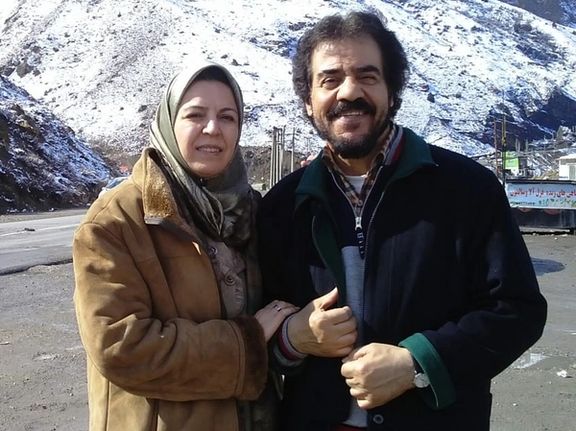
The Tehran Appeals Court has upheld an eight-year prison sentence for Assadollah Fakhimi and Hoorieh Khanpour, a couple known for their civil activism.

The Tehran Appeals Court has upheld an eight-year prison sentence for Assadollah Fakhimi and Hoorieh Khanpour, a couple known for their civil activism.
The ruling, issued on February 6th, includes a five-year prison term for Fakhimi and three years for Khanpour on charges of “assembly and collusion with intent to commit crimes against national security.”
The verdict also includes one-year sentences for each of them on charges of “propaganda against the system.”
Initially handed down by Tehran Revolutionary Court, in January, the eight-year sentence against the couple has been fully confirmed by the appeals court.
The home of Fakhimi and Khanpour was raided by agents of the ministry of intelligence on July 11 last year, during which computers, laptops, and mobile phones were seized, and the couple was subsequently summoned to Evin Courthouse.
In a notable act of solidarity, on October 29th, Fakhimi, alongside several other civil activists and families of detainees, visited the family of imprisoned human rights activist Narges Mohammadi, a recipient of the 2023 Nobel Peace Prize, presenting a Human Rights Statue.
Since its establishment, the Islamic Republic has consistently arrested, tortured, and imprisoned government critics, civil and political activists.
Since the nationwide uprising against the Islamic Republic in September 2022, the government's crackdown on civil, political, and protesting activists has persisted and intensified.

Three days after the detention of 30 journalists at the office of liberal-leaning website Fardaye Eghtesad in Tehran, five remain missing, raising fears they have been detained.
The newspaper's editor, Ali Mirzakhani, deputy editor, Behzad Bahmannezhad, and three video-journalists have not returned home since Monday and no information has been disclosed regarding their whereabouts and conditions.
On Monday evening, security forces raided the office of the economic news site, detaining and holding 30 journalists incommunicado inside the building overnight. They also confiscated all office computers and electronic devices, including mobile phones, and interrogated the staff.
The judiciary’s official news agency, Mizan, released a statement on Tuesday, claiming that the raid and journalists’ arrests were not linked to journalistic activities but were under investigation by a security agency.
Iranian media and observers say the detentions might be linked to a recent revelation published about Iran's international clandestine fund transfers.

Meta, the owner of Instagram and Facebook, has removed the accounts of Iran’s Supreme Leader Ali Khamenei on the two platforms.
“We have removed these accounts for repeatedly violating our Dangerous Organizations & Individuals policy," Middle East Eye news website quoted a Meta spokesperson as saying.
Based on that policy, “organizations or individuals that proclaim a violent mission or are engaged in violence” are removed from Meta platforms.
According to IranWire news website, Meta’s recent action was taken in response to the accounts’ explicit support for Iran’s proxy groups in the region, such as Hamas and Hezbollah.
Many Iranian activists had previously called on Meta and X to disable Khamenei’s accounts over the flagrant violation of human rights in Iran under his rule.
Instagram, X, Facebook, Telegram and many other platforms are not accessible in Iran as a result of the government’s filtering policy.
Since the Iran-backed Hamas militia in Gaza invaded Israel on October 7, Iran's proxies in Iraq, Syria, Lebanon and Yemen have all acted in support of the group, attacking both Israel and US targets since the war broke out.

Iran’s judiciary has amputated the fingers of a 35-year-old man for allegedly stealing five sheep from a farm belonging to an IRGC member as the medieval practice gains pace.
According to the Oslo-based Iran Human Rights Organization (IHRNGO), the amputation was carried out last July in the central prison of Iran’s religious city of Qom, the revelation showing a parallel rise in both executions and amputations over the last year.
“The amputation of a man’s fingers for stealing a few sheep by a corrupt system whose officials compete with each other in stealing and embezzling billions of dollars shows the extent of the Islamic Republic’s cruelty and immorality,” said IHRNGO Director Mahmood Amiry-Moghaddam.
According to the Abdorrahman Boroumand Centre, since January 2000, the Iranian authorities have amputated the fingers of at least 131 men, Amnesty International reported in 2022.
The latest victim, known only as Yousef, was working as a builder at the farm when he was arrested. “He denied the theft and insisted he was innocent throughout the 13 months he was behind bars,” IHRNGO quoted the source as saying.
Last month Ali Mozaffari, the Chief Justice of Qom Province, announced that the fingers of two prisoners who were sentenced to amputation for theft were cut off and warned more cases would follow, in spite of its contravening international law.
It comes as Iran's execution rates are also surging. Amid the worst national uprising since the founding of the Islamic Republic, crackdowns on dissent have seen record numbers of executions, the United Nations citing more than 800 in 2023 alone.

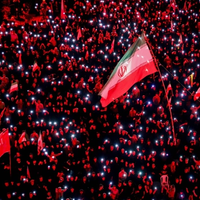
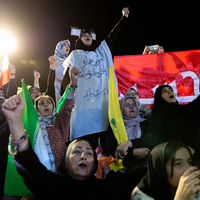
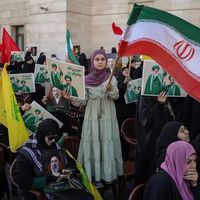
Iran’s Jews and non-Muslims have been forced to attend celebrations of the Islamic revolution as the regime continues to fight for credibility on the eve of upcoming elections.
On the Iranian Jewish community’s Telegram channel, the community wrote publicly about its "enthusiastic presence" at the event last month.
The event was attended by figures such as the head of Jewish community and representative in Iran’s pseudo parliament, Homayoun Sameach, and rabbis Arash Tehrani and Davis Sasani. An Armenian representative was present at the ceremony along with a Zoroastrian group, in addition to IRGC figures and commanders.
Alireza Nader, an Iranian-American expert on religious communities in Iran, told Iran International, “The regime treats Iran’s minorities terribly but wants to present a false image that they support the Islamic Republic through such events. Nothing can be further from the truth.”
Tehran-born Jew, Ben Sabti, who is a researcher in the Iran program at the Institute for National Security Studies, told Iran International that minorities are “hostages in the hands of the Iranian regime and they have to do anything that is needed to survive”.
At the time of the revolution in 1979, there were roughly 80,000 Jews living in Iran while today their numbers are between 5,000 to 8,000. The largest numbers have moved to Israel and the US.
Karmel Melamed, an LA-based Iranian-American Jew told Iran International, “It shouldn't surprise anyone that the mullah regime in Iran has paraded out Iran's Jews and other religious minorities from the country to supposedly honor the regime's Islamic revolution of 1979 because this has been their long standing propaganda tradition to do so.”
Melamed, who has written extensively on Iranian Jews, said that since the founding of the regime, the authorities have either paid off or used duress against religious minorities in Iran to have them participate in sham public events that promote the regime under a guise of religious pluralism. Officially, Iran only permits the three monotheistic religions but even the country's Sunni Muslim minority suffer extreme oppression.
Iranian law denies freedom of religion to large minority groups such as the Baha’is with ongoing arrests under sham security charges plaguing the community. Businesses have been forced to close and its community prohibited to register with universities, according to Human Rights Watch.
The government also discriminates against the country’s Azeri, Kurdish, Arab, and Baluch ethnic minorities with activists systematically arrested on sham charges.
In contrast to such public shows of support to the regime, Melamed explained that the country’s Jews and non-Muslims are treated “as third class citizens with limited to no rights and created an environment of extreme hostility, imprisonment or confiscation of their properties, to the point where the vast majority of non-Muslims in Iran have fled Iran since 1979 ... therefore they now resort to these events with religious minorities participating in order to keep up appearances of supposedly being wanted by the people of Iran.”
While Tehran continues to call for the destruction of Israel, the world’s only Jewish state, and amidst a proxy war being waged against Israel and its ally, the US, the country’s Jews are under deepened pressure.
Melamed said, “For anyone foolish enough to believe that this mullah regime in Iran is benevolent to the Jews of Iran and created a safe place for them to live in, just look at the numbers of Jews living in Iran today. The numbers don't lie."
The first court session was held Wednesday for the trial of the security forces accused in the September 2022 massacre of peaceful protesters in Zahedan, Iran International can reveal.
Being held under Judge Mohammad Marzouyeh, the defendants are police officers accused of shooting protesters, all of whom are believed to be out on bail.
On September 30, 2022, security forces opened fire at peaceful protesters in Zahedan, the provincial capital of Sistan-Baluchestan, a day known as Bloody Friday amid the nationwide uprising dubbed Women, Life, Freedom.
The incident was the bloodiest during the nationwide uprising triggered by the death in morality-police custody of Mahsa Amini in 2022, resulting in the deaths of at least 105 civilians, including 17 children.
Holding the first court session 16 months after the massacre has surprised political and civil activists. Many view the trial as a desperate attempt by the Iranian regime to gain public trust and credibility in a bid to convince people to participate in the upcoming elections.
Activists said trying the police officers does not go far enough, calling for the commanders who ordered the killings to also be tried.
Since the massacre, weekly protests have continued in the province, Sistan-Baluchestan, one of Iran's poorest, a flashpoint of unrest since the uprising began.
In September, the Oslo-based Iran Human Rights Organization urged the international community to refer the massacre to international judicial bodies for investigation as crimes against humanity.