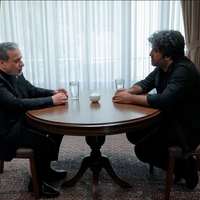
Iran's Supreme Leader Ali Khamenei during a meeting in Tehran on January 16, 2024
Despite international criticism of Houthi attacks in the Red Sea, the leader of the Islamic Republic commended and praised the militia.
In a speech on Tuesday, Ali Khamnenei claimed that the Houthis have struck a blow to the "vital arteries of Israel."
The Shiite Houthi group in Yemen, known as Ansarullah, which has long enjoyed significant financial and military support from the Islamic Republic, has committed dozens of attacks on global shipping, including US and Israeli linked vessels since November.
US and British forces jointly targeted dozens of positions of the militants in response to Houthi attacks on international shipping routes in the Red Sea and the Gulf of Aden last Thursday.
Subsequently, the US President announced that Washington had delivered a "private message" to Iran regarding the Houthis and their attacks on commercial ships in the Red Sea, which is a major trade passage, forcing many companies to go longer, more costly routes. The Iranian Foreign Minister confirmed receiving the message but stated that the Houthis would continue their attacks in the Red Sea until the end of the Gaza conflict.
In his speech to Friday prayer leaders in Tehran, Ayatollah Khamenei, who first called for the blockade in the wake of the Gaza war sparked by Hamas's invasion of Israel on October 7, praised and prayed for the "struggle and resistance" of the Shiite Houthis, urging it to "continue until victory."
He said, "What they did in supporting the people of Gaza is commendable. They struck blows to the vital arteries of the Zionist regime, without fearing the United States."
Khamenei's comments recall his statements about the extremist group Hamas in response to its attack on Israeli soil on October 7 when he said, "We kiss the foreheads and arms of the resourceful and intelligent designers [the operation] and the Palestinian youth." Hamas has also long been supported financially and militarily by Iran in its battle against Israel and the West.
An RAF Typhoon aircraft takes off to join the US-led coalition from RAF Akrotiri to conduct air strikes against military targets in Yemen, aimed at the Iran-backed Houthi militia, in Cyprus, January 12, 2024.
The US military on Tuesday carried out a new strike in Yemen targeting anti-ship ballistic missiles Of Iran-backed Houthi forces, two US officials told Reuters.
The strike was the latest Western military action against the militant group over its targeting of Red Sea shipping.
US officials, speaking on the condition of anonymity, said the strike on Tuesday targeted four anti-ship missiles. The strike has not been previously reported.
Houthi attacks on Red Sea shipping have continued even after President Joe Biden last week ordered an initial wave of strikes to degrade Houthi capabilities.
The Houthis, who control most of Yemen's Red Sea coast, have claimed their attacks on commercial ships are aimed at supporting the Palestinians in Israel's war in Gaza. The attacks began in mid-November after Iran’s Supreme Leader Ali Khamenei called for a blockade of Israel.
On Tuesday, Khamenei praised the Houthis, saying that they proved they were not afraid of the United States.
The Houthi movement has pledged to expand its targets in the Red Sea region to include US ships and has vowed to keep up attacks after US and British forces carried out dozens of strikes last week against radar and missile capabilities.
On Monday, Houthi forces struck the US-owned and operated dry bulk ship Gibraltar Eagle with an anti-ship ballistic missile, the US military said.
The Health and Climate Change Department of the Ministry of Health in Iran has disclosed that 14% of the country's natural deaths are attributed to air pollution.
Department head, Abbas Shahsavani, also said Tehran holds the 19th position globally in terms of suspended particle concentration, placing it among the worst capitals worldwide.
“The average concentration of suspended particles in Iran was revealed to be 7.6 times higher than the World Health Organization guidelines and more than three times the national standard,” he added.
Alarming findings from studies indicate that for 107 days of the past year, weather conditions in Tehran were deemed unhealthy for sensitive groups, with 36 days considered unhealthy for the general population.
Globally, the impact of air pollution on mortality stands at an average of 11.65%, shedding light on the severity of the issue.
The revelation comes amid recent protests against mazut burning in several Iranian cities. Mazut, recognized as the most polluting fossil fuel, has been utilized in Iran's industries and power plants during the second half of each year due to a shortage of natural gas.
Despite mounting concerns, authorities in the Islamic Republic have not provided transparent explanations for the use of mazut, with some even denying its burning. The CEO of the Ramin Power Plant in the southern city of Ahvaz confirmed the use of mazut in one of its production units, citing the "approval of the Supreme National Security Council."
Further confirmation came from the Director-General of the Environmental Protection Organization of Markazi Province, acknowledging mazut burning at the Shahzand Power Plant in Arak.
People hold placards during a demonstration in front of the United Nations headquarters, following missile attacks by Iran's Revolutionary Guards, in Erbil, Iraq, January 16, 2024.
Baghdad has exhibited an unusually strong reaction to the Iranian missile strike Monday night on targets in Erbil, northern Iraq, by recalling its ambassador.
Iraq has close ties with the Islamic Republic of Iran, both Shia-dominated governments, but the Iranian attack that destroyed the house of a well-know Iraqi Kurd, killing him and his family, solicited Baghdad’s angry response on Tuesday.
Tehran claimed that it targeted an Israeli “spy center” but Iraqi Kurdish leaders condemned the ballistic missile launch that killed a wealthy and influential member of their community.
Iran's Revolutionary Guards and regime officials in Tehran took a victory lap on Tuesday while also highlighting that they fired ballistic missiles at northern Syria, in their longest-range attack to date. They claimed they hit ISIS bases, where Afghan Islamic State forces were being trained. The Afghan ISIS had claimed responsibility for a January 13 twin suicide bombing in Iran that killed nearly 100 people.
It remains unclear why the IRGC did not target the specific group allegedly responsible for the terror attack in Afghanistan.
Iran’s missile strike in Iraq, however, is likely to deepen worries about worsening instability across the Middle East since the war between Israel and Hamas started on October 7, with Iran's militant proxy forces also entering the fray from Lebanon, Syria, Iraq and Yemen.
Policemen line up as people gather to demonstrate in front of the United Nations headquarters, following missile attacks by Iran's Revolutionary Guards, in Erbil, Iraq, January 16, 2024.
There has also been concern that Iraq could again become a theater for regional conflict after a series of US strikes on Iran-linked militant groups that are also part of Iraq's formal security forces. Those strikes came in response to dozens of attacks on US forces in the region carried out since mid-October.
The Guards said the late Monday attack, Iran's first direct military strike in the region linked to the Gaza war, was in response to Israeli 'atrocities" against several of its commanders and those of Iranian-allied forces around the Middle East since the conflict started.
Iraq National Security Adviser Qasim al-Araji condemned the strike as an infringement of sovereignty.
"We are very astonished by what happened because the Iraqi government was not informed," he said.
In protest to the strike, Iraq recalled its envoy from Tehran and summoned Iran's charge d'affaires in Baghdad, with the foreign ministry saying Baghdad would take all legal steps against what it called a violation of sovereignty.
The strike, on a residential area near the US consulate in Kurdistan's capital Erbil, was described by Iraqi Kurdish Prime Minister Masrour Barzani as a "crime against the Kurdish people" in which at least four civilians were killed and six injured.
Multimillionaire Kurdish businessman Peshraw Dizayee and several members of his family were among the dead, killed when at least one rocket crashed into their home, Iraqi security and medical sources said.
Araji denied the house was an Israeli spy center.
"To respond to the claim that there is a Mossad headquarters we visited the place and toured every corner of this house, and everything indicates that it is a family house belonging to an Iraqi businessman from Erbil," he told reporters.
A view of a damaged building following missile attacks, in Erbil, Iraq, January 16, 2024.
'RECKLESS'
Israeli government spokesperson Avi Hayman said he would not speculate, when asked at a press briefing about Iran's assertion that it struck a Mossad site.
"What I will say is Iran continues to use its proxies to attack Israel on multiple fronts. We condemn Iran's activities, and we call on the international community to stand up in defiance of Iran and call for peace in the region as soon as possible," he said.
Defending the attack, Iranian Foreign Ministry spokesman Nasser Kanaani said Tehran respected the sovereignty and territorial integrity of other countries, but it was Iran's "legitimate right to deter national security threats".
The Guards said the attacks would continue "until avenging the last drops of martyrs' blood", referring to the killing of three members of the Guards in Syria last month who had served as military advisers there.
France and Britain accused Iran of violating Iraq's sovereignty and Washington condemned the attacks as "reckless", while American officials said no US facilities were struck and there were no US casualties.
A view of the effects of land subsidence in a school
A subsidence crisis has led to several more schools being evacuated in Esfahan and others under close supervision.
According to the government, 285 schools have been either evacuated or put under urgent monitoring, and schools in Tehran, Khorasan Razavi, Yazd, Fars, and Qazvin, are now also on alert.
Majid Abdollahi, the Technical and Supervision Deputy of the National Organization for School Renovation, Development, and Equipment, told ILNA news agency that "out of the dozens of affected schools in Esfahan, 14 have been closely monitored, and some have been evacuated."
In August, Hamidreza Khan-Mohammadi, the head of the organization, announced the evacuation of several schools in Esfahan due to land subsidence. Abdollahi acknowledged that while Esfahan faces the most significant challenge regarding subsidence, some isolated cases have also surfaced in Tehran.
Documents received by Iran International in May unveiled that the Islamic Republic deliberately concealed information about the worsening subsidence crisis from the public. Provinces with the highest populations, such as Tehran, Khorasan Razavi, and Esfahan, are at the forefront of the risk of land subsidence. Assessments indicate that the situation in the metropolitan area of Esfahan is notably critical compared to other cities in the country.
According to statistics from 2017, an estimated 4.2 million residential units in subsidence-prone areas lack proper structural frameworks, heightening the risk for residents.
On December 30, the ISNA news agency reported that 359 plains have experienced subsidence, while 420 plains witnessed a drop in elevation. The report highlighted an alarming annual subsidence rate of 45 to 50 centimeters in Iran, underlining the urgency of addressing the multifaceted challenge.
Nasser Kanaani, the spokesperson for the Iranian Foreign Ministry
Iran has claimed its attacks on the Iraqi Kurdistan region were in line with “the defense of the country's sovereignty, security, and ongoing counterterrorism efforts.”
Nasser Kanaani, the spokesperson for the Iranian Foreign Ministry, stated on Tuesday that the operation formed a crucial component of the Islamic Republic's strategy to administer "punishment against those who threaten the country's security."
He claimed that Iran is “committed to exercising its legitimate and legal right to address threats to national security, safeguard its citizens, and prosecute criminals.”
Though not mentioned, the declaration may be linked to the Kerman attacks on January 3, which resulted in a loss of nearly one hundred lives and scores of injuries along the route leading to the burial site of former IRGC commander Qasem Soleimani. The attack was later claimed by the Islamic State.
The Islamic Revolutionary Guard Corps (IRGC) also announced on Tuesday that their operations “successfully” targeted gathering places of key commanders and elements associated with “recent terrorist activities'', particularly those linked to ISIS, in Syria. The IRGC's Aerospace Force Commander, Amir-Ali Hajizadeh, disclosed that four Khaibar-class ballistic missiles were launched from southern Khuzestan to a destination in Idlib, Syria, controlled by a group labeled as a "terrorist group."
Hajizadeh provided additional details, saying that, in addition to the operations in Khuzestan, in the south, four missile launches originated from Kermanshah, west of Iran and seven were launched from West Azarbaijan, targeting "Zionist regime facilities in the Kurdistan region of Iraq."
The reported target of the IRGC's attack was the residence of Kurdish businessman Peshraw Dizayee, a multimillionaire involved in oil exports from Iraqi Kurdistan to Israel.
The IRGC-affiliated Tasnim news agency alleged that the attacks were in direct response to the assassination of specific IRGC and "resistance front" commanders by Israel.