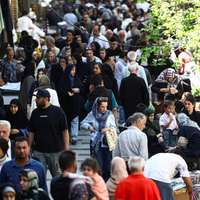
Iranian Steel Worker Protests Continue For Sixth Day
Striking steel workers in Ahvaz, southern Iran, December 2023
Iranian National Steel Industrial Group employees entered their sixth consecutive day of strike action on Thursday to obtain better working conditions.
The protest in Ahvaz has been sparked by dissatisfaction over the recent terminations of and the failure to implement job classification plans.
21 employees
A group of workers met with representatives from the Khuzestan province's General Department of Labor, the National Bank, and several other government agencies on Thursday according to the Free Union of Iranian Workers Telegram channel.
A list of demands to be raised at the meeting was published, which included "Removal of the corrupt CEO, removing the National Bank ownership, and workers' participation in the management of the company". However, no results have been released as of yet.
"The independent voice of Ahvaz National Steel Industrial Group workers" released a statement through the Free Union of Iranian Workers, prior to the scheduled meeting.
The authors of the statement said that in the last six days, “Authorities have been eyeing the workers' protest for their share of the company's loot”, and they are using “every means to create division and disrupt the strike” by making “empty promises” and exerting military and security pressure.
Moreover, they stated they would continue their strike as long as “authorities' threats and inaction continue”. A further 17 employees were prohibited from working on the second day of the protests.
Iranian National Steel Industrial Group, previously controlled by Amir Mansour Aria Investment Company, has gone under private ownership following legal proceedings and the execution of Aria for embezzlement.
In the past few months, workers from a variety of industries, members of different guilds, and retirees have organized protests to oppose the current economic climate, met with crackdowns by security forces during several of the gatherings.
Fatemeh Sepehri, a political prisoner at Vakilabad Prison in Mashhad, is reportedly in critical condition, according to her lawyer, Khosrow Ali-Kordi.
Ali-Kordi warned, "Due to an elevated heart rate, my client can hardly speak, and her respiratory condition is a serious concern."
In a social media video, Sepehri's brother, Asghar Sepehri, revealed, "In Tuesday's meeting, my sister's heart rate was so high that speaking was difficult for her."
Imprisoned since September 21, 2022 amid the Women, Life, Freedom protests, Sepehri faces severe charges, including "collaboration with hostile countries" resulting in a 10-year sentence, "conspiracy and collusion" leading to five years of imprisonment, "insulting the leadership" resulting in two years of imprisonment, and "propaganda against the system" leading to one year of imprisonment.
Despite a brief release in October 2022 for medical treatment, Sepehri was re-arrested three days later at her home in Mashhad by security forces.
She is the latest in a long line of prisoners such as rapper Toomaj Salehi and Nobel Laureate Narges Mohammadi, whose lives remain threatened in the confines of Iranian prisons.
Talks between government representatives and security agencies aimed at resolving the ongoing strike by gold retailers in Tehran have failed to find a solution.
Last week, the Tax Affairs Organization issued a statement warning about the obligation for gold jewelers to issue electronic invoices in a comprehensive system.
Subsequent to the announcement, news of a purported 25% tax on gold and jewelry sales circulated but was promptly denied.
After almost a week of strikes and protests, Ehsan Khandouzi, the Minister of Economy, labeled reactions to the government's new tax policies in the gold sector as "false news" and promised resolution in the coming days.
On Tuesday, information reached Iran International revealing that security agencies in Tehran are urging the reopening of gold trade units. However, market activists remain resolute in their determination to continue the strike until the end of the week.
Yusef Taqizadeh, the head of the Gold and Jewelry Union in Mashhad, reported on Tuesday that the government has temporarily reversed its decision to register the information of gold sellers and buyers in the comprehensive trade system. In response, Taqizadeh called for the cancellation of the strike in Mashhad and the reopening of gold shops by the shopkeepers.
Twenty years since a 6.6-magnitude earthquake shook Bam city in southeast Iran, killing 34,000, fears of a repeat loom large amid Iran's dire corruption.
Earthquake mortality has been found to be higher in countries where corruption is high and in the past 30 years, 83% of all earthquake-related deaths have occurred in anomalously corrupt countries, according to a 2011 report.
In the aftermath of a natural disaster, deterioration of public institutions and a proliferation of inferior building stock can lead to more severe consequences.
As Iran is prone to natural disasters, the UN emphasizes the importance of adopting an effective long-term strategy but the details of mismanagement indicate that tragedies such as the tragedy of the Bam earthquake may repeat themselves.
Authorities reported the Bam earthquake death toll a massive 17 years after the tragedy. Until then, the numbers were estimates and not based on official data. The authorities in Bam resorted to “traditional” healing methods in the first nights following the earthquake, which the Rouydad24 website identified as “opium” being given to survivors.
Bereaved families mourn for their loved ones who died in Bam earthquake (December 2023)
Further examples of poor management can be found in the book by Bijan Daftari, the head of the Iranian Red Cross Society (IRCS) Rescue and Relief Organization at the time of the earthquake. The authorities failed to locate the epicenter of the earthquake for hours, he said.
Many could not imagine earthquakes occurring in that region since it was the home of Bam City, a UNESCO World Heritage Site dating back to the Achaemenid era (6th to 4th centuries BC) that had stood strong for centuries. Furthermore, all communication with the city of Bam was disrupted, and the airport was temporarily inaccessible.
Municipalities, fire departments, hospitals, medical centers, and police stations in Bam city were destroyed, as well as key municipal officials, such as the mayor. In other words, virtually all of the city's infrastructure and vital arteries were destroyed.
The arrival of rescue forces took hours, and the only effective force for rescue was the remaining healthy victims, who, according to another IRCS official Jamal al-Dini, had not received sufficient training. Daftari also pointed out that the government made a mistake by involving the IRGC in the disaster management process.
People carrying bodies of the victims of Bam earthquake (December 2023)
“Given that the IRGC did not have a pre-defined plan for such cases, and no exercise had been conducted with other organizations, this decision made the response process difficult for some time,” Daftrai wrote in his memoir.
Iran experiences an average of 10,000 earthquakes per year, according to the UN which defines the only acceptable response to such disasters as long-term reconstruction, recovery, and risk reduction. It has been demonstrated that earthquake-resistant construction can prevent tragedies from occurring such as is found in Japan and Chile. After a 7.3-magnitude earthquake in Ezgeleh southwest Iran in 2017, the Iranian authorities were once again inadequately prepared to deal with the ensuing crisis.
In a report titled "Crisis in Crisis Management'' in 2017, Shahrvand newspaper quoted Hamidreza Eskash, a crisis management lecturer and consultant, as saying: "Crisis management in Ezgeleh was no different from what happened in Bam. The number of facilities and resources had increased a bit, and we saw more helicopters in the sky.”
This statement is supported to a large extent by the report of the Housing, Road and Urban Development Research Center on the Ezgeleh earthquake. The report states that the destroyed structures were not suitable for seismic zones, the same thing which happened in Bam and its surrounding villages.
Mismanagement still prevails in logistics preparation and response to the crisis, which is the result of managers' ideological viewpoints. A memorandum of understanding signed with the Qom seminary to reduce natural disasters reflects the view of the leaders of the Islamic Republic.
With experts warning of a possible tremor in Tehran with a population of 11 million and located in a seismic region, any large earthquake will result in a disaster of epic proportions, unless the government begins to seriously prepare itself.
Iran has praised Iraqi officials for cutting oil output, saying the two countries had a common position regarding both OPEC and the wider OPEC+ grouping which includes allies such as Russia.
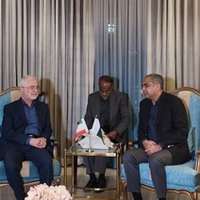
Iranian oil minister Javad Owji's comments came as he signed a number of preliminary agreements with his Iraqi counterpart in Tehran, state media reported.
"Iran and Iraq have a common position regarding OPEC and OPEC+. We thank the Iraqi officials for the voluntary cuts they implemented to improve (oil) prices. We have had negotiations about future issues related to OPEC and OPEC+," Owji said without giving any further details.
Iraq has said it will begin voluntarily cutting its oil output by 220,000 barrels per day (bpd) from the start of January to the end of March as part of a wider voluntary agreement by some of the OPEC+ group.
The agreements signed in Tehran on Wednesday include memoranda of understanding (MoU) to develop shared oil and gas fields, particularly Sindbad in Iraq and Khorramshahr in Iran, Iran's Borna news agency said without giving further details.
Owji said he was hopeful that the development of shared fields would begin soon.
"We reached acceptable agreements on the renovation of Iraqi refineries by Iranian experts and a committee to follow up on this issue has been created," Owji added.
Argentinian filmmaker and former pilot Enrique Piñeyro was forced to remove the image of Mahsa Amini from his Boeing 787 to land in Egypt delivering aid to Gaza.
The social activist unveiled the livery to raise awareness over the crisis in Iran following the "Woman Life Freedom Movement" movement last year which challenged the regime and its religious authority.
The nationwide protests were sparked by the death in morality police custody of 22-year-old Mahsa Amini in September 2022, now an icon of the uprising.
“To fly a humanitarian cargo to El Arish for Gaza, the Egyptian government would not allow the livery with the photo of Mahsa Amini and the legend,” Piñeyro wrote on X.
The Boeing aircraft also featured an image of Iranian footballer Amir Reza Nasr Azadani and the following slogans: “No woman should be forced to cover her head. No woman should be killed for not covering her head. No man should be hanged for saying this”The footballerwas sentenced to 21 years in prison after he was arrested during the protests.
Enrique Piñeyro also helps Ukrainian refugees get to safety, using a Boeing 787 that he owns and operates as part of Solidaire, his charitable organization.