Iranian Activist Narges Mohammadi Refuses To Attend Trial
Iranian activist and Nobel Peace Prize laureate Narges Mohammadi
Renowned Iranian activist and Nobel Peace Prize laureate Narges Mohammadi publicly declared her decision to abstain from attending her trial session on Tuesday.
Mohammadi, currently imprisoned, shared the decision through her Instagram account, where she characterized the Revolutionary Court as the "slaughterhouse of the youth" and expressed her unwillingness to participate in what she views as a judicial system influenced by security institutions and extrajudicial elements.
Mohammadi's decision to refrain from the trial is rooted in several concerns, including the perceived lack of independence of the judiciary, the illegality of the Revolutionary Court, secret show trials, and the denial of defendants' right to a fair defense.
The announcement of Mohammadi's trial was made on December 10, with the session scheduled for December 19, her first trial after being honored with the Nobel Peace Prize.
This marks the third trial for Mohammadi, with recent proceedings focusing on her activities within the confines of the prison and her anti-government statements. Mohammadi, in her Instagram post, labeled the prison as the "stronghold of the despotic government," asserting that such methods have failed in suppressing the determination of courageous prisoners.
In her previous two cases during her imprisonment, Mohammadi was sentenced to 27 months in prison along with four months of street cleaning and community service.
The Defenders of Human Rights Center, in a report following the Nobel Peace Prize ceremony, branded the latest prosecution against Mohammadi a retaliatory measure by the judiciary against her years of human rights advocacy.
The Nobel Peace Prize ceremony in 2023 took place on December 10 in Oslo, Norway, without Mohammadi's presence. Her children, Ali and Kiana Rahmani, accepted the prestigious award on her behalf.
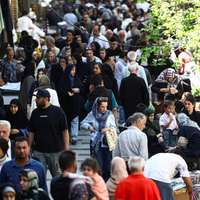
An Iranian woman defying mandatory hijab in public
In a renewed show of solidarity, nine political and civil activists in Iran issued a joint statement on Saturday, expressing their unwavering support for the demand for optional hijab.
Prominent figures such as Zahra Rahnavard, a leader of the Green movement, and Nasrin Sotoudeh, a human rights lawyer, lent their signatures to the statement.
The activists called for an end to all discriminatory policies imposed by the Islamic Republic against women in various personal and social spheres. The statement labels the hijab law in Iran as "a major social, political, and security dilemma," characterizing it as a "tool for violating the dignity and honor of Iranian women and undermining their rights."
In a powerful assertion, the signatories declared, "In an era when the discourse of the equality of human rights, regardless of gender, race, ethnicity, belief, and religion, has become the central theme of human progress, the Islamic regime has invented the issue of hijab to enforce multiple discriminations against women."
The statement also delves into developments in Iranian society over the past year, particularly referencing the protests known as Women, Life, Freedom. It condemns the "inhuman and violent actions" of the Islamic Republic's regime in enforcing compulsory hijab, highlighting the lasting impact on the hearts and consciences of the majority of the people.
The protests, initially sparked by the death of Mahsa Amini in the custody of the morality patrol, faced severe suppression by the security forces of the Islamic Republic. Human rights activists report that the protests resulted in over five hundred deaths. Despite becoming a catalyst for widespread civil disobedience among Iranian women, challenging compulsory hijab, the Islamic Republic persists in enforcing related laws.
A demonstration in support of Women, Life, Freedom protests, outside City Hall in Los Angeles, California, US, October 1, 2022
Jailed Iranian dissident Zohreh Sarv, who ended her hunger strike following a call from Iran’s exiled Prince Reza Pahlavi, has sent a message of unity for the opposition.
In a letter from the women’s ward of Evin Prison in Tehran to Prince Pahlavi, Sarv thanked him and expressed her gratitude to her fellow inmates, including Nobel Peace Laureate Narges Mohammadi, and other activists "of various political inclinations" who supported her during her ordeal.
“Once again, inmates at Evin’s women's ward showed that factional and political affiliations of individuals have no importance when it comes to helping each other and that we are all like a family supporting one another,” Sarv, an Instagramer wrote. She has been jailed twice since 2019 for “insulting the Supreme Leader”, “propaganda against the regime” and acting against national security.”
“My duty towards my friends and comrades [in prison] is has become even more important because of the all-round support they displayed,” she added. “Like pieces of a puzzle that only make sense when they are placed together, every one of us, irrespective of our [political] orientation, will contribute to the freedom of Iran. There is no power greater than unity.”
She began her hunger strike on November 23 to protest authorities' constant efforts to bring new false charges against her and their denial of her rights, including conditional release or prison furlough for medical treatment.
Political prisoner Zohreh Sarv
Former Crown Prince Pahlavi urged Sarv to end her hunger strike. “You have demonstrated your resolution and patriotism in Islamic Republic’s captivity. End your hunger strike. This struggle [against the regime] will continue until the freedom of Iran and requires you to be in good health,” he urged Sarv in a tweet on Wednesday.
Sarv reportedly took an overdose of tranquilizers after pressure from the Revolutionary Guards' Intelligence to collaborate with them against other opponents of the regime. She declared her intent to continue her hunger strike to the end after treatment at the hospital and returning to prison.
Sarv’s message comes following a major controversy on Iranian social media following the Nobel Peace Prize ceremony held earlier this month. Monarchists or constitutional monarchists criticized remarks by Mohammadi’s husband Taqi Rahmani on the sidelines of the ceremonies. He argued that Iranians do not want a sudden revolution, preferring slower change. This is the buzzword for reforms rather than an overthrow of the clerical regime, monarchists and other proponents of regime change claim. The debate got ugly at times with personal attacks and rhetorical accusations by the two sides. Some monarchists went as far as condemning the Nobel Committee for awarding Mohammadi, whom they accuse of an advocate for reforms rather than a regime change.
Unlike many of his supporters, Prince Reza Pahlavi has not condemned the Norwegian Nobel Committee’s decision to award Mohammadi.
“The Norwegian Nobel Committee awarding Narges Mohammadi this year’s peace prize is a recognition of the Women, Life, Freedom movement and this national struggle for freedom,” Prince Reza Pahlavi said in a tweet on October 6 following the Nobel Committee’s announcement of the Peace Prize for the Iranian activist without directly congratulating Mohammadi.
“I hope that this award will encourage a shift in Western policy toward offering tangible means of maximum support for the Iranian people and their national revolution and not serve merely as a symbolic gesture meant to deflect attention from appeasement of this criminal regime,” he added.
The crown prince’s wife, Yasmin Pahlavi, however, recently criticized Mohammadi when she was reported to have a brief phone call with Angelina Jolie from prison.
Social media users who claim to be ardent supporters of the Pahlavi monarchy have been relentlessly attacking Mohammadi and even accusing her of complicity with the regime due to her support of reformists in the past and voting in elections that they had boycotted.
Mohammadi has recently declared that she no longer believes that the Islamic Republic could ever be reformed and would never vote again.
The division between the monarchists and some others in the opposition has escalated in recent weeks with both sides exceedingly targeting each other on social media.
“It is really disappointing when you see many opponents of the regime who cannot bear the continuation of the Islamic Republic are either resorting to the same repressive methods [as the regime] or are facilitating the regime's plans to create discord,” well-known caricaturist Nikahang Kowsar said in a tweet.
Narges Mohammadi, a prominent human rights activist already spending her prison long time, is set to face a third trial on Tuesday in Tehran.
Mohammadi was awarded the 2023 Nobel Peace Prize. The trial, scheduled in the Revolutionary Court, would focus on her human rights activities inside Tehran's Evin Prison.
Last week, after receiving the Nobel Peace Prize, Mohammadi was summoned to the women's ward office and notified that her trial would take place on December 19.
She has issued several statements from prison against the government. The Defenders of Human Rights Center confirms the news, describing the swift initiation of a new case following the Nobel Peace Prize ceremony as the regime's retaliation for her years of human rights advocacy.
The Center emphasizes, "The award has provided an unprecedented opportunity for the unheard voices and the realization of freedom and justice for political and ideological prisoners."
The Nobel Peace Prize ceremony on December 10 in Oslo, Norway, took place without Mohammadi's presence. Instead, her children, Ali and Kiana Rahmani, accepted the award on her behalf.
Close associates of Mohammadi reveal that since November 29, prison authorities have deprived her of phone calls and family visits. Over the past years, she has faced various charges related to her human rights activities, resulting in multiple arrests, trials, and approximately six years of imprisonment.
Her most recent arrest occurred in November 2021, leading to a cumulative sentence of 10 years and 9 months in prison, 154 lashes, a 4-month travel ban, street cleaning, and two cash fines in various cases.
The Iran Human Rights Organization (IHRNGO) has issued a report sounding the alarm about the rising threat of more executions in Iran coinciding with the Christmas holidays.
On Saturday, the organization based in Norway also reported that the execution of Samira Sabzian is expected to take place in the upcoming days. Initially scheduled for December 13, her execution for the alleged murder of her husband was deferred by a week. Samira, who was married as a child, has been on death row for a decade.
IHRNGO is calling on the public, civil society, and the international community to intervene and prevent the executions of Samira and other individuals on death row by engaging in anti-death penalty campaigns and political actions. Director Mahmood Amiry-Moghaddam expressed apprehension about the average of over four executions per day in the past week, stressing the need for the global community to speak out. He voiced concerns that, during the Christmas and New Year holidays, when many parts of the world are on vacation, more individuals may face the risk of execution.
“During this time, particularly individuals such as women, juvenile offenders, protesters, and political prisoners whose executions could elicit stronger reactions under normal circumstances are at greater risk.”
The Mizan news agency of Iran's notorious judiciary also announced the execution of an unnamed man on December 16 in Zahedan Central Prison, citing "links with foreign services, including Mossad." The timing of the execution, occurring a day after the armed attack on the Rask police headquarters, raises suspicions of it being retaliatory.
Iran Human Rights has documented a total of 31 executions between December 9 and December 16, 2023.
A Revolutionary Court in Tehran has handed down an 11-year prison sentence to Sajjad Iman-Nejad, one of the detainees from last year's anti-government protests.
According to the Human Rights Activists News Agency (HRANA), Iman-Nejad faces charges of "armed confrontation" and "intentional assault on law enforcement officers with a cold weapon."
In addition to the prison term, the court has mandated restitution, requiring Iman-Nejad to pay over 50,000 USD to seven law enforcement officers. The court session addressing the charges against the political prisoner took place on November 20 but the verdict became public Sunday.
HRANA, citing an informed source close to Iman-Nejad's family, reported that there are seven complainants by alleged victims, with three of them stating that Iman-Nejad did not assault them. The source further highlighted Iman-Nejad's health challenges, stating, "He is suffering from a disc herniation and physical problems. Despite being transferred to the hospital multiple times for treatment during his detention, he was told there were no available beds. Despite his serious need for treatment, he was returned to prison."
He was arrested on October 8, 2022, in connection with the Iranian uprising against the regime in Tehran. Currently detained in Evin Prison, Iman-Nejad, born in 1991 in Ardabil and residing in Tehran, is single and holds a bachelor's degree in architecture.