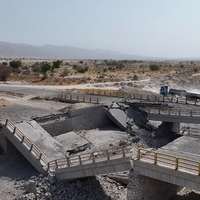
Revolutionary Guard ground forces during an event in the southeastern Kerman province (November 2023)
Israeli government officials were today renewing their efforts to intensify the pressure on the EU and Germany to sanction Iran’s Islamic Revolutionary Guard Corps (IRGC) as a terrorist entity.
When asked if the EU and Germany should outlaw the IRGC, Lior Haiat, a spokesman for Israel’s foreign ministry told Iran International “We do. Because it is a terror organization.”
Israel’s special envoy for combating antisemitism, Michal Cotler-Wunsh, told Iran International, that the “IRGC and Hezbollah are terror groups and must be designated as such”.
Norbert Röttgen, a German MP from the Christian Democratic Union, told Iran International that "The German government has now repeatedly stated that the legal prerequisites for putting the IRGC on the EU terror list do not exist. This is simply not true. There are numerous cases, from within the EU as well as Canada and the US, which could be used as a basis for the process. I believe that the German government and the EU do not want to put the IRGC on the terror list, because they still hope for a revival of the JCPOA. But this is wishful thinking.“
The JCPOA is an acronym for the Joint Comprehensive Plan of Action, the formal name for the Iran nuclear deal.
Israel's Special Envoy for Combatting Antisemitism Michal Cotler-Wunsh
Röttgen, who has spearheaded the efforts in Germany and on the continent to classify the IRGC as a terrorist organization, added “The regime has made it abundantly clear that they have no interest in a new deal. They are playing for time to finish building the nuclear bomb and they are already dangerously close. Germany and the EU urgently need a new Iran policy which focuses on supporting the people in Iran which want to get rid of the regime. This entails doing everything within our means to make life as difficult as possible for the Islamic Republic, including putting the IRGC as the political, economic and military center of power of the regime on the EU terror list."
Iran International sent press queries to Germany’s foreign minister, Annalena Baerbock, from the Green party, who has consistently refused to designate the IRGC a terrorist organization.
The United States during the Trump administration designated the IRGC as a foreign terrorist organization in 2019. US lawmakers previously called on American allies to outlaw the IRGCas a terrorist entity.
Iran International reported that Iranians pressed the EU in January to list the IRGC as a terrorist organization.
Josep Borrell, Europe’s foreign policy chief, according to reports, does not wish to sanction the IRGC because it could impact the Islamic Republic’s willingness to negotiate an atomic deal that would impose temporary restrictions on its illegal nuclear program. Borrell also argues there needs to be aEuropean judicial ruling against the IRGC’s terrorism activities to secure a ban of the Revolutionary Guard Corps.
German lawmaker Norbert Roettgen
However, Röttgen and counter-terrorism experts have provided rulings. A telling example was the A German court convicted a Pakistani man in 2017 who was paid by the IRGC to engage in an assassination attempt of pro-Israel advocates.
The Quds Force—a part of the IRGC—paid Pakistani Syed Mustaf at least 2,052 euros from July 2015 to 2016 to spy on Jewish and Israel institutions and carry out the assassination plot.
Borrell’s office did not immediately answer Iran International press queries.
The Islamic Republic’s organized plan to aid Hamas in its massacre of 1,200 people, including at least 31 Americans, was front-and-center in the thinking of Supreme Leader Ali Khamenei, according to a report published by the Middle East Media Research Institute (MEMRI). Khamenei hinted on two different occasions, in 2022 and 2023, at "The Complete Conquest" of Israel in his media mouthpiece Kayhan.
According to a MEMRI translation from Khamenei’s propaganda outlet, Kayhan, the plan of mass murder was engineered by the late Iranian global terrorist Qassem Soleimani in 2020. The U.S. military assassinated Soleimani in early January 2020 for his overseeing the killing of over 600 American military personnel.
Kayhan wrote, according to the translation, that in August 2023 "The significance is that, last year, the Leader [Khamenei] gave 'the promise of the imminent conquest,' and this year he gave 'the announcement of the complete conquest,' and Operation Al-Aqsa Flood is part of this imminent conquest. This promise and announcement, along with the clarity and power of [Khamenei's] statements and positions in his meeting [with leaders and ambassadors of Islamic countries] on the occasion of the Prophet [Muhammad's] birthday, have profound significance and content."
The European Union has only classified Hezbollah's so-called “military wing” a terrorist entity but permits its “political wing” to raise funds and recruit new members. Hezbollah considers its movement to be a monolithic organization without wings.
The EU commissioner tasked with fighting anti-semitism, Katherina von Schnurbein, and her German counterpart, Felix Klein, have repeatedly refused to urge the EU and Germany to outlaw the lethal antisemitic organization IRGC. Both von Schnurbein and Klein faced criticism this year from Israeli General Amir Avivi because they praised an allegedly deficient German national report to combat antisemitism as a “milestone.” Avivi objected to the report because Klein and Germany’s interior ministry failed to include antisemitism from Hamas and Iran’s regime in the report as major threats to German Jews and the state of Israel.
Klein and von Schnurbein declined to respond if they agreed with their Israeli counterpart, Cotler-Wunsh, about the immediate need to designate Hezbollah and the IRGC as terrorist entities.
After considerable pressure from then-US ambassador to Germany, Richard Grenell, the German interior ministry outlawed all Hezbollah activities within its territory in 2020. Germany, however, has failed to enforce the ban, argue critics. According to German intelligence reports from 2023, there are 1,250 active Hezbollah operatives in Germany.
Afghan women shout slogans during a rally to protest against what the protesters say is Taliban restrictions on women, in Kabul, Afghanistan, December 28, 2021.
The German education minister says education is essential for the foundations of women's rights in Iran and Afghanistan, calling for international support.
Speaking to Iran International about ways to empower women in Iran and other authoritarian states, Bettina Stark-Watzinger, the Federal Minister of Education and Research and the Deputy Leader of the Free Democratic Party, praised the efforts by Afghan and Iranian women, pointing out that the fight for freedom is fostered by education, which is “the best way to make people independent.”
Speaking on the sidelines of an event organized by the Axel Springer Freedom Foundation, an NGO that supports human rights activists through financial support, Stark-Watzinger told Iran International’s Ali Samadi that the first steps for supporting Iranian women would be supporting dissident figures and make the world see “how human rights and women’s rights are violated.”
“We always have to speak up against” such violations, she added, alongside Iranian opposition figure Masih Alinejad and several other activists and officials.
Addressing Stark-Watzinger, Alinejad voiced appreciation for the German government, which she said has promised to back Iranian and Afghan women in their fight for freedom.
A group photo of some of the participants of the Axel Springer Freedom Foundation's Award for Courage, Berlin (November 2023)
On the anniversary of the death of Mahsa Amini, whose death in morality police custody triggered a nationwide uprising, German Foreign Minister Annalena Baerbock pledged Berlin's solidarity with the people of Iran.
"Even if the protests have disappeared from the headlines, we will not leave the people of Iran on their own," she said. "We will place the fate of the people in Iran on the agenda in Brussels, New York and Geneva."
"As much as it breaks our hearts, we will be unable to change conditions in Iran from outside, but we will not hold back from giving the people in Iran a voice," Baerbock said at the time. Germany has also backed ongoing EU sanctions on Iran relating not only to its nuclear program but for its brutal suppression of protesters during the Women, Life, Freedom uprising. Baerbock has repeatedly condemned Iranian authorities for human rights violations and is among the most vocal European leaders who speak out against Tehran’s treatment of women and protesters.
Alinejad recognised the support, and said, “We believe that Iranian and Afghan women are fighting against a common enemy: gender apartheid".
During the event, the Axel Springer Freedom Foundation gave its courage award to Afghan women for their fight against the rule of Taliban, which has been intensifying restrictions on women’s education and social presence since it seized power in August 2021 as US-led forces withdrew after 20 years of war.
Referring to the award, Alinejad said that giving awards alone is not enough. “If you do not take practical steps to remove the Islamic Republic and the Taliban, they will eliminate you on German soil,” referring to assassination attempts she has so far evaded from regime security forces on foreign soil.
A UN assessment of the women’s rights situation submitted to the 15-member Security Council in November read, "The basic rights of women and girls, including the right to education and to work, and representation in public and political life – are not only fundamental obligations of a state, but also critical to build state capacity for long-term development and economic growth and peace and security.
"Any formal re-integration of Afghanistan into global institutions and systems will require the participation and leadership of Afghan women.”
Since the Taliban returned to power, most girls have been barred from high school and women from universities. The Taliban have also stopped most Afghan female staff from working at aid agencies, closed beauty salons, barred women from parks and curtailed travel for women in the absence of a male guardian.
In Iran, since last September's uprising, women have been under increasing oppression as they rebel against mandatory hijab. They have been banned from public spaces, education and faced fines and jail terms for shunning the state laws which has seen a nation rise up.
American troops in the region have been targeted at least 73 times since Israel began its onslaught on Gaza in response to the Hamas attack of 7 October, which killed 1,200. Iran-backed militant groups in Iraq and Syria have claimed responsibility for the attacks, but Tehran has claimed they are acting independently, angered by the war in Gaza.
However, the Islamic Republic calls these militant groups part of its axis of resistance against the United States and Israel. Almost every armed group that has targeted US forces in recent weeks is backed by or affiliated with the regime in Iran.
And yet Ambassador Iravani flatly denied any Iranian involvement and called such claims “baseless accusations’ – just as an IRGC-affiliated news agency published a video purporting to show images of the aircraft carrier USS Dwight D. Eisenhower being monitored with drones while passing through the Strait of Hormuz.
USS Eisenhower was deployed to the Middle East last month as concerns grew that the war on Gaza could spread across the region. The deployments – including warships and THAAD and Patriot batteries – were meant to deter hostile forces from attacking US personnel and interests.
But they seem to have failed to do so.
While Iran-backed groups have regularly attacked American bases in Iraq and Syria, injuring dozens, the Houthis in Yemen have seized a container ship and frequently launched missiles, including a ballistic missile last weekend that aimed at a US warship in the Gulf of Aden. The US has issued a warning to commercial shipping in the Indian Ocean.
The Pentagon has maintained throughout that it will do whatever it takes to protect American forces. But many on the Capitol have raised questions about the Biden administration's will to address the threats posed by Iran and its proxies.
“President Biden seems to be going out of his way to avoid targeting Iranians or the resources it holds dear,” Senator Tom Cotton posted on X Tuesday. “This weakness only invites more aggression.”
Republicans in Congress have been trying hard to push the Biden administration towards a more forceful stance in dealing with the regime in Iran. Several pieces of legislation have been introduced to limit the President's freedom of action in making concessions to Tehran or reverse his administration’s policies.
One such initiative in the Senate would designate Houthis as a terrorist organization, citing the group’s weekend missile attacks on a U.S. warship as an alarming escalation.
The legislation is led by Senator Ted Cruz and six other Republicans. It will reapply all sanctions on the Houthis that were lifted in 2021 when the Biden administration took office.
“The Biden administration made a day one politically driven decision to dismantle terrorism sanctions against the Houthis and their leaders,” said Senator Cruz. “That decision was an obvious and catastrophic mistake from the very beginning, and it has only become more obvious and more catastrophic as time has gone on.
Siavash Sobhani, a 61-year-old Iranian doctor based in Northern Virginia, recently discovered that his US citizenship, acquired at birth, was mistakenly granted due to a bureaucratic error.
Born in Washington, DC, to a father with diplomatic immunity, Sobhani applied to renew his passport in February, expecting a routine process. However, he received a shocking letter from the State Department, stating that he should not have been granted citizenship at birth and instructing him to apply for lawful permanent residence.
“I’m waiting for an interview but does that mean I wait another year for an interview?” he said. “Then another three years for the next step? Then another 10 years before I can travel outside of the country?”
The letter clarified that individuals born in the US to parents with diplomatic immunity do not automatically acquire citizenship. As his father was on a job at the Iranian Embassy, Sobhani was born at Walter Reed Army Medical Center in 1961. After living in Turkey during his childhood, he returned to the US for education, earning degrees from George Washington University and Boston University before attending Georgetown Medical School.
Concerned about the implications for his medical practice, Social Security benefits, and attendance at his son's wedding, Sobhani diligently followed the directive to apply for permanent residence. However, he faces uncertainty regarding the timeline and fears prolonged bureaucratic delays. Having already incurred over $40,000 in legal fees, he expresses concern about potential hurdles and the inability to visit family and friends abroad.
Iran's Supreme Leader Ali Khamenei during a visit to the IRGC Aerospace Force Achievements exhibition in Tehran, November 19, 2023
US officials have attributed the prevention of specific weapons parts sales to Iran to a controversial surveillance tool.
The CIA and various intelligence agencies leveraged data collected through monitoring the electronic communications of foreign weapons manufacturers, reported Politico on Tuesday.
The surveillance effort successfully thwarted multiple shipments of advanced weapons components intended for Iran via land, air, and sea.
The initiative is in line with the administration's broader objectives to curb Iran's ballistic missile program. Officials express concerns that Iran might be using the program to support Russia in the ongoing conflict in Ukraine. Additionally, efforts are directed towards limiting Iran's involvement in conflicts with wider implications for US national security, including the ongoing conflict between Israel and Hamas.
The revelation serves as the administration's latest argument in favor of reauthorizing Section 702 of the Foreign Intelligence Surveillance Act before its expiration at the end of the year, underscoring its perceived significance for national security.
Officials emphasized the instrumental role of Section 702 in halting weapons sales to Iran. The process involved identifying US-made supplies needed by Iran through other intelligence means and subsequently querying the 702 database for detailed intelligence on the components, including cost, timing, and size.
Specific details about the manufacturers or components involved were not disclosed, and officials spoke on condition of anonymity due to the sensitive nature of intelligence matters.
Last month, the UN sent letters to countries announcing the end of bans on Iran's missile program, removing barriers for the clerical regime to sell dangerous technologies. Iran, historically allied with Russia, faces accusations of supplying lethal drones to Moscow for use in Ukraine, though it asserts its neutrality in the conflict.
The Iranian and other flags flutter in front of the International Atomic Energy Agency (IAEA) organisation's headquarters in Vienna, Austria, June 5, 2023.
The UN nuclear watchdog claims Iran is not fulfilling commitments and there is no progress ahead, yet no resolution was issued at the body’s key summit.
Washington and its European allies did not move to censure Iran at the critical meeting of the International Atomic Energy Agency (IAEA) in Vienna from November 20 to 24 while Tehran is enriching uranium at levels with no non-military use and is stockpiling more of it.
After the previous round of the 35-nation IAEA Board of Governors meeting in September, the Islamic Republic ejected one-third of the inspectors with expertise in uranium enrichment. And each time the board issued resolutions as the IAEA decided it is “essential and urgent” that Iran act to fulfil its legal obligations and clarify all outstanding safeguards issues without delay, Iran responded by augmenting activities.
Iran has steadily leveled up its nuclear game since 2021, developing more plants, enriching more uranium at higher levels, stockpiling more, and simultaneously eroding IAEA monitoring. The latest IAEA report said Iran has enough uranium enriched to up to 60% for three atom bombsand is still stonewalling the agency on key issues, with IAEA Director General Rafael Grossi highlighting that “significant safeguards issues remain outstanding" in Iran’s nuclear program. Experts say analyzingIAEA recent reports proves that Iran now has enough enriched uranium to produce weapons-grade uranium (WGU) for one nuclear weapon in as little as seven days and up to 12 nuclear weapons in five months.
Director General of the International Atomic Energy Agency (IAEA) Rafael Grossi holds a press conference on the opening day of a quarterly meeting of the agency's 35-nation Board of Governors in Vienna, Austria, November 22, 2023.
"If Iran fails to implement the essential and urgent actions contained in the November 2022 Resolution and the 4th March Joint Statement in full, the Board will have to be prepared to take further action in support of the (IAEA) Secretariat to hold Iran accountable in the future, including the possibility of a resolution," Britain, France, Germany -- the so-called E3 -- and the US warned in September. Since the last resolution last November, the West has refrained from formally condemning Tehran's progress or setting a deadline for Iran to come into compliance with a five-year IAEA investigation into Iran's violations of the Nuclear Non-Proliferation Treaty (NPT).
Andrea Stricker, a research fellow at the Foundation for Defense of Democracies (FDD), has called on the West to push back Iran’s nuclear advances, asking, “How many inspectors must Iran eject and how many nuclear weapons’ worth of uranium will Tehran amass before the West stands up to the regime? The current approach ensures Iran can stroll to nuclear weapons at a time of its choosing.”
Pointing out Iran’s destabilizing activities, Anthony Ruggiero, Senior Director of FDD’s Nonproliferation Program said, “Tehran funds and supports proxies attacking Israel and is on the threshold of nuclear weapons. President Biden should call for a special IAEA board meeting to censure Iran and support the IAEA’s director general. Washington must fully implement US sanctions and respond to Tehran’s proxies attacking US troops by targeting Iranian personnel responsible for the attacks.”
There is bipartisan consensus at US Congress that anuclear Iran isunacceptable, but no measure did manage to slow down Tehran’s nuclear drive.
It seems that some of world leaders have come to terms with a nuclear Iran and its hypothetical atomic bombs, and apparently a dozen more states that are at the verge of going nuclear. During the World Nuclear Exhibition in Paris on Tuesday, Grossi said, "We already have 10 countries which have entered the decision phase (to build nuclear power plants) and 17 others which are in the evaluation process. There will be a dozen or 13 (new) nuclear countries within a few years.” Producing electricity also gave birth to Iran’s nuclear program.