Director General of the International Atomic Energy Agency (IAEA) Rafael Grossi holds a press conference on the opening day of a quarterly meeting of the agency's 35-nation Board of Governors in Vienna, Austria, November 22, 2023.
The head of the UN nuclear watchdog warned of a lack of progress on curtailing Iran's ongoing stockpiling of enriched uranium, claiming "no progress" has been made since March.
Director General of the International Atomic Energy Agency (IAEA) Rafael Grossi made the remarks on the opening day of a quarterly meeting of the agency's 35-nation Board of Governors in the Austrian capital Vienna on Wednesday.
Presenting his latest report on verification and monitoring in the Islamic Republic of Iran in light of United Nations Security Council Resolution 2231 (2015), Grossi said. “You will note that Iran’s stockpiles of uranium enriched up to 5%, enriched up to 20% and enriched up to 60% – high enriched uranium – have all increased since we met in September with the increase of the 60% continuing at the same rate as I reported at the time of the last Board."
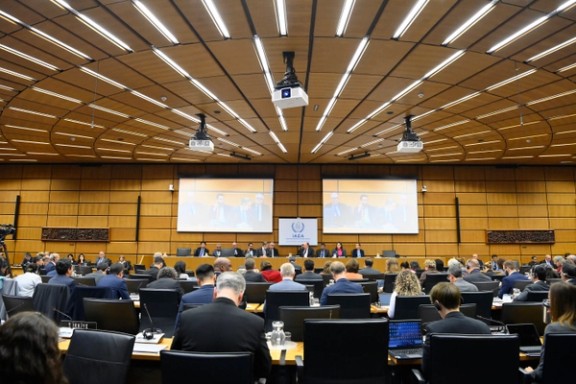
The 1696th Board of Governors meeting held at the Agency headquarters in Vienna, Austria, 22 November 2023
He also urged cooperation for implementing commitments made by Iran in another report on the NPT Safeguards Agreement with the Islamic Republic of Iran. “I regret that no further progress has been made in implementing the Joint Statement signed in Tehran on 4 March... I am seriously concerned that the implementation of the Joint Statement of 4 March 2023 has come to a standstill. A way forward must include an honest and cooperative implementation of the commitments we agreed.”
A few days after Iran secured a prisoner swap with the US that included unfreezing of about $6 billion of its oil revenues blocked in South Korea, Tehran withdrew the designation of several inspectorsassigned to conduct verification activities in Iran under the Non-Proliferation Treaty Safeguards Agreement. he said the move “contradicts the spirit of cooperation agreed in the Joint Statement of March 2023.”
Grossi said, "It takes a long time to train inspectors of this kind... We will go ahead (with inspections) but this is a very negative development and a serious blow. We hope that this decision will be reversed."
He emphasized the need for Iran to provide technically credible explanations for the presence of uranium particles of anthropogenic origin at Varamin and Turquzabad and to inform the Agency of the current location(s) of the nuclear material and/or of contaminated equipment.
“These outstanding safeguards issues stem from Iran’s obligations under its Comprehensive Safeguards Agreement and need to be resolved for the Agency to be in a position to provide assurance that Iran’s nuclear program is exclusively peaceful,” he stated.
Iran has enough uranium enriched to up to 60% for three atom bombs and is still stonewalling the agency on key issues, IAEA reports showed earlier in the month. Iran's stock of uranium enriched to up to 60% grew by 6.7 kg (14.8 pounds) to 128.3 kg (282.9 pounds) since the last report on September 4, one of the two reports to member states seen by Reuters said. That is more than three times the roughly 42 kg (92.6 pounds) that by the IAEA's definition is theoretically enough, if enriched further, for a nuclear bomb. Weapons-grade is around 90% purity.
Mohsen Naziri Asl, the resident representative of the Islamic Republic of Iran to the IAEA, at the Board of Governors meeting held at the Agency headquarters in Vienna, Austria, 22 November 2023
Amid simmering tensions in the region -- started by Iran-backed Hamas's bloody invasion of Israel on October 7, Grossi also stressed the need to make the Middle East a nuclear-free zone. “I think there have been repeated calls for all countries in the Middle East – and this includes Israel – to join the NPT and to open all their nuclear facilities to comprehensive safeguards inspections and this is very clear... Every country in the Middle East should be party to the NPT which is the most successful treaty in arms control and non-proliferation in history.”
Grossi underlined “the fact that a nuclear war cannot be won and therefore should never be fought,” falling short of addressing the political aspect of a nuclear weapon as a sword of Damocles hanging over globalsecurity.
Washington has called on the Islamic Republic to stop torture, mock execution and issuing death sentences without fair trial for prisoners.
In a statement issued Tuesday via the Farsi account of the US State Department on the social media platform X, the United States called on the Islamic Republic to cease the practice.
The State Department utilized the hashtag #SamanYasin in expressing deep concerns over the wellbeing of the imprisoned Iranian rap artist.
Saman Seydi, widely recognized by his stage name Saman Yasin, was arrested in October 2022 during anti-regime protests in Iran and was initially handed a death sentence. However, the sentence was later overturned by the Supreme Court.
Ahmadreza Haeri, a political prisoner held in Qezel Hesar Prison, revealed in a letter on Monday that Yasin had recounted a disturbing incident from December of the previous year. According to Yasin, Evin Prison officials took him out of his ward at three in the morning, stating, "If you have a will, write it."
Reportedly, Yasin was taken to the gallows with his hands tied and eyes blindfolded, where officials discussed tying the noose off-center to ensure a swift and less agonizing death.
In a turn of events, officials informed Yasin, after a phone call, that he was being given another chance for "cooperation," leading to the abandonment of his execution.
In response to the reports, the US Department of State emphasized, "The use of fabricated execution, torture, and issuing death sentences without a fair trial not only violates human rights but is also contrary to fundamental respect for human dignity."
The US called on the regime to "immediately cease such inhumane actions and conduct fair and transparent trials for their citizens."
In May alone, a record 142 prisoners were excited as the surge continues. In July, Iran Human Rights Organization reported at least 354 executions had taken place this year.
Masoud Setayeshi, the spokesperson for Iran's Judiciary, has called on the Swedish appeal court to ensure a fair and correct proceeding for former Iranian jailor Hamid Nouri.
Nouri, a former deputy prosecutor at Gohardasht Prison near Tehran was sentenced to life in prison by a Swedish court last year for his alleged role in the purge of political prisoners in Iran during the 1988 killings.
Speaking on Tuesday, Setayeshi emphasized the need for the judge to conduct the proceedings with “correctness, honesty, and without bias, considering both God and the law.” He cautioned against the influence of “political atmospheres, highlighting the importance of adherence to principles of justice and legality.”
Setayeshi's call flies in the face of the fact that the Iranian regime regularly conducts unjust court proceedings and delivers biased rulings. Innumerable sentences have been given without fair trial or proper legal representation. Both historical records and recent evidenceby legal experts and rights groups suggest that the death penalty is wielded by the Islamic Republic as a means of political repression, particularly to instill fear among opposition forces. In trials that may result in death sentences for defendants, Iran's Judiciary prohibits protesters and dissidentsfrom selecting their legal representation.
In Iran, individuals on trial for crimes against national security can only be represented by lawyers with the "endorsement" of the chief justice. Dissidents facing charges related to national security, insulting the Supreme Leader, or unlawful assembly often have limited options for legal representation.
Protesters are sometimes charged with offenses such as "corruption on earth" or "waging war against God," both of which carry the death penalty. Iran's revolutionary courts have sentenced numerous protesters to death on such charges, with seven executions reported so far and others facing the same fate.
Senior scholars held an event in Canada, discussing pressing global security concerns with a focus on the alliance by China, Russia, Iran and North Korea (CRINK).
About 300 influential Western figures, including military leaders, lawmakers, diplomats, scholars, and activists wrapped up the 2023 Halifax International Security Forum (HISF) Sunday, after three days of expert panels covering a wide range of topics. The discussions revolved around the challenges posed by CRINK, an acronym derived from the initials of the four nations that have been directly or indirectly involved in numerous military conflicts worldwide.
The summit delved into various themes, with a significant emphasis on the ongoing conflict in Ukraine and the conflict between Israel and Hamas. Notably, the alignment of China, Russia, Iran, and North Korea was identified as a substantial threat to the established world order. Leaders of these countries, including Iran’s ruler Ali Khamenei, have repeatedly talked of a new global order not based on Western values.
After opening remarks on the first day of the event, Canada’s Minister of National Defense Bill Blair -- who co-hosted the 15th annual forum with the founding President of forum Peter Van Praagh -- answered to Iran International's Mahsa Mortazavi who asked about Canada's possible plans against the Islamic Republic's influence and its entrenchment into the Canadian society.
Canada’s Minister of National Defense Bill Blair (left) and Peter Van Praagh, the founding president of the 2023 Halifax International Security Forum Nova Scotia, Canada (November 2023)
“Canada has already listed Iran as a state sponsor of terrorism which on a level of international law is a very significant and serious determination,” Blair said, when asked why Canada is not following its ally the US in designating Iran’s Revolutionary Guards as a terrorist organization. He noted that “part of Iran's export of terrorism is through the Quds force,” referring to the IRGC’s extraterritorial wing. “We've already listed those as a terrorist entity.”
About agents of Iran’s Revolutionary Guards active in Canada, Blair said, “I want to assure Iranian Canadians we understand how concerning the activities of the IRGC is. We believe that it is necessary to do more, and that work is ongoing.”
In one of the panel discussions, US Senator Jim Risch (R-ID) argued that the Middle East conflicts are fueled and funded by the Islamic Republic. “It is all Iran, whether Hamas, Hezbollah or Houthis, it is all Iran.”
Masih Alinejad, in a panel discussion with some fellow dissident activists, said “It's a shame that the US government designated the Revolutionary Guards as a terrorist organization, but the US allies are still hesitating to do the simple thing.”
Claiming that Iran’s Khamenei, Russia’s President Vladimir Putin, China’s Xi Jinping are “more united than Democratic countries,” Alinejad called for specific measures to counter the global threats Iran poses. "First, criminalize the Revolutionary Guards as a terrorist organization," she said, adding that the second is ridding Canada from the IRGC agents. She claimed there are over 700 IRGC agents "living luxury lives” in Canada. “Kick them out not because they are the threats for us Iranians, they are threats for democracy; for Canadians as well.”
Participants expressed concerns about the volatile situations in the Middle East, the South China Sea, and the Russia-Ukraine conflict, considering them potential hotbeds that could escalate into broader global conflicts. There was a consensus among democratic nations that unity is crucial to counterbalance the influence of the CRINK alliance.
Islamic Republic hardliners claim that closer economic and political relations with the East and Asian countries, which Khamenei has promulgated with the catchphrase "Looking East", will help Iran's development and strengthen it against Western powers, particularly the United States. Since 2018, and Khamenei's advocation of the policy, "Looking East" has become one of the centerpieces of a 'revolutionary economy' which hardliners have been hard at work to theorize and promote.
Almost all the experts were unanimous that the Middle East, particularly the ongoing Israel-Hamas war, and the crisis in South China Sea over Taiwan are the critical flashpoints, from which the conflicts can escalate into bigger wars. Additionally, the Russia-Ukraine conflict was highlighted in several panels, with global leaders stressing the importance of supporting Ukraine in resisting the Russian aggression.
Activists and experts urged the US to send a significant amount of weaponry so that Ukraine can come out a winner from the almost two-year war with Russia. Garry Kasparov, a former World Chess Champion-turned-political activist, told US military men present at the event that the arms needed by Ukraine to win the war “are collecting dust in Pentagon storehouses.”
The Halifax International Security Forum presents an award annually in honor of US Sen. John McCain, who died in 2018, to “individuals from any country who have demonstrated uncommon leadership in the pursuit of human justice.” “On the 75th anniversary of Israel’s creation, and in the aftermath of the October 7 attack that resulted in the greatest loss of life to the Jewish people since the Holocaust, it is fitting to present an award that bears Senator McCain’s name to: The People of Israel,” a statement by the security forum read.
As the HISF concluded, the consensus among democratic nations was clear: a united front is essential to address the destabilizing activities orchestrated by the CRINK alliance and to uphold the principles of the global world order.
Journalist Josh Rogin, who hosted one of the panels, said, “The bottom line is that … we're entering into a bipolar world... our adversaries are teaming up against us in Ukraine, in Israel, in Europe, and in the Pacific.”
“Iran is arming Russia and Hamas; North Korea is exporting weapons to Russia to use against Ukrainians; Russia and China are teaming up to help Hamas diplomatically; and China is helping Russia and Iran evade sanctions and continue their aggression,” he said, stating that “these conflicts are intertwined and therefore our response needs to be intertwined.”
As Kasparov put it, the leaders of CRINK exactly say what they are going to do, and they are delivering on their promises. He explained that Putin had talked of annexation of lands he deemed as part of Russia, or China’s Xi has been vocal about taking over Taiwan, and Iran’s Khamenei has been trumpeting his prophecy of Israel’s annihilation. He said the world should take their threats at face value.
“At times like this, conferences like this one matter. Threats to international stability are on the rise – and in the face of those threats, we’ve got to work together. We must learn from one another and share experiences. We must step up to address these challenges, and to preserve peace and prosperity for our peoples. Together, I’m confident that we can build a safer world. We can ensure that our militaries are ready to face the threats of tomorrow. And ultimately, we can protect and strengthen the rules-based international order that keeps us all safe.”
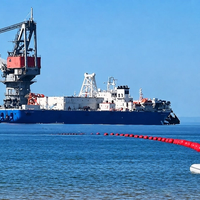
A Turkish activist is at the helm of gathering around 1,000 boats in Turkey in a bid to disrupt Israeli marine activity as the Gaza conflict widens.
Amid the war in Gaza, declared by Iran-backed Hamas on October 7, the action echoes the deadly events of more than a decade ago when in 2010, the Israeli navy raided the Turkish Mavi Marmara, dubbed the Gaza Freedom Flotilla, carrying pro-Palestinian protesters aiming to impose a blockade.
After violent resistance, 10 activists were killed and a further 10 military personnel were injured in the incident.
Volkan Okçu is organising the latest mass blockade telling local news site Haber7, that the boats will carry 4,500 people from 40 countries. Among the 1,000 vessels will be 313 boats filled with Russian activists, and 104 filled with Spanish activists, he said.
While it is not backed by the Turkish government, President Erdogan has recalled the Turkish ambassador in Israel and been forthright in his condemnation of the attacks on Gaza in response to the massacre in Israel on October 7, killing 1,200 mostly civilians. A further 240 were taken hostage to Gaza.
Turkey is also host to Hamas, one of the two bases outside Gaza used by political leader Ismail Haniyeh, who is currently in Doha meeting with Red Cross officials to negotiate a ceasefire in return for the release of some of the hostages, which include 40 children, the elderly and the sick.
Okçu told Haber7 that the flotilla is scheduled to leave Turkish coasts on Thursday, first stopping in Cyprus before going next to the Israeli port of Ashdod. The goal he says is to disrupt trade and goods heading to Israel for up to 10 days.
The Turkish activist said there will not be a repeat of the incident of 2010, the flotilla following international law and the vessels sailing under flags of the US, the UK, Luxembourg, Russian, Germany, Spain, Poland, and others.
The Mavi Marmara Freedom and Solidarity Association announced this week its intentions of delivering aid to Gaza. ”We are setting out again towards Gaza as a civil and independent movement in line with the decision we made with the International Freedom Flotilla, of which we are a member,” the association said on its website.
“Our actions against the naval blockade in Gaza adhere to the principles of nonviolence and non-violent resistance," it added.
As the Israeli onslaught of Gaza continues, hundreds of the militia’s commanders assassinated and large swathes of the strip destroyed, Hamas’s political leader in exile, Ismail Haniyeh, said that a truce with Israel was “close”.
In spite of the celebrations of victory by Hamas, the proscribed terror group is being pushed further underground as Israel’s land incursion deepens, unraveling the group’s thousands of miles long terror tunnel network.
It is understood that both sides would agree to release women and children, Hamas to release hostages, and Israel to release those held in its prisons, according to Hama’s Issat el Reshiq.
Mirjana Spoljaric, president of the International Committee of the Red Cross (ICRC), met Haniyeh in Qatar on Monday to "advance humanitarian issues" related to the conflict, the Geneva-based ICRC said in a statement. She also met separately with Qatari authorities.
The ICRC said it was not part of negotiations aimed at releasing the hostages, but as a neutral intermediary it was ready "to facilitate any future release that the parties agree to.” In Israel, families of the captives demand the organisation do more to access the hostages to prove signs of life and address critical health needs.
The flotilla comes as the war on Hamas widens further into the international arena. Iran’s proxy in Lebanon, Hezbollah, conducted its most brutal assault on Israel’s norther border since the start of the war on Monday. Iran’s largest and most powerful terror proxy employed more developed destructive weapons, in spite of Iran’s ongoing official denials of its involvement in the conflict. Top regime officials however have lauded the Hamas attacks and voice support for other groups joining the efforts of “resistance” against Israel.
On Sunday,Iran’s proxy the Houthis in Yemen, hijacked a Japanese-operated cargo ship in the Red Sea. The car carrier, Galaxy Leader, was taken to a Yemeni port, the proxy group believing it was owned by an Israeli businessman. On Monday, Japanese officials announced they were in direct talks with the Houthis after confirming the vessel was operated instead by Tokyo-based firm Nippon Yusen.
Spanish police on Tuesday detained three people over an assassination attempt on a politician sympathetic to Iran’s opposition, looking into whether he has links with foreign countries.
The former head of Spain's center-right People's Party in the Catalonia region, Alejo Vidal-Quadras, was shot in central Madrid on November 9 and taken to hospital. Spanish media was teeming with stories about Iran’s possible role in the assassination attempt.
One of the suspects was arrested in the southern port city of Malaga and the other two in Granada, a police source told Reuters. Two of them were Spanish men and the third arrested was a British woman, the source said.
The 78-year-old conservative politician survived the attack as the bullet passed through his jaw but he is reportedly still in hospital.
Immediately after the incident, Spanish media reported speculations of Iran’s possible involvement in the attack with claims that Vidal-Quadras told doctors and relatives post-surgerythat he believes Iran is behind the hit, which was then relayed to Spanish authorities. If true, it would be an unprecedented attack by the Islamic Republic on Spanish soil.
In October 2022, the Iranian Ministry of Foreign Affairs imposed sanctions on a long list of critics for their solidarity with the popular uprising sparked by the death in custody of a young woman that came to be known as the Women, Life, Freedom movement.
Vidal-Quadras, who served as European Parliament vice-president between 2009 and 2014, was accused by Tehran of "supporting terrorism and terrorist groups and spreading violence and hatred" for his strong condemnations of the crackdown on protests by the country’s ruling circle as well as his contacts with exiled opposition group Mojahedin-e-Khalq (MEK). The Spaniard was among eight European entities and 12 people who were blacklisted by Tehran in retaliation to the European Union sanctions imposed on Iran.