Iran's Supreme Leader Calls For Temporary Severance Of Ties With Israel

Ali Khamenei, the Supreme Leader of Iran, has urged Muslim states with political connections to Israel to temporarily sever ties as a result of its attacks on Gaza.

Ali Khamenei, the Supreme Leader of Iran, has urged Muslim states with political connections to Israel to temporarily sever ties as a result of its attacks on Gaza.
"Some Islamic governments have condemned Israeli crimes in assemblies while some have not. This is unacceptable," he said Sunday, though it was unclear which nations he was referring to as nations across the Arab world all have stood by Gaza in the wake of the war declared by Hamas on October 7. Israel's relentless retaliation has seen several Muslim countries expel Israeli ambassadors, including Turkey and Jordan.
Iran, a financial and military supporter of Hamas, has lauded the attacks on October 7 which saw 1,200 mostly civilians killed in Israel and 240 more taken hostage, as a "success", while denying direct involvement.
His calls for severing ties come on the heels of Khamenei's recent call for an Islamic embargo on oil and food to Israel during a summit between the Organization for Islamic Cooperation and the Arab League on November 11, where Muslim states did not reach a consensus on imposing extensive sanctions on Israel, as suggested by Iran's President Ebrahim Raisi.
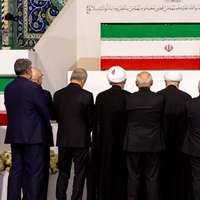
Khamenei delivered his latest remarks at an exhibition showcasing the "latest achievements" of the Islamic Revolutionary Guard Corps' Aerospace Force, introducing the Fattah 2, an upgraded version of Iran's purported first hypersonic missile.
He criticized Israel for falling short of its goal to destroy Hamas despite extensive bombings in Gaza. Israel however, has destroyed large swathes of Hamas infrastructure across Gaza from command centers to parts of its extensive tunnel network, in addition to killing at least 5,000 terrorists, including numerous high level commanders, in its mission to eradicate Gaza of Hamas.
This weekend, the Crown Prince and Prime Minister of Bahrain became the first Arab leader to unequivocally condemn the Hamas attacks which saw women, children and the elderly savagely murdered in the single most deadly day for Jews since the Holocaust, calling the attack "horrific". The country, which normalized ties with Israel in 2020 under the Abraham Accords, has stood firm in condemning Israel's retaliation but the rare branding of Hamas's attacks as "barbaric" rang loud across the Arab world which has as yet, largely avoided direct criticism of the proscribed terror group.
Iranian actress Hanieh Tavassoli has been handed a six-month prison sentence for content shared on social media amidst worsening crackdowns.
The charges against her include "publishing false information with the intent to disturb public opinion." The prison sentence has been suspended for three years, as conveyed by the lawyer.
Speaking in an interview with the semi-official news agency ISNA on Sunday, her legal advisor, Maryam Kian Ersi, detailed that Tavassoli is also obligated to pay a fine of 150 million rials (approximately 300 USD).
Tavassoli, who was apprehended at her residence in September, has since been released on bail. The arrest was linked to content shared on her social media accounts, particularly a tribute to Mahsa Amini, who tragically lost her life in morality police custody. The incident coincided with national protests commemorating the one-year anniversary of Amini's death.
Several weeks preceding her arrest, Tavassoli took to Instagram to express her views, indicating a perceived decline in religious authority and clerical influence in Iran. She emphasized the necessity for Iranian cinema to align itself with the "intelligent, rebellious, and courageous youth and society of today."
Tavassoli joins a growing list of celebrities, athletes, and public figures who have faced arrests and penalties for expressing anti-regime sentiments online. Consequences have included job losses, travel bans, and frozen bank accounts.
Since the death of Mahsa Amini in September 2022, anti-regime demonstrations have witnessed a widespread rejection of the mandatory Islamic head covering, known as hijab. The symbolic protest serves as a collective expression against the enduring power consolidation of the clerical establishment in Iran since the 1979 revolution.

The Israeli military said on Sunday that Yemen's Houthis had seized a cargo ship in the southern Red Sea as it was sailing from Turkey to India, calling this "a very grave incident on a global level".
In a social media post, the military said that the vessel, which it did not name, was not Israeli-owned and had no Israelis among its crew. Arabic-language media outlets say there are 52 crew members aboard the vessel. Israeli PM's office says onboard the vessel are 25 crew members of various nationalities including Ukrainian, Bulgarian, Filipino and Mexican.
It is not yet clear how the Houthis mounted the ship, but Journalist Ben Caspit says there was unverified report that they landed on it by helicopter.
The hijacked ship is Galaxy Leader, registered under a British company, which is partially owned by Israeli tycoon Abraham Ungar who goes by Rami. He is the founder of Ray Shipping Ltd., and is known as one of the richest men in Israel. The vessel was leased out to a Japanese company at the time of the hijacking.
The Israeli Prime Minister's Office issued a statement after the hijacking of the ship, calling it "an act of Iranian terrorism that expresses a leap in their aggression", asserting that "no Israelis were present on the ship and the ship is owned by a British company operated by a Japanese company."
"This is another Iranian act of terrorism that represents an escalation in Iran's belligerence against the citizens of the free world, with concomitant international ramifications vis-a-vis the security of global shipping routes."
In 2021, the Revolutionary Guards attacked the MV Helios Ray in the Gulf of Oman. There was no retaliation after the attack on the vessel, which was also owned by Tel-Aviv based company called Ray Shipping.
Earlier on Sunday, the spokesman for Yemen's Iran-aligned Houthi military, Yahya Sarea, said the group will target all ships owned or operated by Israeli companies or carrying the Israeli flag, according to the group's Telegram channel. The spokesman called on all countries to withdraw their citizens working on the crews of any such ships.
Iran's Foreign Minister Hossein Amirabdollahian said that “resistance groups allied to Iran are cleverly adjusting pressure" on Israel and its supporters. The ‘resistance' front or axis is the term coined by the Islamic Republic to describe its logistic, financial and intelligence support for the Syrian regime, the Lebanese militant group Hezbollah, and dozens of militia groups in the region, several of which were created by Iran.
"Resistance groups still have inactivated capacity (for pressure on Israel)," he added.
Last Wednesday, Amir-Abdollahian denied responsibility for a drone attack that was intercepted by the US Navy in the Red Sea. According to the Pentagon, a US Navy warship shot down a drone early Wednesday morning that “originated from Yemen and was heading in the direction of the ship.” Although the Pentagon did not specify who was behind the attack on November 15, the incident occurred after Iranian-backed Houthi forces in Yemen vowed to target Israeli ships in the Red Sea.
Iran-backed Islamist group Hamas launched a surprise terror attack on Israel on October 7, killing at least 1,200 civilians and taking at least 240 hostages, after which Israel started a massive retaliation against Gaza. It has seen since Iran-backed proxies around the region instigating attacks from Lebanon, Syria, Iraq and Yemen.
The alleged Houthi attack comes after calls by Iran’s leader Ali Khamenei to ban shipment of oil and food to Israel. His call was repeated by his ultra-hardliner loyalists such as Hossein Shariatmadari, who runs the Kayhan Daily newspaper in Tehran. The firebrand Hossein Shariatmadari called for blocking "maritime traffic in the Persian Gulf, Bab-el-Mandeb Strait, the Oman Sea, the Red Sea and the Suez Canal,” in a Kayhan Daily editorial, which is funded by the Supreme Leader.
Prior to this, an Iranian ultraconservative lawmaker also claimed last week that Houthis had targeted Israeli ships after Ali Khamenei had made public statements against Israel.

The firebrand Hossein Shariatmadari, the editor of the flagship Khamenei-funded hardliner newspaper Kayhan, decried talk of a two state solution in the Palestine-Israel conflict.
In a rare moment in which a regime representative speaks of Israel in its internationally accepted name, rather than 'the Zionist entity' as is standard, he said: "The only solution is to eliminate Israel from the face of the earth and from the world map."
He also said anyone supporting such a solution to the Middle East's most intangible conflict, was committing "treason and complicity in Israel's crime".
The provocative stance from Kayhan comes in the wake of Iran's recent acceptance of the two-state solution, a move that appears to have irked the ultraconservative elements in the country.
Last week, an ultraconservative lawmaker initiated impeachment proceedings against Foreign Minister Hossein Amir-Abdollahian, accusing him of "weakness in playing a central and effective role" in addressing the Gaza conflict. The war has become the most bitter conflict between Israel and Iran-backed Hamas since the designated terror group took control of the strip in 2007 following a Hamas invasion on October 7 in which 1,200 mostly civilians were murdered and around 240 more were kidnapped to Gaza.
Mahmoud Abbaszadeh-Meshkini, a member of the Parliament’s National Security and Foreign Policy Committee, questioned the shift in discourse, stating, "How is it that until recently, the goal was to eliminate the Zionist regime, but now the discourse has shifted."
The two-state solution proposes an independent Palestinian state alongside Israel, aiming to address the long-standing Israeli-Palestinian conflict. However, disputes over borders persist, particularly regarding Israel's withdrawal from territories occupied in 1967, a demand rejected by Israel.
Iran has traditionally maintained a public position advocating for the annihilation of Israel as a state, rejecting any two-state agreement. Despite this, on October 27, the UN General Assembly passed a resolution calling for a "humanitarian truce" in Gaza, which Iran voted in favor of.
While hardliners within the Iranian regime continue to call for the destruction of Israel and express eagerness to engage in the Gaza conflict, the top leadership has been cautious, avoiding direct involvement in spite of its funding Hamas over $100 million a year and supporting it with military aid.

The Commander of the Iraqi Border Patrol has finished the construction of over 100 observation towers along the borders of the Kurdistan Region of Iraq with Iran.
According to a statement from the Iraqi Border Patrol, the measure is part of the security agreement between Baghdad and Tehran to protect the borders against security threats and smuggling.
Back in March, during a ceremony attended by Prime Minister Mohammed Shia' Al Sudani in Baghdad, then-Secretary of Iran’s Supreme National Security Council (SNSC), Ali Shamkhani, and his Iraqi counterpart al-Araji signed a joint security cooperation document aimed at curtailing the activities of Iranian-Kurdish militants.
The Islamic Republic had previously threatened to take action if the Kurdish groups do not move their forces away from the Iranian borders in the Kurdistan Region of Iraq.
On September 19, Iraq announced that it had complied with the terms of the joint security pact with Iran and disarmed the opposition groups on the border.
Late in September, Iraqi border guards built “a 200-kilometer-long security barrier and installed more than 150 thermal cameras within the border with Iran,” state media reported, citing an interior ministry official.
Tehran has long accused the Kurdistan Regional Government (KRG) of harboring opposition groups labeled as "terrorist" or "anti-revolutionary" and permitting them to use border areas as launchpads for attacks against Iran. The groups claim that their armed campaign aims to "defend the rights of the Kurds" in Iran.
During the nationwide uprising against the Islamic Republic following the government's killing of Mahsa Amini, the Revolutionary Guard repeatedly targeted Kurdish positions.

Morteza Aqa-Tehrani, a leader of Iran’s hardliner Paydari party, holding the majority in the parliament (Majles), demands more seats in the next election in March.
The party held its general assembly at a mosque in Tehran this week where Aqa-Tehrani asserted that Paydari is not seeking to monopolize power. This is a claim many politicians in Iran would readily dispute based on the party's actions in the past few months. Many politicians in the inner circles of the ruling elite have argued that Paydari is behind the political "purification" project which aims to purge the Iranian political landscape, to ensure monopoly on power by ultraconservatives.
Paydari is also one of the main contestants in the upcoming parliamentary elections and despite Aqa-Tehrani's claim of not seeking dominance, it is fiercely fighting other groups to win the lion's share of parliamentary seats. This behavior has even annoyed an insider in Khamenei’s inner circle, former Majles Speaker Gholam Ali Haddad Adel, who accused Paydari of "radicalism".
According to Khabar Online website, Aqa-Tehrani, who is currently the head of the Cultural Committee of the Majles and has been the driving force behind the law to restrict Iranians' access to social media and the Internet in general, said at the party's general assembly that the party takes pride in promoting the restrictions. He argued that "Islam has certain rules for better utilization of social media," while Islamic precepts were formed hundreds of years ago.

He also said that his party has been behind the law to criminalize and ban abortion. He further claimed credit for helping the government in circumventing US sanctions. Although he did not present any evidence other than saying that he took part in an inter-parliamentary meeting in Africa, yet it is widely known in Iran that "circumventing sanctions" could mean money laundering and financial corruption, sometimes through acting as private companies that sell Iran's oil at a discount in unofficial markets.
Quoting the founding father of Paydari, the late Ayatollah Mohammad Taqi Mesbah Yazdi, the cleric said: "Mesbah made it clear upon that Paydari Party’s fundamental principle should be Velayah (rule by the Supreme Leader). He went further by quoting ayatollah Mesbah as having said that “People should be absolutely obedient to the Supreme Leader."
A video exists on social media showing Ayatollah Mesbah trying to kiss Khamenei's feet before a meeting as a token of his absolute obedience. Khamenei, however, prevented him from doing so.
Mesbah said many times during the past decades that the Supreme Leader is appointed by God, not appointed, or elected by the people. Aqa-Tehrani said: "Based on that, we should see what the Supreme Leader wants and then we should obey him and defend him against seditionists.
This can be a hint as to why Khamenei facilitated Paydari’s success in the 2020 parliamentary elections by allowing his loyalists in the Guardian Council to disqualify many other candidates.
Reports say that Mesbah Yazdi's son, Mojtaba, was also present at Paydari Party's meeting and offered guidelines to party leaders and members. Khabar Online website in Tehran wrote with a latent sarcasm that "Mojtaba followed the footsteps of his father." He said any intelligent movement needs a roadmap, a leader and a guide. Ayatollah Ruhollah Khomeini offered the roadmap for the Islamic revolution and Supreme Leader Ali Khamenei is leading it.
Reformist commentator Sadeq Zibakalam commented that as a result of the disqualification of non-conservative candidates and political purification, even fewer Iranians will vote in the upcoming election in March 2024 than the previous election which set an all-time record in low turnout in Iran.