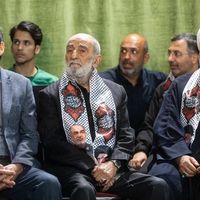
A session of the Iranian parliament on November 5, 2023
Iran's new development plan envisions granting foreign policy authority to the armed forces, nuclear agency, and intelligence ministry, separate from the foreign ministry.
As lawmakers are reviewing the country’s Seventh Development Plan, small amendments of the new plan are revealing nuances in the regime’s long-term policy orientations.
The administration of President Ebrahim Raisi submitted its Development Plan to the parliament last month. After lawmakers refused to approve the initial proposed draft, apparently for being too general and vague, the administration practically extended its expired development plan for the third timesince 2021 with a few amendments and called it a new plan. The old document, the 6th Development Plan, was to be implemented between 2016 and 2021, but many parts of it have remained untouched as the government lacked the appropriate resources due to a catalogue of foreign policy and economic problems.
Through amendments to the roadmap, which works as a compass for all the state bodies, the administration seeks to de-nationalize the oil industryto cover for its debts and increase even more control over the private sector, already a tiny portion of Iran’s economy. More than 80 percent of Iran's economy is controlled by the clerical regime, including the Revolutionary Guard, leaving little room for real businessmen or private companies to flourish. However, the amendment on the foreign policy was not included in Raisi’s proposed draft and was added by the parliament.
A group of Iranian lawmakers during a session of the parliament on November 5, 2023
According to an article on the general policies of the Seventh Development Plan "for active engagement in official and public diplomacy, the country's executive institutions (with the exception of the armed forces, the Ministry of Intelligence, and Atomic Energy Organization of Iran) are required to carry out all their actions in the field of foreign relations in coordination with the Ministry of Foreign Affairs.”
Coordination with the Foreign Ministry is not new but one somewhat peculiar addendum is the exemption of the three bodies from the need to coordinate with the Ministry of Foreign Affairs for conducting foreign relations.
The general policies for development plans are issued by Iran’s rulerAli Khamenei and then the administration devises executive plans to actualize Khamenei’s decree. The parliament is then tasked with checking the details to see if the plans are consistent with the Supreme Leader’s orders and the constitution. The end result still needs final approval from the Guardian Council, a Khamenei-appointed and constitutionally mandated 12-member council that has a veto power over legislation passed by the parliament.
Although the Foreign Ministry and the Intelligence Ministry, as well as the country’s nuclear agency are legally part of the administration, Khamenei has direct oversight on their work. He is also the chief commander of the armed forces, which itself is spread through several military bodies such as the traditional army and the Revolutionary Guards. All these bodies are ultimately ruled by the Supreme Leader, therefore envisioning separate autonomy for foreign relations can be aimed at diversifying the regime’s official stance regarding global developments.
Faraz Daily, a website not directly controlled by the government, says the move will “weaken” the foreign ministry. “The change that the parliament has made in Article 100, exempting three important institutions from coordination with the Ministry of Foreign Affairs, can potentially lead to chaos in foreign policy,” Faraz Daily said on Sunday.
Parallel organizations are not something new in Iran’s politics, already having several intelligence institutions, but parallel foreign relations bodies can help Iran keep its hawkish anti-Western stance without strategic retreats while simultaneously pursuing diplomacy with the world. This new shift in the regime’s foreign policy is in line with Khamenei’s dictum that “diplomacy and battleground” are two complementary things which do not negate each other.
Iranian politician Zahra Rahnavard, a Green Movement leader
Iranian hardline newspaper, Kayhan, criticized Zahra Rahnavard, a Green Movement leader, for her statements concerning the death of Armita Geravand.
Despite her current house arrest, Rahnavard reiterated her call for an end to compulsory hijab, while drawing parallels between 16-year-old Geravand's death and the deaths of other civilians during nationwide protests last year.
She criticized the Iranian regime, stating "The rulers of Iran, delusionally, see the consolidation of their power in the guise of a few pieces of cloth and a law called compulsory hijab … Each time, they attribute the deaths of these girls to physiological disorders, syncope, underlying illnesses, or suicide.”
Armita Geravand's death last month after enduring a head injury allegedly inflicted by the Islamic Republic's morality police, has drawn significant attention. It echoed the death of Mahsa Amini whose death triggered the nationwide protests which rocked Iran last year. The regime never accepted responsibility for her death.
Pro-regime Kayhan blamed Rahnavard for repeating critical news channels that have reported outside the regime's strict censorship, citing Iran International among them. Earlier this year, threats from regime security forced Iran International to temporarily relocate its London offices to the US.
Iranian officials have also blocked the Internet and restricted access to websites to deny the population news and information.
Kayhan operates under the editorial guidance of Hossein Shariatmadari, a staunch hardliner who enjoys the trust of Supreme Leader Ali Khamenei. He was personally appointed to oversee the newspaper—a publication widely regarded as one of the regime's most uncompromising media outlets.
Iran's Minister of Education Reza Morad Sahraei during an event in Tehran on November 4, 2023
Iran's Minister of Education made an announcement on Sunday regarding the replacement of approximately 20,000 school administrators.
He denied it was part of a nationwide "purge" to rid the system of anyone voicing dissent and said under a new program teachers can be recruited without the need for an examination.
Reza Morad Sahraei had previously disclosed that nearly 20,000 school administrators had been replaced this year to "bring about transformations in schools" as the new academic year began. However, he now describes the changes and reassignments as "routine" occurrences that take place every year.
In a conversation with ILNA news agency, he dismissed allegations of "purging" certain administrators, claiming that some are retiring while others are being replaced by new personnel.
The development comes as Jalal Mahmoudzadeh, a Sunni member of the Iranian Parliament, criticized the "purging" by the government. He asserted that in less than five months, 15,000 to 20,000 school administrators had been removed from their positions due to "political and ideological reasons," leaving many children without adequate teaching resources.
Iran has been grappling with a teacher shortage since the beginning of the new academic year. Members of parliament have raised concerns about empty classrooms. Iranian media outlets have reported cases of parents stepping in as temporary educators. A parliamentary education committee member claimed that 100,000 classrooms in Iranian schools are currently without a teacher.
Regarding the extent of the teacher shortage, various figures have emerged in the past few weeks, ranging from 200,000 to 260,000 vacant positions.
Is Hezbollah’s stalling out of a sense of self-preservation amid the overwhelming US military deployment in the region and the unequivocal trans-Atlantic support for Israel? What does Nasrallah mean when he says that the liberation of Palestine is a task that is to be accomplished by Palestinians? Has Hezbollah forfeited it long-held commitment to the cause of Palestine? A historical review of Iranian proxies establishes that the answer lies somewhere in between.
Iranians during a gathering to watch Lebanon's Hezbollah leader Hassan Nasrallah's address in Tehran, November 3, 2023
Nasrallah’s Symphony of Terror
Nasrallah’s speech was a feat of rhetorical discombobulation in both form and content. The roughly hour and twenty-minute-long speech was a long-winded rant of Nasrallah’s grievances against the United States and Israel and represents a paradigm shift from Hezbollah’s 1985 anti-Israeli and anti-American manifesto in both praxis and propaganda.
Nasrallah’s speech officially leaves the task of “the liberation of Palestine” solely to Palestinians as “the autonomous” agents of their actions. His accompanying offer of support and unity is nothing but a vague veiled threat of escalation of the war against Israel. First, he ranted at the US as the main cause of conflict in the region and exclaimed no fear of the US’ deployed arsenal in the region. Then, he demanded the US stop Israel’s devastating attack on Hamas.
Next, he proclaimed that none of the members of the region’s Axis of Resistance, namely, Hamas, Iran-backed Iraqi and Syrian militia, Lebanese Hezbollah, and Yemeni Houthis, take orders from Tehran. The October 7 attack, he exclaimed, was exemplary of Hamas’ independence in planning and operation as neither he nor the Iranian patrons knew about it beforehand. He claimed that Hezbollah would retaliate against Israel’s attack on Hamas at the right time and place.
For the time being, Hezbollah would engage in limited and incremental escalation of the conflict to bog down Israel’s precious troops in the north away from Gaza.
Nasrallah’s speech replaces the unequivocal thirty-year long pledgeto fight off and destroy Israel and American forces both in words and deeds, with an ambiguous and equivocal pledge of general support. To invoke a more intellectually fashionable refrain, it appears that Nasrallah’s commitment to Palestine has become more “nuanced” than before.
An Ostinato, Not Cadenza
To debunk Nasrallah’s claims of the full autonomy of Iranian regime proxies one shall start from the speech itself. Nasrallah’s oratory performance is an ostinato rather than a cadenza in the Axis of Resistance’s symphony of horrors. How Nasrallah disavows any involvement with Hamas’ deeds corresponds uncannily to Khamenei’s similar disclamations uttered over the past month; “we did not know about Hamas attack, we got taken aback, they did it on their own.”
Yet, some analysts query if Hezbollah has reinvented the rules of engagement against Israel and has thus reinvented a new ladder of escalation. They further enlighten us that Hezbollah’s actions constitute a doctrinal shift in their patron-client relationship with the Islamic Republic of Iran. The operating hypothesis of any such analysis is Hezbollah’s autonomy from the Iranian regime despite their continued dependence on Iran financially and militarily.
Historical examination of Hezbollah’s evolution to date shows such applications of classic patron-client dynamics amongst sovereign state actors to Iran-Hezbollah relations is somewhat far-fetched. A historical review of Hezbollah’s genealogy and its evolution into an entity that is joined at the heap with the Islamic Republic of Iran may be a better framework to appraise Hezbollah’s ostensible autonomy.
Iran’s Festering Proxy Expansionism: Pseudo-State Actors within Failed States
The scholars and experts agree that the rise of the Axis of Resistance was an undertaking that was accomplished by the Iranian regime. Now with proxy performers scattered across the region from Lebanon to Yemen, the Islamic Republic of Iran is the chief conductor of the concert of its armed proxies. These armed proxies and their theocratic leaders are not typical clients. Several of them are pseudo-sovereign entities that have mushroomed in the advent of civil wars or foreign interventions that turned their “homelands” into failed states or made their failed state status worse.
Between 1975 and 1982, the Lebanese civil war reduced the country into a failed state. Israel’s 1982 invasion of Lebanon simply reinforced this situation, but it most importantly gave rise to the emergence of Hezbollah by the Iranian regime and the blessing of Assads’ Syria. The Arab Spring in 2012 helped Hezbollah grow into a miniature Islamic Republic with Nasrallah as its Supreme Leader and rose to a prominent transnational status.
A child during a gathering by Hezbollah supporters to watch Lebanon's Hezbollah leader Hassan Nasrallah's address, in Beirut's southern suburbs, Lebanon November 3, 2023
Hezbollah: A Miniature Islamic Republic of Iran in the Levant
The historical evolution thrusting Hezbollah into a quasi-state status has no exact parallels in the region. Hezbollah rules overvast areas of Lebanese territory and controls much of its security apparatus and economic sector. Hezbollah brokers peace and conflict in its neighborhood independent from the Lebanese government and in line with the national security interests of Iran and Syria whilst inserting its own interpretations and modus operandi in formulating such arrangements. Revisiting Hezbollah’s rise serves as a guide to Hamas’ rise as a Palestinian clone of Hezbollah. The only apt analogy of Hezbollah that may afford some explanation of its operation and purpose is that of an organized crime network with an ideological agenda.
Hezbollah first grew as a compliant proxy arm of Iran and Syria. Yet, only with the dual support of the Iran-Syria axis did Hezbollah manage to outmuscle the many armed political factions in Lebanon. Ever since the Taif agreement that “ended” the Lebanese civil war through a new constitutional settlement in Lebanon, the nexus of Iran, Syria, and Russia used Hezbollah as their arm in the region. Hezbollah has been increasingly turning Lebanon into a racket.
In the 1990s, the Iranian Revolutionary Guards (IRGC) took over Iran’s lucrative state infrastructure projects through their engineering core Khatam-al-Anbiya Construction Headquarters, or KCHQ. The KCHQ and other IRGC military top brass became part of Hezbollah’s Jihad al’Bana(the Jihad of Construction). Many of these commanders took Lebanese wives, often second or third wives, and became fully integrated with Hezbollah’s upper echelon. IRGC and Hezbollah became seamlessly fused by the 2000s, and Hezbollah became more adventurous as it was robustly armed by the IRGC.
2006 proved to be a pivotal year for Hamas, Hezbollah, and the IRGC. The Islamic Republic of Iran had played a central role in the creation of Hamas and the Islamic Jihad of Palestine in the 1990s. The need to become Hamas’ patron was intensified in the aftermath of, first, Palestinian elections that saw Hamas take control of Gaza and, second, the 2006 Israel-Hezbollah conflict. The 2006 conflict with Israel was, some argue, the result of Hezbollah’s unexpected rise as a hybrid-IRGC entity with a tight grip over all Lebanese domestic and foreign affairs.
Israel’s unrelenting bombardment of Lebanon during the 2006 33-day war undermined Hezbollah in the eyes of the average Lebanese and reinforced public perception of Hezbollah’s involvement in the assassination of popular ex-PM Rafiq Hariri. The 2006 conflict also revealed the strategic importance of Hamas that, if massively armed, could help balance Hezbollah’s stakes against Israel to the point of threatening Israel existentially from two fronts. The conflict further exposed Hezbollah to the rest of the Arab world as a Shia Lebanese-Iran hybrid whose “resistance” against Israel had only pushed Lebanon to the edge of annihilation and turned it into a puppet state of Iran and Syria.
Hezbollah supporters gather to watch Lebanon's Hezbollah leader Hassan Nasrallah's address, in Beirut's southern suburbs, Lebanon November 3, 2023.
The Road to Hezbollah-Hamas-IRGC Nexus
Two events, the 2008-2014 Israel-Hamas conflict and the Syrian civil war, completed Hezbollah’s evolution into a fully self-functioning Lebanese-IRGC Hybrid. The 2008-2014 conflict with Israel intensified Hamas’ leadership to forego their anti-Shia fanatical beliefs and collaborate with the IRGC, Hezbollah, and Iranian Ayatollahs, more closely. Hamas nonetheless courted the support of Qatar as a major financial patron and a haven against Israel’s secret service assassins. As the only Persian Gulf oil rich monarchy that never hid its rivalry with Saudi Arabia, Qatar was happy to oblige. Hezbollah-IRGC assistance to Hamas was placed on a backburner for a variety of reasons with Syria plunging into a civil war, in the aftermath of the Arab Spring.
The Syrian civil war and the rise of ISIS there helped Hezbollah to redefine itself and reorganize into the neighboring Syria as the savior of Syria. Tapes obtained by Iran International in April 2021 of a confidential oral history recorded by Javad Zarif, Iran ex-foreign minister, reveal that the Syrian civil war did in fact help the IRGC rose to unquestionable prominence within the hitherto Mullah dominated regime.
With Qassem Suleimani at the helm of anti-ISIS operations in Iraq and Syria, the Hezbollah-IRGC hybrid entity leapt over the head of the Iranian ruling clerics and linked up with Russia. By 2018, not only was it abundantly clear that Iran was run, and is still run, by IRGC, but that its hybrid Iranian Lebanese colonial actor, i.e., Hezbollah, enjoyed an equal partner status as the patron of the Iranian Shia proxies in Syria.
Despite IRGC’s massive assistance to Hamas to build and expand the tunnels underneath Gaza from 2014, the Hamas-Hezbollah-IRGC relationship was very much strained during the Syrian civil war. Hamas objected to the combined IRGC-Hezbollah assault on Palestinian refugee camps and protested the destruction of the anti-Assad Sunni militia at their hands. Indeed, the combined zeal of Hezbollah and IRGC, with Russian Wagner assistance killed hundreds of thousands of Syrians civilians and displaced millions of them during 2011-2020.
However, three main developments changed the strategic landscape that brought Hamas and Hezbollah ever closer. The first development was the successful conclusion of the Syrian civil war on the part of Assad-Hezbollah-IRGC nexus by 2019. In the face of an increasingly right-wing Israel with its expanding settlements in the West Bank and its constant harassment of Hamas, Hamas needed Hezbollah, more than ever. The second development was Trump’s departure from the Iran nuclear deal in 2018 that was followed and his maximized pressure policy against the regime. The third development was the onset of the Abraham accords that ushered in an era of rapprochement between conservative Arab monarchies and Israel. This normalization threatened to marginalize IRGC-Hezbollah-Hamas’ nexus and has been perceived to have the potential of thrusting the region into an era of peace, stability, and prosperity.
In 2017, Khamenei, during a meeting with “Islamist” students ordered them to follow the military maxim of “fire at will” and fight off all western cultural representations in the country as they saw fit. At the time, many hardliners in Iran declared that Qassem Soleimani was a living example of an IRGC general that acted according to the maxim of “fire at will” per Khamenei’s guidelines. Moreover, in the aftermath of Soleimani’s killing by the US, several IRGC commanders stated publicly that the Axis of Resistance would inflict dreadful strikes upon US and its allies in the region on a “Fire at Will” basis.
With the revelation of Zarif tapes in 2021, we now know that Soleimani affected much control over the Iranian foreign policy in the region vis-à-vis Iraq, Syria, Lebanon, Yemen, and Palestine. As Hezbollah evolved under his watch into a translational IRGC hybrid entity during the Syrian civil war, the October 7by Hamas raise serious questions as to what degree Hezbollah and IRGC acted on a “fire at will” basis to train Hamas for all manner of operations.
Nasrallah’s speech reinforces two important aspects of the “fire at will” policy of the Islamic Republic of Iran for its regional proxy. It reveals that Hezbollah is not just an arm of the Islamic regime of Iran or an autonomous proxy, but that it is the Iranian regime’s clone at worst or a Shia Lebanese hybrid of the regime just under Israel’s nose. “Fire at will” is in effect a strategic partnership doctrine, which does not follow the same dynamics of patron-client relations that is customary between sovereign states. Rather, it must be understood according to the dynamics that govern the relationship between members of an organized crime franchise.
The mob boss, the IRGC of Iran, dispenses areas across a defined geography as zones wherein a criminal franchisee can build a racket. Each franchisee’s relationship with the neighboring gangs is regulated and monitored according to the dictates set by the mob boss. At the same time, each franchisee retains a free hand in eliminating all unsanctioned competition, which in this case were anti-Assad Sunni militants and ISIS forces in Syria between 2012 and 2020. In the regional dynamics of Tehran regime proxies, the Iranian regime would expect the proxies, ‘acting on their own’ act on a “fire at will” upon Tehran’s “resistance” guidelines.
The IRGC and the Iranian ruling clerics perceive every sovereign state in the region as a criminal racket with which they are in competition. There are friendly rackets, like Assad’s Syria and Gaddafi’s Libya, and there are unfriendly ones. If a state fails, the regime’s IRGC moves in to create “autonomous” rackets that can become self-sustaining. Hamas and Yemeni Houthis became the budding rackets in whom the IRGC invested to clone Hezbollah type hybrid entities in Palestine and the Arabian Peninsula.
Israeli democracy, despite all its flaws and pitfalls, is perceived as a threat to the Iranian regime’s racket. The IRGC and Iranian regime would turn a blind eye on how each of these criminal rackets deal with the other actors that pose an existential threat to their existence.
This willful blindness is at the heart of their criminal collusion and by no means confer the autonomy that Nasrallah asserts. Nasrallah’s speech spoke true to form as to how the criminal collusion worked. They would not open a second front, unless their very own “franchise” is threatened and/or if they feel the destruction of the other franchise, in this case Hamas, would pose an existential threat to them.
Will Hezbollah shower its thousands of rockets and missiles upon Israel simply because Israel may end up destroying Hamas? The principle of “fire at will” applies only if Hezbollah feels Israel is succeeding in this undertaking. However, Hezbollah would not take such an action without the Iranian regime’s approval. Hence, as the Iranian minister for foreign affairs stated in the so many words, the regime and its proxies’ fingers are on the triggers. However, the Iranian regime and Hezbollah’s parasitic symbiosis has intertwined them to such a degree that a lethal strike on Hezbollah can destabilize the IRGC’s grip over its other proxies in Iraq and Syria. The domino effect of the destruction of Hezbollah into Syria and Iraq can eventually hunt the regime within the Iranian borders. Indeed, the chain reaction destruction of the Iranian proxies in the region could lead to an anti-regime critical mass uprising by the Iranian people.
Israel’s security dilemma shall nonetheless persist as long as Hezbollah thrives in Lebanon. The main head of the monster may be in Tehran, but it’s the destruction of its conjoined head in Lebanon may be key to the eventual destruction of the Islamic Republic of Iran.
Iran has renewed its threats to the United States, cautioning that if Washington fails to enforce a ceasefire in Gaza, there will be repercussions.
Mohammad-Reza Ashtiani, Iran's Minister of Defense, emphasized the urgency, stating, "Our advice to the Americans is to immediately halt the war in Gaza and implement a ceasefire, otherwise they will be hit hard."
The warning comes amid the ongoing conflict in Gaza which began on October 7 when Iran-backed Hamas invaded Israel, murdering over 1,400 mostly civilians and taking more than 240 more hostage.
The US immediately defended Israel's right to defend itself and has offered military support, in addition to moving its war ships and 2,000 marines into the region.
Additionally, Mohammad Reza Naqdi (Naghdi), the Deputy Coordinator of Iran's Islamic Revolutionary Guard Corps, has added to the tensions by stating, "If Israel's crimes continue, we should strike America's interests," not mentioning its proxies' attacks on US facilities which have been ongoing in recent weeks in Syria and Iraq.
Iranian regime officials have consistently warned Israel of potential escalation should the attacks on Gaza not cease, and the death toll in the strip rises to over 9,000. Its Yemeni proxy, the Houthis, have already been sending missiles towards Israel, intercepted by Israel, the US and Saudi Arabia. Meanwhile, on Israel's borders, attacks from its proxies in Syria and Lebanon continue to ramp up, with action also seen from its militia in Iraq.
Iran's Vice President Mohammad Mokhber proposed new economic policies this week amid an ongoing national crisis.
Speaking at the 6th China International Import Expo on Sunday, Mokhber introduced six initiatives aimed at reshaping global trade patterns.
Mokhber's proposals include “the expansion of electronic trade, the establishment of international centers, and backing the development of the multilateral trade system for organizing international regulations.”
Meanwhile, at home, mounting inflation and currency devaluation continues to drive the population into worsened poverty.
As negotiations with the United States and Europe regarding Tehran's nuclear program remain unresolved and US sanctions persist, Iran is increasingly looking to Asian countries, particularly China, for trade relations. However, China has yet to significantly challenge US sanctions and has been strengthening ties with Persian Gulf Arab countries and Israel.
In March 2021, Iran entered into a controversial 25-year agreement with China, initially proposed by Iran's Supreme Leader Ali Khamenei during President Xi's visit to Tehran in 2016. Many Iranians have expressed dissatisfaction with the cooperation agreement with China, viewing it as a compromise of national interests.
Iran experiences an inflation rate of over 50 percent. The significant depreciation of the Iranian rial reflects the inflationary pressures in the country, causing increased costs for imports and, subsequently, higher prices for consumers.
While large-scale protests in 2022 primarily centered on social and political issues, the current economic crisis is fueling discontent among disillusioned youth. Labor unrest has also been on the rise in 2023 as real incomes of workers continue to erode.