Faezeh Hashemi, the daughter of late President Akbar Hashemi-Rafsanjani
Daughter of former Iranian president Hashemi Rafsanjani has written a harshly worded letter addressed to Iran’s ruler Ali Khamenei, telling him “Enough is enough!”
Enumerating the names of some of the iconic victims of the regime, jailed MP-cum-activist Faezeh Hashemi Rafsanjani asked the Supreme Leader, “How many Nedas, Navids, Mahsas and Armitas must be sacrificed and how long this destruction must continue until you realize the severity of the situation?"
"If you have no compassion for the people of this country, be concerned about your own position," read parts of the letter a copy of which was obtained by IranWire.
Hashemi, daughter of late President Ali Akbar Hashemi Rafsanjani, was arrested in September 2022, days after nationwide anti-regime protests broke out, as the government tried to control the situation by detaining well-known critics and many journalists. She was sentenced to a five-year prison term in January.
She told Khamenei that he has brought Iran to the “peak of oppression and discrimination, poverty and corruption, hypocrisy and immorality, mismanagement and inefficiency” and criticized the regime for its “terrorist” acts.
Former president Akbar Hashemi Rafsanjani visiting Supreme Leader Ali Khamenei when he was hospitalized, September 2014
Faezeh’s father – who died mysteriously in a swimming pool in 2017 – was the second most powerful man in the Islamic regime in the 1990s and early 2000s, when he served as president (1989-1997) and held influence and key positions, until Supreme Leader Ali Khamenei gradually pushed him aside. Rafsanjani was the key cleric who helped Khamenei succeed the founder of the Islamic Republic, Ruhollah Khomeini when he died in 1989, although Khamenei did not have the required clerical rank and credentials for the post. Khamenei’s men continued to persecute members of the Hashemi clan, who had become affluent and had legal vulnerabilities that could be exploited by Khamenei’s courts and intelligence services. Faezeh Hashemi who served as a member of parliament, became increasingly estranged from the regime and began defending women’s rights and hurling criticism at the regime, indirectly targeting Khamenei.
Elsewhere in her letter from prison, Hashemi listed the mistakes made by the last shah of Iran that culminated in the collapse of the Pahlavi dynasty in the 1979 revolution and the establishment of the Islamic Republic. She told Khamenei that he is making the same mistakes and more. She said a lack of flexibility in politics and resistance against social demands will only lead to people’s revolt and an end to autocracy.
Hashemi specifically mentioned the case of Armita Geravand, a teenage girl in coma in a heavily guarded hospital following an encounter with hijab enforcers. Armita allegedly fell into a coma after being assaulted by hijab enforcers on her way to school at a Tehran subway two weeks ago. Authorities have significantly restricted the family's access to Armita at Fajr military hospital. Armita’s mother was briefly detained by security authorities earlier this month after protesting the authorities’ refusal to allow her to see her daughter.
Armita’s serious head injury, which authorities claim she sustained when she fainted in a subway car, serves as a stark reminder of the death of Mahsa Amini in September last year. Mahsa's death ignited months of protests and unrest across the country, and the government is still refusing to accept responsibility for it. The news of another young girl's life-threatening injury, along with televised interviews with her parents and classmates, which many believe were "forced," has outraged many Iranians who are being kept in the dark about her circumstances.
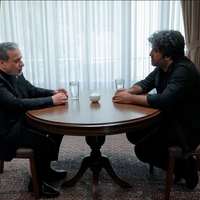
Hamas leader Ismail Haniyeh and Iranian Foreign Minister Hossein Amir-Abdollahian in Qatar on October 14, 2023
The Islamic Republic’s unwavering support for Hamas has led many Iranians to adopt a contrasting stance, favoring Israel in its military actions, according to pundits.
These opposing views, the result of economic hardships, widespread poverty, political impasses, and a negative approach by policy-making institutions toward Iranian culture and lifestyle, are contributing to a broader shift in attitudes among the opposition.
Former government spokesman Ali Rabiei, in a commentary published by the reformist Etemad newspaper on Saturday, highlighted that this perspective on the Gaza situation extends beyond "some among the masses" to include "some intellectuals and writers" who either remain silent on the Gaza issue or express support for Israel.
Ahmad Bokharai, head of the political sociology department of Iran's Sociological Association also told Didban-e Iran (Iran Monitor] news website Saturday that “the proxy wars Iran has waged in the past few years” are not acceptable to the majority of the Iranians.
Highlighting that Iranians who lived through the eight-year war with Iraq (1980-88) and witnessed its devastating aftermath tend to favor peace, Bokharai argued that those dissatisfied with the government's stance lean towards supporting Israel over the Palestinians. He pointed out that the "majority in Iran" expressing support for Israel is a reaction to the minority who misuse government resources to suggest that Iranians are pleased with Hamas's attacks on Israel.
Ahmad Bokharai, head of the political sociology department of Iran's Sociological Association
Judging from social media comments, many ordinary Iranians are supporting Israel, blaming Hamas for starting the recent war, and condemning the atrocities it has allegedly committed against Israelis. Pounding Gaza and driving the residents out of the Palestinian enclave, they say, is only a response to Hamas’ atrocities and photos and footage that has emerged of their actions is proof of its barbarism.
In contrast to other regional countries like Turkey and Pakistan, there have been no significant pro-Gazan protests in Iran, aside from small, state-sponsored rallies that were organized to "celebrate the Palestinian victory" in Hamas' Al-Aqsa Storm Operations last week and after Friday prayers this week.
The level of support shown for Israel on social media these past few days has no precedent even in the past few years when anti-government protesters often chanted against the regime’s financial support of militants in other countries, particularly in Gaza and Lebanon.
“Neither Gaza, nor Lebanon, I will sacrifice my life for Iran” was first chanted by anti-government protesters on Quds Day in 2009 in reaction to the government-sponsored demonstrations and again during the anti-government protests of 2017, 2019, and 2022-23. In a speech on October 13, 2021, Iran's Supreme Leader Ali Khamenei said those who chanted the slogan were “deluded” and “would even not defend Iran”.
Khamenei and other officials have fervently praised Hamas for initiating the recent attack on Israel and their goal of eradicating the Jewish state. However, they deny any direct involvement by the Islamic Republic in the attack. "This was carried out by Palestinians themselves," Khamenei stated in a speech on Tuesday during a military event in Tehran.
Many Iranians consider it unacceptable that the country's resources are directed toward supporting proxy forces in the region, including those in Lebanon, Palestine, Syria, and Yemen. These actions provoke the international community against Iran and Iranians. This happens while the pressing needs of the Iranian people, whose livelihoods are significantly impacted by these policies, are being neglected.
Most expatriate opposition figures including former Crown Prince Reza Pahlavi have condemned Hamas and expressed solidarity with Israel while in Iran some opposition figures such as the reformist former President Mohammad Khatami have called the Hamas attack a result of years of Israeli oppression and occupation but urged the Islamic Republic to take a cautious stance.
Others, such as outspoken Sunni leader Mowlavi Abdolhamid are arguing that the regime’s enmity with Israel is pointless and should be abandoned in favor of a solution that accepts the existence of two states for Israelis and Palestinians.
Iran's exiled Prince Reza Pahlavi says the crisis in the Middle East can be solved by putting pressure on the regime, the engine behind numerous regional terror groups.
Pahlavi, who appeared on Fox News on Sunday, stated that the crisis in the region is a symptom of the cancerous Islamic Republic regime. “If you want to solve and cure the cancer, you have to take the eye of the octopus out and not just fight the tentacles. The ultimate solution is a regime change in Tehran,” he said, referring to Iran’s arms and logistics supply for Hamas -- and many other -- terrorist groups.
Calling for international action against the Islamic Republic over its threats to expand the conflict to "other fronts” against Israel, Pahlavi urged the freezing of Iran's funds that were recently unblocked from a South Korean bank. These oil revenues were frozen under US sanctions and are now held in Qatari banks as part of a prisoner exchange deal between Tehran and Washington.
Pahlavi, who has long campaigned for a secular and democratic Iran, said the US should implement stricter sanctions on Iran to curb Iran’s oil exports. The revenues will be spent on the regime’s “campaign of instability” vie its proxy groups, suppression of the people at home and advancement towards nuclear weapons. The sanctions on Iran's oil exports have been so laxly enforced that Iran's exports have reached record highs in recent months.
Pahlavi, who visited Israel this spring and met with senior officials, including Prime Minister Benjamin Netanyahu, added that one of the main operatives behind the militant attacks is the Revolutionary Guards and called on the US to push its allies to designate the IRGC as a terror group.
Iran’s Supreme Leader Ali Khamenei during a meeting with senior commanders of the Revolutionary Guards in Tehran
The gruesome attack by Hamas militants on southern Israeli communities has revived a controversial question about “terrorism” and its sponsors.
Although the Biden administration has been quick to condemn Hamas, declare its unequivocal support for Israel, and condemn the Iranian Ayatollahs as supporters of Hamas, the US curiously calls for restraint vis-à-vis Iran as it claims to be in search of a direct link between the Tehran regime and this specific savage terrorist attack by Hamas. The critical question is whether the Iranian regime should be held responsible in every sense of the term as the state that sponsors Hamas.
The US government concedes the universally established fact that the Iranian regime is the primary financial and military patron of Hamas, and acknowledges that its officials have publicly proclaimed their support for Hamas. However, US officials stop short of holding the Iranian regime responsible for the attack, splitting hairs in their definition of “responsible.” The US skirts the issue of Iran’s obvious complicity by searching for “direct evidence” of the Iranian regime’s involvement in Hamas’ barbaric attacks. Interestingly, various media outlets report that “the Iranian officials were taken aback by Hamas attacks,” sowing the seeds of doubt of Iran’s yet to be established direct involvement.
The historical record, nonetheless, shows that the US rarely relies on “direct links” to pursue and punish sponsors of terrorism, from Gaddafi’s Libyain the 1980s to the present regional proxies of the Islamic Republic of Iran in the region. The standards by which to hold state sponsors of terrorism accountable stem from a combination of domestic legal legislation and jurisprudence, enforceable resolutions of international institutions, customary international law, or international conventions, and caselaw of international legal institutions. The more the Biden administration refuses to pursue and punish the Iranian regime for its complicity in the crimes committed by Hamas against the Israeli civilians, the more it will be exposed to the prosecution of the truth by the US Congress, the US courts, and eventually by the international community.
Hamas leader Ismail Haniyeh (right) and Iranian Foreign Minister Hossein Amir-Abdollahian in Qatar on October 14, 2023
US Domestic Law and Jurisprudence - The Flatow Precedent: Khamenei’s Liability as a Sponsor of Terrorism
The roots to hold sponsors of terrorism accountable can be found in US domestic law. Domestic law has paved the way for the shaping of the international rule-based order before the emergence of customary international practices, and international treaties and conventions.
Between 1996 and 2016, the US Congress passed two major laws (ADEPA, 1996, and JASTA 2016) that narrow the scope of immunity of foreign states that sponsor terrorism with regards to lawsuits by the victims of terrorist acts. Accordingly, foreign states and their leaders can be taken to court by the victims for damages. In Flatow v. Islamic Republic of Iran, the US federal district court held that both the Islamic Republic regime of Iran and its leader, Ali Khamenei, were liable for the Islamic Jihad of Palestine’s terrorist attack on a bus in the Gaza trip in 1995 that killed the 20-year-old US citizen, Alisa Platow.
The court found that “sponsorship” meant that the government shared in the terrorist act “either deliberately or permissively as a matter of policy or custom.” The court concluded that “if a foreign state's heads of state, intelligence service, and minister of intelligence routinely provide material support or resources to a terrorist group, whose activities are consistent with the foreign state's customs or policies, then that agent and those officials have acted squarely within the scope of their agency and offices within the meaning of 28 U.S.C. § 1605(a) (7) and 28 U.S.C.A. § 1605 note.”
Since Khamenei, as the supreme leader of the Iranian regime sets the Islamic Republic’s policy to sponsor groups like the Islamic Jihad of Palestine, he was found to have provided both financial and logistical support for them, and thus was held responsible as a sponsor of terrorism.
A group of firefighters stand on the street near the destroyed World Trade Centre in New York on September 11, 2001.
9/11 and Afghanistan: International Collective Action
The US rallied the support of NATO allies, as the 9/11 attack was launched against a NATO member, and in their support of the United States, NATO allies passed a unanimous resolution that held the Taliban State responsible for harboring Al ‘Qaeda terrorists. No one has ever offered or been concerned about a lack of “direct evidence” to establish that Mullah Omar, the then head of the Taliban, was involved in the planning and implementation of 9/11 by Al ‘Qaeda leaders.
The US and NATO actions with regards to 9/11 had the support of the primary institution of the international rule-based order, the United Nations. On 12 September 2001, “guided by the purposes and principles of the Charter of the United Nations”, the UN General Assembly adopted resolution 56/1, condemning the 9/11 attacks on the United States. Importantly, paragraph four of the resolution stated: “Also urgently calls for international cooperation to prevent and eradicate acts of terrorism, and stresses that those responsible for aiding, supporting or harboring the perpetrators, organizers and sponsors of such acts will be held accountable.”
International Law: General State Liability and Crimes against Humanity
Since 9/11, new approaches to international law contend that founding international law conventions, namely, the International Convention on Prevention and Punishment of the Crimes of Genocide, 1951, the international treaty for the founding of the International Criminal Court, the Rome Statute, 1998, and the International Convention for the Suppression of the Financing of Terrorism, 1999, already provide the requisite framework to hold state sponsors of terrorism liable. Indeed, the proponents of these new approaches cite international judicial precedent against the perpetrators of “acts of terrorism” based on the said conventions. The proposed frameworks contend that upon establishing what constitutes “a terrorist act”, the ostensibly insurmountable ad nausea academic squabbles over the definition of terrorism are overcome. These new approaches to international law place “acts of terrorism” within the general categories of “war crimes” and “crimes against humanity.” “Acts of terrorism” are criminal violent acts that are systematically perpetrated against certain groups of people.
The State Liability Approach
The state liability approach cites the ruling of the International Court of Justice (ICJ) in the Bosnia Genocide case against Serbia (1996). The ICJ held the republic of Serbia liable for its sponsorship of Serbian proxies during the Bosnian War (1992-1995) that committed crimes against the Bosnian population. The case provides a legal framework wherein the military assistance that Serbia supplied to non-state groups was tantamount to the sponsorship of systematic terrorizing of the Bosnian population. Furthermore, the proponents of this approach argue that the International Convention for the Suppression of the Financing of Terrorism provides yet another concrete layer for legal action for states that sponsor non-state groups that recourse to terrorist acts.
State Liability Per International Criminal Law
The absence of the crime of terrorism in the Rome Statute has raised questions as to whether the ICC has any jurisdiction over states that sponsor non-state actors that resort to terrorist acts. The challenge in applying the Rome Statute to such acts has arguably had a destabilizing effect on international peace, especially in the Middle East. An example was the 15 February 2005 assassination of Rafiq Hariri, the popular ex-PM of Lebanon. The crime scene was littered with the figurative fingerprints of the Iranian proxy Hezbollah of Lebanon and Syria’s secret service.
The UN set up an international investigative commission whose report implicated Syria and its proxies in Lebanon. Following the disturbing findings of the commission, the UN Security Council adopted resolution 1636 in line with Chapter II of the UN Charter. In section 4 the UN Security Council clearly found the Commission’s finding concerning Syria, as a state sponsor of terrorism, viable and instructive. Resolution 1636 thus explicitly states that: “ [UN Security Council] Determines that the involvement of any State in this terrorist act would constitute a serious violation by that State of its obligations to work to prevent and refrain from supporting terrorism, in accordance in particular with resolutions 1373 (2001) and 1566 (2004) and that it would amount also to a serious violation of its obligation to respect the sovereignty and political independence of Lebanon.”
There is also an ongoing debate about whether to expand the jurisdiction of the International Criminal Court to include terrorism. Some argue that a combination of conventions regarding counter terrorism already set the stage to prosecute terrorist crimes at the ICC, but are unsure if the Rome Statute would need to be amended to explicitly include “terrorism.” However, others believe there is no need to amend the Rome Statute to include terrorism as “terrorist acts” fall under the category of “crimes against humanity,” which are already enshrined in the Statute. Citing article 7 of the Statute of Rome, they argue that two constituent elements of acts of terrorism allow the perpetrators and their sponsors to be prosecuted by the ICC as crimes against humanity. First, perpetrators of terror attacks seek to create a climate of terror in the targeted communities. Second, terrorist acts are "part of a widespread or systematic attack directed against any civilian population.” Certainly, the procedures enshrined in the Rome Statue of International Criminal Court make it too arduous to prosecute state sponsors of terrorism, yet, the recent international warrant against Vladimir Putin has opened a new gateway for ICC prosecutors.
In view of the domestic precedents in the US, as well as the above-mentioned UN General Assembly and UN Security Council resolutions, what exactly does it take for the US to acknowledge that the Islamic Republic of Iran was involved in the Hamas attacks on Israeli civilians that approximate a rehearsal for genocide?
Smoke rises following Israeli strikes in Gaza, October 12, 2023.
Tehran-Gaza Axis, A Criminal Racket
Until 7 October 2023, many dismissed the public statements of the Islamic Republic of Iran for the destruction of the state of Israel as nothing but “rhetoric.” In this vain, the same apologists of Hamas and the Iranian regime do equally trivialize the Iranian Supreme Leader’ periodic prophesies of the imminent destruction of the state of Israel as purely rhetorical. The Iranian regime’s “explainers” have time and again invoked that Tehran’s support for regional proxies such as the Hezbollah of Lebanon and Hamas stem from a longstanding Shia-Islamic bond and anti-imperialist aspirations to counter the Israeli occupation of Palestine. To them, any citation of their “acts of terrorism” against Israeli civilians is nothing but some jingoistic overstatement. These defenders of Hamas consistently resort to “whataboutism” in their advocacy. They either trivialize or outright ignore the fact that Hamas attacks have historically targeted civilians and not the Israeli military. Instead, they constantly invoke Israeli occupation of Palestine and its settlers as grounds to justify any violence against civilians.
Hamas’ barbaric operation on 7 October 2023, however, concretely proves that the Iranian regime does share one and the same criminal interest with Hamas: the destruction of Israel. The 7/10 Hamas’ crimes against humanity show that the Iranian regime has a sinister client and agent intent on fulfilling Khamenei’s prophecies of doom and gloom for Israel.
State sponsorship of terrorism fits the fundamental elements typical of criminal conspiracy. The right hand, the state sponsor, feeds the left hand, the non-state actor, to do its criminal bidding. The state sponsor does not necessarily know about “the left hand’s” ongoing operations and details of its monstrous devices. So long as they both share the same criminal purpose and benefit from their commonly sanctioned criminal acts, it is immaterial to what extent the patron state sponsor was aware or involved in the specific criminal acts of the client terrorist entity.
The Islamic Republic of Iran is the criminal patron of Hamas, and Israeli civilians have been the victims of this criminal conspiracy ever since Iran has sponsored Hamas. The actions of Hamas clearly fall under article 7 of the Statute Rome, and the Islamic Republic of Iran’s leaders who have sponsored Hamas in every sense of the term, must be held criminally liable by the ICC.
The dry river bed of Zayandeh Rud in the city of Esfahan
Farmers in Esfahan (Isfahan) have held gatherings within the past few days to protest their water rights, demanding the reopening of the Zayandeh-Rud River.
The river has been a vital source for orchard irrigation in western Esfahan and agricultural use in the east.
In the current Iranian year that began in mid-March, eight separate water releases from the Zayandeh-Rud were carried out to irrigate crops and gardens in western Esfahan.
However, any potential continuation will rely on the formation of a new drought mitigation committee.
In recent days, farmers in eastern Isfahan have joined the protests, echoing their counterparts' demands for the reopening of Zayandeh-Rud. The river, once a permanent waterway, has been transformed into an irrigation channel with sporadic water flow.
Environmental activists and experts are voicing concerns about the detrimental impact of the intermittent management, not only on the river's ecosystem but also on the broader environment.
In recent decades, recurrent droughts and the extensive utilization of underground water and rivers by the agriculture and industrial sectors have significantly aggravated the water scarcity issue in Esfahan in central Iran.
The emphasis on achieving self-sufficiency in agriculture, which includes the cultivation of water-intensive crops like rice and other grains, has also been identified as a contributing factor to the region's water challenges.
Supreme Leader Ali Khamenei, in 2000 and 2001, actively promoted population growth and the attainment of self-sufficiency in wheat and rice production as the primary agricultural objectives, further straining resources.
Iranian director Dariush Mehrjui and his wife Vahideh Mohammadifar
The gruesome murder of celebrated Iranian director Dariush Mehrjui and his wife at their home near Tehran has caused shock in Iran with speculation abounding about the case.
Mehrjui and his wife, Vahideh Mohammadifar, a screenwriter and costume designer, were discovered brutally mutilated in their own home in the Fardis district of Karaj, located approximately 30 kilometers west of the capital, Tehran, on Saturday night.
According to Faraz Daily news website, the perpetrators cut the throats of the pair and broke their arms and legs, and inflicted severe injuries on them. Mehrjui’s head was clobbered with a blunt object and his wife was almost beheaded. Mohammadifar’s arm was also bent from the elbow to the back, and her wounds were deeper, leading the daily to the conclusion that the attackers had a deeper animosity towards his wife.
Mohammadifar had recently reported a confrontation with an apparent burglar outside their home and had received direct threats from the unidentified individual wielding a knife.
Information obtained by Iran International reveals that the Mehrjui couple had been threatened with death multiple times by unidentified individuals in recent days. Although Mehrjui had reported these threats to the police on multiple occasions, the police did not take them seriously.
The Mehrjuis' residence in Fardis
Tasnim news agency, affiliated with the Revolutionary Guards, reported that despite Mohammadifar's social media posts about the threats, the family had not officially filed a complaint with the police. Nasser Khaki, the town's prosecutor, rejected initial reports about beheadings, stating, "This couple were killed due to suffocation, severe bodily blows, and sharp bodily injuries, presumably from a knife."
Khaki claimed that the murders happened between 9pm and 10pm, adding, “We know that the murders likely occurred after opening the house's safe, and that other signs of theft were also evident, and even Mohammadifar's gold jewelry was taken from her hands.”
According to Mona, the daughter who discovered her parents dead, her father had talked to her on the phone at 8.50pm, but when she arrived home at 10.25pm her parents were dead.
In an Instagram post that was apparently published several months ago, Mohammadifar claimed that the burglar who threatened her with a knife had a non-Iranian accent. This detail has led to speculation online suggesting that the perpetrators might be Afghan migrants who live in large numbers in the area.
According to Fars news agency, another IRGC-linked media outlet, four suspects have been arrested for the murder case so far, but none of the detained individuals were foreigners. "Given the nature of the crime and its violence, there is a possibility of personal vendetta. It's possible that the partial theft of gold and mobile phones was carried out with the aim of disguising the true motives," the agency claimed.
There is a conspiracy theory circulating online that the murders are intended to exploit the growing concern about the increasing number of Afghans in Iran and the reported violence, both by them and against them. Mohammadifar mentioned in another Instagram post that she was accused of racism because she complained about being threatened by a foreigner.
Another theory circulating online claims the murders were the continuation of the politically motivated serial assassinations –also known as Chain murders of Iran, a series of 1988–98 murders and disappearances of Iranian dissident intellectuals.
Mehrjui's notable stance against censorship and his vocal opposition to security measures imposed on Iranian cinema were well-documented. In a video message addressing the cancellation of the screening of his film “La Minor” (A Minor), he asserted, "I can no longer endure this. I will mobilize and, alongside my team, stage a protest at the Ministry of Culture. I am ready to fight."
Fans, friends, and coworkers of Mehrjui have expressed their sadness on social media, remembering his work as a pivotal figure in Iran's film new wave during the early 1970s.
"We have just learned of the tragic death of Iranian film director Dariush Mehrjui and his wife, both brutally murdered by thieves," said Jean-Marc Thérouanne, the director of the Vesoul International Film Festival of Asian Cinema in France, in a statement. He noted that several of Mehrjui's movies were screened at Vesoul.
In 1959, Mehrjui moved to the United States to study at the UCLA’s Department of Cinema. He studied there under Jean Renoir. He received many awards, including a Silver Hugo from the Chicago International Film Festival in 1998 and a Golden Seashell at the San Sebastián International Film Festival 1993. Most of Mehrjui’s films are inspired by literature and adapted from Iranian and foreign novels and plays.
In 1959, Mehrjui moved to the United States to study at UCLA's Department of Cinema. He studied there under French cinema giant Jean Renoir. He received numerous awards, including a Silver Hugo from the Chicago International Film Festival in 1998 and a Golden Seashell at the San Sebastián International Film Festival in 1993. Most of Mehrjui's films are inspired by literature and adapted from Iranian and foreign novels and plays.