Tehran, Washington Close To Deal To Release Americans Held In Iran

Tehran and Washington are inching closer to an agreement on the release of Americans imprisoned in Iran.
Tehran and Washington are inching closer to an agreement on the release of Americans imprisoned in Iran.
The revelations were made by Oman’s foreign minister, Sayyid Badr Albusaidi, speaking to Al-Monitor who claimed on Wednesday that he feels a sense of “seriousness” on the part of both the US and Iran.
He said negotiators are doing their best to salvage the 2015 nuclear pact under which the Islamic Republic agreed to curb its nuclear ambitions in exchange for sanctions easing.
Siamak Namazi, Emad Shargi and Morad Tahbaz are three of an unknown number of dual nationals imprisoned in Tehran’s notorious Evin Prison on espionage charges.
Al-Monitor also quoted experts as saying that the Biden administration will not reach a deal with Iran over its nuclear dossier unless Tehran releases the prisoners first.
If inked, the deal would lead to release of billions of Iran’s frozen assets in North Korea though according to sanctions, the Iranian regime would only be allowed to use those funds for humanitarian issues.
Oman, Qatar, and the UK have also been attempting to mediate to bring the nuclear talks to a conclusion, but attempts have failed so far. “I can say they are close. This is probably a question of technicalities,“ Albusaidi told Al-monitor.
Albusaidi did not confirm Oman's involvement, but said his country has “offered in good faith our offices to help both sides, be it here or anywhere else.”
Oman has been active in mediation efforts between Iran and its neighbors, including the recent detente between Saudi Arabia and Iran, of which Oman, China and Iraq played key roles.







The Israeli state defense contractor announced Wednesday the development of a new system to counter hypersonic missiles, a week after Iran claimed its first such weapon.
The SkySonic interceptor will "enable us to intercept all kinds of hypersonic threats - hypersonic ballistic missiles, hypersonic cruise missiles," Yuval Steinitz, chairman of Rafael Advanced Defense Systems Ltd, told Reuters at a media event.
The state-owned company was behind the Iron Dome and David's Sling air shields that have been effective against a variety of rockets and missiles Iran’s proxy forces have launched against Israel.
The Pentagon was briefed on the development, Rafael said. It declined to say if or when the Israeli military might deploy SkySonic. Israel's defense ministry had no immediate comment.
Hypersonic missiles can fly at least five times faster than the speed of sound and on a complex trajectory, making them hard to shoot down.
Iran claimed its hypersonic missile, dubbed Fattah (conqueror) has a range of 1,400 kilometers, can breach and overcome all anti-missile shields, and hits speeds of Mach 13-15, which means about 13 to 15 times faster than the speed of sound -- known as Mach 1.
Currently available technology perhaps supports hypersonic missiles flying at 5-8 Machs, so Iran's claim of 15 mach speed seems an exaggeration.
A true hypersonic missile should also be maneuverable to be useful, which poses a significant challenge not only to Iran but even for great military powers, such as the United States, which still has not fielded such a weapon.
Although President Vladimir Putin had announced in 2018 the production of Kinzhal as a “hypersonic” weapon that could overcome all existing air defense systems, in May, Ukraine used US-supplied Patriot batteries to down several Kinzhals, shattering the myth of a Russian hypersonic weapon.
An animated video rendition of SkySonic issued by Rafael showed an interceptor missile taking off vertically from a launch battery. The missile's warhead is then shown detaching and flying with its own booster toward an incoming threat.
Rafael said the system would be unveiled at the Paris Air Show next week.
Iran has intensified its anti-Israel rhetoric this year, openly taking credit for rocket and missile attacks launched by its Palestinian and Lebanese proxies and vowing to destroy the Jewish state.
Having restored relations with Saudi Arabia, Tehran feels emboldened and out of isolation in the region. It also continues to build close military ties with Russia, delivering drones and possibly missiles for the invasion of Ukraine.
When Iran on June 6 unveiled its Fattah missile, Israeli Defense Minister Yoav Gallant said: "To any such development, we have an even better response." He did not elaborate.
With reporting by Reuters
Saudi Arabia's Foreign Minister, Prince Faisal bin Farhan, will visit Tehran on Saturday, Iran's Tasnim news website affiliated with the IRGC said on Thursday.
He is set to meet with Iranian officials, Tasnim said, but not immediately clear if he will also meet Supreme Leader Ali Khamenei. Such a meeting could signal how far the Iranian regime values the restored ties.
Iran and Saudi Arabia agreed in March, in a deal brokered by China, to end a diplomatic rift and re-establish relations following years of hostility that had endangered regional stability including in Yemen, Syria and Lebanon.
This ended Islamic Republic’s regional isolation after years of opposition by oil-producing Persian Gulf Arab states alarmed by Iran’s expanding regional military influence and its nuclear program.
The agreement in Beijing to restore ties with Chinese mediation was seen as set back to Washington’s influence with Saudi Arabia that in May also improved ties with Syria’s Bashar al-Assad.
However the Biden administration has welcomed the reduction of tensions and began its own overtures with Tehran to reach agreements on certain issues, such as freeing US hostages held in Tehran.
Iran officially reopened its embassy in Saudi Arabia on June 7.
Officials including minister Ali-Akbar Mehrabian on Wednesday claimed that outage of drinking water in Tehran has completely ended but evidence indicates otherwise.
Mehrabian said that water treatment facilities have resumed operations since Tuesday evening and are working at full capacity. “We are trying to raise the water pressure back to the normal level gradually,” he said. But videos on social media showed tankers distributing water to residents on Wednesday.
Drinking water outage which started in some districts of the capital Tehran Friday has impacted not only households but also many businesses, particularly restaurants. Beside regular household use, the outage has disrupted the use of cooling systems in houses when often near 40 degrees Celsius during the day at this time of the year.
Videos sent to Iran International TV by citizens indicate that outage or low pressure has continued in some of the areas of the capital. They also say water tankers are still distributing water in various neighborhoods.
Reports from Tehran also indicate that bottled water has vanished from shelves in some areas of the capital and the price has gone up too.
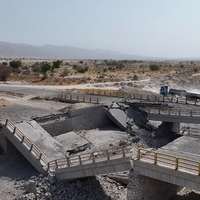
The water outage started when torrential rains flooded rivers and caused extensive landslides in various areas of the country including around the capital where riverbeds were completely blocked by debris from the mountains.
Karaj, the capital of Alborz Province, which is a city of over 1.6 million only about 40 kilometers (25 miles) to the west of Tehran has also been affected by the outage.
Some citizen reports on social media indicate that the outage has continued in some areas of the city despite officials’ claims that it ended at midday Monday.
Many citizens have expressed anger on social media over lack of accountability by the water supply network officials who did not provide timely warnings to citizens and repeatedly claimed the outage would end within hours.
Water shortage has been threatening the Iranian capital of 10m for years. Causes include drought and the massive waste of water due to the dilapidation of the distribution infrastructures.
Iran has been suffering from drought for at least a decade and officials have been warning of a further decrease in precipitation. The volume of water in the five dams that supply Tehran, for instance, has consistently been going down in recent years.
Mohammadreza Bakhtiari, the former CEO of Tehran Water and Sewerage Company, said in early April that about 20 percent of drinking water in Tehran, as much as 300,000 cubic meters, goes to waste before reaching households and businesses.
In recent years, massive protests have occurred in several cities against government mismanagement of water resources, harmful dam building, and politically motivated diversion of rivers that have devastated agriculture and drinking water sources in many areas.
In July 2021, water protests erupted in several cities in the oil-rich Khuzestan province that ended with the forceful intervention of police and the Revolutionary Guards. More than ten people were killed and hundreds detained during the protests that lasted a week.
In November of the same year, thousands protested in Esfahan over lack of water for agriculture where the iconic Zayandeh-Roud river has turned into a dry bed over the past few years. The protests soon turned into anti-government unrest.
Iran says it is not following China’s model of internet access but in reality is inching towards a similar national network.
Minister of Information and Communications Technology Eisa Zarepour claimed Tuesday that modeling China is on the agenda but admitted that the ministry is not the main decision-making body in this regard.
China has its own local platforms and has done a special job on that,but Iran has its own development model, he said, adding: “Of course we are looking for cooperation and synergy with all countries, including China.”
Describing the internet in China as “not very favorable,” he noted that 95 percent of internet traffic in China is domestic. “The government does not intend to implement such a plan in Iran,” he said, quipping that the Islamic Republic’s cabinet members who had travelled there were surprised by the limitations by the lack of access to foreign websites.
Zarepour’s remarks seem contradictory to earlier ones by the regime officials who have always envied the control that Beijing enjoys over the nation’s access to information.
Not all the Internet is available in China as sites belonging to Google, Facebook, Wikipedia companies as well as hundreds of other websites, apps, and video games, are censored or blocked, prompting people to use VPNs for access, inspiring the policy's colloquial nickname: the "Great Firewall of China." A Firewall is a network security device that monitors and filters traffic based on previously established policies.
Second only to China, Iran is on top of the list of countries that have put restrictions on the access of the internet to their people. There are also reports that the regime has started devising plans to give unrestricted internet access to authorities and a cherrypicked list of elites as well as foreign tourists, all of which have uncanny similarities to strategies taken by China.
Earlier in the year, President Ebrahim Raisi ordered the communications ministry to increase the ratio of domestic traffic, so that about 70 percent of the country's total Internet traffic would be from the Iranian national network within the next five years. It means only 30 percent of the online traffic in Iran can be used to access the global Internet.
Last week, Hossein Jalali, a member of the Cultural Committee of the Iranian parliament, urged the government to follow the example of China in setting up a national internet to prevent hackers from infiltrating the country’s infrastructural and governmental portals after major hacks have led to disastrous leaks of troves of confidential data.
Last year, Ali Yazdikhah, another MP, praised China’s “unique” experiences in this field and called for using such experiences in the establishment of a national internet – technically an intranet. The former head of Iran’s state broadcaster, Abdol-Ali Ali-Asgari, has also called for a national internet, famously saying that China has reduced the “American Internet” in the country and that Iran should have its own Internet.
Hundreds of Iran's government websites have been attacked in recent years by hacktivist groups or groups affiliated with other countries. The cyberattacks hiked particularly since last September, when “Women, Life, Liberty” protests engulfed the country after the death of 22-year-old Mahsa Amini in police custody.
In the most recent case, the hacktivist group ‘Uprising till Overthrow' claimed on May 29 that it breached 120 servers at the presidential office, about a month after the group breached into the Islamic Republic’s foreign ministry servers, disabling 210 sites and online services. Troves of confidential data have been leaked following the hacks.
The Iranian communications minister – who was sanctioned by the US for his role in limiting internet as part of the crackdown on popular protests -- also stated that the country’s Supreme Council of Cyberspace is in charge of decisions about the Internet access across Iran, highlighting that his ministry is only one the 27 members of this council.
Describing people's concerns about free access to the Internet as a result of the efforts by the "enemies," Zarepour claimed that no one wants to shut down or limit the Internet in the Islamic Republic.
In April, Zarepour himself said that considering the current situation, he is not in favor of unblocking social media platforms such as Telegram, WhatsApp, and Instagram. Playing down the impact of deliberate government internet outages in 2022 on businesses, Zarepoursaid in March that there is no accurate data regarding the damage from internet access restrictions despite reports of about $770 million in losses.
Prominent female dissident Zahra Rahnavard has warned the clerical rulers that Iranian women will eventually defeat them in the war over compulsory hijab.
Advising the rulers of the Islamic Republic to once and for all put an end to the enforcement of hijab, Rahnavard who has been under house arrest together with her husband Mir-Hossein Mousavi for thirteen years, since February 2011, also called for the abolishment of existing hijab laws.
Rahnavard, 78, was born into a family that did not particularly condone wearing the hijab. While studying art at Tehran University in the late 1960s, she became an advocate of wearing the hijab and even wrote several articles and books in its praise, both before and after the Islamic Revolution of 1979 when she became the first-ever female university chancellor in the country.
“The rulers [of the Islamic Republic] have waged a close combat against Iranian women by devising and advertising the chastity and hijab bill,” she said in a new statement, adding that they must realize that they will be “the real losers” in their war against the Iranian nation and women.
Rahnavard was referring to a bill called “Supporting the Culture of Hijab and Chastity and Health of Society” jointly prepared by the notoriously hardliner judiciary and the government of President Ebrahim Raisi, who asked the parliament to put it on its agenda with double urgency.
She said in her statement that the bill includes a “revolting list of medieval beliefs, violations of citizens’ rights and women’s natural and humanistic freedoms,” arguing that those behind the bill are unable to understand how economic, ethnic and gender discriminations should be lifted and remedied.
If the double urgency stature of the bill was approved, it would have been printed and distributed to lawmakers within six hours and debated within a maximum of two days.
The bill’s urgency was put to vote Tuesday, but lawmakers only agreed to the single urgency of the draft law, which means it will be referred to relevant committees for examination.
Women’s defiance of hijab rules is as old as the Islamic Republic itself, but it has escalated to new levels since the death of 22-year-old Mahsa (Jina) Amini in custody of morality police last September for “improper hijab” sparked nationwide protests.
The unrest gradually subsided after several months but defiance of hijab as a form of civil disobedience has increased and forced the authorities to try to stop the anti-compulsory hijab movement by resorting to various measures including new laws which center around cash fines.
Parliament speaker Mohammad-Bagher Ghalibaf (Qalibaf) said after the vote that giving the bill a single urgency did not indicate its insignificance and was only meant to provide more time for investigation.
“We want to stop [moral] depravity with this law,” he said and argued that the proposed bill has only looked at the criminal aspect of the hijab issue but that it was more a “cultural, social, and Sharia issue” and “a factor in the identity of the Islamic Republic”.
Soon after taking office in August 2021, and after weeks of harsher measures on the streets to enforce hijab rules by street patrols known as the ‘Hijab Police’, Raisi ordered all government entities to strictly implement the already existing “chastity and hijab” law.
The hijab required in the Islamic Republic consists of a long and loose dress in muted colors worn over trousers with a similarly plain headscarf that covers all hair and shoulders. Authorities including Supreme Leader Ali Khamenei say wearing a long black veil (chador in Persian) that covers from head to toe is the ‘optimal hijab’.