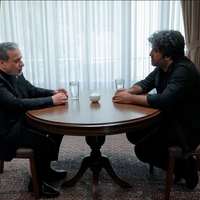
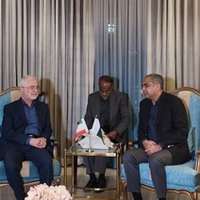
Iran’s President Ebrahim Raisi (left), Oman's Sultan Haitham bin Tariq al-Said (center), and Supreme Leader Ali Khamenei during a meeting in Tehran on May 29, 2023
Only two days after Muscat mediated a prisoner swap between Iran and Belgium, Sultan Haitham bin Tariq al-Said traveled to Tehran, meeting with President Ebrahim Raisi and Supreme Leader Ali Khamenei.
Traditionally, Oman works as a mediator between Iran and Western countries, and it also plays a role in facilitating relations between Tehran and Arab countries. It was one of the key players in the talks which eventually led to Iran and Saudi’s détente.
Given that this time the Sultan himself has come to Iran, there is no doubt this is a vital visit. Almost all of the reports by Iranian state media on the first day of the visit were focused on bolstering economic cooperation between the two countries, with some discussion on recent developments in the region. However, no details about trade or regional diplomacy were released.
The joint statement released after Oman’s sultan meeting with the Iranian president abounds with clichés such as “strengthening friendly and brotherly relations on the basis of common interests, especially in the fields of trade, energy, investment and culture.”
A meeting between Oman’s Sultan Haitham bin Tariq al-Said and his delegation with Iran’s President Ebrahim Raisi and senior officials in Tehran on May 28, 2023
On the second day of the trip, Sultan bin Tarik met with the Supreme Leader, apparently delving deeper into Iran’s détente with its classic rivals Saudi Arabia and Egypt. The only takeaway from the readout of the meeting by Khamenei’s office, was the Supreme Leader’s welcoming of better relations with Egypt.
Khamenei's comments came as Middle Eastern countries including Egypt are taking steps to ease regional tensions and relations between Egypt and Iran have often been fraught in recent decades although the two countries have maintained diplomatic contacts. In March, regional rivals Sunni Saudi Arabia and Shiite Muslim Iran ended years of hostility and agreed to restore diplomatic relations under a China-mediated deal.
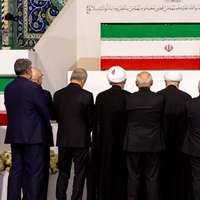
The presence of Iran’s top nuclear negotiator Ali Bagheri-Kani during Oman’s sultan meeting with Khamenei, which is somewhat unusual, indicates that there must have been a nuclear aspect to the meeting, despite a possible media ban on this aspect of the talks.
Iran’s top nuclear negotiator Ali Bagheri-Kani (center) during a meeting between Supreme Leader Ali Khamenei and Oman’s Sultan Haitham bin Tariq al-Said (not seen) in Tehran on May 29, 2023
The seeming lack of openness about the nuclear side of the talks has drawn suspicion from global Iran watchers who are looking to Oman to mediate in the possible revival of talks on the 2015 nuclear deal, which has fallen apart. There are also rumors that the US and the Islamic Republic are about to reach a deal in the near future, which could be among the secret topics discussed during the visit by Oman’s sultan.
Former diplomat Fereydoun Majlesi told Fararu on Monday that Oman has a respected position in the Persian Gulf. "Oman speaks on behalf of all the countries of the Persian Gulf and what is in the interest of Oman is in the interest of all Arab countries in the region,” he said, noting that minimizing the risks of tensions or wars and unease between the Islamic Republic and the US and Israel plays an important role in that.
“These countries are worried that any kind of conflict between Iran and its long-time enemies would overshadow all the peace and security they have achieved during the last half century," added Majlesi who said that Iran’s foreign minister has recently assessed the revival of the JCPOA as “important and vital and expressed willingness to restore the deal”.
Ali Bigdeli, another pundit, told Fararu that the most important possible reason for Sultan of Oman's visit to Iran is mediating for exchange of dual-national prisoners.
Apparently, the talks that have made progress focused on Iranian funds held in Iraq and South Korea. Iran is apparently expected to show more flexibility on issues related to its nuclear program in exchange for the release of its funds in Iraq, and free hostages with dual nationality in exchange for its assets in South Korea.
Currently there are three dual nationals with American citizenship and two individuals with US permanent residency held by Iran on trumped-up charges of espionage.
Also on Monday, Israel’s state television channel Kan 11 reported that a deal between Tehran and Washington will be finalized in the coming weeks.
During an interview with Reshet Bet on Monday, Israeli opposition leader Yair Lapid expressed alarm about reports of the imminent nuclear agreement, saying: "Such an interim agreement is dangerous. Every effort must be made to prevent this from happening.”
A member of Iranian healthcare professional community
Around 10,000 healthcare practitioners have left Iran over the past two years to work in the Arab world.
With economic and financial conditions at rock bottom, MP Hossein Ali Shahriari, chairman of the Iranian parliament's Health and Treatment Committee, said most have gone to the Persian Gulf countries including Oman and the United Arab Emirates.
"Unfortunately, we are facing a human resources shortage in private and even state medical centers, but the government apparently has no plan to deal with it," he said.
The number of Iran's healthcare professionals leaving the country is on the rise, worsened by the country's lack of freedoms and the months of violent uprisings since September. Doctors earn an average of $450 in a sector which is now facing shortages of basic goods such as IV fluids and cold pills in addition to medicine, due to global sanctions.
Thousands of physicians, dentists, midwives, and nurses have either emigrated in the past few years or are planning to leave for other countries.
There is no transparent data on the emigration of healthcare and other professionals, but medical officials and lawmakers often offer fragmentary information on the scope of the problem.
In February, Mohammad Sharifi-Moghadam, a member of the central councilof Iran's Nurses’ Organization, said between 2,500 to 3,000 nurses were emigrating from Iran each year.
A survey by Iran Migration Observatory in 2022 found that economic and social instability, institutionalized corruption, and the regime’s governance methods were responsible for the very high desire to emigrate among medical students, professors and other healthcare professionals. The sector employs around 100,000 people in total but emigration of such large numbers could pose major challenges to the system, especially in the more rural regions where healthcare is less accessible.
The report warned that those who failed to emigrate were in danger of losing their motivation for work.
Two days after the deadly clash on the Iran-Afghanistan border, Iran's Interior Minister described the incident as a "brief conflict".
Ahmad Vahidi said Monday that "the issue was resolved after negotiations were held with the Taliban," playing down the severity of the clash.
"There was a cross-border shooting by the Afghan border guards, and naturally, they were given an appropriate response."
"Currently, there is no problem, and the border is open and in peace," added Vahidi.
Clashes at the border on Saturday over water rights claimed the lives of at least two Iranians and one Taliban soldier. According to a report by Iranian reformist daily newspaper Ham-Mihan, about 50 Iranians have been killed in border regions since 2020.
Despite Tehran’s claims that the clashes are over, and the situation is in control, Taliban sources have released videos of capturing an outpost inside Iran.
Earlier, Abolfazl Zohrevand, the former ambassador of Iran in Kabul, described the conflict as "a serious war" in an interview with Entekhab website saying that the conflict could be resumed.
On Sunday, Qasem Rezaei, deputy commander of Iran's Law Enforcement Forces and Kiumars Heydari, the Commander of the Iranian Army's Ground Forces, traveled to Sistan-Baluchestan province bordering Afghanistan to probe the situation.
Disputes between Tehran and Kabul have risen over the Taliban’s obstruction of Iran's access to Helmand River water in violation of a 1973 treaty.
Iran has accused Afghanistan's Taliban of violating a 1973 treaty by restricting the flow of water from the Helmand River to Iran's parched eastern regions, an accusation denied by the Taliban.
An Iranian lawmaker who has disclosed a major case of financial corruption at the parliament says he has been barred from speaking during legislative sessions.
Ahmad Alirezabeigi, the member of parliament from Tabriz says he has not even been allowed to make brief comments on the proceedings at the Iranian Parliament (Majles). He added that the authorities have muted his desk microphone.
"I have asked twice to make brief comments on the legislations being discussed at the Majles but I have been denied the permission to speak," Alirezabeigi told Etemad Online. He added: "I expect the Majles presidium to intervene in the matter and defend my rights as a member of parliament."
His comment sounded odd as it is the presidium that allows MPs to speak or mutes their microphone to bar them from commenting. Alirezabeigi said that presidium members should resign if they cannot restore lawmakers' rights.
He reiterated that no one may prevent a member of the parliament from expressing his views during sessions. "Article 75 of the Majles internal regulations in particular says that lawmakers should be given a chance to respond to accusations made against them at the parliament," he said.
Following the disclosure involving nearly 140 SUVs given to lawmakers at extremely discounted prices to bribe them to stop an impeachment motion against a former industry minister, Alirezabeigi has been questioned by a prosecutor and an investigation committee at the parliament.
The lawmaker told Etemad Online that he thinks "a secret power is trying to prevent me from fulfilling my responsibility as a member of the parliament," however, he did not name anyone.
Alirezabeigi said elsewhere that even the ethics committee, which questioned him following the disclosure about the bribes is not legally authorized to bar him from speaking at the Majles.
Ahmad Alirezabeigi, the member of parliament representing Tabriz
Majles Speaker Mohammad Bagher Ghalibaf, a former IRGC general, has been often criticized by some lawmakers and other politicians for running the parliament like a military garrison. Khabar Online Website has quoted lawmakers as having said that "by running the parliament like a military center, Ghalibaf has made the legislature useless."
According to Khabar Online, criticism of Ghalibaf's leadership at the Majles surfaced when he stopped impeachment motions for ministers in a bid allegedly to support President Ebrahim Raisi.
A video posted on Fararu website on Saturday showed Ghalibaf threatening lawmakers to name those who do not work hard enough or refuse to take part in voting.
At another level, politicians in Iran have often criticized Ghalibaf and other lawmakers for making the parliament so weak that key decisions on issues such as raising fuel prices or the final decisions on the annual budget are made at a meeting between the heads of the three government branches rather than by lawmakers.
Other key issues such as the decision to accept the terms of the international financial watchdog, the FATF have been referred by Supreme Leader Ali Khamenei to the Expediency Council, apparently as he has deemed the Majles not knowledgeable enough about the matter.
The Council is a collection of aging clerics and demoted politicians susceptible to pressures by Khamenei’s henchmen.
Meanwhile, the Supreme Leader makes many decisions such as sending troops to Syria or giving weapons to Russia to help Putin in the war against Ukraine without consulting the parliament.
Iranian authorities say efforts are underway to release Hamid Nouri, a former Iranian jailor who is serving a life sentence in Sweden.
Nouri, 61, was given a life sentence last July for his leading role in the massacre of large numbers of jailed opposition members at Gohardasht Prison in July and August 1988.
Askar Jalalian, Deputy Director of International Affairs and Human Rights at the Ministry of Justice, called prospects of his release "good news”.
The development comes after Iranian diplomat Assadollah Assadi, convicted of terrorism, was freed on Friday in exchange for a Belgian aid worker, causing global outrage.
Assadi, a former attaché at the Iranian embassy in Austria, was convicted of plotting to bomb a gathering of the exiled opposition group Mujahedin-e Khalq Organization (MEK) near Paris on June 30, 2018.
Belgian Olivier Vandecasteele, who was detained in 2022 and sentenced to 40 years in prison and 74 lashes for alleged “spying and cooperation with the United States, money laundering and smuggling $500,000 out of Iran,” was also released as part of a deal mediated by Oman.
Critics of the deal warned that such a treaty would effectively establish Belgium as a “sanctuary country” for terrorist operations, and a haven for Iranian intelligence services to maintain a European command center, setting a dangerous precedent for the future.
Iran has become notorious for its ‘diplomatic hostage taking’ and the latest developments are causing alarm among rights groups and international diplomatic circles that the tactic is succeeding.
Iran's ruler Ali Khamenei offering prayers on the Muslim Fitr holiday in 2021
Recent media reports in Iran indicate that local observers are increasingly convinced the revival of the 2015 nuclear deal (JCPOA) is impossible.
The latest report in reformist daily Sharghon the issue, which has also been carried by other media outlets such as Iran Diplomacy and Rouydad24, says some officials have been considering alternative solutions.
Shargh relying on recent statements by several Iranian politicians and pundits said that perhaps the best route to resolve the nuclear dispute is direct talks between Iran and the United States, something that Supreme Leader Ali Khamenei has forbidden.
While several Iranian and international observers are still considering Khamenei's latest reference to "heroic flexibility"as an allusion to the feasibility of an agreement with the West, his reference to the Shiite principle of Taqiyyah based on which Shiites can prudently hide their real beliefs and goals, and his explanation that heroic flexibility is "a way of circumventing a rock on the way of your progress" put an end to all hopes about a possible softening of Iran's stances.
In other words, for Khamenei nuclear talks are a means to neutralize foreign opposition while following his real objectives.
As a result, some observers characterized Khamenei's rhetoric as a double-edged guidance to Iranian diplomats. It is characteristic of Khamenei to make statements in order to evade responsibility if his suggestions lead to a failure and to claim victory if they happen to gain something for the Islamic Republic.
Iran's former foreign minister Mohammad Javad Zarif and US Secretary of State John Kerry as they met in 2014 to start nuclear talks
In the meantime, Iranian officials including Foreign Minister Hossein Amir-Abdolahian make occasional statements about secret talks with the United States. The latter has repeatedly refuted such statements and labelled them as lies.
The report in Shargh said that boosting of Iran's nuclear activities since 2021 is one of the reasons why observers believe that the JCPOA can no longer be revived. Another obstacle is Iran's insistence on its financial demands before returning to the negotiations. However, a key problem is that the deadlines to lift the embargo on Iran's missile development and nuclear activities respectively in October 2023 and 2025 are getting closer quickly.
Shargh noted that the current 5+1 has no similarity to the P5+1 in 2015. There is a vast divide between Russia and the four Western partners of the JCPOA and the relations between China and the United States are no longer friendly. Changes have even occurred between the four Western partners. Last March the three European partners demanded an IAEA resolution against Iran, but the United States disagreed with them, which was a reversal of roles compared to the past. In the meantime, Iran's involvement in Russia's war against Ukraine has also changed many things. No one in the West supports the lifting of sanction on Iran, and doing so will be costly for Western governments.
In this situation, the Biden Administration has said that "The JCPOA is no longer on the agenda, however, the problem with Iran can be solved only through diplomatic ways." The policy of "neither JCPOA, nor crisis" just gives Biden one less subject to worry about. At the same time, some Western officials have been talking about an interim agreement or "less for less," Iran has not yet agreed with that.
Meanwhile, Israel's insistence on posing a "valid military threat" against Iran's nuclear program and two joint military exercises with the United States in November 2022 and January 2023 have made the matter even more complicated.
Under the circumstances, according to experts quoted by Shargh, Iran's constant rhetoric about its readiness to return to the JCPOA and its continued efforts to boost its nuclear capabilities exert pressure on the West. At the same time, unwanted consequences are also probable in the absence of a dialogue.