Saudi Arabia Hosts Senior Hamas Delegation To Improve Ties

After normalization of ties with Iran and Syria, Saudi Arabia has invited a senior delegation of Palestinian Islamic Resistance Movement – Hamas to Riyadh.
After normalization of ties with Iran and Syria, Saudi Arabia has invited a senior delegation of Palestinian Islamic Resistance Movement – Hamas to Riyadh.
The Hamas-affiliated al-Resalah newspaper wrote Sunday that Political Bureau Chief Ismail Haniyeh, and Head of Hamas Diaspora Office Khaled Mashaal, who have been living in Qatar in the past years, arrived in Riyadh Sunday at the head of a high-level delegation.
The London-based Al-Araby Al-Jadeed news website also reported that Hamas hopes the visit will serve as an opening to improve relations between the movement and Saudi Arabia.
In a statement, Hamas said "We affirm our keenness on positive relations with our brothers in Saudi Arabia and all brotherly countries in the service of the Palestinian cause and our Arab and Islamic nation."
In recent years, relations between Hamas and Saudi Arabia have been tense, with the Kingdom detaining some members of the movement and blaming them of supporting terrorism. The tensions mounted as Hamas drew closer to the Islamic Republic.
The Palestinian Authority has not yet responded to the Saudi invitation of the Hamas delegation.
With China's mediation, Saudi Arabia normalized ties with Iran on March 10 and returned its relations with Syria to the level before the Syrian war. The Saudi embassies in Iran and Syria are scheduled to reopen in the coming weeks.
Israeli Prime Minister Benjamin Netanyahu said after returning to power that normalization with Saudi Arabia is one of the main goals of his new administration.
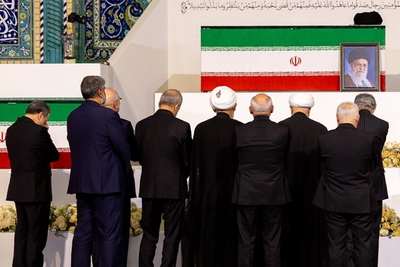









Government media and regime supporters in Iran have been speculating about the economic benefits of restored diplomatic ties with Saudi Arabia, amid domestic crisis.
Dozens of articles and interviews have been published in Tehran media in the past month on a possible economic windfall, since China brokered a deal between Iran and Saudi Arabia to re-establish relations after a seven-year bitter animosity.
The reason for the high degree of Iranian interest in economic and trade ties are clear. Saudi Arabia has turned into a financial and economic power house, not only in the region but in the world. Its influence in the energy market is on the rise with the latest OPEC+ agreement to further reduce oil production and keep prices high.
Saudi Arabia’s GDP has grown from $200 billion to more than $800 billion in the past 20 years, while Iran has been subjected to international and US sanctions with its energy and non-oil sectors struggling to stay afloat.
By the most optimistic estimates, Iran’s GDP is less than $250 billion, down from $480 billion in 2016, and even Iraq, with all its internal problems has caught up with its much larger neighbor because of relentless and rising volume of oil exports. Non-oil producing Turkey has long surpassed Iran by a more than $800 billion GDP.
Iran has become a small and insignificant oil exporter since the United States imposed crippling third-party sanctions on its energy and banking sectors in 2018, when former President Donald Trump withdrew from the JCPOA nuclear deal, demanding major concessions from Tehran.
However, an Iranian businessman, Mehdi Alipour, speaking with FarazDaily website in Tehran explained that many Sunni Arab countries in the region, such as Egypt, Jordan and the Emirates follow Saudi Arabia’s foreign policy line and if Tehran establishes good ties with Riyadh chances are that it will also secure more trade opportunities.
Iran’s main non-oil exports are petrochemicals, steel and agricultural products, but so far except in Iraq, it has a very small share of the market in other Arab countries.
In case of Saudi Arabia, chances are that Iranian products would not be able to compete with Chinese imports, like in many other markets. The only advantage Iran has is its geographic proximity, but not the volume of production that makes cheaper products possible.
China exported almost $30 billion of goods to Saudi Arabia in 2021, a year marked with the Covid pandemic. There are no final figures for 2022.
However, any significant uptick in Iranian exports depends on removing US economic and banking sanctions. Even Iraq that imports natural gas and electricity from Iran does not pay in cash and it owes Tehran more than $11 billion. Iranian funds are kept in Trade Bank of Iraq and the Islamic Republic can only buy humanitarian essentials with the money in Iraq.
Iranian media also hint at potential Saudi investments, although this seems a more far-fetched proposition than trade. Domestic and foreign private sectors have a tough time in investing confidently in the current circumstances in Iran with draconian government interventionism and the state directly or indirectly controlling 80 percent of the economy.
Saudi Government investments could be a different matter, but even China has pulled out of Iran after initial attempts to get a foothold a decade ago.
It seems that most of the talk in Iran about an economic windfall from relations with Saudi Arabia are aimed at instilling optimism among the people and helping the battered local currency with spreading positive news.
Iranian officials, clerics and military commanders made pompous remarks about the demise of Israel on the last Friday of Ramadan, the regime’s Quds Day.
Those with a controversial background made the most outlandish hard-line comments to prove their loyalty to the regime.
The rhetoric used on Qods Day speeches were a mixture of impolite, uneducated and politically incorrect opinions and part of Iran's rationalization of its irrational phobia about Israel's influence in the region.
Deputy IRGC Commander for Political Affairs General Yadollah Javani who was implicated last year in an infiltration case involving an alleged Israeli agent, Catherine Shakdam, a former consultant for UNSC on Yemen, went out of his way to threaten Israel's Jewish people rather than the Israeli government. He said, "The Jews should know that Israel is no longer a place to live," and told them "pack your suitcases!"
Javani stressed: "Israel should be wiped off [the map] and this is something that will materialize and the Jewish people will have to return to their home countries." Javani who was speaking in Rasht in northern Iran said the enemies are downplaying the importance of the Quds Day by creating doubts among young Iranians.
In Tehran, the day was marked in one of the Iranian capital's smallest squares, the Palestine Square and later on Revolution Square, a slightly larger venue to make sure that the people who were bussed in would fill the space.
Javani claimed the Quds Day is now an international event. This was against the fact that some counties including Germany have reportedly banned Quds Day events.
He further claimed that recent unrest in Israel was a sign of its impending destruction, adding that the "Zionist regime" is no longer capable of surviving.
In Tehran, the former Judiciary Chief who currently chairs the Expediency Council, Sadegh Amoli Larijani, another insider implicated in major financial corruption cases, claimed the issue of Quds [meaning the problem of Palestine] is the world's biggest problem.
Another speaker, vice president for economic affairs, Mohsen Rezaei, said that Iran is collaborating with regional counties to create a strategic alliance against Israel. He was obviously mindless of the fact that nearly all Persian Gulf Arab countries maintain friendly ties and trade and cultural relations with Israel.
The rhetoric against Israel was also heightened IRGC-linked Fars news agency which recycled old comments by Khamenei on Israel. The report quoted Supreme Leader Ali Khamenei as saying that by wiping Israel [off the map] he meant that one day the Palestinians will elect their own government, and this is something that will most certainly happen.
Highlighting that Khamenei does not call for the destruction of the Jewish people stems from the fear of Israeli threats to attack Iran's nuclear facilities even without US help.
Khamenei is also utterly shaken by recent attacks attributed to Israel on Iran's military interests in Syria. Some recent reports indicated that Israel had attacked the depots of Iranian military equipment airlifted to Syria disguised as relief aid following a recent earthquake in the region. Iran has named at least three IRGC commanders who were killed during Israeli strikes.
On the other hand, Tehran hopes that news of conflicts in Israel and missile attacks on the country will overshadow the fiasco that followed alleged Israeli attacks on Iran's drone factory in Esfahan. Regime insiders might even hope that the anti-Israeli propaganda would downplay the importance of nationwide protests in Iran and rally Iranians behind the regime.
This hope was dashed by low turnout in Quds Day rallies as Iranians continue to defy the regime, especially rejecting its campaign to force women to use hijab.
The United States is not in a position to support Israel, spokesman of the Revolutionary Guard said in reaction to statements that Israel can act alone against Iran.
Ramezan Sharif was quoted by IRGC-affiliated Fars news website Saturday said Israel has repeatedly issued similar statements, but he has one message and that is: The situation of the Americans in the region is such that they cannot support the Zionists.
Israel has long threatened that if the Islamic Republic gets close to obtaining a nuclear weapon it will use all methods including a direct military attack to prevent it. President Joe Biden has also vowed not to allow the Iranian regime to produce nuclear weapons, with “all options on the table.”
But Tehran has been emboldened by a recent agreement with Saudi Arabia to restore diplomatic relations, mediated by China. It sees itself as not so isolated in the region and believes that a possible threat of an Israeli-Arab military alliance has receded.
China brokering a deal between two regional rivals has been widely seen as a defeat for the United States in the region and the ascendance of Chinese influence in the Middle East.
Sharif also said that “The Americans seem to be trying not to fall into the lap of the Zionists, because they know that if Zionists take action against us our in-kind retaliation will engulf the bases of those supporting them.”
However, the United States has continued to pledge its readiness to support Israel and held large joint military drills in January.
The US Navy also announced April 8 the deployment of a guided-missile submarine capable of carrying up to 154 Tomahawk missiles to the Middle East, in what appeared to be a show of force toward Iran following recent tensions in Syria and rocket attacks on Israel.
IRGC’s spokesman went on to say that Israeli statements about attacking Iran without American help stem from US messages that they are not able to assist Israel as the case was in the past and “are not ready to enter a battle [knowing] where it would end.”
After the agreement to restore ties with Saudi Arabia was announced March 10 in Beijing, Iran has become more aggressive against Israel, openly calling on its allies and militant proxies to attack the Jewish state. The new belligerent policy was reinforced by massive anti-government protests in Israel against Prime Minister Benjamin Netanyahu’s plans to overhaul the country’s judiciary.
The Wall Street Journal reported Friday that the commander of IRGC’s extraterritorial Quds Force, Esmail Qaani has held a series of secret meetings with leaders of Iran’s armed proxy groups in recent weeks to plan attacks against Israel.
The Journal said that to coordinate a rocket a rocket attack from Lebanon on Israel in early April Qaani met in Beirut, with Hamas leader Ismail Haniyeh and his deputy Saleh al-Arouri and Hezbollah chief Hassan Nasrallah.
IRGC’s chief commander Gen. Hossein Salami on Friday boasted that “The Zionist regime is the target of military attacks by all countries and does not even know from where the attacks are coming.” Salami was speaking at a ceremony marking the anti-Israeli Quds Day in Esfahan, central Iran. He took credit for the attacks saying that the Islamic Republic is now a source of legitimacy for regional countries, while just a few months ago they had distanced themselves from Tehran.
Iran’s president Ebrahim Raisi speaking in Tehran on the Quds Day reiterated that the liberation of Quds (Jerusalem) is imminent; “Closer than you can imagine,” adding that “the normalization of relations with regional states [such as the United Arab Emirates and Bahrain] has not brought and will not bring security for the Zionist regime.”
The Islamic Republic held its annual anti-Israel rent-a-crowd parade Friday, reiterating threats against regional countries over normalization of ties with Israel.
The state-sponsored event is held guised as defending the rights of Palestinians but serves as a phenomenon to perpetuate antisemitic and anti-Israel propaganda among the Muslim world under the auspices of a collective cause propagated by Iran's dictator.
The day, which takes its name from the Arabic-language name for Jerusalem, is often described as the official demonstration in support of the Revolutionary Guards Quds (Qods) Force – an IRGC division primarily responsible for extraterritorial military and clandestine operations – because it seeks to justify the Islamic Republic’s destabilizing activities across the region.
Directed against Israel’s existence, Al-Quds Day was proclaimed by the founder of the Islamic Republic Ruhollah Khomeini on 7 August 1979. He called on Muslims worldwide to unite in solidarity against Israel and in support of the Palestinians, saying the "liberation" of Jerusalem was a “religious duty to all Muslims”.
Among the most salient programs during the day is burning the flags of Israel, the United States, the UK and other countries that the Islamic Republic deems as enemies, no matter their role in the conflicts between Israel and Palestinians. Effigies of Western officials in chains are also among the sights of the regime’s carnival of hate.
Almost all the regime’s insiders are socially obligated to attend the event as a renewal of allegiances with one of the main foreign policy issues of the Islamic Republic, the destruction of the State of Israel.
The president and his cabinet ministers as well as members of the parliament, prominent politicians and their entourage and so many other officials from the inner circles of the regime are usually seen during the rallies.
Such state-sponsored events are usually shunned by the general public and the regime ends up transporting paramilitary Basij forces and its supporters from small towns to provincial capitals to form demonstrations with large crowds for the façade of mass support.
As he was walking along his large retinue while people were chanting "Death to America" and "Death to Israel" around him, President Ebrahim Raisi spoke to reporters, emphasizing that “the collapse of the Zionist regime is very close”. Repeated relentlessly with a sense of spiritual foreboding by the Supreme Leader and his cronies, Israel is ironically about to celebrate its 75th year. According to Khamenei’s prophecy, Israel has 17 years left until its downfall.
Raisi reiterated that the liberation of Quds (Jerusalem) is imminent; “Closer than you can imagine,” adding that “the normalization of relations with regional states [such as the United Arab Emirates and Bahrain] has not brought and will not bring security for the Zionist regime.”
Parliament Speaker Mohammad Bagher Ghalibaf delivered the final speech of the event at Enqelab (revolution) Square after droves of people were guided to the final venue from 10 routes designated for the rallies throughout the capital Tehran. As it was expected, he emphasized that resistance is the only way to achieve success and ultimate victory over Israel.
“Quds Day is a very significant and influential day for the Muslim Ummah and Islamic countries,” he said. “Quds Day indicates that success and victory could be attained only through resistance”. Ghalibaf also lauded recent Iran-backed Palestinian missile strikes into Israel from Gaza, Lebanon and Syria, saying all Palestinian groups have closed ranks to liberate al-Quds (Jerusalem), which he described as the capital of the Muslim world.
The Islamic Republic is so invested in the idea of resistance that it calls its proxy forces and aligned militia across the region “the axis of resistance,” mainly organized by the IRGC’s Quds force. Its current commander Esmail Qaani was also present in the rallies and photos and banners of his predecessor Qassem Soleimani – killed January 2020 by a US drone attack in Baghdad — abounded throughout the event.
The IRGC’s commander-in-chief Hossein Salami also delivered a speech at the event, claiming that Israel is on the brink of destruction, and that it cannot prevent the arming of Palestinians in the West Bank, referring to the likes of Hamas and Islamic Jihad, which openly admit funding from and affiliations to Iran.
“There are operations in the West Bank and Tel Aviv, and the regime that surrounds itself like a barracks and has the strongest and most modern security systems cannot prevent the arming of the West Bank and the operations of the Palestinian forces,” he said.
This year, the Islamic Republic also released a communiqué at the end of the event – dubbed the Quds Day Resolution – threatening states that have restored relations with Israel, a veiled warning against Saudi Arabia and its allies which are bolstering ties with Jerusalem.
The regime in Tehran, which is in the middle of rapprochement with Riyadh, did not directly mention Saudi Arabia in its Quds day statement, and prevented people from chanting slogans against the Al Saud, a prevalent motto in previous years.
As the regime continues to fight a losing battle against the tide of hijab rebellion, a trigger for months of violent unrest in the country, the day’s final statement reiterated the regime’s rhetoric that the “hijab is one of the necessities of Islam, and not observing it is a religious and political haram and will cause the foundations of families to weaken.”
With divine grace, soon there will be nothing called the “Zionist regime”, the chief staff of the Iranian armed forces said Friday, as the government marked Quds Day.
In an announcement carried by local media, the armed forces of the Islamic Republic said that “countdown for the disintegration of Zionism has begun.”
In official jargon used by the Iranian regime, Israel is called “the Zionist entity” or the “Zionist regime.” In its 44-year history Iran’s clerical rulers have been calling for “eradication” or “destruction of Israel.”
In 2015, Iran’s ruler Ali Khamenei announced that Israel would cease to exist in the next 25 years and in 2016, the regime put up a countdown clock in Tehran’s Palestine Square that showed time ticking. This followed the signing of a nuclear agreement between Iran and World powers in July 2015.
Iran’s armed forces said, “Seventy-five years has passed since the occupation of Palestinian lands with a conspiracy by evil Britain and the American mafia regime,” and called for Muslim unity in supporting Palestinians.
Iranian officials have become vociferous in the past few weeks, calling for Palestinians to attack Israel and insisting that Jerusalem “will be soon liberated.” This followed the political rift and protests in Israel over Prime Minister Benjamin Netanyahu’s quest to overhaul the judicial system.
Palestinian attacks followed both from Gaza and Lebanon, triggering Israeli responses in a series of military tit-for-tat confrontations.
“The countdown has begun for Zionism’s downfall,” the statement said, adding that “with God’s grace soon there will be nothing called the Zionist regime.”