Afghan Opposition Condemns Handover Of Tehran Embassy To Taliban
Afghanistan’s embassy in Tehran
The National Resistance Front of Afghanistan has slammed Iran’s move in ceding the Afghan embassy in Tehran to the Taliban.
In a statement published by the spokesperson of National Resistance Front, Sibghatullah Ahmadi, the group said the action was taken despite the Front’s concerns about its “adverse consequences”.
“Nonetheless, [Iran] allowed the representatives of the illegitimate and the terrorist group of Taliban to enter the diplomatic mission of Afghanistan.”
It also warned that the political presence of the Taliban in Iran, with its “dark history” is “perilous”, especially for the millions of refugees who have sought protection in Iran.
“Handing over the diplomatic mission of Afghanistan in Iran to a group that is a murderer of the people of Afghanistan…is dubious and contains an unpleasant message to the people of Afghanistan and other countries.”
The statement expressed regret about the embassy takeover by a “criminal group”, adding that this situation will not last long.
Iran has good relations with the Taliban and also ties to the resistance front that comprises more non-Pashtun, Persian speaking Afghans.
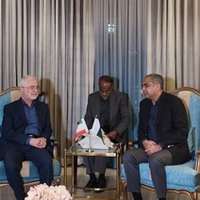
Afghanistan’s embassy in Tehran was “formally” handed over to the Taliban on Sunday afternoon, according to an Afghan diplomat in Iran.
Sources say the Taliban has appointed Fazl Mohammad Haqqani, the first secretary of the former ambassador of Afghanistan in Iran, as the group’s charge d’affaires in Tehran.
Iran is the third country after Pakistan and Russia that handed the Afghan embassy to the Taliban.
The Commander of Iran’s Revolutionary Guard Hossein Salami says the IRGC is ready to expand its ties with the Iraqi military and train its armed forces.
General Salami said the Islamic Republic is ready to play an effective role in Iraq. He further noted that in addition to advisory assistance and exchange of experiences, the IRGC is ready to train Iraqi armed forces at different levels.
Salami made the comments during his Monday meeting with Iraq’s Defense Minister Thabet Mohammad Said Reda.
“We are after a strong Iraq while the Americans and Zionists are seeking to dominate the region and create insecurity in Iraq and Iran,” added Salami.
Iran’s IRGC created large militia forces in Iraq in mid-2010s to fight against the Islamic State group, but also uses them to maintain influence in Iraqi politics. Many Iraqis have protested against Tehran’s interference in their country.
Iran's defense minister, Mohammad Reza Ashtiani, also stressed on Sunday that Iran is willingto share its expertise with Iraq to help it achieve "independence" and "self-sufficiency" in the military and defense industry.
Ashtiani's remarks came in a joint press conference with his Iraqi counterpart, Reda, who arrived in the Iranian capital on an official visit on Friday.
"Iran and Iraq share a close geopolitical connection that encompasses national, religious, cultural, economic, and energy-related areas. We should cherish this connection as a factor of unity and solidarity between the two countries. It is a strong point that the enemies of both countries want to undermine," he said.
The current chairman of the Iran Chamber of Commerce, Gholam-Hossein Shafei
Over 40 percent of candidates running for chambers of commerce in Iran who are somewhat independent of the government were disqualified by a supervisory body.
Disqualifications have been so widespread that the actual elections of chambers of commerce, industries, mines and agriculture often referred to as “private sector’s parliament”, had to be postponed from February 29 to March 10 to allow investigation of candidates’ complaints.
Mehdi Karbasian, a former deputy minister of industries, mines and trade, who represents several high-profile companies, and Masoud Khansari, the incumbent chairman of Tehran Chamber of Commerce, the most influential chamber in the country, are among the candidates who have been disqualified.
In a commentaryentitled “Butchering Chamber of Commerce Election [Candidates] Following Increase of Businessmen’s Criticism of Raisi Government”, Aftab News website on Saturday said disqualified candidates believe due to profuse criticisms of the government policies by businessmen and chambers, the ministry of industries, mines and trade has decided to take control and only allow its own supporters to take the key positions.
Iran’s economic crisis has deepened in recent months as the national currency has lost more than half of its value and hyper-inflation is feared in the next few months. Prominent businessmen holding positions in chambers of commerce have urged the government to change its foreign policy and end US economic sanctions.
Head of Tehran Chamber of Commerce, Industries, Mines and Agriculture Masoud Khansari
The vetting was based on a recent regulation that required candidates to have at least two consecutive years of membership in chambers of commerce, to have paid insurance for a minimum of twenty employees during the past year, to have had a minimum annual turnover of 150 billion rials, and to have also been awarded for exports by the Trade Development Organization.
The boards in every city where the chamber of commerce elections were to be held consist of representatives of the Chamber of Commerce of Iran and the ministry of industries, mines and trade.
One of the barred candidates who did not want to be named, told Aftab News that that disqualifications were more a result of the candidates’ political leanings than the new regulations. “The ministry of industries, mines and trade and the government are trying hard to shift the control of the chambers, particularly the chambers of Iran and Tehran, to a certain political faction,” he said.
Aftab News which is believed to be close to former President Hassan Rouhani and the Moderation and Development Party, said most of the disqualified candidates have reformist affiliations.
The reformist Etemad newspaper wrote last week that those who are currently key members of the chambers were very unlikely to be allowed to run again. The newspaper predicted that the elections of the “private sector parliament” would be engineered to shift the control to government supporters.
The current chairman of the Iran Chamber of Commerce, Gholam-Hossein Shafei and some other high profile former members did not nominate themselves to run.
Chambers of commerce often produce economic reports that the government finds embarrassing while some prominent members such as Shafei have been vocal critics of the government’s lack of communication with representatives of the private sector over its economic policies.
Referring to the current foreign exchange rate crisis Saturday, a member of Tehran Chamber of Commerce, Ahmadreza Farshchian, described the past four years as the most difficult years for the private sector since the end of the Iran-Iraq War (1980-1988).
A screen grab from Iran International’s Mahsa Mortazavi with Canada’s Minister of Immigration, Refugees and Citizenship Sean Fraser
Canada's immigration minister has told Iran International Ottawa is seeking new measures to support Iranians in the face of systematic human rights violations by the Islamic Republic.
Minister of Immigration, Refugees and Citizenship Sean Fraser elaborated on the Thursday announcement about Canada making it easier for Iranians who wish to extend their temporary status in Canada, allowing them to apply for a new permit from inside the country.
In his virtual interview with Mahsa Mortazavi, he said the measures were meant to help those Iranians who fear for their safety and prefer to stay longer in Canada after their temporary visa expires rather than return home amid an uprising in Iran, now into its six months and gaining more momentum.
Fraser said as per their new regulations, Iranians studying, working or visiting family or any other temporary stay can get an extension of two years. The application process will be up and running as of March, he added.
In addition to the new measures, the Canadian government also plans more options for other Iranians, who wish to immigrate to Canada. He, in particular, mentioned the special program that Canada has for people who seek refuge because they are being persecuted as human rights defenders.
“We’re seeing and hearing stories from the Iranian community in Canada that there are many individuals who are vulnerable as a result of them standing up for human rights in Iran,” he said, adding that they are looking at the options to expand access to this stream.
Answering a question about the situation of many Iranians who fled to Turkey in recent months to escape persecution by the regime, he said the situation is very challenging. He acknowledged the “extraordinary danger” they are facing in Turkey – considering Ankara’s close relations with Tehran and its proximity – saying Canada wants to do more to facilitate the protection of vulnerable individuals.
He noted that there are certain unique challenges in Turkey, some of which are outside the control of the Canadian government and related to Turkish regulations, such as the documents needed to exit Turkey.
He promised they are going to consider other options for the Iranians who have fled and are staying in third countries, such as Turkey.
A Woman, Life, Liberty rally in Canada
Amid nationwide protests, ignited by the death of 22-year-old Mahsa Amini in September, economic hardship and uncertainty about their future, more and more Iranians are emigrating, and Canada is one of the top destinations. However, since going directly to Canada needs a long process in addition to money, many have to go to nearby countries. The accelerating exodus is not limited to medical and engineering professionals anymore as many business owners have also started to transfer their businesses to neighboring countries where business is easier.
Fraser also talked about the sanctions and inadmissibility provisions on Iranian individuals connected to the Islamic Republic and especially to the Revolutionary Guard. He insisted that anyone the top 50-percent regime officials would not be admitted. He explained that in addition to their list of sanctions on specific individuals, Ottawa is also putting in place regulations that can track down such individuals inside Canada and remove them from the country.
Canadian Parliamentary Secretary to the Minister of Foreign Affairs Rob Oliphant told Iran International late in January that Ottawa needs to have a coordinated front against the atrocities of the Islamic Republic and the IRGC, both inside Canada and abroad.
He said the quickest action the Canadian government can take is limiting the activities of the Islamic Republic “through both the immigration act as well as through the special economic measures act that targets sanctions on those in the IRGC who are most directly responsible for the atrocities which they are committing on behalf of the regime.”
Amirali Hajizadeh, the head of the Revolutionary Guards aerospace force
Washington has warned Tehran saying it would respond to any attacks after a top IRGC commander claimed the Islamic Republic intends to kill former US officials.
In an emailed statement to Al Arabiya English, the US State Department warned the clerical regime that “any attempt to harm US citizens, including those who served in the past, would be met with a strong response.”
Amirali Hajizadeh, the head of the Revolutionary Guards aerospace force, on Saturday spoke of Iran's often repeated threat to avenge the US killing of Qassem Soleimani, Tehran’s top military and intelligence operator in the Middle East, saying "We are looking to kill (former US President Donald) Trump."
"God willing, we are looking to kill Trump. (Former Secretary of State Mike) Pompeo ... and military commanders who issued the order (to kill Soleimani) should be killed," Hajizadeh said in the televised interview.
A US State Department spokesperson also reiterated Washington’s commitment to work with its allies and partners to deter and respond to any attacks carried out by Iran.
“Iran would test our resolve to protect our citizens at great peril. As the Administration has consistently made clear, the United States will protect and defend its citizens. This includes those serving the United States now and those who served in the past,” a State Department spokesperson said.
Two days after explosions and gunfire in Karaj near Tehran that government media described as military drills, Iran's minister of intelligence called it a "fake operation by the enemy".
Esmail Khatib said that "The enemies faked an operation in Karaj so that they could use it to gain prestige for themselves, but such fake news and propaganda will have a short life."
He did not clearly say if there was an attack and what was targeted, although there was visual evidence of explosions and anti-aircraft fire.
On Thursday night, residents in the area reported on social media that first a series of explosions were heard, and then anti-aircraft guns began firing into the air.
One of the videos shared by the citizens showed anti-aircraft tracer rounds soaring into the sky as an explosion could also be seen on the ground. There was no prior public notification of planned military exercises.
However, the official government news website IRNA citing an informed source, described the event as military drills by the IRGC near Karaj, during which targets were attacked by anti-aircraft systems.
A military installation in the central province of Esfahan was recently attacked by unknown drones and the Islamic Republic claimed Israel was behind the attack; however, the Israeli authorities did not comment on the matter.
Regarding the Esfahan attack, Khatib said “a team was arrested in Esfahan, and despite the training they received, it failed to carry out its operation.”