People In Several Iranian Cities Hold Anti-Regime Protests
Protests in Iran
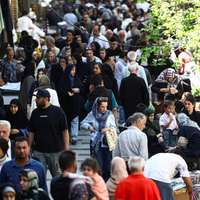
Reports from Iran say people have poured into streets in several cities following calls by underground groups to hold nationwide protests for three days starting Monday.
Based on reports on social media, people in Tehran, Mashhad, Rasht, Mahabad, Kermanshah, and several others have taken to streets to protest against the clerical regime.
In the capital Tehran people have held a gathering in a subway station chanting “Death to Dictator” and “Death to Khamenei”.
Some say a large crowd gathered at Enghelab Square in downtown Tehran without chanting slogans, but regime forces attacked to disperse them. The internet is reportedly cut off around Tehran.
In Javanrud west of Iran, a large group gathered for the funeral of Mohammad Haji Rasoulpour, who was earlier killed by security forces. The funeral ceremony turned into a protest with people chanting, “Martyrs don’t die!”
In Mahabad, West Azarbaijan province, residents marked the 40th day after the murder of Faeq Mam-Ghaderi by government forces, chanting anti-regime slogans.
Similar gatherings have also been reported in Rasht, Mashhad and Golshahr west of Tehran.
Reports say the Revolutionary Guard (IRGC) has been flying choppers over some Kurdish cities including Sardasht, Piranshahr, and Oshnavieh for the second consecutive day.
The protests in Iran began following the death of Mahsa Amini in police custody in mid-September. Nearly 500 people have been killed by the security forces and thousands have been detained so far.
Seyed-Mohammad Hosseini, sentenced to death in Iran
The attorney of an Iranian protester who has been sentenced to death says he was severely tortured to ‘confess’ to killing a Basij militiaman at a protest.
“I met with Seyed-Mohammad Hosseini at Karaj Prison. He cried through his account of tortures, being beaten with tied hands and legs and blindfolded, to being kicked in the head and losing consciousness, the soles of his feet being beaten with an iron rod to being tased in different parts of the body,” Ali Sharifzadeh Ardakani who says he has just recently been allowed to represent Hosseini tweeted Sunday.
“There is no legal validity to the confessions of a man who has been tortured,” he added.
Sharifzadeh had earlier this week said the Revolutionary Court of Karaj did not allow him to take on Hosseini’s case, study the case file, and represent him in the process of appeals to the death sentence. “This is gross violation of the rights of a person sentenced to death,” he tweeted on December 15.
Seyed-Mohammad Hosseini was arrested in November in Karaj, capital of Alborz Province to the west of Tehran, and charged with "waging war against God” and “corruption on earth”, both carrying the death sentence.
Hosseini has been accused of participation in the alleged killing of Ruhollah Ajamian, 27 on November 12. Ajamian who served alongside other security forces as a member of the Basij militia of the Revolutionary Guards (IRGC) was stabbed, beaten, and stripped naked by a group of men and died of his injuries later.
Thirteen protesters were put on trial for his killing by the Revolutionary Court shortly after the incident five of whom, including Hosseini, were sentenced to death.
Protesters set fire to a police car in Karaj on November 3
Hosseini was sentenced in an unfair trial without access to his chosen defense attorney, like the majority of other protesters put on trial in the past few weeks.
The Revolutionary Court regularly refuses to accept the power of attorney of independent lawyers who the accused or their families appoint and only approves its trusted lawyers who in many cases only make an appearance during the trial without having even seen the case files.
Hosseini is in imminent danger of execution like at least a dozen other young men who were arrested since protests swept across the country in September following the death in custody of the 22-year-old Mahsa Amini.
“How desperate is a regime to treat its people this way? Do they think that a "confession" under torture is worth anything at all? Now we don't have to assume, we know,” Ye-One Rhie, a member of the German parliament (Bundestag) who has taken on the political sponsorship of rapper Toomaj Salehi asked quoting Sharifi Ardakani’s tweet.
The Islamic Republic has so far executed Mohsen Shekari and Majidreza Rahnavard, both 23. Both were allegedly tortured into “confessing” to the crimes they were charged with and tried without due process. The executions have enraged many Iranians who believe they were hastily tried and executed to instil fear in the rest of the population and keep them away from the streets.
“Five were sentenced to death for the killing of one Basiji. One was executed for injuring a Basiji. No one was held accountable for the killing of hundreds of citizens. No one was held accountable for killing thousands in the protests in the past few years. This regime has taken justice and freedom to the slaughterhouse,” a tweet posted with the photos of the five sentenced to deathin Karaj said on December
More and more activists are calling on people to withdraw their money from Iranian banks as a measure to reduce the liquidity at disposal of the state.
Iranian political activist, lawyer and Nobel Peace Prize laureate Shirin Ebadi urged people on Sunday to join the campaign of withdrawing money from banks, noting that state-controlled banks in Iran are not institutions to serve the people and only act as the economic arm of the “killing Republic” referring to the clerical regime.
"Now it has been proven to everyone that there is no will in the regime to accept the demands of the people," she said, adding that the campaign to shun banks in daily transactions can deal a "fundamental blow" to the government.
Political activist, lawyer and Nobel Peace Prize laureate Shirin Ebadi
This movement dubbed “Join this campaign" has been formed so that citizens can deal a major blow to the government’s repressive structures, she said.
Ebadi added that such campaigns should not be limited to banks, noting that time has come for a coordinated action against all institutions that have a part in the crackdown on the popular protests. Some activists have suggested that people should refuse to pay their utility bills and other payments to government entities.
Her remarks come as grassroot groups and activists have also announced calls for another three-day nationwide protests and strikes starting Monday, for December 19, 20, and 21. In addition to daily protests on the streets and sit-ins at universities, strikes continued among employees of many industries, particularly in the oil, gas and petrochemical sectors.
It has become obvious for many Iranians that the banks are not able to survive if people start to use cash instead of debit cards, which have managed to keep the level of liquidity at a level that banks do not go bankrupt.
The head of the Central Bank of Iran (CBI), Ali Salehabadi, said in addition to US sanctions on Iran, recent popular protests have encouraged capital flight from the country and contributed to the fall of the rial. But he promised to reduce the alarming growth in the money supply until March, when the Iranian calendar year ends.
As a psychological op to counter the capital drain from the banks, rumors are circulating on social media that the Islamic Republic plans to increase interest rates by five percent. However, Salehabadi said Monday that no decision has been finalized to increase the rates.
Most economist in Iran have repeatedly told the local media that there is no quick fix to the deep-rooted banking and financial problems facing the regime.
Iran’s rial was hovering near 400,000 against the US dollar on Monday, while in most of 2021 the rial was stable at around 250,000, a more than 50-percent drop in 15 months, which coincides with the presidency of hardliner Ebrahim Raisi.
The banks run by regime insider have always been under pressure to grant loans to the powerful circles or invest in state-run projects, but they prefer to avoid such financings because most of the projects in the country are not producing profits and banks would face problems redeeming their loans.
Iran has also a problem with the demands made by the international financial watchdog, the FATF since 2017, to enact legislation against money laundering and financing of terrorism. Without this, Iran will remain blacklisted by many international financial institution
Bahaoldin Hosseini-Hashemi, an economist in Tehran, says the closing months of the year are usually when more money is printed by the CBI, because the government has to pay its end-of-year obligations. Hosseini-Hashemi drew attention to official reports showing that the CBI has printed money at a faster pace since the end of September as government debt to the bank has increased. A second challenge is presented by state or quasi-state banks, which also rely on borrowing from the CBI.
Reports from Iran say that the regime officials use private chats, phone logs and text messages of protest detainees as incriminating evidence.
CNN on Monday quoted an Iranian woman who says she has been accused by Iranian authorities of running an anti-regime activist group on Telegram.
The woman introduced as Negin has denied the allegation, but she has told CNN she has “some friends” who were political prisoners.
“They put in front of me transcribed printouts of my phone conversations with those friends,” she said, and “questioned me on what my relationship with those people were.”
“They told me ‘Do you think you can get out of here alive? We will execute you. Your sentence is death penalty. We have evidence, we are aware of everything,’” said Negin, which is not her real name.
Negin said that she realized security agents accessed her Telegram account with a different IP address.
Iranian regime reactivated her Telegram account to see who has been in touch with her while Negin was in jail, she added.
Negin was one of hundreds of protesters detained at Iran’s notorious Evin prison in northern Tehran within the first few weeks of anti-government protests following the death of Mahsa Amini in police custody in mid-September.
The Iranian government may have used similar tactics to surveil the Telegram and Instagram accounts of Nika Shahkarami, the 16-year-old demonstrator who lost her life after a protest in Tehran on September 20.
A view from the bazaar in the religious city of Qom
Unknown people attacked four Shiite clerics with sharp objects in the religious city of Qom, with to hospitalized as similar incidents have taken place in recent months.
The public relations office of Qom University of Medical Sciences announced that the four clerics were wounded by a sharp object, but another source said they were hit by shotgun pellets.
Tasnim website quoted Qom University of Medical Sciences as saying that before noon on Sunday, unknown people injured four mullahs in “several different regions” of the city, and two of them were taken to the hospital for treatment, for injuries in the shoulder and leg.
Before the eruption of anti-regime protests in mid-September, several cases of attacks on clerics had been reported in Iran. On August 29, two who were introduced as imams of mosques in Qom, were attacked with an “iron pipe”.
Before that, a young mullah was attacked with a knife in the evening of July 28 in Karaj, west of Tehran.
On July 1, Iranian media reported that the imam of a mosque in Isfahan was attacked by an unknown motorcyclist with a firearm.
During the recent protests against clerical rulers following the death of Mahsa Amini in police custody, youth tossed turbans of many mullahs in the streets to show their anger at them.
Argentinian football super-star Messi celebrating after winning the World Cup. December 18, 2022
Members of Russia's Pussy Riot band were detained on Sunday after trying to storm the pitch at the World Cup final in Qatar to protest the war in Ukraine, the imprisonment of Russian opposition leader Alexei Navalny and the oppression of women in Iran, activists said.
According to the Cinema for Peace Foundation, a Berlin-based charity that focuses on humanitarian and environmental issues, security detained member Nika Nikulshina, an associate of the protest group, Peter Verzilov, and a Ukrainian member of Pussy Riot.
Reuters was not able to independently verify the reports.
The activists were stopped by security forces before they could invade the pitch, Cinema for Peace said in a statement.
Jaka Bizilj, founder of the Cinema for Peace Foundation, told Reuters that Verzilov told him that he was pulled back by security forces seconds before entering the pitch.
"When I texted with Peter he was in police detention," Bizilj said.
Iran's clerical rulers have faced the biggest protests in years since September when 22-year-old Iranian Kurdish woman Mahsa Amini died in the custody of the morality police who enforce strict dress codes.
The 2018 World Cup final in Moscow was briefly interrupted when Pussy Riot activists, including Verzilov, burst onto the pitch to draw attention to human rights abuses in Russia before being hauled off by stewards.
Cinema for Peace evacuated Verzilov after the 2018 World Cup in Moscow for treatment for alleged poisoning. The foundation also brought Navalny in 2020 from Russia to Berlin for life-saving treatment after his poisoning.