Amid Dire Economic Woes, Iranian President Claims Country Is Progressing

Iran’s president Ebrahim Raisi has claimed the Islamic Republic has had more economic success during the current US sanctions than before.
Iran’s president Ebrahim Raisi has claimed the Islamic Republic has had more economic success during the current US sanctions than before.
Raisi addressed the West saying that they sanctioned Iran supposing that the Islamic Republic will be stopped but the country’s production increased instead.
Speaking in the city of Birjand on Thursday, Raisi said “despite the sanctions, both oil and non-oil exports of the country increased... showing that the sanctions did not bite.”
The comments come at a time when Iran’s national currency has hit another historic low against the US dollar this week.
Traders in Tehran exchanged 387,000 rials to one US dollar on Wednesday, up from a closing rate of 368,000 last week.
With one of the world’s largest natural gas deposits, the government is unable to provide natural gas for industries and many have been forced to shut down in December.
The Supreme National Security Council earlier issued a warning that households which use excessive amount of natural gas would be fined and their gas would be shut off.
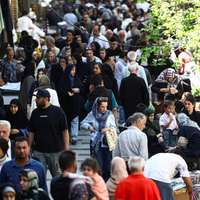
Inflationary pressure on consumers has also accelerated with food price inflation reaching alarming levels in 12 provinces across Iran showing an average jump of 67.7 percent compared with the same period in the previous year.
Raisi’s comments regarding progress comes as reports from Tehran indicate people are withdrawing their money from banks to buy gold and US dollars.






Iranian economist Hossein Raghfar says the country's economic crisis cannot be resolved before security organizations put an end to their business activities.
It is time for the Iranian government to decide which one is important for it: The regime's survival or protecting the oligarchy of its rich insiders, Raghfar said in an interview with Rouydad24 website.
He noted that President Ebrahim Raisi promised to control inflation and prevent the devaluation of the national currency, but during the past eight months the US dollar has risen by another 110,000 points reaching 380,000 rials. This shows to what extent Iranians' purchasing power has declined.
Speaking on the current situation and accelerated price increases, Raghfar reiterated that the main reason for instability in the market is the presence of powerful insiders and institutions who have been pocketing hefty sums as consumer prices rise.
Other economists, some politicians and opponents of the Islamic Republic have been saying that the Revolutionary Guard (IRGC) and the financial holdings operating under the aegis of Supreme Leader Ali Khamenei's office are the main players in Iran's economy, adding that they have chased the private sector out of Iran's economy.
Raghfar speaking in Tehran as someone who is not a regime opponent argued that this situation benefits those who want to overthrow the Islamic Republic.
He added that if the government fails to control inflation, it should expect an a larger uprising by the poor in addition to the current unrest. The combination, he said will lead to destructive consequences no one is able to control. He pointed out that the government does not give any indication to the people that their economic problems are important for the officials.
"If the government takes this challenge seriously, it should know that there is no way out of this crisis other than pushing [oligarchies] out of the country's economy," Raghfar said.
Raghfar also accused the government of a direct role in runaway inflation. "The main player…is the government itself as it takes measures to cope with its budget deficit."
All economists and politicians agree that in the past five years the state has vastly increased liquidity by resorting to printing too much money.
He suggested that the government should instead reduce its expenses and try to increase tax revenues by taxing the oligarchic companies that currently enjoy exempt status.
Speaking almost along the same lines, historian Majid Tafreshi told moderate conservative Khabar Online website that the ongoing crisis in Iran is partly due to the elimination of moderates from the Iranian political scene. He added that even some children of prominent officials have joined those who are unhappy with the government's performance. This comes, he added, while some officials appear to benefit from turning Iran into another North Korea.
Nonetheless, Tafreshi says it is still not too late for a dialogue between the protesters and the government.
However, not only many Friday prayer Imams have called for harsher measures against protesters, but some non-clerical figures have also been beating on the drums of more executions to silence opposition.
While many Iranians have been complaining about summary trials that have so far led to the execution of two young men in their early 20s in less than one week, conservative Lawmaker Mostafa Mirsalim has said on Wednesday that the courts should issue and implement death sentences faster - in 5 to 10 days. Some say the man who is known for his outlandish remarks and is better known in Iran as the member of parliament from Mars is appeasing the hardliner Judiciary because his own son is in jail for being a member of an outlawed opposition group - a situation that usually entails death sentence. But Mirsalim's son has just returned to jail after several months of furlough that was exposed on social media.
While China has undermined Iran’s territorial integrity by signing a Gulf Cooperation Council statement, Tehran has used a mild tone to express its dissatisfaction.
Iran’s President Ebrahim Raisi on Tuesday told China’s Deputy Prime Minister, Hu Chunhua, that the Islamic Republic is “unhappy” about the position of Beijing and expects its ally to make up for it.
However, he emphasized that the visit of the Chinese delegation to Iran is “important” for the development of mutual economic and commercial cooperation.
In a statement last week during the visit of China’s President Xi Jinping to Saudi Arabia, the Gulf Cooperation Council and the Chinese side made a reference to three small islands in the Persian Gulf that Iran took over as its historic territory in 1971 but the United Arab Emirates claims as its own.
The concluding statement of the meeting that was attended by GCC dignitaries as well as Xi Jinping said: “The leaders affirmed their support for all peaceful efforts, including the initiative and endeavors of the United Arab Emirates to reach a peaceful solution to the issue of the three islands; Greater Tunb, Lesser Tunb, and Abu Musa, through bilateral negotiations in accordance with the rules of international law, and to resolve this issue in accordance with international legitimacy.”
Following the United Kingdom’s withdrawal of its forces from the region to give independence to the small Arab littoral Sheikdoms, Iran’s Mohammad Reza Shah decided to take over the Greater and Lesser Tunbs and Abu Mousa. The UAE was just being formed and there was a serious political and military vacuum on the Arab side of the Persian Gulf.
In the wake of China’s stance, many Iranians on social media harshly criticized their government for a major failure. They asked the clerical regime what exactly went wrong that its ally, China acquiesced to such a statement.
Iran’s foreign ministry on Saturday held a meeting with the Chinese envoy to Tehran to express its displeasure about the statement, but unlike the language it uses for Western countries, the foreign ministry did not use the term “summoning” saying the Chinese diplomat was “invited” and refrained from using terms like “protest” or “condemn”.
It said on its website that the envoy “had a visit” with an Iranian official on Saturday, during which Tehran’s “strong dissatisfaction” was expressed.
Regime’s Foreign Minister Hossein Amir-Abdollahian also came under fire after he said in a tweet “the islands are inseparable parts of Iran and are part of the eternal belongings of our motherland. We firmly insist on the need for respecting Iran's territorial integrity.”
Iranians on social media strongly criticized him saying he “did not even dare” to name China, and asking why he has only tweeted in Farsi this time whereas he used to tweet both in Farsi and Chinese to express support for China on Taiwan.
However, it was not the end of the story as China and the Gulf Cooperation Council member states urged for dialogue on Iran’s “destabilizing regional activities” and “support for terrorist and sectarian groups and illegal armed organizations”, as well as its ballistic missiles and drones proliferation.
The statement also emphasized that the peaceful nature of the Iranian nuclear program must be ensured urging the Islamic Republic to fully cooperate with the International Atomic Energy Agency.
Again, Iran’s reaction was so mild when the Foreign Ministry Spokesman Nasser Kanani said it was a “surprise” to see Iran-related clauses in the statement.
Hardliner Kayhan newspaper affiliated with the office of Supreme Leader Ali Khamenei wrote on Sunday, “The expansion of ties between Beijing and Riyadh is more a strategic challenge for the undisputed dominance of the US rather than being a challenge for Iran.” It added that China is entering a region that has always been considered the backyard of Washington.”
The state-run Iran Daily also claimed in its editorial Sunday that China and Russia “have no alternative in their regional policy except Iran” saying relations between Beijing and Arab states “will lead to the realization of the Islamic Republic’s interests.”
However, Nusratullah Tajik, the former ambassador of Iran to Jordan told a website Sunday that “The Chinese have clearly told us they do not agree with our anti-American approaches.”
“We should not rely too much on China as they may use or even misuse Iran's anti-US policy,” he added.
Calls are mounting to remove the chief of Central Bank of Iran (CBI) after the national currency hit another historic low against the US dollar on Tuesday.
Traders in Tehran exchanged 380,000 rials to one US dollar on Tuesday, up from a closing rate of 368,000 last week.
The accelerated fall of the rial has led to reasonable concerns in Tehran business and media circles that soon the dollar will surpass the 400,000 mark in a downward spiral no one can control.
Amid soaring prices, people on social media and websites said Ali Salehabadi, the CBI must be removed while some others believe he is going to resign soon; something he denied later in the day.
A lawmaker on Tuesday addressed the government, saying “President Raisi, Minister of Economy, Governor of the Central Bank, do you know the dollar rate has reached 380,000 rials?”
“What is the current situation you have created for people? They are facing problems in renting houses,” added Ramezanali Sangdavini.
According to a recent report by EcoIran website, food prices have jumped an average of 67.7 percent compared with the same period in the previous year.
Rials drop is directly tied to a 50-percent annual inflation rate. Recently, the CBI reported that housing prices in Tehran increased by 45.9% compared to the same period last year.
The average price of one square meter of housing in Tehran has reportedly reached 467,000,000 rials.
While there are already several parallel intelligence organizations active in Iran, a lawmaker says the Islamic Republic’s judiciary is about to set up a new one.
Abolfazl Amouei, the spokesman of the parliament's National Security and Foreign Policy Committee, said Monday plans are in place to discuss the establishment a new intelligence organization for the Judiciary branch. The aim of the new outfit will be "preventing and countering measures to threaten and bribe judicial authorities."
Gathering information and reports about sensitive cases “to counter the propaganda campaigns by the global arrogance” is also mentioned as part of the duties of the new organization, indicating that the body will also coordinate with other entities out the judiciary apparatus. “Global arrogance” is a term used by the Islamic Republic to refer to the United States.
Iran has a traditional Intelligence Ministry, but other state entities, such as the Revolutionary Guard have established their own spy and security agencies. Now it appears the hardliner Judiciary has joined the game, which is not an unprecedented in the Islamic Republic. The trend, which has been evolving for over four decades, reached a turning point in 2009 with the formation of the Intelligence Organization of the Islamic Revolutionary Guard Corps, an intelligence agency within the IRGC and part of the Council for Intelligence Coordination.
The Council is comprised of at least 13 to 16 separate active intelligence agencies, according to different sources. Most of these parallel agencies have strong ties with the IRGC and the judiciary as well as the office of the Supreme Leader. The intelligence minister, the interior minister, foreign minister and the country’s chief justice are members of the body. The IRGC’s Intelligence Organization, and its Intelligence Protection Organization, and their counterparts in the traditional Army and Police force as well as cyber police are some of the other members.
Such parallel structures among the intelligence agencies is a can of worms that regime’s officials rarely speak about. However, a few politicians, such as outspoken conservative Ali Motahari, who was deputy-speaker in the previous parliament, have talked about the issue and repeatedly criticized it. Motahari famously said that the intelligence minister should not allow other organizations to interfere in the work of the Ministry. Heydar Moslehi, the intelligence minister under President Mahmoud Ahmadinejad, also warned against the "parallel work and confusion in intelligence operations." Amid tensions between the ministry and the IRGC’s intelligence organization, he had also sued the Fars news agency, affiliated to the Revolutionary Guards, accusing it of "spreading false news."
The deputy head of Fars news agency has been recently arrested for “forging briefing reports” after a large set of documents was released by a hacktivist group late in November.
Earlier in the week, Chief Justice Gholam-Hossein Mohseni Ejei also criticized the forced confessions coerced through torture and threats from people who have been arrested during the current wave of protests. His remarks suggest that such confessions, which have been the basis for the regime’s justification of executions and prison sentences, have been extracted by intelligence agencies outside the judiciary, mainly by IRGC intelligence. His criticism came on the backdrop of remarks by the former chief of Iran's state television, who says there are operatives in intelligence organizations with unknown identities, with vast powers and no accountability.
The former chief of Iran's state television says there are operatives in intelligence organizations who have vast powers, but their identities remain unknown.
Mohammad Sarafraz who resigned his post as head of IRIB (Islamic Republic of Iran Broadcasting) in May 2016 due to interventions in his organization's financial operations by Supreme Leader Ali Khamenei's son Mojtaba and former IRGC intelligence Chief Hossein Taeb, was one of the closest persons to Khamenei until then. The Supreme Leader later appointed Sarafraz as a member of the Supreme Council of Cyberspace. But Sarafraz says he resigned this post also, although Khamenei never accepted his resignation.
In an interview conducted by one of his former aides, Shahrzad Mirgholikhan, and published on You Tube, Sarafraz said that Iranian intelligence officers can even tell judges at the court what they should decide when ruling on various cases.
Sarafraz accused the government and banking system of systematic corruption that has led to vast income gaps among Iranians. He said most of this corruption exists in companies that enjoy the benefits of private firms but pretend to be government entities when they are paying taxes or report their financial status. These companies, he said, leave no room for competition by real private companies.
Eighty percent of Iran’s economy is directly or indirectly controlled by the government or semi-official companies. A privatization drive began 15 years ago, but it mainly turned into setting up quasi-governmental firms controlled by powerful insiders who block competition and use public funds to stay afloat.
Sarafraz explained that these entities use insider information to benefit from foreign exchange and gold price fluctuations when the government intervenes in the market. They also make hefty profits by circumventing sanctions.
Sarafraz also criticized the government for destroying most political parties and depriving Iranians of the right to choose their own candidates for the parliament or presidency. He said, "I believe that in a healthy system the government should provide a budget for political parties that train cadres for the government."
Instead, Sarafraz pointed out, rich and powerful government institutions act like political parties. These institutions determine who should be the country's President or who should win in the parliamentary elections, thanks to their financial, political and intelligence powers. Sarafraz was probably referring to the Revolutionary Guard (IRGC) and Khamenei's office and family who have been accused by politicians, such as reformist cleric Mehdi Karrubi, of engineering all presidential elections since 2005.
This has created “systematic corruption which is likely to land the country in deep trouble,” Sarafraz insisted and said, that most of what the intelligence agencies and the IRGC do in Iran are illegal, but they can get away with it as no one is in control. Meanwhile, none of these organizations assume responsibility for the instability their actions create.
Sarafraz pointed out that "Government forces killed between 300 to 1,500 people in the 2019 protest. But no one accepted responsibility for even one of those cases.”
"These individuals and institutions also control the state television and order it how to report events, how to get forced confessions from political prisoners and how to broadcast them. That is one of the reasons why society has no trust in the state-owned television. Not only they do not tell the truth, but they also fabricate fake news to present a different narrative," the former head of IRIB said.
"The same guys and their agents wanted to take over the TV by controlling its financial resources," said Sarafraz while claiming that there are Mossad and CIA agents among them. He explained: "I told IRGC Commander Hossein Salami that those individuals and institutions [IRGC Intelligence and Khamenei's office] first tried to control the state TV and then targeted the IRGC. I told him that they were discrediting the IRGC."
"If the CIA has planned this, we need to praise them," he said.