Iranians Abroad Show Anger At Brutal Killing Of Detained Protester
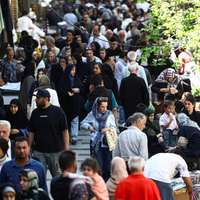
Iranian diaspora communities hold protests in support of their compatriots in Iran on December 10, 2022.
Iranians abroad have once again held protest rallies to declare opposition to the Islamic Republic and express support for their compatriots’ uprising.
On Saturday thousands of Iranian diasporas across the world chanted slogans against the clerical regime condemning the illegal treatment of detained protesters and the execution of the first protester Mohsen Shekari.
Coinciding with the International Human Rights Day, the protests were held in dozens of countries around the world including Hungary, Denmark, Japan, Australia, Itay, Turkey, Belgium, and Germany.
Following the execution of the 23-year-old protester Mohsen Shekari on Thursday, several public figures and organizations called on Iranians abroad to hold protest gatherings.
In Tokyo and Sydney, Iranians took to streets to show anger at the brutal hanging of Mohsen Shekari by the Islamic regime.
In the city of Rome, a group of Iranians chanted "Women, Life, Freedom" while holding a sit-in at the Embassy of the Islamic Republic in Italy. They called on Italian politicians to severe diplomatic ties with the Iranian government. Similar events were held in Torino, Geneva, Istanbul, Brussels, Perth, Copenhagen, and Berlin.
Friday night, a group of Iranians living in New York also held a protest rally in front the Permanent Mission of the Islamic Republic to the United Nations.
A scene from the November 3 protests in Karaj that ended in death sentences four several people
Many Iranians enraged by the execution of 23-year-old Mohsen Shekari held protests Friday evening in some cities and more are planned for Saturday.
Security forces Friday attacked protesters marching in silence in Kermanshah, capital of a province of the same name in western Iran, and in Podol, a village of 1,200 near Bandar Lengeh in southern Hormozgan Province, where the locals have been protesting almost every night, and fired at them in both places.
In Tehran protesters gathered in smaller groups in different neighborhoods, and chanted slogans on the streets or from their windows. Young protesters who had gathered outside Shekari’s home and lit candles in his memory were also attacked and beaten up.
Smaller protests were also held in Karaj, capital of Alborz Province only half an hour from the capital. “They took our Mohsen away, they brought back his lifeless body,” protesters chanted in Karaj where five other protesters have apparently received the same sentence as Shekari, the death sentence.
“Five were sentenced to death for the killing of one Basiji. One was executed for injuring a Basiji. No one was held accountable for the killing of hundreds of citizens. No one was held accountable for killing thousands in the protests in the past few years. This regime has taken justice and freedom to the slaughterhouse,” a tweet posted with the photos of the five sentenced to death in Karaj said Saturday.
These include three young teenagers-- Hossein Mohammadi, Hamid Ghara Hasanlou, and Mohammad-Mehdi Karami as well as Reza Aria, a middle-aged radiologist, a fifth person whose name has not been publicly announced.
Four citizens arrested in November awaiting execution. From L-R, Mohammad Mehdi Karami, Hossein Mohammadi, Reza Aria and Hamid Hassan-Gharanlu
On November 30, these individuals and eleven others were put on trial for allegedly beating Rouhollah Ajamian, a Basij paramilitary member to death during a protest in Karaj a month earlier. The five sentenced to death have been charged with “corruption on earth” for “acting against national security, attacking Basij and police members” resulting in Ajamian’s death.
Like Shekari, some of the accused were deceived into admitting crimes they had not committed or tortured into making self-incriminating confessions which were then aired by the state television. Reportedly, dozens more have similarly been charged with “waging war against God” and “corruption on earth” which carry the death sentence.
Prominent journalist Abbas Abdi in a commentary published by the reformist Etemad newspaper Saturday argued that Shekari’s execution could not be attributed to the implementation of the law, as he was very hastily tried in a closed court and without access to a lawyer of his choice, and his sentence was carried out within less than three weeks, which is very much out of the ordinary.
According to Abdi, by executing Shekari the authorities were either trying to “set an example for others or utilize the element of fear as a deterrent” and may also have been sending the message that there will be nosympathy and leniency and authorities are determined “to execute and eliminate” despite the claims that they wanted to hear the protesters’ message.
Abdi wrote that this could be “catastrophic” even if the execution radicalized ten percent of the protesters who can resort to violent methods.
There have been calls on social media for further protests Saturday afternoon in various cities to honor those killed in the protests, now nearly 500, and Shekari who was the first protester known to be executed.
Iran’s exiled queen Farah Pahlavi has expressed sorrow over the execution of Iranian protester Mohsen Shekari asking the people to preserve their unity.
In a message on twitteron Friday she said “the bloodthirsty and youth-killing regime of the Islamic Republic took another young man's life in prison this time. Mohsen Shekari, was only 23 years old and like other young people had no wish but a dignified life, freedom, and prosperity for Iran.”
The former Iranian Queen also sympathized with the family and mother of Mohsen Shekari, saying “the regime tries to justify its crimes by broadcasting coerced confessions and false scenarios. I am confident that you will not be deceived by the old and failed tricks and will stand by the families of the victim.”
In another message on the International Human Rights Day, Farah Pahlavi, who lives in exile, once again urged the Iranian armed forces not to kill people.
“This year, the International Human Rights Day will be marked in a situation that the Iranian regime does not hesitate to commit any crime, even the killing of children and teenagers to remain in power,” reads the message.
Iran's exiled Prince Reza Pahlavi on Thursday also condemned the executionof Mohsen Shekari calling on the world leaders to expel regime ambassadors.
Australian foreign minister Penny Wong, Nov. 1, 2022
The Australian government has imposed sanctions on several Iranian government entities for human rights violations and abuses.
In a statement on Saturday, foreign affairs minister Penny Wong, announced that Australia has imposed sanctions against Iran’s morality police and Basij Militia Force as well as six individuals amid the crackdown on protesters following the death of Mahsa Amini and the continued repressive policies against the people of Iran.
The individuals named in the Australian designation include Hossein Ashtari, Commander-in-chief of Law Enforcement Force of Islamic Republic, and Gholamreza Soleimani, the head of the IRGC’ Basij force.
Antigovernment demonstrations have been taking place in most cities and towns since Mahsa Amini's death in police custody on September 16. Despite the widespread suppression of protesters, the Islamic Republic has not been able to quell the unrest.
Australia has also sanctioned three Iranian individuals and a business that have been involved with supplying drones to Russia to use in its war on Ukraine.
“Russia is using Iranian-made drones to target civilians and critical infrastructure, with the intention of denying Ukrainian people energy, heating and water as they face freezing winter temperatures,” Wong said.
“The supply of drones to Russia is evidence of the role Iran plays in destabilizing global security. This listing highlights that those who provide material support to Russia will face consequences,” reads the statement.
The European Union has urged the Islamic Republic to stop the repression and execution of protestors, as well as support for Russia.
The bloc’s Foreign Policy Chief Josep Borrell in a tweet on Friday said he has spoken with Iranian Foreign Minister Hossein Amir-Abdollahian on several issues including the execution of the 23-year-old protester Mohsen Shekari.
Iran on Thursday announced the first execution of a protester convicted over the recent anti-regime protests. Mohsen Shekari was hanged after a brief and sham trial simply for allegedly wounding a government agent and closing a street.
Borrel added he has conveyed EU’s position on the matter urging the Islamic Republic to immediately “stop executions and repression, respect fundamental freedoms of Iranian people and stop military support to Russia.”
The execution of Mohsen Shekari has drawn widespread condemnation from many countries and United Nations human rights experts.
In a short statement on its Twitter account, the regime’s Ministry of Foreign Affairsclaimed that the government has “exercised the utmost restraint in dealing with the riots.”
“In countering riots, the Islamic Republic has shown utmost restraint and -- unlike many Western regimes who smear and violently crack down even on peaceful protesters -- Iran has employed proportionate and standard anti-riot methods,” the statement read.
The ministry then repeated the official rhetoric, blaming other countries for the protests, saying that “Yet, public security is a redline. Armed assault and vandalism aren't tolerable, even to Western regimes.”
Protesters in the western Iranian city of Mehabad on November 9, 2022
Media in Iran are discussing how the current wave of protests are different from all previous antigovernment outbursts and why there is no end in sight.
The sweeping demand of the protesters for regime change and open disdain expressed for the Islamic Republic’s leaders, has emboldened even local commentators to express opinions that three months ago would have been a taboo in the government-controlled newspapers and websites.
What the media are hesitant to touch, is where the movement is heading mainly due to the invisible nature of its leadership.
The main question, as the latest report on Rouydad24 website in Tehran pointed out is "what is it that the new generation of protesters are hoping to achieve beyond what older protesters demanded in previous years? What is the outlook of this movement and in what ways it is different from other protests?"
One of the main characteristics of this round of protests is that Iran has entered an episode of continuous protests that has for the first time forced the Islamic Republic government to go on the defensive against the nation's anger.
It seems that women's latent dissatisfaction over their status as second grade citizens the government thinks they are, has turned them into a mighty force that has already achieved some irreversible successes. Women have shown they can stand up to the clerical regime, discard the hijab despite existing laws and demand much more. They have shattered the myth of an all-powerful untouchable regime.
Rouydad24 noted that a majority of the Iranian protesters are in their twenties and all they have known has been high inflation, devaluation of the Iranian currency, the fading away of a prospect for life including dreams to get married, buying a house and a car; the three symbols of success in Iran.
The bazaar in Shiraz on strike to support the protest. November 15, 2022
The Iranian uprising enjoys more international support by foreign governments and organizations than past protests did. Millions of Iranian expats in Europe, America and Australia are also passionately supporting the movement. At the same time, there is no indication that the regime has done anything to address widespread dissatisfaction, the website said. The government has tried to scare people of the danger of Iran's disintegration. Iranians do not believe in that, nor they have shown any separatist tendencies.
The regime has even accused striking shopkeepers in Esfahan, in central Iran of separatism. Witty Esfahanis joked that their city is hundreds of miles from any borders. There is no way for it to be separated from Iran unless they dig a hole and go to the other side of the planet! Many Iranians liked Omid Shokoohi’s tweet who wrote: "I have frequently travelled in and around Iran from border areas to the central desert. And I have not seen even one separatist. Separatism is excuse the government uses to suppress dissent."
The government's usual and probably favorite choice of a solution for any kind of protest or peaceful gathering is shooting at protesters. However, regardless of the violence, the protesters have not given up. They have remained in the streets for nearly three months now. This is one of the unique characteristics that makes this uprising different from all previous protests in Iran.
Some protesters understandably have a bit of a concern about the future. Nonetheless, they understand that as the movement's leadership is invisible for security reasons. In other words, the secrecy about the movement's leadership prevents it from being beheaded.
An opinion poll kept secret by the government has been disclosed by the Black Reward hackers. The poll's result show that at least 56 percent of Iranians believe that the protests will go on. They may not know exactly where the movement is headed. But they certainly know that first, they want to change this regime and second, they want to replace it with a secular democracy. In the meantime, there appears to be a consensus among protesters and Iranian as well as international observers that even so far, something essential has irreversibly changed in Iran.