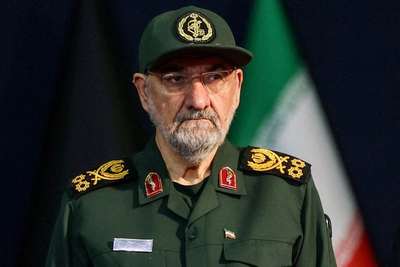
Supreme National Security Council Secretary Ali Shamkhani
Hardliners are blaming the secretary of Iran's Supreme National Security Council (SNSC) Ali Shamkhani for failure to suppress protests and demanding his removal.
In video-taped remarks released on the internet Sunday, former lawmaker Hamid Rasaei, a hardliner cleric, claimed all security bodies he has spoken to “point in the direction of the secretary of the Supreme National Security Council” as the culprit when it comes to failure in suppressing the protests.
Rasaei also accused President Ebrahim Raisi of not taking timely action and constantly postponing Shamkhani’s replacement.
Shamkhani has kept a very low profile since the protests began. There were rumors among the political elite in Tehran that Major General Mohammad Bagheri, chief of staff of the Armed Forces, would soon replace Shamkhani as the Secretary of the SNSC, an informed source told us recently.
The demand for Shamkhani’s removal from office may be an indication of serious incongruities among the Islamic Republic’s many intelligence and security bodies vis-à-vis protesters.
So far, the IRGC has not resorted to large scale operations against protesters as it did in November 2019 when it immediately used lethal military force, killing at least 1,500 and arresting thousands within a few days.
This time the IRGC has only deployed its plainclothes agents in the field, leaving the official handling of the protests to the police and its special forces. There has also been less use of assault rifles against protesters, but shotguns and beatings have claimed the lives of at least 318 so far according to Human Rights Activists News Agency (HRANA).
Hamid Rasaei, a hardliner cleric and politician
The protests should have ended after Commander of the Revolutionary Guards (IRGC) Major General Hossein Salami’s warning last weekthat demonstrators should cease and desist, Rasaei insisted in his remarks.
In his speech on October 29 Salami had accused the US, Israel, and European powers of fomenting unrest in Iran. “Stay away from the streets,” he told the Iranians in a threating tone.
Rasaei demanded that the incumbent Secretary of the SNSC and former President Hassan Rouhani who appointed him to the post in 2013 be held to account for the “current circumstances”. He also criticized Shamkhani for his “inefficacy” in suppressing the November 2019 protests in an optimal manner and demanded accountability about allegations of financial corruption against him and his family members.
The secretary of the SNSC is appointed by the president with the consent and express approval of Supreme Leader Ali Khamenei, who also appoints the SNSC secretary as his own representative in the council. Shamkhani has held both positions since 2013.
“Tolerance and dallying are enough,” lawmaker Hossein Jalali told the SNSC and security bodies in a speech in the parliament Sunday where some other ultra-hardliner lawmakers blasted Shamkhani and other security and judicial bodies for indecisiveness. They also demanded that some protesters to receive the death penalty.
Jalali also referred to Molavi Abdolhamid, the leader of Sunni Baluch community, in his speech and alleged that Shamkhani has failed to act against him because “he has given priority” to his “friendship” with former reformist President Mohammad Khatami.
“Preserving the regime is the highest priority, even more important than preserving the life of the 12th Imam of Shiites who is believed to be in occultation,” he told Shamkhani. Many can consider this remark as religious sacrilege since the hidden Imam is supposed to be represent the continuation of Prophet Mohammad’s rule.
Shamkhani, an admiral of the Navy, served as defense minister in Khatami’s first cabinet (1997-2001). Despite having run against the president in the 2001 elections, Khatami reinstated him in his second cabinet, but their relations soured considerably.