Iran’s Foreign Minister Visits Turkey To Boost Security Ties

Iran’s foreign minister has traveled to Turkey to bolster ties with Ankara amid Israel’s repeated warnings about terror plots by the Revolutionary Guard against Israeli citizens there.

Iran’s foreign minister has traveled to Turkey to bolster ties with Ankara amid Israel’s repeated warnings about terror plots by the Revolutionary Guard against Israeli citizens there.
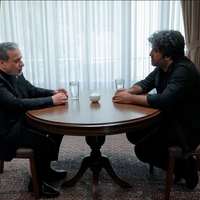
Hossein Amir-Abdollahian held a joint press conference with his Turkish counterpart Mevlüt Çavuşoğlu before he held a meeting with President Recep Tayyip Erdoğan on Monday.
Amir-Abdollahian, whose plans to visit Ankara had earlier been cancelled twice because of IRGC's plot to harm Israelis in Turkey, said during the presser that, “We consider the fake Israeli regime as the number one enemy of Muslims and the Islamic world.”
Earlier in June, Turkey reportedly warned the Islamic Republic against attacking Israelis in Turkey, saying it is not prepared to allow Iran to use its territory to carry out acts of terrorism against other nations.
According to Iran’s top diplomat, the EU's foreign policy chief’s recent trip to Iran was also discussed with his Turkish counterpart. “I briefed my brother Mr. Cavusoglu on the visit to Tehran by Mr. Josep Borrell... and our agreement to continue negotiations on the removal of sanctions. We hope that in the new round of the negotiations between Iran and the other parties we will achieve a final agreement, if the United States and three European countries act realistically.”
He told reporters that Tehran would not oppose a new proposed Turkish military operation targeting Kurdish forces in Syria, saying that “We understand Turkey’s security concerns very well.”
Iran says Israel’s integration into the US Central Command (CENTCOM) and its participation in joint military drills with regional countries constitute a great threat to the Middle East.
Chairman of the Chiefs of Staff of the Iranian Armed Forces Major General Mohammad Baqeri made the remarks on Monday during a meeting with his Pakistani counterpart Lieutenant General Nadim Reza Nishan, noting that “Iran will not tolerate such threats and will certainly respond to them.”
Describing Israel as a destabilizing force in the region, he said, “The regime, through the implementation of certain plots, seeks to forge relations with regional countries and achieve its interventionist goals.”
Last week, Israeli Defense Minister Benny Gantz said, “I have been leading for the past year together with my colleagues at the Pentagon and the [Biden] administration an extensive program to strengthen cooperation between Israel and the countries of the region, under American leadership and CENTCOM.” “Part of that vision is what I call MEAD, Middle East Air Defense, which we are building amid Iran’s attempts to hit the region’s countries with rockets, cruise missiles and UAVs [unmanned aerial vehicles, or drones].”
Israel is improving relations with the Persian Gulf monarchies especially since the 2020 ‘normalization’ agreements with Bahrain and the UAE, arguing they face a common threat in Iran.
Seriously concerned about the growing ties, the Islamic Republic has repeatedly warned neighbors against allowing Israel to establish presence in the Persian Gulf.
Iran's IRGC Navy commander said earlier in June if for whatever reason someone allows “the number one enemy” into the Persian Gulf, it will create “chaos and instability” both for itself and for the region.

Former senior lawmaker Ali Motahari has lashed out at Iran’s foreign minister over his remarks about Russia to benefit from the revival of the 2015 nuclear agreement.
Motahari, a social conservative who has often criticized hardliners in recent years, said on twitter on Sunday that the JCPOA (Joint Comprehensive Plan of Action) has nothing to do with Russia and Moscow does not have the right o benefit from it.
His reaction was to a sentence by Hossein Amir-Abdollahian, who told Croatian daily Večernji List in a recent interview that Russia has demanded that if the JCPOA were to be restored, the agreement should also benefit Russia as a party that has taken constructive measures for its revival.
Motahari criticized the sentiment, saying that “Is Iran one of the Russian Commonwealth of Independent States or a Russian colony whose interests are tied to Russia's interests?”
“Russia has taken its share of interests from Iran and its territory years ago with the annexation of Azerbaijan, Georgia and Armenia,” he said referring to the early 19th century, adding that “it is not necessary that Russia takes advantage of the JCPOA too.”
Pundits in Tehran say Russia supports the revival of the nuclear deal but wants tensions to continue between Iran and the West.
Vienna talks were almost completed in March before Russia demanded a US guarantee that sanctions for its invasion of Ukraine should not hurt its trade with Tehran.
If finalized, the renewed nuclear agreement between Iran and world powers lets Russia cash in on a $10-billion contract to build atomic reactors in Iran.

The government in Iran is intensifying social restrictions, including closing cafés and detaining women for “improper” hijab, reports on social media indicate.
Latest news received from the southern historic city of Shiraz say that security forces and ‘morality police’ shut down several cafés and are pressuring others to strictly enforce hijab rules. The same process is taking place in other cities, including Tehran.
The hijab or morality police have also expanded patrols in streets, stopping women they believe are not wearing their headscarves properly or for other dress code violations. These law enforcement units are all accompanied by special vans, and they push women into these vehicles for further questioning, admonishment, or arrest.
There have been many recorded incidents in recent months showing women resisting the morality police who use force to push them into their patrol vans. One journalist in Tehran tweeted on Monday that morality police are using new tactics to convince women to enter the vans without making a bigger scene in public. Reportedly, authorities while they have decided to harass citizens are also concerned about a backlash and incidents that could lead to street protests.
A video that went viral on June 23 showed dozens of teenage boys and girls in Shiraz congregating in a park and mingling freely, which is forbidden according to the Islamic rules in the country. Most of the girls had no headscarves and the incident turned into a major issue.
The government immediately announced that the organizers of the gathering were arrested while many ordinary Iranians on social media expressed satisfaction that teenagers defy the religious rules.
One Shiraz resident complained on social media that authorities are taking away what little exists for relaxation and socializations, by closing down cafés.
Another viral video on Sunday [June 26] showed a woman screaming profanities at a cleric who stopped her in a supermarket to admonish her for inadequate hijab. Some on social media commented that clerics do not object to doubling and tripling of prices in a matter of weeks but are upset by hijab infringements.
Young people in Tehran are also complaining about increasing pressure on café owners not to force clients with loose headscarves to cover their heads properly. There are also reports about taxi drivers telling women to cover themselves properly, out of concern that they would be stopped by the police.
In recent weeks, the economic situation in Iran has deteriorated with prices of daily necessities doubling and tripling almost overnight and protests breaking out around the country.
No one knows if the enforcement of strict religious rules is related to the authorities trying to show force, but some citizens see the effort as a scheme to pit people against one another.
Massoud Jafari, a café owner twitted that he is constantly harassed by morality police who walk in anytime they want and accuse him of running a business promoting “prostitution”, insulting him and his customers.
Last week, 120 people touring a nature reserve were arrested and accused of dancing and drinking alcohol.
There is also pressure on female singers who entertain in private wedding parties. One local prosecutor in Hormozgan province on Sunday announced the arrest of four female singers. “If these acts continue, both the performers and persons organizing the wedding party will be arrested,” he announced.

A hacking group called Predatory Sparrow targeted Monday three of Iran’s major steel plants by a cyberattack, purportedly forcing one of them to halt production.
The group said that it hacked Mobarakeh Steel Company in the central Esfahan province, Khuzestan Steel Company in southwestern Iran near Ahvaz, and Hormozgan Steel Company in the south.
According to some reports, Khuzestan Steel Company – Iran’s second biggest after Mobarakeh -- had to stop work until further notice “due to technical problems” following the attack, which is one of the biggest on the country’s strategic industrial sector in recent years.
However, Tasnim news agency, affiliated with the Revolutionary Guard, quoted the managing director of the plant, Amin Ebrahimi, as saying that the company's production line is now working and the brief disruption to the company's website and information channels will be resolved soon.
He claimed the cyberattack was unsuccessful and no structural damage to production lines happened, thanks to “timely measures and vigilance.”
Another Iranian news channel, Jamaran, said the attack failed and no machines were harmed because the factory happened to be non-operational at the time due to an electricity outage.
Earlier in the month, a hacktivist group named ‘Uprising till Overthrow' hacked into and deactivated over 5,000 surveillance cameras and 150 websites and online services of Tehran Municipality. Some of them have not restarted operations yet.

Despite all speculations and expectations, the visiting Iraqi premier and Iranian president did not announce any news about talks between Tehran and Riyadh on Sunday.
Mustafa al-Kadhimi, who arrived in Iran after a visit to Saudi Arabia, attended a joint press conference with President Ebrahim Raisi, where they spoke about regional developments and bolstering political and economic relations between Tehran and Baghdad.
Highlighting the importance of relations between Iran and Iraq and the role played by the two countries in developments across the region, Raisi said, “We believe that dialog among regional countries can solve regional problems, [but] the presence of foreigners in the region only creates more problems and does not help solve those problems.”
Criticizing a number of regional Arab countries’ normalization of relations with Israel, Raisi said, “The efforts made by the Zionist regime to normalize relations with regional countries will by no means bring security to this regime.”
Raisi said both Iran and Iraq support establishing a durable ceasefire in Yemen, lifting the economic blockade, and facilitating intra-Yemeni talks as the solutions to the current crisis in the impoverished country.
Kadhimi, for his part, said he discussed issues related to the security of the two neighboring countries and the stability of the region with Raisi, adding that Baghdad attaches great importance to its relations with Tehran on the basis of common interests.