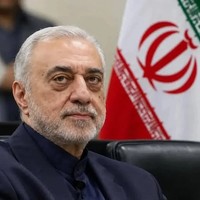
The car in which Colonel Hassan Sayyad-Khodayari, a member of the Quds Force of Iran’s Revolutionary Guards, was assassinated on May 22, 2022
The IRGC official killed by gunmen in Tehran Sunday was responsible for recruiting operatives for terror attacks against Israelis, an informed source has told Iran International.
The source, a European security official, who spoke to Iran International on condition of anonymity said Hassan Sayyad-Khodaei who was shot in front of his house in Tehran in broad daylight Sunday had been involved in a number of terrorist operations against Israelis in three continents including Asia, Europe, and Africa including an attack in the Indian capital, New Delhi, on February 13, 2012.
The intelligence source also told Iran International that Sayyad-Khodaei tried not to attract attention to himself as an intelligence agent and avoided wearing the IRGC uniform. According to the source, Sayyad-Khodaei who went by the alias Shekarchi was fluent in regional languages including Turkish, Kurdish, and Arabic.
“Sayyad-Khodaei was responsible for the work on the ground when the Qods Force’s secretive Unit 840 tasked him with carrying out missions,” the source said.
In the 2012 New Delhi attack, the explosion of a magnetic bomb attached to the car used by the wife of Israel’s defense attaché wounded her and his driver.
Israeli and Indian media at the time said a motorcyclist had placed the explosive device on the vehicle and pointed out that the attack resembled some of the attacks that had killed four of Iran’s nuclear scientists between 2010 and 2012.
Two of the attacks on Iran’s nuclear scientists were carried out with magnetic bombs attached to their cars.
Yoram Cohen, then chief of Israel’s security agency Shin Bet, also accused Iran of trying to take revenge for covert operations, including the assassinations of its nuclear scientists.
On the same day as the New Delhi attack in 2012, other operations against Israeli targets, allegedly by Iranian agents, were uncovered and aborted in Tbilisi, Georgia, and several Central Asian countries.
Then prime minister of Israel, Benjamin Netanyahu, immediately blamed Iran for the bombs aimed at Israeli Embassy personnel in the Indian capital, New Delhi and Tbilisi.
•
•
Two days later, on February 14, a series of explosions against Israeli diplomats occurred in Bangkok, Thailand, for which the Thai authorities blamed Iranian nationals. One of the suspects, Saeed Moradi, was seriously injured before the operations were carried out when the bomb meant for the attack exploded at his rented house and injured him. He sustained further injuries during a standoff with the Thai police when a grenade he threw at the police bounced off a tree and severed both his legs.
Moradi was convicted in court for attempting to kill an Israeli diplomat and was sentenced to life. Moradi and his two co-conspirators were freed from Thai prison in November 2020 in exchange for Kylie Moore-Gilbert, an Australian-British prisoner in Iran. They received heroes' welcome upon their arrival to Tehran.
“The Qods Force chose individuals without any connection to the IRGC for these operations. They were civilians who had not had proper military training. Sayyad-Khodaei was responsible for establishing contact with criminals including drug traffickers to carry out such operations on its behalf,” the source told Iran International.
He added that Mansour Rasouli, who was reportedly interrogated by the Mossad a year ago inside Iran, was among the individuals recruited by Khodaei to kill Israelis and others in countries including Turkey and Germany.
On April 30, Israeli media, including Channel 12, released an audio recording with the photo of a man introduced as Iranian national Mansour Rasouli, 52, who they claimed the Mossad had interrogated inside Iran. Israeli media did not provide a source for the audio file that they said Mossad operatives posing as Iranian secret service recorded at Rasouli's home in Iran.
The recording surfaced hours after Iran International's report of an alleged Iranian triple assassination plot. Iran International's diplomatic sources had said a member of the IRGC'S Qods Force had been detained in an unnamed European country for assassination plots in Germany, France and Turkey.
In an audio tape released in early May, a man who introduced himself as Rasouli claimed he had been taken by unknown agents and been coerced to make the confessions in the audio recording.
A 10-storey building in Iran's southern city of Abadan partly collapsed on Monday, killing at least five people and trapping over 80 people under the debris.
Operations are still going on to rescue the people buried in the rubble of the residential-commercial property named Metropol in the southwestern Khuzestan province.
A helicopter, seven rescue vehicles, and two teams of rescue dogs are also present at the site of the incident. The number of casualties is increasing every hour and no official estimate is still out from the damages.
According to reports, in addition to emergency teams from nearby cities of Khoramshahr, Mahshahr, and Shadegan , anti-riot forces are also dispatched to the scene as Abadan residents have gathered at the site and are shouting slogans against the city authorities and government.
The head of Khuzestan province's judiciary has ordered an investigation into the building's collapse, and its owner and the contractor who built it have been arrested, Abadan’s special prosecutor Hamid Maranipour said.
The owner and builder, Hossein Abdolbaghi, had previously received a safety award from police, and in 2018 was selected by the Industry Ministry as the "Top Entrepreneur of the Arvand Free Zone", an area of 37,400 hectares at the confluence of the Karun and Arvand (Shatt al-Arab) rivers in the province. He is known to be close to Iran’s security forces.
Videos posted on social media also showed a group of people protesting to Abadan Mayor Hossein Hamidpour, who was present at the scene. According to some reports, the mayor was beaten by the angry protestors.
Despite potential oil market competition, Iranian firms are planning to revamp Venezuela’s largest oil refinery, Reuters said Monday in an exclusive report.
The deal would deepen an energy relationship that has become a lifeline for Venezuela’s dilapidated oil industry amid a crisis caused by decades of mismanagement and lack of investments, Reuters said.
But Iran’s Sharq newspaper reported on Sundaythat Iran’s energy dealings with its South American ally has backfired, as Venezuela’s discounted oil exports have increased potentially taking market share from Iran.
Both countries are under American sanctions and try to sell their oil by illicit shipments mostly to China, which has increased its purchases since early 2021. Iranians do not hide that China is buying their oil, but the quantity and price remain a state secret. One thing which is clear, Tehran has increased its shipments to more than 700,000-900,000 barrels per day in the past few months.
During the Trump administration, the United States confiscated Iranian fuel shipments on their way to Venezuela and auctioned the cargoes. The Biden administration has not enforced US sanctions vigoruously.
Sharq newspaper in its report said that Iran’s deal to ship light crude oil – or gas condensate- to Venezuela has enabled Caracas to boost its crude exports. The Venezuelan oil is too heavy for easy shipping, but when it can mix its product with light Iranian oil, it is able to ship more.
The reason Iran is willing to give its potential competitor light crude, is that it has too much of it and cannot store it indefinitely. Gas condensate is a biproduct of natural gas production, and as long as Iran needs to take gas out of the ground, it has to also take the light crude.
Using Iranian shipments of light crude Venezuela has boosted its production from 450,000 barrels a day in early 2021, to 900,000 barrels in December. Sharq noted that around 600,000 barrels is available for export and China is willing to buy despite US sanctions.
Russia has started offering up to $20 discount on each barrel of its oil and Iranian indirect shipments to China are reported to be unsold on tankers or storage in Asia because China in March and April has shifted to importing Russian oil.
Hamid Hosseini a member of the Iranian association of oil biproducts and petrochemicals exporters, told Sharq that Iran has no space to store 300,000 barrels of light crude it has no markets for. As a result it sells as much as it can to Caracas and imports Venezuelan goods in return, but he did not explain what Venezuela, which itself is in dire economic conditions and shortages could supply to Iran.
In the past there were reports of Iran getting paid in gold for its goods and services by Venezuela, which senior officials in Tehran confirmed.
However, Caracas was able to double its oil exports to China in March, selling 248,000 barrels, according to Rifinitiv data company.
Other Iranian officials told Sharq that Venezuela’s limited oil exports are not a threat to Iran and in return for boosting its ally’s export potential, Tehran has received some “management” rights. Alireza Salehi, an Iranian oil official, said that “If a deal is a win-win arrangement it is defensible.”
A UN Special Rapporteur has come under fire for receiving donations from repressive regimes, but she says the media accusing her are in violation of ethics.
Last week, Alena Dohan concluded a controversial 11-day visit to Iran in which she rejected appeals by Iranian human rights activists to meet dissidents and did not speak about the crackdown on the ongoing protests. She is the UN Human Rights Council’s Special Rapporteur on the negative impact of unilate7ral coercive measures on the well-being of the people.
To shed further light on the controversy, Iran International sent written questions to her office and received a written response, in which the special rapporteur defended her actions and lack of actions, threatening the media by using language such as “serious violation of ethics may have been committed by some news outlets…ending up in defamation and libelling.”
Criticism of Douhan’s mission has been spearheaded by United Nations Watch (UNW), a Geneva-based UN watchdog. Hillel Neuer, executive director of UNW, has argued that Douhan is a lobbyist for repressive regimes such as China, Russia and Qatar from which she took hundreds of thousands including $200,000 from China for the UN human rights expenses,
“Alena Douhan of Belarus is only able to exploit her UN human rights post to shield brutal regimes—Venezuela’s Maduro, Xi Jinping’s China, and, last week, Khamenei’s Iran—because of her enablers in the international human rights community,” Neuer tweeted Sunday.
In the response to Iran International, Douhan’s office wrote that receiving donations from government’s is “standard practice for the UN” and other countries such as South Korea, Japan and Norway and Russia have also donated to her office. But the issue is that she appeared at a virtual event along Chinese officials who covered up human rights violations committed against millions of Uyghurs.
Douhan has said that reduced revenues from the export of goods, low salaries and the deteriorating economic situation, and inflation have “reduced the capability of the [Iranian] government to maintain the level of social support it used to exercise in the spheres of food, health and housing”. Critics say this is a one-sided judgement as it only blames the sanctions and fails to consider the government’s own inefficiency and wrong policies.
Iranian officials have welcomed Douhan’s assertion that US sanctions have hugely deprived Iranian people of their human rights while stressing that that her mission was solely to investigate the impact of sanctions. The role of this rapporteur was created at the UN Human Rights Council by the adoption of a resolution proposed by Iran on behalf of Non-Aligned Movement in 2014.
Amir-Ali Abolfath, an international affairs expert, told the semi-official Iranian Students News Agency (ISNA) Sunday that Douhan’s visit as a UN representative and her report which will be presented at the next meeting of the UN Human Rights Council in September were important because Iran could use the evidence gathered by her in the future at international courts of law against the United States.
London-based human rights lawyer Shadi Sadr in a tweet Fridayalleged that Douhan has become a “mouthpiece for the Islamic Republic”. “She is a disgrace to UN human rights experts,” she said, adding that her words and actions will discredit the UNOHCR among Iranian victims of human rights violations.
Iran has not allowed visits to anyof the fourteen UN human rights experts who have made requests to monitor the situation of human rights in the country, including to the special rapporteurs for monitoring human rights in Iran appointed by the UN Human Rights Council.
Iranian Nobel Peace Prize Laureate Shirin Ebadi is among critics who said Iran would exploit Douhan’s visit to deflect attention from its human rights violations, and called for the postponement Douhan’s visit until Iran lets inJavaid Rehman, the UN Special Rapporteur on Human Rights.
Referring to such demands, in her press conference in Tehran Wednesday, Douhan said her critics ignore the subject of her mission and added that countries that impose sanctions have always opposed her missions. “I’m not a Special Rapporteur on Human Rights, others must speak about [human rights violations in those countries],” she said but admitted that Iran has not allowed any of the other Special Rapporteurs in the past 17 years. “I hope this is not the first and the last.”
Trade unionist Reza Shahabi has been questioned while suffering from high blood pressure and other complaints, the campaign for his release said Monday.
Shahabi, a member of the Workers Syndicate of Tehran and Suburbs Bus Company (Sherkat-e Vahed), was arrested following a recent strike and protests by Tehran bus drivers. The campaign calling for his freedom said in a phone call from prison he had told his family he had high blood pressure, head and back ache, and that half his body was numb.
Shahabi was arrested May 12 as Tehran’s bus drivers began a strike over unpaid wages, creating chaos across the city with security forces in the streets and the government wary of possible protests over rising food prices.
Shahabi defended his meeting with two French citizens, trade union leader Cecile Kohler and her husband, after pictures were broadcast. Shahabi told his family during the phone call that there was nothing unusual in meeting trade union activists, although the pair, subsequently arrested, were in Iran as tourists.
In 2012 Shahabi was jailed for seven years on security charges - "gathering and colluding against state security" and "spreading propaganda against the system – two years after he was first imprisoned.
President Ebrahim Raisi said Monday Iran will “definitely” take revenge for the spectacular assassination of a Revolutionary Guard Qods Force colonel in Tehran.
“Revenge against the criminals for the blood of the great martyr [Hassan Khodaei] will definitely be taken, without any doubt” Raisi who was speaking to reporters before leaving Tehran for Oman for an official visit said.
In lightly veiled terms, Raisi accused the United States and Israel for the assassination saying the “global arrogance” and those, who he said, had been defeated in battlefields” by defenders of Shiite holy shrines in Syria had resorted to assassinations due to their “frustration”.
Colonel Hassan Sayyad-Khodaei, who Israeli media say was the acting commander of an elite Qods (Quds) Force unit, Unit 840, was shot dead behind the wheel of his unarmored Iranian-made Kia Pride by two gunmen who fled the scene on a motorbike.
The colonel’s name appeared as Sayyad-Khodayari in earlier reports.
The assassination took place in front of Sayyad-Khodaei ’s home on Mojahedin-e Eslam street very close to the Iranian Parliament in central Tehran in broad daylight.
Agents and onlookers gathered around Khodaei's house on Sunday
There is no mention of Unit 840 of Qods Force, the extraterritorial arm of the IRGC, in Iranian media. The existence of a such a unit has only been reported by Israeli media, which in November 2020 reported that Israeli Defense Forces (IDF) had accused Unit 840of placing explosives on Syrian border.
IRGC Spokesman Ramezan Sharif on Monday blamed intelligence services of the “global domination system and Zionism” for the assassination which in Iranian official rhetoric refer to the United States and Israel. Armed Forces’ Spokesman Abolfazl Shekarchi said intelligence bodies are investigating the assassination and will announce its results later.
Earlier this month, Mansour Rasouli, an Iranian man who was seen in a video confessing to planning assassinations on behalf of the IRGCclaimed in another video shared on social media that he was coerced by unknown people, allegedly Mossad agents, into making the confession.
Israel’s Channel 13 news on Sunday claimed that Rasouli had been one of the operatives under Sayyad-Khodaei ’s direction.
Israel’s Channel 12 also claimed that Sayyad-Khodaei had also been behind an attempt by Iranian operatives recently uncovered by Shin Bet to lure Israeli academics, businesspeople, and former defense officials abroad to kidnap them as well as alleged plot to kill five Israelis in Cyprus.
Diplomatic sources who spoke to Iran International in April said the man in charge of the alleged assassination plots was a member of the secretive Unit 840 whose mission is to conduct operations against Western targets and Iranian opposition groups and individuals.
In another statement that seemed like an attempt to compensate for the security lapse in Tehran, the IRGC and Iran's Intelligence Ministry announced they had discovered and captured a team of "thugs" linked with Israel's Mossad.
The statement said the Israeli intelligence networks "were engaged in stealing and damaging public and private properties, kidnapping and getting forced confessions".
Iranian state-run media on Sunday, around the time of the assassination, also said the IRGC’s intelligence organization had arrested members of an Israeli spy ring operating in the country.
In recent years Iran has blamed Israel for the assassination of its nuclear scientists as well asMohsen Fakhrizadeh, said to be Iran’s top nuclear man, in November 2020 in a highly complicated operation east of the capital Tehran involving a remotely-controlled one-ton automated weapon that had been smuggled into the country in pieces.